Okayama-3.8m optical - near infrared telescope Kouji OHTA (Kyoto - - PowerPoint PPT Presentation

okayama 3 8m
SMART_READER_LITE
LIVE PREVIEW

Okayama-3.8m optical - near infrared telescope Kouji OHTA (Kyoto - - PowerPoint PPT Presentation

Okayama-3.8m optical - near infrared telescope Kouji OHTA (Kyoto Univ.) May 22, 2019 AMON WS@Chiba 1 Chiba (you are here) Okayama Kyoto 2 Okayama site Observable nights ~60% Seeing ~ 1.5 - 2 Our observatory site Weather

slide-1
SLIDE 1

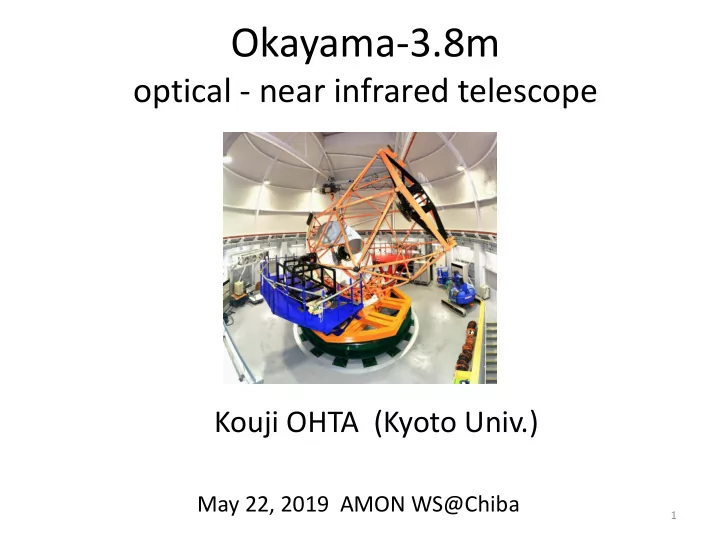
Okayama-3.8m

  • ptical - near infrared telescope

Kouji OHTA (Kyoto Univ.)

May 22, 2019 AMON WS@Chiba

1

slide-2
SLIDE 2

Chiba

(you are here)

Kyoto Okayama

2

slide-3
SLIDE 3

Okayama site

Okayama Astrophysical Observatory, National Astronomical Observatory, Japan (picture taken in 2012)

188cm telescope

Our observatory site

Observable nights ~60% Seeing ~ 1.5”-2” Weather condition is almost the best in Japan Night sky is not very dark

3

Site as of 2012

slide-4
SLIDE 4

Okayama 3.8m telescope

nickname: Seimei(晴明※) telescope

Kyoto University

As of Sep, 2018

Opening ceremony Feb, 2019

(still under development)

※named after famous ancient astrologer

4

slide-5
SLIDE 5

Unique Features of the 3.8m

  • 1. Segmented mirrors (petal type)

inner 6 segments + outer 12 segments

  • 2. Mirror fabrication by

mainly grinding (and polishing)

  • 3. Light weight torus structure

=> rapid slewing slew speed 3-4 deg/sec

  • Pointing accuracy ~3” rms

=> ~5” rms

  • Two Nathmyth foci available

Almost handmade telescope still under development

5

slide-6
SLIDE 6

Another unique feature:longitude

○: >3m opt-NIR telescopes (general purpose)

○ ○

6

slide-7
SLIDE 7

Instrument currently working

  • KO

KOOLS-IFU IFU

  • Low
  • w/intermediate disp

spersi sion

  • n op
  • ptical sp

spectrog

  • graph

(KO KOOLS) fed b by fiber bundle type IF IFU KOOLS spectrograph IFU FoV:15”Φ 1fiber FoV:0.9”φ

7

slide-8
SLIDE 8

KOOLS-IFU: performance

*FOV: 15”Φ *Wavelength coverage: 4000-10000 A *Spectral resolution: λ/Δλ ~ 500-2000 depending on grism *Limiting magnitude: Spec:S/N~10, 18-19AB mag w/ 30min (seeing ~ 1.5”) currently ~17 mag

8

slide-9
SLIDE 9

9

(i) GRB GCN notice (e-mail/socket) positional accuracy is ~3” w/SWIFT XRT => automatic telescope slewing if the pointing accuracy is <3”, the IFU can catch the target (partly archived) (ii) Neutrino, GW candidates by OISTER/J-GEM (incl. Kanata/Tomoe-Gozen) => 3.8m telescope

Transient target supply (plan)

slide-10
SLIDE 10

Instrument under development

(related to MMA)

Sim imult ltan aneous m mult lti-ba band d opt ptic ical al i imag ager + NIR im imag ager

NIR J/(Hs) sensor g-band CMOS r-band CMOS

Light from the telescope

i(/z/Y)-band CMOS

10

slide-11
SLIDE 11

Simultaneous Opt-NIR multi-band camera: Expected performance Opt: FoV: 6’x11’ 0.34”/pix Band: g, r, i, (z, y) (5000-9000A) Sensor: CMOS SN~10 ~23 mag (V) w/10min NIR: FoV:2.9’x2.9’ Band: J-band (1.2um), very short H-band SN? (I don’t have info…)

11

slide-12
SLIDE 12

Simultaneous Opt-NIR multi-band camera: Schedule Opt: 2019FY fabrication 2020FY observation (hopefully) Future plan: low/intermediate dispersion spectroscopy w/ grism(s) NIR: 2019-20FY fabrication 2021FY observation (hopefully)

12

slide-13
SLIDE 13

Operation of 3.8m telescope

  • Obse

serving g runs s st started from

  • m March 2019

as s a phot

  • ton
  • n bucke

ket t telesc scop

  • pe
  • Exc

xcept for

  • r engi

gineering t g time,

  • Ha

Half of

  • f the m

machine time i is s use sed f for

  • r op
  • pen u

use se for

  • r

Japanese se com

  • mmunity
  • Th

The ot

  • ther half of
  • f the machine t

time is s for

  • r Ky

Kyot

  • to
  • Un

Univ

  • We accept Ta

Targe get of

  • f Oppor
  • rtunity ob
  • bse

servation

  • ns

s w/prop

  • pos
  • sal base

se

  • Tw

Two

  • se

semest sters: s: A: A:Jan-Jun, B: B:Jul-Dec

13

slide-14
SLIDE 14

Summary

  • We

hav ave c constructe ted d a a new 3 3.8 .8m ( (Seim imei) ) tele lescope pe.

  • Once w

we g get ta target c can andi dida dates, , we w wil ill l be be ab able le t to m mak ake o

  • pt

ptic ical al s spe pectroscop

  • pic

ic or mult lti-ba band im d imag agin ing (i (in f future) ) obs bserva vatio ions qu quic ickly ly.

  • But st

stil ill l unde der ad adju justment and d de deve velo lopm pment

14