M. Sugizaki on behalf of MAXI collabolation (RIKEN, JAXA, Tokyo - - PowerPoint PPT Presentation
m sugizaki on behalf of maxi collabolation riken jaxa
SMART_READER_LITE
LIVE PREVIEW

M. Sugizaki on behalf of MAXI collabolation (RIKEN, JAXA, Tokyo - - PowerPoint PPT Presentation

M. Sugizaki on behalf of MAXI collabolation (RIKEN, JAXA, Tokyo Inst. Tech., Osaka Univ., Aoyama Gakuin Univ., Nihon Univ., Kyoto Univ., Miyazaki Univ.) 1 MAXI Team RIKEN: T.Mihara, M.Sugizaki, M.Kohama, Y.Nakagawa, T.Yamamoto JAXA :


slide-1
SLIDE 1

1

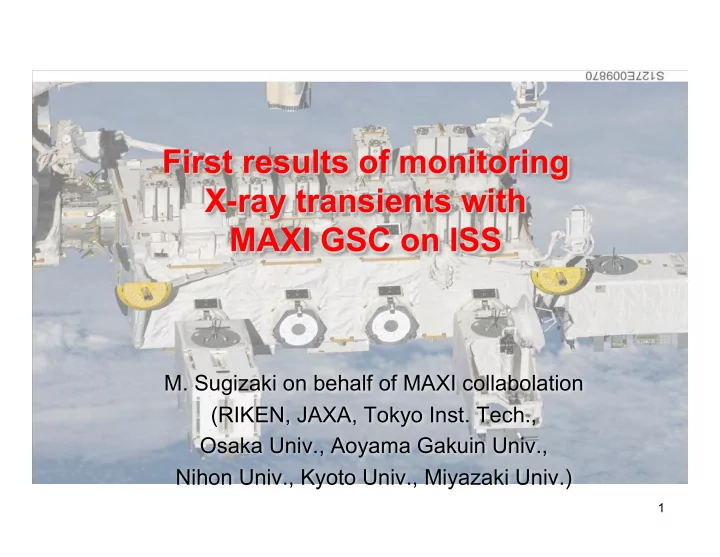
  • M. Sugizaki on behalf of MAXI collabolation

(RIKEN, JAXA, Tokyo Inst. Tech., Osaka Univ., Aoyama Gakuin Univ., Nihon Univ., Kyoto Univ., Miyazaki Univ.)

slide-2
SLIDE 2

2

MAXI Team

  • RIKEN: T.Mihara, M.Sugizaki, M.Kohama, Y.Nakagawa,

T.Yamamoto

  • JAXA: M.Matsuoka, K.Kawasaki, S.Ueno, H.Tomida,

M.Suzuki, Y.Adachi, M.Ishikawa, Y.Itamoto, H.Katayama, K.Ebisawa

  • Tokyo Inst. Tech. : N.Kawai, M.Morii, K.Sugimori
  • Osaka Univ.: H.Tsunemi, M.Kimura
  • Aoyama Gakuin Univ.: A.Yoshida, K.Yamaoka,

S.Nakahira, I.Takahashi

  • Nihon Univ. : H.Negoro, M.Nakajima, S.Miyoshi,

R.Ishiwata, H.Ozawa

  • Kyoto Univ.: Y.Ueda, N.Isobe, S.Eguchi,

K.Hiroi

  • Miyazaki Univ.: M.Yamauchi, A.Daikyuj
slide-3
SLIDE 3

3

MAXI Mission on ISS

MAXI JEM EF

  • X-ray all-sky monitor on ISS
  • Transported by Space Shuttle

STS-127 on July 16, 2009

  • Installed on JEM (Japanese

Experiment Module) EF (Exposed Facility) on July 23.

  • Commissioning started on

Aug 3.

  • First light image on Aug 15.

ISS orbit and particle count-rate map

  • rbit inclination = 51.6 deg.

See P5 – 211 (Kawai) for mission overview

slide-4
SLIDE 4

4

Gas Slit Camera (GSC) on MAXI

Field of Views

Scan with ISS rota8on

Slat Collimator Slit

160 deg 1.5 deg (FWHM)

Celestial sphere

Energy band: 2-30 keV PSF beam size ~ 1.5x1.5 deg.

slide-5
SLIDE 5

5

GSC sky coverage

1 orbit scan (90 min.) 1 day

Solar- protection area Aurora, SAA (high- radiation) area Scan- rotation axis

2009/10/25 coverage > 95% per day

slide-6
SLIDE 6

6

Daily all-sky image (Aug.15-Oct.28 movie)

  • Axis of rotation moves due to the precession of the ISS orbit by

44 days.

  • Dead area for solar protection is reduced from 15 deg. to 5 deg.

during the commissioning operation.

slide-7
SLIDE 7

MAXI GSC Red (2–4 keV), G (4–8 keV), B (8–16 keV) no background subtraction, not corrected for exposure

2-month image (Sep 1– Oct 22, 2009)

slide-8
SLIDE 8

~A about 160 sources visible by the eye. Some of the bright sources not in the HEAO A-1 catalog are marked with circles.

Comparison with HEAO A-1

slide-9
SLIDE 9

9

Crab Nebula: 2-month Light Curve

2009-08-15 2009-10-10

  • 1 bin = 90 min = 1 orbit scan
  • Effective area variation is corrected (but not perfect).
  • systematic errors ~ 5%

56 days

slide-10
SLIDE 10

10

Crab Nebula: Image and Spectrum

1-day data (8/15)

Preliminary spectral fit 1. normalization, power-law index: OK 2. NH (low-energy absorption): needs calibration

Crab A0535+62 1 6 d e g .

2 keV 30keV

PSF FWHM ~ 1.5 deg.

slide-11
SLIDE 11

2009-09-05 2009-09-06

Flare of UX Ari (an RS CVn star)

11

 Sep 06, 2009  peak flux ≈50 mCrab  duration ≤ 1 day

10mCrab

GSC 3-10 keV Preliminary

slide-12
SLIDE 12

XTE J1752-223 (new black hole candidate)

12

XTE J1752-223 is a new black hole candidate discovered on 2009-10-23 at 19:55 (UT) with the RXTE/PCA scan (ATEL#2258, Markwardt et al. ). MAXI recorded its flux since the onset of the outburst, preceding the first RXTE detection.

2009-10-22 2009-10-24 2009-10-27

flux (mCrab)

RXTE detection MAXI detection

1 2 3 4 5 6 (days)

Preliminary

slide-13
SLIDE 13

13

Bright Galactic X-ray Binaries (1)

GRS1915+105 Cyg X-3

1 Crab 0.5 Crab

GSC 3-10 keV 90 min/bin Preliminary

Periodicity by 4.8-h orbital period

slide-14
SLIDE 14

14

Bright Galactic X-ray Binaries (2)

1 Crab 0.5 Crab

Cyg X-1 Cyg X-2

GSC 3-10 keV 90 min/bin Preliminary

slide-15
SLIDE 15

15

Galactic X-ray variables

0.5 Crab 0.1 Crab

Her X-1 Cen X-3

GSC 3-10 keV 90 min/bin Preliminary

  • Eclipse by 1.7-day
  • rbital period
  • 35-day activity period
slide-16
SLIDE 16

16

AGN

Mkn 421 Cen A

50 mCrab 50 mCrab

GSC 3-10 keV 1 day/bin Preliminary GSC 3-10 keV 1 day/bin Preliminary

slide-17
SLIDE 17

17

Current Status

  • Hardware

– 8 (out of 12) GSC cameras are operational in regions with low particle flux ( ~50% of orbits) .

  • 2 GSC cameras had high voltage breakdown
  • 2 more GSCs have similar symptoms
  • Sensitivity

– 20 mCrab/scan, 5 mCrab/day, 1 mCrab/week (goals) – achieved: somewhat lower due to high background, limited live time (< 50%), and insufficient calibration

  • Calibrations: under progress

– alignment and position encoding: PSF and localization accuracy to be improved – energy response

  • Software pipeline : under testing

– “Nova Search”: under testing – Light curves: in preparation.

slide-18
SLIDE 18

18

Summary

  • MAXI started observation in August 2009, currently in the

commissioning phase

  • Achieving <10 mCrab sensitivity per day
  • Performance somewhat compromised due to high particle flux

and operation constraints on the ISS

  • Instrument calibration, background study, and data processing

pipeline are under progress.

  • Distribution of light curves of monitored sources starting in

December 2009 at http://maxi.riken.jp/ .

  • Transient/nova alert distribution planned to start in Dec or Jan.
  • Contact us for including your favorite sources in the monitor list.
  • Cooperative works with other wavelength missions, which

include Fermi, will be helpful to study high-energy transient phenomena.

  • See poster P5 – 211 (Kawai) for mission overview, other

science topics including X-ray bursts, GRBs.

slide-19
SLIDE 19

19

Backup

slide-20
SLIDE 20

20

Exposure for a single target

1 day 100 days Sun SAA 15 orbits per day Effective area time variation for a position

  • n the sky

Coverage: 45 sec. x 2 / 90 minutes ~ 1.7%

1 orbit = 90 min. Detector boundaries

slide-21
SLIDE 21

21

Image Response

Transmission

  • f collimator

FWHM =1.5 degree. Sco X-1 in 1 scan Scan direction design Crab and A0535+26 sep=4.5 deg 1day acc. Wire dir. Crab and A0535+26 1day acc. Position resolution

  • f 1-D position

sensitive counter FWHM ~1.5 degree

15 20 25

R A [ . 1 d e g ]

Crab A0535+26

Scan direction Wire direction

slide-22
SLIDE 22

22

ISS orbit and event-rate map

i = 51.6