Touch / Somatosensation (Chap 13) Lecture 20 Jonathan Pillow - - PowerPoint PPT Presentation

touch somatosensation chap 13
SMART_READER_LITE
LIVE PREVIEW

Touch / Somatosensation (Chap 13) Lecture 20 Jonathan Pillow - - PowerPoint PPT Presentation

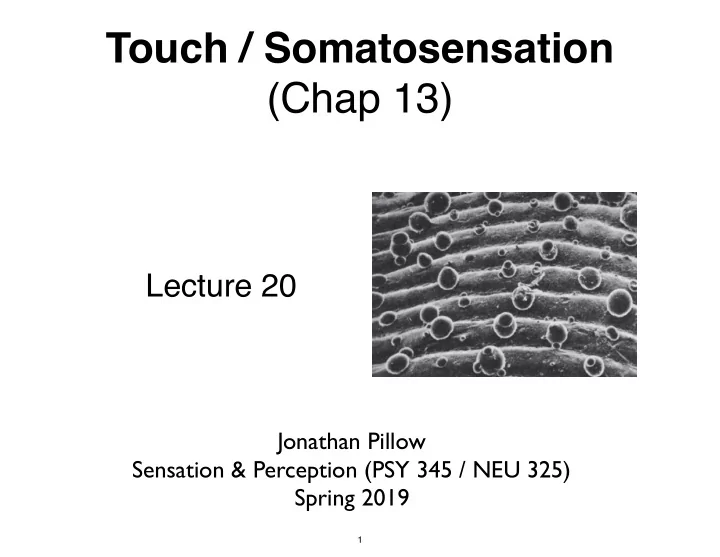
Touch / Somatosensation (Chap 13) Lecture 20 Jonathan Pillow Sensation & Perception (PSY 345 / NEU 325) Spring 2019 1 Touch is really a collection of many different senses relating to the surface (and internal states) of the

slide-1
SLIDE 1

Touch / Somatosensation (Chap 13)

Lecture 20

Jonathan Pillow Sensation & Perception (PSY 345 / NEU 325) 
 Spring 2019

1

slide-2
SLIDE 2

Somatosensation - collective term for sensory signals from the body Cutaneous senses


  • tactile sense

  • temperature 

  • pain 

  • others: itch, tickle, “pleasant touch”

“Touch” is really a collection of many different senses relating to the surface (and internal states) of the body.

  • Kinesthesis - perception of the position and

movement of our limbs in space

  • Proprioception - perception of the body in space

(kinesthesia + vestibular senses)

2

slide-3
SLIDE 3

Measuring tactile abilities

  • 1. sensitivity
  • 2. acuity

3

slide-4
SLIDE 4

How sensitive are we to mechanical presssure?

Traditionally measured with Von Frey Hairs

  • Max von Frey (1852-1932)
  • Camel hair inside a tube
  • various levels of pressure are applied
  • calculations made based on how much the

hair is bent during the examination

  • sensitivity varies over the body

(face most sensitive, then hands and arms)

Or make your own with fishing line (various thicknesses) glued to a popsicle stick

4

slide-5
SLIDE 5

5

slide-6
SLIDE 6

Obvious Experiment: Touch Acuity (or Two-Point Threshold) “one” “two”

receptive fields

  • 2. Touch Acuity

6

slide-7
SLIDE 7
  • Two-point threshold: minimum

distance at which two stimuli are just perceptible as separate

  • Like sensitivity to pressure,

spatial acuity varies across the body Extremities (fingertips, face, and toes) show the highest acuity

How finely can we resolve spatial details?

7

slide-8
SLIDE 8

Physiology of the Somatosensory System

8

slide-9
SLIDE 9

(SA1) (SA2) (FA1) (FA2) epidermis dermis Touch receptors: 
 embedded on outer layer (epidermis) and underlying layer (dermis) of skin

9

slide-10
SLIDE 10

Tactile receptors

Called “mechanoreceptors” because they respond to mechanical stimulation: pressure, vibration, or movement

4 types, defined by:

  • 1. Receptive field size (type I vs. II)

big

II I

small

10

slide-11
SLIDE 11

Tactile receptors

Called “mechanoreceptors” because they respond to mechanical stimulation: pressure, vibration, or movement

4 types, defined by:

Touch Stimulus

Fast Adapting (FA) Slow Adapting (SA)

  • 2. Response properties (FA vs. SA)

11

slide-12
SLIDE 12

SA1 SAII FAI FA II small large 4 kinds of mechanoreceptors

12

slide-13
SLIDE 13

Cross section of the human hand illustrating locations of the four types of mechanoreceptors and the two major layers of skin

(SA1) (SA2) (FA1) (FA2)

A-beta fibers

  • wide fibers with fast conduction

velocities (all tactile receptors)

13

slide-14
SLIDE 14

Other type of mechanoreceptors:

  • Kinesthetic receptors: sense of where limbs are, what kinds
  • f movements are made,

  • found within muscles, tendons, and joints


 Types: Muscle spindle: located in a muscle, senses its tension
 (also known as a “stretch receptor”) Receptors in tendons signal tension in muscles Receptors in joints signal when joint is bent

14

slide-15
SLIDE 15

A muscle spindle

15

slide-16
SLIDE 16

Importance of kinesthetic receptors:

Strange case of neurological patient Ian Waterman:

  • Cutaneous nerves connecting kinesthetic mechanoreceptors

to brain destroyed by viral infection

  • Lacks kinesthetic senses, dependent on vision to tell limb

positions

“Lacking kinesthetic senses, Waterman is now completely dependent on vision to tell him about the positions of his limbs in

  • space. If the lights are turned off, Waterman cannot tie his shoes,

walk up or down stairs, or even clap his hands, because he has no idea where his hands and feet are! Caught in an elevator when the lights went out, he was unable to remain standing and could not rise again until the illumination returned.”

http://www.youtube.com/watch?v=FKxyJfE831Q

16

slide-17
SLIDE 17

17

slide-18
SLIDE 18

Temperature:

  • thermoreceptors: signal changes in skin temperature
  • Two distinct populations of thermoreceptors: 


warmth fibers, cold fibers

  • Respond when you make contact with an object warmer
  • r colder than your skin

18

slide-19
SLIDE 19
  • transmit information about noxious

stimulation that causes damage or potential damage to skin

Pain

  • signaled by nociceptors - have “free nerve endings”

(slower)

19

slide-20
SLIDE 20

Pain can be moderated by anticipation, religious belief, prior experience, watching others respond, and excitement

Pain Perception

20

slide-21
SLIDE 21

Gate control model

(Melzack and Wall, 1988)

  • extreme pressure, cold, or
  • ther noxious stimuli can

stimulate “gate” neurons in SG that prevent the T cells from transmitting pain signals


  • signals from central NS 


(eg. brain) can also stimulate gate neurons

T

SG

+ + + + + +

  • -
  • Pain Perception

21

slide-22
SLIDE 22

Benefit of pain perception: Sensing dangerous objects Case of “Miss C” (Melzack & Wall 1973):

  • Born with insensitivity to pain

“Not only did Miss C lack pain sensation, but she did not sneeze, cough, gag, or protect her eyes reflexively. She suffered childhood injuries from burning herself on a radiator and biting her tongue while chewing food. As an adult, she developed problems in her joints that were attributed to lack

  • f discomfort, for example, from standing too long in the

same position. She died at age 29 from infections that could probably have been prevented in someone who was alerted to injury by painful sensations.”

22

slide-23
SLIDE 23

The Hazards of Growing Up Painlessly

http://www.nytimes.com/2012/11/18/magazine/ashlyn-blocker- feels-no-pain.html?pagewanted=all

23

slide-24
SLIDE 24

Two Pathways from skin to cortex

  • 1. Spinothalamic pathway
  • 2. DCML pathway

(Dorsal Column Medial Lemniscal)

pain & temp touch & proprioception cross early cross late

24

slide-25
SLIDE 25

Primary somatosensory receiving areas in the brain

  • S1: primary somatosensory cortex 


(located on postcentral gyrus)

  • S2: secondary somatosensory cortex

25

slide-26
SLIDE 26

Somatotopic organization - topographic map of body surface (compare with “retinotopic” and “tonotopic”) Homunculus: Maplike representation of regions of the body in the brain

26

slide-27
SLIDE 27

If our bodies reflected S1...

27

slide-28
SLIDE 28

S1 maps across species: catunculus homunculus primatunculus rabbitunculus

28

slide-29
SLIDE 29

Pleasant Touch

Newly uncovered fifth component of touch: Pleasant touch (contrast with: “Discriminative touch” - classic touch sensations of tactile, thermal, pain, and itch experiences)

  • Mediated by unmyelinated peripheral C fibers known as

“C tactile afferents” (CT afferents)

  • Respond best to slowly moving, lightly applied forces

(e.g., stroking)

  • Processed in orbitofrontal cortex rather than S1 or S2

29

slide-30
SLIDE 30

Somatosensory Illusions

Although less common than visual illusions, still possible to fool the somatosensory system!

30

slide-31
SLIDE 31

Aristotle Illusion

  • brain fails to account for crossing of body parts
  • 1. Cross fingers and touch nose

⇒ two noses?

31

slide-32
SLIDE 32

Aristotle Illusion

  • brain fails to account for crossing of body parts
  • 2. Close eyes, have a partner tap backs of hands in rapid

succession

  • easy if hands are uncrossed
  • with crossed hands, significant error

rate

32

slide-33
SLIDE 33

Rabbit Illusion

  • points appear closer together if presented rapidly in time
  • like “rabbit hopping up the arm.” (Geldard & Sherrick, 1972)

33

slide-34
SLIDE 34

Body image is malleable: body-swapping illusion

  • subjects report

viewing their own body from behind

34

slide-35
SLIDE 35

body-swapping illusion

Petkova & Ehrsson, PloSOne 2008

35

slide-36
SLIDE 36

body-swapping illusion

Petkova & Ehrsson, PloSOne 2008

36

slide-37
SLIDE 37

body-swapping illusion

stress response

37

slide-38
SLIDE 38

body-swapping illusion

38

slide-39
SLIDE 39

http://www.youtube.com/watch?v=TCQbygjG0RU

Rubber hand illusion

39

slide-40
SLIDE 40

Click to edit Master title style

  • The inability to identify objects by touch
  • Caused by lesions to the parietal lobe

Haptic Perception

Tactile agnosia

40

slide-41
SLIDE 41

Click to edit Master title style

  • Patient documented by Reed and Caselli (1994):

▪ Tactile agnosia w/ right hand but not left.


(Could not recognize objects such as a key chain in right hand, but could with left hand or visually.)

▪ Rules out a general loss of knowledge about

  • bjects.

▪ Other sensory abilities were normal in both

hands.

Haptic Perception

Tactile agnosia

41

slide-42
SLIDE 42

Summary

  • proprioception / kinesthesis
  • cutaneous senses: tactile sense, temperature, pain
  • other cutaneous senses: itch, tickle, pleasant touch
  • touch sensitivity (Von Frey Hairs) vs. acuity (two-point test)
  • somatosensory homunculus
  • mechanoreceptors (FA vs. SA, I vs II),
  • A-beta fibers (fast)
  • kinesthetic receptors, muscle spindles
  • spinothalamic vs DCML pathway
  • gate control model for pain perception
  • pleasant touch
  • illusions: Aristotle, rabbit, body-swapping
  • tactile agnosia, haptics, exploratory movements (read in book!)

42