Touch & Haptics Blind and deaf people have been using touch to - - PDF document

touch haptics
SMART_READER_LITE
LIVE PREVIEW

Touch & Haptics Blind and deaf people have been using touch to - - PDF document

1/26/2016 Touch & High Information Transfer Rate Touch & Haptics Blind and deaf people have been using touch to substitute vision or hearing for a very long time, and successfully. OPTACON Hong Z Tan Purdue University & 12


slide-1
SLIDE 1

1/26/2016 1

Touch & Haptics

Hong Z Tan Purdue University & Microsoft Research Asia

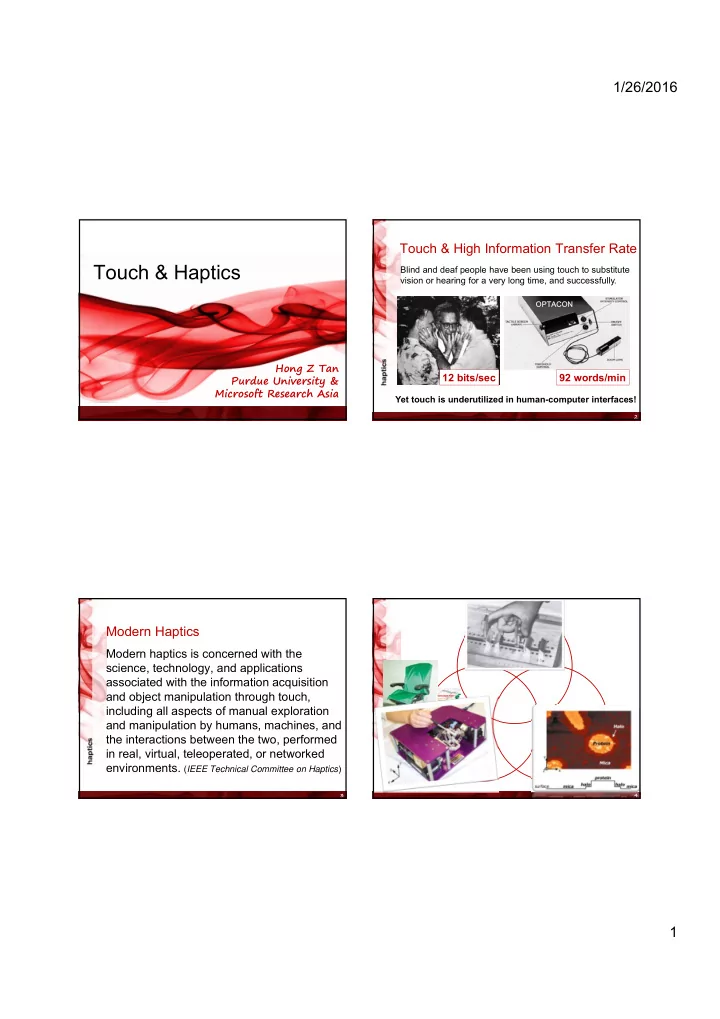
Touch & High Information Transfer Rate

Blind and deaf people have been using touch to substitute vision or hearing for a very long time, and successfully.

12 bits/sec

OPTACON

92 words/min

Yet touch is underutilized in human-computer interfaces!

2

Modern Haptics

Modern haptics is concerned with the science, technology, and applications associated with the information acquisition and object manipulation through touch, including all aspects of manual exploration and manipulation by humans, machines, and the interactions between the two, performed in real, virtual, teleoperated, or networked

  • environments. (IEEE Technical Committee on Haptics)

3

Human Haptics Machine Haptics Computer Haptics

4

slide-2
SLIDE 2

1/26/2016 2

When we touch something

We feel a panel!

nerve innervation density: 0.8 – 1.0 mm

5

Exploratory Procedures

6

Haptic Display Technologies

Vibrotactile actuators (tactors) Force displays Thermal displays Array displays (on the torso) Fingertip displays

7

Vibrotactile Actuators

(intensity, frequency, waveform, duration, delay, etc.)

$1.50

Frequency Response of C2 Tactor (Strapped to Wrist) With 1.5V ptp Input

  • 10
  • 5

5 10 15 20 25 30 35 50 100 150 200 250 300 350 400 450 Frequency (Hz) Gain Ratio (dB)

Frequency Response of C2 Tactor (Rubberbanded) With 1.5V ptp Input

  • 20
  • 10

10 20 30 40 50 50 100 150 200 250 300 350 400 450 Frequency (Hz) Gain Ratio (dB)

8

slide-3
SLIDE 3

1/26/2016 3

Force-feedback Haptic Devices

(intuitive, conveys object shape, surface properties, etc.)

PHANToM by SensAble Technologies Omega by Force Dimension Falcon by Novint, modified for torque display

$200

9

Custom-Designed Force Displays

(position resolution, bandwidth, back-drivability)

From Butterfly Haptics: http://butterflyhaptics.com/

The Maglev designed by Ralph Hollis, CMU The (Purple) Mini-stick designed by Dov Adelstein, NASA Ames Position resolution: 1.5 m

  • PHANToM: 30 m
  • Omega: 9 m

10

A/D D/A Bipolar Power Supply & Voltage Amplifier

Temperature Curve 20 25 30 35 40 2 4 6 8 10 12 Time (s) Temperature (C)

Peltier device Index finger Thermistor 1 Thermistor 2 A/D D/A

Bipolar Power Supply & Voltage Amplifier PI Control

20 25 30 35 40 2 4 6 8 10 12 Time (s)

Peltier device Index finger

Real Simulated Real material Simulated material

Slide courtesy of Dr. Lynette Jones, MIT.

Thermal Display (very new…)

11

Photo Courtesy of Dr. Lynette Jones, MIT

Array Displays

12

slide-4
SLIDE 4

1/26/2016 4

Courtesy of Prof. Ian Summers Exeter University, UK

Fingertip Displays

13

Fingertip Displays

TeslaTouch by Disney

Courtesy of Prof. Ed Colgate Northwestern Univ.

Piezoelectric actuators excite the glass surface at resonance Graphical display is positioned underneath the glass surface

TPaD

14

There is NO “Standard” Haptic Display

We simply do not have the haptic equivalent of a computer monitor or speaker today Either a position (vibration) or force display, but not both Hard to cover the whole body surface

15

A “Full-Range” Position Display

A “general” position display requires

 a bandwidth of > 500 Hz  a dynamic range > 100dB

 At 250 Hz, human hands

can sense a 0.1 m (pk) vibration

 At < 5 Hz, human fingers

has a > 10 mm range of motion TACTUATOR, A haptic

hearing aid for individuals with hearing impairments Range of perceivable motion/vibration

16

slide-5
SLIDE 5

1/26/2016 5

The 400-Probe Stimulator

Reaching the Human Resolution

Photo Courtesy of Dr. Diane Pawluk, VCU

17

APPLICATIONS OF HAPTICS

Now, more “practical” systems …

18

Typing is hard with visual feedback only Buzzing helps, but … it can feel sluggish and … cheap

We Can Do Better!

19

Recent Innovations

(from BloombergNewsweek, illustrations by Mckibillo)

Pacinian Senseg Artificial Muscle Tactus Technology

20

slide-6
SLIDE 6

1/26/2016 6

Haptics in mobile phone

Click feedback without real keys

21

#1

Acceleration profile of a telephone key Input / output of piezo actuator

How Does It Work?

22 Win8 OS Slate (Metro UI) | Authoring email in Windows Live Mail Eyes track only one part ( vertical letter display close to the cursor )

  • f the screen to figure out what’s going on.

Right thumb does the selecting, at one of 3 locations. Right feels confirmation clicks. Left thumb does the positioning, along an arc. Left feels ridges between letters.

The “Touchy Feely Finger”

23

Feeling Surface Texture

How People Do It

Texture is defined as the microscale structure of a surface Humans perceive texture through two types of cues: spatial-intensive & temporal

Perceptual Dimensions

  • f Texture:

 Roughness  Hardness  Stickiness

24

slide-7
SLIDE 7

1/26/2016 7

Feeling Surface Texture

How Machine Does It

25

Simulating Texture through Vibrations

26

Simulating Texture through Friction

TeslaTouch (UIST 2010)

Trick: Lateral force can create the illusion of height variations in microscale (i.e., texture)

Flat surface Virtual bump Virtual hole F F

27

Advantages of Touch

Private, Fast (spinal reflex), Intuitive Large receptor area Multidimensional (force, motion, vibration, thermal) Low cognitive load in stressful situations Compliments auditory/visual inputs

28

slide-8
SLIDE 8

1/26/2016 8 TOWARDS GRACEFUL INTERACTION BY INTEGRATING HAPTICS INTO USER INTERFACES

29