Topic 10 Abstract Classes I prefer Agassiz in the abstract, rather - - PowerPoint PPT Presentation

topic 10
SMART_READER_LITE
LIVE PREVIEW

Topic 10 Abstract Classes I prefer Agassiz in the abstract, rather - - PowerPoint PPT Presentation

Topic 10 Abstract Classes I prefer Agassiz in the abstract, rather than in the concrete. 1 Back to the Property Example There are properties on a monopoly board Railroads, Utilities, and Streets are kinds of properties One


slide-1
SLIDE 1

1

Topic 10

Abstract Classes

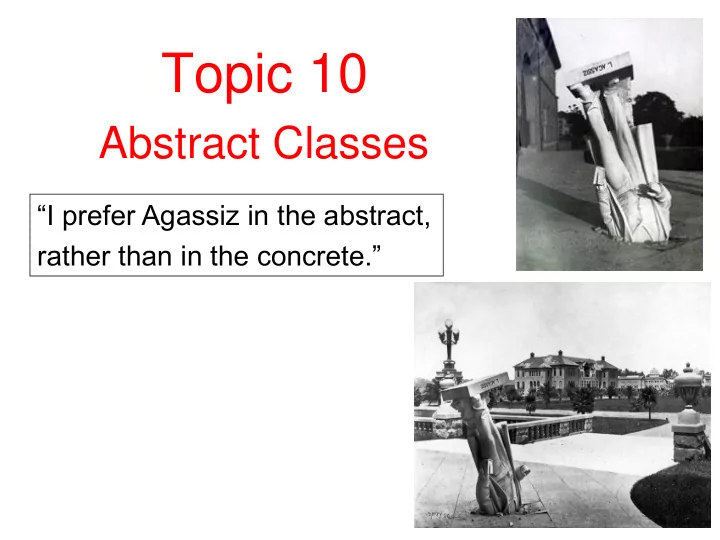
“I prefer Agassiz in the abstract, rather than in the concrete.”

slide-2
SLIDE 2

CS314 Abstract Classes

2

Back to the Property Example

There are properties on a monopoly board Railroads, Utilities, and Streets are kinds of properties One behavior we want in Property is the getRent method problem: How do I get the rent of something that is “just a Property”?

slide-3
SLIDE 3

CS314 Abstract Classes

3

The Property class

public class Property { private int cost; private String name; public int getRent() { return hmmmmm?????; } Doesn’t seem like we have enough information to get the rent if all we know is it is a Property.

slide-4
SLIDE 4

CS314 Abstract Classes

4

Potential Solutions

  • 1. Just leave it for the sub classes.

 Have each sub class define getRent()

  • 2. Define getRent() in Property and simply

return -1.

 Sub classes override the method with more meaningful behavior.

slide-5
SLIDE 5

CS314 Abstract Classes

5

Leave it to the Sub - Classes

// no getRent() in Property // Railroad and Utility DO have getRent() methods public void printRents(Property[] props) { for(Property p : props) System.out.println(p.getRent()); } Property[] props = new Property[2]; props[0] = new Railroad("NP", 200, 1); props[1] = new Utility("Electric", 150, false); printRents(props);

What is result of above code?

  • A. 200150
  • B. different every time
  • C. Syntax error
  • D. Class Cast Exception
  • E. Null Pointer Exception
slide-6
SLIDE 6

CS314 Abstract Classes

6

Fix by Casting

// no getRent() in Property public void printRents(Property[] props) { for (Property p : props) { if(p instanceof Railroad) System.out.println(((Railroad) p).getRent()); else if(p instanceof Utility) System.out.println(((Utility) p).getRent()); else System.out.println(((Street) p).getRent()) } } Property[] props= new Property[2]; props[0] = new Railroad("NP", 200, 1); props[1] = new Utility("Electric", 150, false); printRents( props); What happens as we add more sub classes of Property? What happens if one of the objects is just a Property?

slide-7
SLIDE 7

CS314 Abstract Classes

7

Fix with Dummy Method

// getRent() in Property returns -1 public void printRents(Property[] props) { for(Property p : props) System.out.println(p.getRent()); }

Property[] props= new Property[2]; props[0] = new Railroad("NP", 200, 1); props[1] = new Utility("Electric", 150, false); printRents( props);

What happens if sub classes don’t override getRent()? Is that a good answer?

slide-8
SLIDE 8

CS314 Abstract Classes

8

A Better Fix

We know we want to be able to find the rent

  • f objects that are instances of Property

The problem is we don’t know how to do that if all we know is it a Property Make getRent an abstract method Java keyword

slide-9
SLIDE 9

CS314 Abstract Classes

9

Making getRent Abstract

public class Property { private int cost; private String name; public abstract int getRent(); // I know I want it. // Just don’t know how, yet… } Methods that are declared abstract have no body an undefined behavior. All methods in a Java interface are abstract.

slide-10
SLIDE 10

Problems with Abstract Methods

If things can go wrong with a tool, provide safeguards to prevent that from happening. Given getRent() is now an abstract method what is wrong with the following code? Property s = new Property(); System.out.println(s.getRent());

slide-11
SLIDE 11

CS314 Abstract Classes

11

Undefined Behavior = Bad

Not good to have undefined behaviors If a class has 1 or more abstract methods, the class must also be declared abstract.

– version of Property shown would cause a compile error

Even if a class has zero abstract methods a programmer can still choose to make it abstract

– if it models some abstract thing – is there anything that is just a “Mammal”?

slide-12
SLIDE 12

CS314 Abstract Classes

12

Abstract Classes

public abstract class Property { private int cost; private String name; public abstract double getRent(); // I know I want it. // Just don’t know how, yet… } // Other methods not shown

if a class is abstract the compiler will not allow constructors of that class to be called Property s = new Property(1, 2); //syntax error

slide-13
SLIDE 13

CS314 Abstract Classes

13

Abstract Classes

In other words you can’t create instances of

  • bjects where the lowest or most specific

class type is an abstract class Prevents having an object with an undefined behavior Why would you still want to have constructors in an abstract class? Object variables of classes that are abstract types may still be declared

Property s; //okay

slide-14
SLIDE 14

CS314 Abstract Classes

14

Sub Classes of Abstract Classes

Classes that extend an abstract class must provided a working version of any abstract methods from the parent class

– or they must be declared to be abstract as well – could still decide to keep a class abstract regardless of status of abstract methods

slide-15
SLIDE 15

CS314 Abstract Classes

15

Implementing getRent()

public class Railroad extends Property { private static int[] rents = {25, 50, 10, 200}; private int numOtherRailroadsOwned;; public double getRent() { return rents[numOtherRailroadsOwned];} // other methods not shown }

slide-16
SLIDE 16

CS314 Abstract Classes

16

A Utility Class

slide-17
SLIDE 17

CS314 Abstract Classes

17

Polymorphism in Action

// getRent() in Property is abstract

public void printRents(Property[] props) { for(Property p : props) System.out.println(p.getRent()); }

  • Add the Street class. What needs to change in

printRents method?

  • Inheritance is can be described as new code using
  • ld code.
  • Polymorphism can be described as old code

using new code.

slide-18
SLIDE 18

CS314 Abstract Classes

18

Comparable in Property

public abstract class Property implements Comparable<Property> { private int cost; private String name; public abstract int getRent(); public int compareTo(Property other) { return this.getRent() – otherProperty.getRent(); } }

slide-19
SLIDE 19

Back to Lists

We suggested having a list interface public interface IList<E> extends Iterable<E> { public void add(E value); public int size(); public E get(int location); public E remove(int location); public boolean contains(E value); public void addAll(IList<E> other); public boolean containsAll(IList<E> other); }

CS314 Abstract Classes

19

slide-20
SLIDE 20

Data Structures

When implementing data structures:

  • Specify an interface
  • Create an abstract class that is skeletal

implementation interface

  • Create classes that extend the skeletal

interface

CS314 Abstract Classes

20