to 21st Century National Security September 22, 2010 National - - PDF document

to 21st century national security
SMART_READER_LITE
LIVE PREVIEW

to 21st Century National Security September 22, 2010 National - - PDF document

Integrativescienceandtechnology Dynamicandflexible Interrelatedorganizational Integrative Systems Approaches to 21st Century National Security September 22, 2010 National Defense University


slide-1
SLIDE 1

KEYNOTE SPEAKERS

Leon Fuerth, Research Professor of

International Affairs, George Washington University

Jim Locher, President and CEO,

Project on National Security Reform

National Defense University • Fort Lesley J. McNair • 300 5th Avenue SW, Marshall Hall • Washington, DC 20319-5066

Presented by The Center for Technology and National Security Policy (CTNSP) at the National Defense University (NDU) and Argonne National Laboratory.

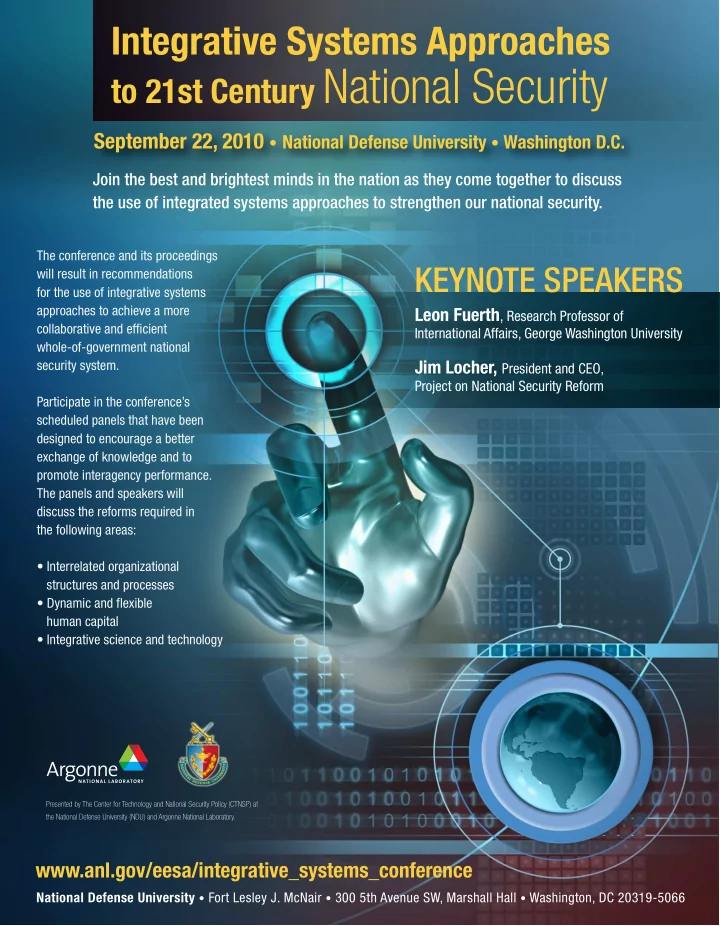
Integrative Systems Approaches

to 21st Century National Security

September 22, 2010 • National Defense University • Washington D.C.

Join the best and brightest minds in the nation as they come together to discuss the use of integrated systems approaches to strengthen our national security.

The conference and its proceedings will result in recommendations for the use of integrative systems approaches to achieve a more collaborative and efficient whole-of-government national security system. Participate in the conference’s scheduled panels that have been designed to encourage a better exchange of knowledge and to promote interagency performance. The panels and speakers will discuss the reforms required in the following areas:

  • ฀Interrelated฀organizational฀

structures and processes

  • ฀Dynamic฀and฀flexible฀

human capital

  • ฀Integrative฀science฀and฀technology

www.anl.gov/eesa/integrative_systems_conference

slide-2
SLIDE 2

Integrative Systems Approaches to 21st Century National Security

Fort Lesley J. McNair, Marshall Hall Rm 155 Washington, D.C. 20319

Wednesday, September 22, 2010

0830-0900 Registration and Continental Breakfast 0900-0915 Conference Welcome and Overview (Argonne/NDU)

  • Dr. Sheila R. Ronis, Director of the MBA/MM Programs at Walsh

College in Troy, Michigan and Distinguished Fellow, Project on National Security Reform in Washington, D.C.

  • Ms. Pam Sydelko, Deputy Associate Laboratory Director, Energy

Engineering and Systems Analysis, Argonne National Laboratory

0915-0945 Keynote Speech

Professor Leon Fuerth, Research Professor of International Affairs at the George Washington University Elliott School of International Affairs, Director of the Project on Forward Engagement

0945-1015 “Observations from the Fray”

  • Mr. Edward Buikema, Senior Consultant to Argonne, former FEMA

Regional Administrator (Region V) and Acting FEMA Response Division Director during Katrina

1015-1030 Break 1030-1130 Panel on National Security Community “Whole-of- Government” Needs

CHAIR: Dr. Sheila R. Ronis, Director of the MBA/MM Programs at Walsh College in Troy, Michigan and Distinguished Fellow, Project on National Security Reform in Washington, D.C.

  • Dr. Steven Aoki, Deputy Under Secretary of Energy for

Counterterrorism, Office of the Under Secretary for Nuclear Security, United States Department of Energy (DOE) Ambassador John Herbst, Incoming Director for the Center for Complex Operations at the National Defense University, Term September 2010 – Present

  • Dr. Irv Lachow, Senior Research Professor, National Defense

University

  • Mr. John F. Morton, Distinguished Fellow and Homeland Security

Lead, Project on National Security Reform (PNSR)

slide-3
SLIDE 3

1130-1300 Lunch and Keynote Speech

Honorable James Locher III, President and CEO, Project on National Security Reform

1300-1330 “Mock Documentary” Illustrating the Use of Alternative Future National Security Scenarios for Driving Systems Level Thinking 1330-1500 Panel on Advanced Science and Technology for Integrative Computing And Data/Knowledge Sharing

CHAIR: Ms. Pam Sydelko, Deputy Associate Laboratory Director, Energy Engineering and Systems Analysis, Argonne National Laboratory

  • Mr. John Crowley, Research Coordinator, Harvard Humanitarian

Initiative

  • Mr. Charles E. Catlett, CIO, Argonne National Laboratory and Senior

Fellow, Computation Institute at the University of Chicago

  • Mr. Clay Robinson, DoD VA Interagency Program Office (IPO)
  • Mr. James Young, Enterprise Manager, Google DoD

1500-1515 Break 1515-1630 Panel on Systems Approaches for Organizational Integration

  • Dr. Michael J. North (Chair), Deputy Director, Center for Complex

Adaptive Agent Systems Simulation, Decision and Information Sciences Division, Argonne National Laboratory, United States Department of Energy

  • Ms. Myra Howze Shiplett, Distinguished Fellow, Project on National

Security Reform

  • Dr. James Douglas Orton, Subject Matter Expert, Organizational

Performance and Interagency Collaboration, Center for Strategic Research, NDU

1630-1700 Closing Synthesizing Speech: “The Center for Strategic Analysis and Assessment in the EOP: A Systems Approach to National Grand Strategy”

  • Dr. Sheila R. Ronis, Director of the MBA/MM Programs at Walsh

College in Troy, Michigan and Distinguished Fellow, Project on National Security Reform in Washington, D.C.

slide-4
SLIDE 4

SPEAKER BIOGRAPHIES

  • Dr. Steven Aoki

Steven Aoki is the Deputy Under Secretary of Energy for Counterterrorism. A career member of the Senior Executive Service, from 2000-2004 he was Senior Advisor for International Affairs to the Administrator of Department of Energy’s National Nuclear Security Administration. Before joining DOE, he served at the U.S. Department of State as the Director of the Office of Proliferation Threat Reduction. During 1993-1996, he was on the staff of the National Security Council, with responsibility for nonproliferation and export control policies. Prior to that, he served as Special Assistant to the Under Secretary of State for International Security Affairs and in several positions in the Bureaus of Politico-Military Affairs and Near East-South Asian Affairs at the State Department, specializing in nonproliferation, regional security, and counter-terrorism activities. From 1978-1984 he was a scientific staff member and program manager at the Lawrence Livermore National

  • Laboratory. He holds a Ph.D. in physics from the University of Chicago.
  • Mr. Edward Buikema

Edward G. Buikema is a senior consultant at Argonne National Laboratory in Chicago,

  • Illinois. Mr. Buikema is also the Director of Preparedness and Response for Armada Ltd, an

emergency management consulting firm based in the Midwest. He is an instructor at the University of Chicago, a subject matter expert for the Mobile Executive Education Team seminars conducted by the Naval Postgraduate School’s - Center for Homeland Defense and Security, and a member of the Emergency Management Accreditation Program (EMAP)

  • commission. Mr. Buikema was appointed by President Bush as the Administrator of Region

V of the Federal Emergency Management Agency (FEMA) (now part of the Department of the Homeland Security) in November, 2001 and served until January, 2009. During his tenure as Regional Administrator, Mr. Buikema oversaw the delivery of disaster relief and assistance in more than sixty-five Presidential declared disasters and emergencies. Mr. Buikema was also designated as a Principal Federal Official (PFO) by the Secretary of Homeland Security for pandemic influenza for Region C in the United States (combined FEMA Regions V and VIII). Mr. Buikema served as the Acting Director of FEMA’s Response Division from February, 2005 through October, 2005. In that position he was responsible for administration and leadership of Response Division programs including the Urban Search and Rescue (US&R) program, the National Disaster Medical System (NDMS) teams, the Mobile Emergency Response System (MERS), logistics, the National Response Coordination Center (NRCC), and the Temporary Disaster Workforce. Prior to his FEMA position, Mr. Buikema was commander of the Emergency Management Division of the Michigan State Police. In this position, Mr. Buikema was responsible for leadership and coordination of the State if Michigan’s emergency management program and served as the state coordinating officer and governor’s authorized representative for nine presidential disaster declarations. He also served as chair of the Michigan Emergency Planning and

1 of 10

slide-5
SLIDE 5

SPEAKER BIOGRAPHIES

Community Right-to-Know Commission, the Michigan Hazard Mitigation Coordinating Council, and Michigan’s Anti-Terrorism Task Force. Mr. Buikema was an officer with the Michigan State Police for more than 26 years, serving in the Emergency Management Division for 19 of those years. Mr. Buikema was awarded the first ever Eric Tolbert Distinguished Service Award by the Emergency Management Accreditation Program (EMAP) at the 2008 National Emergency Management Association (NEMA) conference “for exemplary service and dedication to EMAP and fostering excellence and accountability in Emergency Management. And recently, he was awarded the Steven R. Cohen Award by the Chicago Federal Executive Board for “giving exemplary service to his own agency and the Federal community at large.” A native of Grand Rapids, Michigan, Mr. Buikema holds a bachelor of art’s degree in political science from Calvin College in Grand Rapids and is a graduate of the FBI National Academy in Quantico, Virginia. He is married and has three children and two grand children.

  • Dr. Charlie Catlett

Charlie Catlett is Chief Information Officer of the U.S. Department of Energy’s Argonne National Laboratory and a Senior Fellow at the Argonne / University of Chicago Computation Institute. His current focus areas include cyber security and privacy, mobile devices and social networks, and transformation of information infrastructure. Prior to joining Argonne in 2000, Catlett was Chief Technology Officer at the National Center for Supercomputing Applications (NCSA). He was part of the original team that established NCSA in 1985 and his early work there included participation on the team that deployed and managed the NSFNet. In the early 1990’s Catlett participated in the DARPA/NSF Gigabit Testbeds Initiative, coordinated by the Corporation for National Research Initiatives. Catlett was the founding chair of the Global Grid Forum (GGF, now Open Grid Forum) from 1999 through 2004. During this same period he designed and deployed one of the first regional

  • ptical networks dedicated to academic and research use – I-WIRE, funded by the State of
  • Illinois. He has been involved in Grid (distributed) computing since the early 1990s, when

he co-authored (with Larry Smarr) a seminal paper “Metacomputing” in the Communications of the ACM, which outlined many of the high-level goals of what is today called Grid computing.

  • Mr. John Crowley

John Crowley coordinates a research program on crisis mapping at the Harvard Humanitarian Initiative. Supporting the STAR-TIDES initiative at the National Defense University, he led a tiger team to connect crowdsourcing communities with the U.S. Southern Command’s emergency operations centre during the Haiti response. Between earthquakes, John coordinates the “Camp Roberts” RELIEF experiments through the Naval Postgraduate School—a program that gathers participants from responder communities and

2 of 10

slide-6
SLIDE 6

SPEAKER BIOGRAPHIES

challenges them to swarm around shared problems. John holds an MPA from the John F. Kennedy School of Government at Harvard University, where he was the Robert C. Seamans Fellow in Science, Technology, and Public

  • Policy. He also holds masters and bachelors degrees in intellectual history and music from

Boston University. He tweets at @jcrowley.

  • Mr. Leon Fuerth

Leon Fuerth is the former National Security Advisor to Vice President Al Gore. Following eleven years as a Foreign Service Officer, Fuerth joined then-Congressman Gore’s staff as senior legislative assistant for national security, focusing on issues of arms control and strategic stability. As the Vice President’s National Security Advisor, Fuerth served simultaneously on the Deputies’ and Principals’ Committees of the National Security Council, alongside the Secretary of State, the Secretary of Defense, and the President’s own National Security Advisor. He created and managed five bi-national commissions, and led efforts to: develop the International Space Station; to marshal international support for sanctions against Slobodan Milosevic’s regime; to raise awareness and take action to prevent the spread of HIV/AIDS in Africa; to denuclearize former Soviet states; to win China’s cooperation in protecting the environment and reducing pollution; and to spur foreign investment in Egypt as part of the Middle East peace process. After retiring from government service at the conclusion of the Clinton Administration, Professor Fuerth came to The George Washington University to serve as the J.B. and Maurice C. Shapiro Professor

  • f International Affairs from January 2001 to January 2003. He currently serves as a

research professor at the Elliott School of International Affairs and leads the Project on Forward Engagement, which incorporates three components: (1) a graduate seminar on long- range policy analysis; (2) expert seminars on unpacking Forward Engagement concepts; and (3) public outreach to US citizens in an effort to create a constituency for apolitical long- range analysis and anticipatory governance. In addition, Professor Fuerth is also currently: a consultant for SCITOR, exploring use of space-based sensors in the design of a monitorable climate agreement; a member of the National Academy of Science Committee on Climate, Energy and National Security; a member of the Guiding Coalition to the Project on National Security Reform (PNSR); a consultant to The Alliance on Climate Change; and a consultant to former vice president Al Gore. He holds a bachelor’s degree in English and a master’s degree in history from New York University, as well as a master’s degree in public administration from Harvard University. Ambassador John Herbst Ambassador John Herbst is the incoming Director for the Center for Complex Operations (CCO) at the National Defense University and the outgoing Coordinator for Reconstruction

3 of 10

slide-7
SLIDE 7

SPEAKER BIOGRAPHIES

and Stabilization. He is a career member of the Senior Foreign Service and holds the rank of Career-Minister. As Coordinator, Ambassador Herbst has led the development of U.S. Government civilian capacity to promote the stabilization and reconstruction of societies in transition from conflict or civil strife, and to provide support to countries at risk of instability. In 2007, the Ambassador led the government-wide effort to institutionalize the Interagency Management System (IMS), a whole-of-government system for planning and managing crisis response. The Coordinator is overseeing the establishment of the Civilian Response Corps of the United States. The Corps’s Active, Standby, and Reserve components will span eight federal government agencies, local governments, and the private sector. The Corps is the U.S. civilian rapid response force for reconstruction and stabilization operations

  • verseas.

In May 2003, Ambassador Herbst was appointed the U.S. Ambassador to Ukraine. During his tenure, he worked to enhance U.S-Ukrainian relations and to help ensure the conduct of a fair Ukrainian presidential election. In Kyiv, he witnessed the Orange Revolution. Prior to that, Ambassador Herbst was the U.S. Ambassador to Uzbekistan, where he played a critical role in the establishment of an American base to help conduct Operation Enduring Freedom in Afghanistan. He also promoted improved U.S.-Uzbek relations, in part by encouraging the government in Tashkent to improve its human rights record. Mr. Herbst previously served as U.S. Consul General in Jerusalem; Principal Deputy to the Ambassador at Large for the Newly Independent States; the Director of the Office of Independent States and Commonwealth Affairs; Director of Regional Affairs in the Near East Bureau; as political counselor at the U.S. Embassy in Tel Aviv and at the Embassies in Moscow and Saudi

  • Arabia. Both the Presidential Distinguished Service Award and the State Department's

Distinguished Honor Award were presented to Mr. Herbst. He received a Bachelor of Science in Foreign Service from Georgetown University's School of Foreign Service, Phi Beta Kappa, and a Master of Law and Diplomacy, with Distinction, from the Fletcher

  • School. He also attended the Johns Hopkins University School of Advanced International

Studies Bologna Center. Ambassador Herbst and his wife Nadezda Christoff Herbst have five children. Professor Irv Lachow Irv Lachow is a Senior Research Professor at the National Defense University’s Information Resources Management College. Dr. Lachow has extensive experience in both information technology and national security. He has worked for Booz Allen Hamilton, the RAND Corporation, and the Office of Deputy Under Secretary of Defense (Advanced Systems & Concepts). Dr. Lachow received his Ph.D. in Engineering & Public Policy from Carnegie

4 of 10

slide-8
SLIDE 8

SPEAKER BIOGRAPHIES

Mellon University. He earned an A.B. in Political Science and a B.S. in Physics from Stanford University.

  • Mr. James Locher

James R. Locher III has more than 25 years of professional experience in both the executive and legislative branches of the federal government, and is executive director of the Project on National Security Reform. Locher began his career in Washington as an executive trainee in the Office of the Secretary of Defense. Subsequently, he served in the Executive Office of the President as executive secretary of the White House Working Group on Maritime Policy. Returning to the Pentagon, Locher worked in the Office of the Assistant Secretary of Defense for Program Analysis and Evaluation. As an operations research analyst in the Mobility Forces and Naval Forces Divisions, he evaluated selected Navy and Marine Corps programs.In 1978, Locher joined the professional staff of the Senate Committee on Armed Services, where he would go on to work closely with Senators Nunn, Kennedy, and Levin, among others. Initially, he served as the senior adviser on international security affairs and force projection programs. In 1985, the committee assigned Locher responsibility for strategy and organization. He directed the bipartisan staff effort that resulted in the Goldwater-Nichols Defense Reorganization Act of 1986 and served as the senior staffer for the special operations and lowintensity conflict reform legislation, known as the Cohen- Nunn Amendment. President George H. W. Bush appointed Locher to the post of assistant secretary of defense for special operations and low-intensity conflict in October 1989. He supervised the special operations and low-intensity conflict activities of the Department of Defense, performed as the principal civilian adviser to the secretary of defense on these matters, and represented the secretary in senior subordinate groups of the National Security

  • Council. He served as assistant secretary throughout the Bush administration and the first

five months of the Clinton administration. During the latter period, Locher also served as acting under secretary of defense for policy. Upon leaving government service in June 1993, he was awarded the Department of Defense Medal for Distinguished Public Service, the department’s highest civilian award. Since 1993, Locher has been consulting, lecturing, and

  • writing. He served as a senior consultant to the Commission on Roles and Missions of the

Armed Forces and as a member of the Secretary of Defense’s Task Force on Defense Reform and the National Security Study Group of the U.S. Commission on National Security/21st Century. In 1999, Locher joined the board of directors of Power Medical Interventions, a medical device company. Subsequently, he was elected company secretary and later board vice chairman. In 2002, Texas A&M University Press published his book, Victory on the Potomac: The Goldwater-Nichols Act Unifies the Pentagon. In 2003-04, Locher served as chairman of the Defense Reform Commission of Bosnia and Herzegovina. In 2005, the National Society of the Daughters of the American Revolution awarded Locher its Medal of Honor for “outstanding service to the United States.”

5 of 10

slide-9
SLIDE 9

SPEAKER BIOGRAPHIES

  • Mr. John Morton

John F. Morton is currently a Distinguished Fellow and the Homeland Security Lead for the Project on National Security Reform. He is also the Strategic Advisor to Domestic Preparedness.com and a consultant to Gryphon Technologies under a contract supporting the Navy’s Surface Warfare Directorate, SEA 21. With over 25 years experience in complex national and homeland security issues, he has consulted and conducted independent research and analyses for among others: BAE Systems/Detica, Technology Strategies & Alliances (under a contract with the OSD Office of Net Assessment), Lockheed Martin Government Electronics Group, United Defense, L.P., Business Executives for National Security, Forecast International/DMS, Center for Strategic and International Studies and National Defense Industrial Association. Mr. Morton has been extensively published and has written for virtually every major defense publication. He is currently completing a book for the U.S. Naval Institute Press tentatively titled When, Not If: Instituting American Resilience Now, sponsored by a grant from the Smith Richardson Foundation to the Center for the Study of the Presidency and Congress. Previously, the Naval Institute Press published his Mustin: A Naval Family of the 20th Century, a title on the CNO’s Book List for Leadership and Management.

  • Dr. Michael North

Michael J. North, MBA, Ph.D. is the Deputy Director of the Center for Complex Adaptive Agent Systems Simulation within the Decision and Information Sciences Division of Argonne National Laboratory, a Senior Fellow in the joint Computation Institute of the University of Chicago and Argonne, and an Adjunct Professor of Design in the Institute of Design at the Illinois Institute of Technology. Dr. North has over fifteen years of experience developing and applying advanced modeling and simulation applications for various branches of the U.S. federal government; state government; several international agencies; private industry; and academia. Dr. North is the program director for the widely used free and open source Repast agent-based modeling platform. Dr. North is the lead author of the book Managing Business Complexity: Discovering Strategic Solutions with Agent-Based Modeling and Simulation (Oxford 2007) and has authored or co-authored over fifty journal articles and conference papers. Dr. North has been a keynote speaker at a variety of national and international events. Dr. North has been recognized as a Senior Member by the Association for Computing Machinery (ACM), the Institute of Electrical and Electronics Engineers (IEEE), and the American Society for Quality (ASQ). Dr. North holds ten college degrees, including a Ph.D. in Computer Science from the Illinois Institute of Technology. In addition, Dr. North is a Project Management Institute certified Project Management Professional (PMP), an IEEE Computer Society Certified Software Development Professional (CSDP), and is also certified by the American Society for Quality in software development processes (CSQE).

6 of 10

slide-10
SLIDE 10

SPEAKER BIOGRAPHIES

Dr James Douglas Orton

  • Dr. James Douglas Orton is a business-school-trained Ph.D. in organization and

management theory. More specifically, Dr. Orton is an expert on loosely coupled systems,

  • rganizational sensemaking, strategic management, and national security reform processes.
  • Dr. Orton’s 1990 journal article, co-authored with Dr. Karl Weick, “Loosely Coupled

Systems: A Reconceptualization,” has been cited approximately one thousand times by

  • ther experts in organization and management theory. His 1989-1993 dissertation at the

University of Michigan (Reorganizing: An Analysis of the 1976 Reorganization of U.S. Intelligence) was a study of Ford White House documents leading to intelligence reform in

  • 1976. During his six years as a strategy professor at Hautes Etudes Commerciales (HEC) in

Paris, France, Dr. Orton studied the Cuban Missile Crisis in 1962 and the Aspin-Brown proposals for intelligence reform in 1996. While in Europe, Dr. Orton taught graduate courses, conducted executive education seminars, and presented research papers in Barcelona, Seville, Sophia Antipolis, Paris, Geneva, London, Istanbul, Frankfurt, Vienna, and Warsaw. In the U.S., Dr. Orton has taught graduate-level seminars on his research topics at Boston College, Massachusetts Institute of Technology, University of Nevada-Las Vegas, University of California-Irvine, University of California-Riverside, Michigan Technological University, and The George Washington University. In 2007, Dr. Orton started working with Dr. Christopher Lamb at National Defense University on bringing high- end organizational research into the service of national security reform, organizational performance, and interagency collaboration.

  • Mr. Clay Robinson
  • Mr. Robinson is currently serving as a Data Strategist in the DoD VA Interagency Program
  • Office. He is new in that position but is working to improve health information sharing

between the DoD, VA, and other Federal government entities as well as private health

  • providers. Until this past June, he was the Chief for Data Strategy in the DoD CIO's Office
  • f Enterprise Services and Integration. In that role he served as the IPT lead to analyze and

make recommendations to the Deputy Secretary of Defense and the Vice Chairman of the JCS on improving utilization of Full Motion Video from UAVs in Iraq. He also performed as the liaison to DoD's Information Sharing Executive for technical issues and the DoD's NetCentric Data Strategy. This included supporting the DoD and Federal Information Sharing efforts. Mr. Robinson led the Content Discovery initiatives and policy development in the Office of the Secretary of Defense (OSD). In this role, Mr. Robinson co-chaired the joint DoD and IC Content Discovery IPT. His last published article was entitled "Making Information Visible, Accessible, and Understandable: Meta-Data and Registries" which was published in "Crosstalk" magazine. Prior to working in the DoD CIO's office he was a CIA

  • fficer at the National Reconnaissance Office and served as Chief of the NRO IT Strategic

Direction Group. In his 34 years of service, Mr. Robinson has also held positions in the

7 of 10

slide-11
SLIDE 11

SPEAKER BIOGRAPHIES

Office of the Secretary of Defense, the United States Senate, at the Defense Information Systems Agency and at the Defense Logistics Agency.

  • Dr. Sheila Ronis
  • Dr. Sheila R. Ronis is Director of the MBA/MM Programs at Walsh College in Troy

Michigan where she teaches in the Doctorate and MBA Programs. She is also President of The University Group, Inc., a management consulting firm, and think tank specializing in strategic management, visioning, national security and public policy. Dr. Ronis is a Distinguished Fellow and Vision Working Group leader of the congressionally mandated Project on National Security Reform (PNSR) in Washington, which will prepare the replacement for the National Security Act of 1947. She is currently looking at mechanisms to infuse foresight into the Executive Office of the President of the United States. Her B.S. is in Physics and Mathematics. Her M.A. and Ph.D. are from The Ohio State University in Large Social System Behavior. After nearly forty years of working in government, industry, academia and as the CEO of a management consulting firm, Dr. Ronis published Timelines into the Future: Strategic Visioning Methods for Government, Industry and Other Organizations by Hamilton Books in June, 2007. She edited the Project on National Security Reform Vision Working Group Report and Scenarios, published by the Strategic Studies Institute of the U.S. Army War College in July, 2010 and chaired the conference in which those finds were presented at the Center for Strategic and International Studies. Also, in August, 2010, she chaired a conference at NDU called Economic Security: Neglected Dimension of National Security and will be editing a Proceedings from that event this fall. In June, 2005, she chaired at the Industrial College of the Armed Forces the Army’s Eisenhower National Security Series Conference, “The State of the U.S. Industrial Base: National Security Implications in a World of Globalization.” The Proceedings of that conference, which Dr. Ronis co-edited with Dr. Lynne Thompson was published by the National Defense University Press in April, 2006. In March, 2006, she completed a study of the national security implications of the erosion of the U.S. industrial base for the U.S. House of Representatives’ Committee on Small Business.

  • Ms. Myra Shiplett

Myra Howze Shiplett is the President of RandolphMorgan Consulting LLC. Her work has included advising a variety of governments, non-profit organizations, and private sector firms on organizational effectiveness and human capital management issues. Prior to forming her own consulting firm, Ms. Shiplett directed the National Academy of Public Administration’s Center for Human Resources Management. The Center performed cutting edge research on human capital and organizational effectiveness issues. This research provided a body of knowledge used by Congress and by federal agencies to restructure federal public sector human capital programs, and by foreign governments in developing

8 of 10

slide-12
SLIDE 12

SPEAKER BIOGRAPHIES

countries to establish merit based civil service systems. Ms. Shiplett spent more than 30 years as a federal executive working for both the executive and judicial branches of the federal service. At the Administrative Office of the US Courts, Ms. Shiplett was the Assistant Director for Human Resources and Statistics. In the executive branch, her federal positions included a variety of line manager and human resource executive positions, including Director of Administration for a banking regulatory agency and directing the worldwide passport issuance system for the Department of State. Ms. Shiplett has also taught at the high school and college level, is the author of a number books and articles, and does extensive public speaking. She holds a Masters Degree in Urban Affairs from the Virginia Polytechnic Institute and State University in Blacksburg, VA and a Bachelor of Arts Degree in English and Journalism from the University of South Florida in Tampa, FL.

  • Ms. Pamela Sydelko

Pamela Sydelko is the Deputy Associate Laboratory Director for Energy Engineering & Systems Analysis. Her role within the Energy Engineering & Systems Analysis Directorate is to assist in strategic planning, research coordination and program development. She supports development of initiatives and encourage innovations that lead to new research

  • pportunities across basic and applied sciences and engineering programs. Ms. Sydelko

earned her MBA from the University of Chicago and her M.S. in soil science from the University of Illinois at Urbana-Champaign. She joined Argonne in October 1989, coming from the U.S. Army Engineering Research and Development Center – Construction Engineering Research Laboratory (CERL) in Champaign-Urbana. Until recently, Ms. Sydelko served as the Deputy Division Director for the Decision and Information Sciences

  • Division. She has expertise in systems-level research and technology aimed at developing

innovative modeling, analysis and decision support tools / technologies including the development of integrated multi-component software systems. Key modeling domains include environmental/land use, sustainable energy, national security, and infrastructures. Sponsoring organizations include U.S. Environmental Protection Agency, Department of Defense, Department of Homeland Security, and Department of Energy.

  • Mr. James Young

Jim Young is an Enterprise Manager on Google DoD team focusing on Innovation and Google's cloud computing capabilities. His background includes working for the Directorate

  • f Science and Technology (DS&T) at CIA where he received an Exceptional Performance
  • Award. In addition, Jim worked for the Walt Disney Company, a Fortune 500 IT company

working on large-scale IC programs, several innovative start-up companies focusing on the DoD, and most recently, web security. He graduated from the University of South Carolina with a B.A. in International Studies with an emphasis on National Security. Jim attended graduate-level courses at University of Virginia focusing on employee motivation in the

9 of 10

slide-13
SLIDE 13

SPEAKER BIOGRAPHIES

federal workforce, and at RAND Corporation focusing on Defense Analysis in the 21st

  • Century. Recently Jim was recently elected to the AFCEA DC Chapter Board of Directors

were he served on the Executive Committee as Chapter CIO. In his free time, he plays tennis, trains on the Homes for our Troops Boston Marathon team, and works on Veteran's projects to include GoogleVoice for Homeless Vets. In his younger days, Jim lifted 2000 pounds in the leg press, completed 10,000 situps in a row, and played tennis 34 hours in a row to raise money for charity.

10 of 10

slide-14
SLIDE 14

Edward G. Buikema Senior Consultant Argonne National Laboratory

1 9/24/2010 Argonne National Laboratory

slide-15
SLIDE 15

Cuban Missile Crisis Three Mile Island Union Carbide Incident, Bhopal, India World Trade Center and Murrah Federal Building

2 9/24/2010 Argonne National Laboratory

slide-16
SLIDE 16

Y2K

  • Sept. 11, 2001

Hurricane Katrina

3 9/24/2010 Argonne National Laboratory

slide-17
SLIDE 17

4

Camille (Cat 5) 1969 Andrew (Cat 4) 1992 Ivan (Cat 3) 2004 Katrina (Cat 3) 2005 Katrina (Cat 3) 2005

(with New Orleans & Levee Breaks)

$ Damage

(2005 Dollars)

# Evacuated

(prior to impact)

# Displaced

(after impact)

# Homes

Destroyed

150,000 300,000

# Homes

Damaged

2,000,00 1,000,00 2,000,00 1,000,00

Casualties

500 1500 1000 400,000 100,000 300,000 200,000 $150 B $75 B 1.88 M 1349 $124 B 352,930 310,098

With New Orleans & Levee Breaks

250

Hurricane Katrina Hurricane Katrina Hurricane Katrina Hurricane Katrina

9/24/2010 Argonne National Laboratory

slide-18
SLIDE 18

Complex events involving many

entities/organizations/depts/agencies

Challenges

  • Structures, cultures, resources, needs,

perspectives, agendas, turf, politics, media

5 9/24/2010 Argonne National Laboratory

slide-19
SLIDE 19

Development of Coordination Mechanisms

including plans/agencies

  • National Contingency Plan
  • Federal Response Plan
  • National Response Plan
  • National Incident Management System
  • National Response Framework
  • Post Katrina Emergency Management Reform Act

6 9/24/2010 Argonne National Laboratory

slide-20
SLIDE 20

Program Standards NFPA 1600 – EMAP HSPD 8

  • Planning Scenarios
  • Target Capabilities
  • Universal Task List

7 9/24/2010 Argonne National Laboratory

slide-21
SLIDE 21

Integration and coordination of

practitioners/science/academia/research and development.

  • Using the tools and resources for planning and response

Emergency Management/Homeland

Security/National Security

  • Federal (including military), State, Local Roles

Critical Infrastructure/Key Assets Protection

  • HSPD 7
  • Public/Private coordination/collaboration

8 9/24/2010 Argonne National Laboratory

slide-22
SLIDE 22

Catastrophic Planning Turnover and Fundamentals Managing Expectations Relationships: building and sustaining 5 C’s FEMA Region V/IEMA/OEMC/ANL/S&T

9/24/2010 9 Argonne National Laboratory

slide-23
SLIDE 23

Edward Buikema ebuikema@anl.gov

9/24/2010 Argonne National Laboratory 10

slide-24
SLIDE 24

Collective Situational Awareness

Charlie Catlett CIO, Argonne National Laboratory Senior Fellow, Computation Institute, University of Chicago September 2010

Office of Science “Cyber Federated Model” Emerging Challenge: The Mobile Internet

slide-25
SLIDE 25
  • C. Catlett (c@anl.gov)

>13,000 computers

Millions of probes daily >2M hostile sources identified in 2009

* * *

IP address

192.168.1.37

URL

http://www.badactor.com email address spmr@freemail.org

slide-26
SLIDE 26
  • C. Catlett (c@anl.gov)

Site A Site A Site D Site D Site B Site B Site C Site C Site E Site E

Cyber Federated Model

slide-27
SLIDE 27
  • C. Catlett (c@anl.gov)

Attacker

Site A Site A Site D Site D Site B Site B Site C Site C Site E Site E

Cyber Federated Model

slide-28
SLIDE 28
  • C. Catlett (c@anl.gov)

Local Intrusion Detection Systems

Add to blocked List Share Member Type Manual Review Share-only Full

Inside the Cyber Federated Model

attacker Attacker Address

Site Networks

FM Peers FM Peers FM Peers

Federated Model Peers at other sites Internet

FM Peers FM Peers FM Peers

slide-29
SLIDE 29
  • C. Catlett (c@anl.gov)

Site A Site A Site D Site D Site B Site B Site C Site C Site E Site E

Cyber Federated Model

Genetic Diversity Collective Protection

Local Autonomy

slide-30
SLIDE 30
  • C. Catlett (c@anl.gov)

Mathematical Models Data Analysis & Visualization Integrated Data Sources Agent-Based Simulations

slide-31
SLIDE 31
  • C. Catlett (c@anl.gov)
slide-32
SLIDE 32
  • C. Catlett (c@anl.gov)

>13,000 computers

>30,000 mobile devices

slide-33
SLIDE 33
  • C. Catlett (c@anl.gov)

>13,000 computers

>30,000 mobile devices

slide-34
SLIDE 34
  • C. Catlett (c@anl.gov)

Location Based Applications

science energy safety

slide-35
SLIDE 35
  • C. Catlett (c@anl.gov)
slide-36
SLIDE 36
  • C. Catlett (c@anl.gov)

Secure Intelligent Infrastructure

slide-37
SLIDE 37

Haiti’s ‘Kapab Mednet’: Discovering Systems Problems between Response Organizations

John Crowley twitter: @jcrowley Harvard Humanitarian Initiative & National Defense University STAR‐TIDES

slide-38
SLIDE 38

12 January 2010

Switch from silos in Helmand to Haiti

7.0M Earthquake near Port au Prince Collapsed buildings, crushing injuries Calculating health facilities’ capacity became priority for all responders

slide-39
SLIDE 39

Where are the hospitals? How do we communicate with those hospitals?

Key Questions

How do we supply hospitals for changing throughput rates?

slide-40
SLIDE 40

New Dynamic Changed Response

Relationships forged between Institutions created information sharing around imagery, maps, &

  • perational data. Just do it.

Strong Angel (DARPA), Crisis Mappers, UNOCA/CDAC

slide-41
SLIDE 41

2004 Indian Ocean Tsunami

slide-42
SLIDE 42

2010 Haiti Earthquake:

We waited one day

slide-43
SLIDE 43

Entirely New Public Sources

Globalhawk and P3 World Bank 15cm

slide-44
SLIDE 44

= +

OpenStreetMap is like a Wikipedia

  • f Maps
slide-45
SLIDE 45

OpenStreetMap

1000 contributors turned this map of Haiti...

slide-46
SLIDE 46

OpenStreetMap

...into this...

slide-47
SLIDE 47

OpenStreetMap in Haiti ...in just two weeks...

slide-48
SLIDE 48

18.5546

  • 72.314

My name is Carline Pierre I’m not dead. I am under the rumbles in University Caraibes, which is in Delmas 29. Please come and get me! I’m waiting for you. Mwen se carline pierre mw poko mori mwen anba dekonb nan universite caraibes ki sitye nan delma 29 la tanpri map tann pou yo vini sove m.

Texts

from the

Rubble

Ushahidi @ Tufts Fletcher School

slide-49
SLIDE 49
slide-50
SLIDE 50

Requests from UN and NGOs

slide-51
SLIDE 51

How could we connect SOUTHCOM to these information flows? How could we connect the entire response to health facilities? How could we create an interface of top‐down and bottom‐up?

slide-52
SLIDE 52
slide-53
SLIDE 53
slide-54
SLIDE 54

System Failure

Legal and process delays Inefficient Funding Flows Low stocks of experience and trust Inability to adapt government structures to meet new challenges.

slide-55
SLIDE 55

Roadblock 1: Who owns health?

From SOUTHCOM to PAHO to WHO.

slide-56
SLIDE 56

Challenge 1: Legal Delay Legal concerns diverted effort needed by field staff into interorganizational space, without process for dialogue to resolve

  • issues. Externalizing

risks instead of managing risks.

slide-57
SLIDE 57

Challenge 2: Narrow Interface of Top‐down & Bottom Up Staff on the ground were collecting vital data, but it never made it out of theatre in formats or classifications that the entire international response operation could use. Coordinated action requires communication.

slide-58
SLIDE 58

Roadblock 2: Novice Problem

HHS convened working group, but experts in data standards marginalized. Took 5 weeks to agree to use an existing DHS standard.

slide-59
SLIDE 59

Challenge 3: Experience Gap Staff turnover in agencies will continue to be a problem, but these

  • fficials need to get up to speed on

each crisis and be able to adapt to meet common and unique

  • challenges. They need to know who

to call.

slide-60
SLIDE 60

Roadblock 4: Process Delay

Agencies got stuck in processes to develop processes to verify and validate unexpected assets.

slide-61
SLIDE 61

Challenge 4: Flexibility to react and anticipate We need space to experiment and to measure feedback between the expected and actual, without violating law or policy.

slide-62
SLIDE 62

Challenge 5: Hub and Spokes Mental Model Information assurance compels government to build web portals that force hub and spokes model on international response, yet low trust and centralized architecture prevent its effective use with key stakeholders.

slide-63
SLIDE 63

Roadblock 3: Funding Vehicles

Needed about $150K to run for 8 months, most of which was for local labor. Yet impossible to get on human timescale.

slide-64
SLIDE 64

Challenge 6: Delays Contracting process is designed to ensure fair competition, not speed and flexibility.

slide-65
SLIDE 65

Contracting Flow Delays

slide-66
SLIDE 66

We are acting like a large, lumbering animal on the Serengeti

We need to adapt to survive.

slide-67
SLIDE 67

Process Jazz

Practice with a common song book Encourage different ways to improvise on a theme Adapt when something unexpected

  • pens an opportunity or challenge

Be flexible enough to work within the unexpected Incorporate the audience into the improvisation

slide-68
SLIDE 68

Organizational Analysis of the U.S. National Security System

  • Dr. James Douglas Orton
  • Dr. Christopher Lamb

Institute for National Strategic Studies National Defense University September 22, 2010

1

slide-69
SLIDE 69

Introduction

  • Value of thorough organizational analysis of the entire

U.S. national security system

  • NDU support for the Project on National Security Reform

– Landmark study, Forging a New Shield

  • Ongoing research critiques national security system from

a organizational perspective

– “Broken Shield: Organizational Analysis Reveals Contradictions and Missing Elements of the U.S. National Security System”

2

slide-70
SLIDE 70

24 Lenses 1st Order 2nd Order 3rd Order Leadership Heroic Leadership Administrative Leadership Distributed Leadership Structure Rational Structures Natural Structures Open Structures Culture Integrated Cultures Differentiated Cultures Fragmented Cultures Strategy Firm Strategies Corporate Strategies Network Strategies Decision- making Rational Actor Bureaucratic Politics Organizational Processes Learning Exploitation Learning Experimentation Learning Exploration Learning Sense- making Objective Sensemaking Subjective Sensemaking Enactive Sensemaking Change Macrostrategic Changes Mesostrategic Changes Microstrategic Changes

slide-71
SLIDE 71

Net Assessment

System strengths:

– Deep functional expertise – Innovation in the capillaries – Dedicated workforce

Notable limitations:

– System contradictions – Missing elements

4

slide-72
SLIDE 72

24 Lenses 1st Order 2nd Order 3rd Order Leadership

President-centric System Powerful Secretaries Policy Entrepreneurs

Structure

Weak NSC Staff Bureaucratic Equities Undisciplined Expansion

Culture

No Overarching Culture Cylinders of Excellence Under-resourced National Missions

Strategy

No Real Strategy Portfolio of Policies Few Network Strategies

Decision- making

Slow Decision System Bureaucratic Politics Easily Thwarted Decisions

Learning

Insufficient Information Flow Fractured End-to-End Process Thwarted Learning

Sense- making

Psychic Prisons Biased Stovepipe Filters Squandered Sensors

Change

Congressional Gridlock Changed Environment Incapable of Self- Correction

slide-73
SLIDE 73

Contradiction

(Conventional Wisdom) “Cylinders of Excellence” Encourage Competition More than Collaboration

  • - Biasing, powerful, autonomous, functional stovepipes
  • - Lead agency means sole agency (Beers, 2007)
  • - Country teams do not always work collaboratively
  • - Odd triumvirate in Afghanistan – Defense, CIA, State
  • - Mistrustful mirroring (Pentagon’s mini-State Dept.)
  • - Replication increases conflict and burdens president
  • - Each department requires geographic substructures
  • - Inconsistent maps of the world for each stovepipe
slide-74
SLIDE 74

Contradiction

(Unconventional Wisdom) Small, Ephemeral NSC “Non-headquarters” Cannot Integrate Powerful Functional Bureaucracies

  • - Tiny, ephemeral, “non-headquarters” staff
  • - Treasury, State, Defense, Security, Justice
  • - 71 employees, 155 detailees, $9.09 million budget
  • - Harvard comparative calculation: 3200 HQ members
  • - Limited attention, sleep deprivation, employee burnout
  • - Missing many cross-cutting coordination mechanisms
  • - “Tangled mess of people trying to do the right thing”
slide-75
SLIDE 75

Missing Element

(Conventional Wisdom) Information Flow Necessary for Basic Organizational Learning Processes Is Impeded

  • - Little learning infrastructure at the national level
  • - Knowledge compartmentalization
  • - Structural impediments; e.g. Zegart’s Spying Blind
  • - Missing elements; e.g. no NSC Inspector General
  • - Systematic destruction of institutional memory
  • - The system militates against rigorous evaluation
slide-76
SLIDE 76

Missing Element

(Unconventional Wisdom) Innumerable Information Nodes that Capture Diverse, Weak and Ambiguous Signals are Squandered

  • - Does not process weak signals well
  • - Struggles to triage unimportant from important
  • - Blind to indicators of virtuous circles, vicious circles
  • - Does not effectively employ narrative rationality
  • - Blind to six types of past/present/future rationalities
  • - Small wins stifled by macrostrategic planning
  • - Squanders sensemaking capacity of millions of nodes
slide-77
SLIDE 77

Conclusions

  • Systemic look at national security system

is rare but revealing

  • Makes a compelling case for national

security reform

  • Continuing education required
  • Monograph out soon

– (if you want an electronic copy, please leave your email with conference organizers)

slide-78
SLIDE 78

1

NDU/Argonne Integrative Systems Conference ___________________________________

National Security Whole-of-Government The Intergovernmental Dimension “NETWORK FEDERALISM”

John F. Morton

Distinguished Fellow & Homeland Security Lead Project on National Security Reform 22 SEP 2010

slide-79
SLIDE 79

“The preparation and response to Hurricane Katrina show we are still an analog government in a digital age.”

A Failure of Initiative The Final Report of the Select Bipartisan Committee to Investigate the Preparations for and Response to Hurricane Katrina, U.S. House of Representatives, February 15, 2006 2

slide-80
SLIDE 80

“Where the hell is the cavalry on this one? . . . They keep saying we’re going to get

  • supplies. For God’s sake, where are

they?”

Kate Hale, Director of Emergency Management, Miami-Dade County FL Day Three Press Conference, Hurricane Andrew Response, 1992 3

slide-81
SLIDE 81

“At some point we saw there was . . . nothing for the Federal government to stick on to.”

Scott Wells, FEMA Deputy Federal Coordinating Officer for Hurricane Katrina in Louisiana quoted in Hurricane Katrina: A Nation Still Unprepared Special Report of the Committee on Homeland Security and Governmental Affairs, U.S. Senate, May 2006 4

slide-82
SLIDE 82

“We’ve played the game. We’re done playing the game.”

Wayne Harris, Chairman, County Commission, Okaloosa County, FL 15 June 2010—the day after Commissioners unanimously approved to the decision to shut the Destin Pass into Choctawhatchee Bay during the BP oil spill without authorization from either the state EOC or the Unified Command in Mobile, AL 5

slide-83
SLIDE 83

Whole-of-Government

The Horizontal Dimension

Interagency

The Vertical Dimension

Intergovernmental

And what about whole-of-society, whole-of- nation?

“Inherently Government Functions”

Steady-state “left-of-the-boom” CI/KR Crisis-state “right-of-the-boom” ESAR-VHP, social media/dynamic mapping in Haiti, etc.

6

slide-84
SLIDE 84

The Vertical Dimension

The fundamental reality of the intergovernmental vertical dimension is shared sovereignty over common territory

Federal State Local

i.e., the “problem” is Federalism

7

slide-85
SLIDE 85

which translates to. . . .

The Core Intergovernmental Problem:

The President exercises no delegated authority over state and local jurisdictions, their organizations or personnel

8

slide-86
SLIDE 86

National Preparedness: The Operational Problem

Conflict over all-hazards risk

Federal orientation to terrorism State and local orientation to natural disasters which they deem as high-probability

Inadequate capabilities for catastrophic

  • perational planning at the state and local

levels

States and locals apply scarce resources to planning for routine high-probability

9

slide-87
SLIDE 87

Network Federalism: Four Solutions

Regional Catastrophic Preparedness Staffs (RCPSs) Interagency National Security Professional (INSP) “Enterprise Cadres” Net-enabled Information Sharing Environment (N-ISE) White House Non-Federal Stakeholder Collaboration Office

10

slide-88
SLIDE 88

Regional Catastrophic Preparedness Staffs, I

An FPC-facilitated preparedness, planning and support-staff entity in each Federal region

Drawing personnel for TDY from Federal, state and local departments/agencies

Serving as co-equals

Operating under a structure and process informed by National Incident Management System (NIMS) Effected by Intergovernmental Personnel Act (IPA) Mobility program Funded by Federal direct assistance—not by grants

11

slide-89
SLIDE 89

Regional Catastrophic Preparedness Staffs, II

To develop and sustain regional capability to do

Catastrophic risk assessments Catastrophic operational planning and exercise validation Catastrophic capability inventories via negotiated processes Through which gaps are identified for targeting grants and other resources Evaluations and self-assessments informed by regionally- determined performance metrics

Project on National Security Reform Recalibrating the System: Toward Efficient and Effective Resourcing of National Preparedness (December 2009) http://www.pnsr.org/data/files/pnsr_national_preparedness_system.pdf

12

slide-90
SLIDE 90

Interagency National Security Professional (INSP) Development

PNSR Section 1054 Study on INSP Development PNSR HLS Team recommending means for including non-federal organizations and personnel in the EO 13434-envisaged INSP system

“Enterprise cadres" “National” professional development guidelines (vice "Federal“ requirements) benchmarked by professional boards Pilot an RCPS as a proof-of-concept for INSPs

13

slide-91
SLIDE 91

Net-enabled Information Sharing Environment (N-ISE)

A technology- and governance-based information sharing and analysis architecture

Internet-derived environment Based on common security framework Aggregates data

Configured for specific purposes Presents to other authorized users for other purposes Via a user-defined operating picture

Conforms to governance information protection and privacy protection requirements as they evolve

14

slide-92
SLIDE 92

White House Non-Federal Stakeholder Collaboration Office

A entity in the White House, EOP or NSC Staff to serve as non-FACA mechanism for non-federal HLS stakeholders to provide formal, systematic, up-front concur/non-concur responsibility for:

Strategic guidance Assessment Strategy/policy formulation Implementation/evaluation Issue management, as may be required Input into deliberations involving decisions on homeland security and emergency management risk assessment and resourcing

15

slide-93
SLIDE 93

“I like to steal President Bush's line in reverse: We need to take a thousand points of light sometimes and make it a laser beam.”

ADM Thad Allen, USCG (Ret.), National Incident Commander, Gulf Oil Spill 9 September 2010 Morning Edition Interview with Steve Inskeep, NPR 16

slide-94
SLIDE 94

John F. Morton PNSR Distinguished Fellow, HLS Lead 410-263-0036 jmorton@pnsr.org

17

slide-95
SLIDE 95

1

The complex national security challenges of today and the future require new approaches to system design that focus on missions and

  • utcomes and emphasize integration,

collaboration, and agility.

slide-96
SLIDE 96

2

Equally as challenging are efforts to design, develop, and successfully deploy integrative and adaptive systems solutions across the national security system.