
SLIDE 1
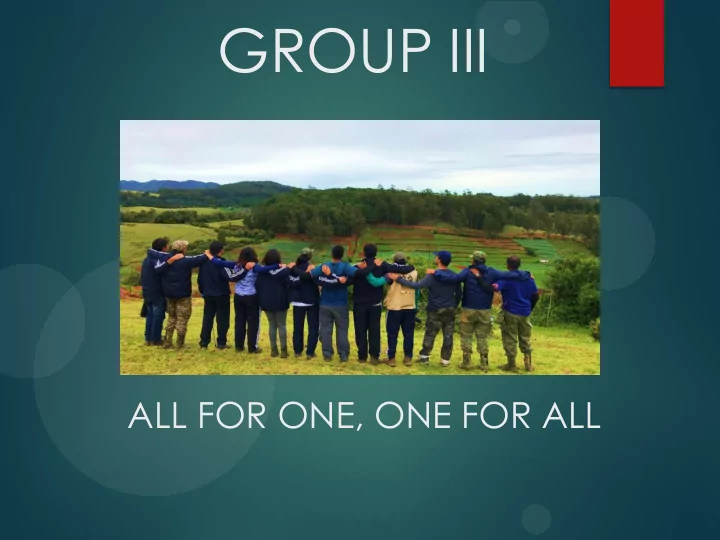
GROUP III ALL FOR ONE, ONE FOR ALL Introduction Two roads diverged - - PowerPoint PPT Presentation
GROUP III ALL FOR ONE, ONE FOR ALL Introduction Two roads diverged in a wood and I I took the one less travelled by and that has made all the difference. - Robert Frost Trekking, the most exciting and awaited part of Foundation course
Two roads diverged in a wood and I – I took the one less travelled by and
that has made all the difference.
the chance to forge bonds for a lifetime.
different states
* STF & Forest Guards: Mani, Hari, Vimal & Murugapandi
together to form a single inseparable family, in a new and challenging environment.
Dumbcharades Cricket Bonfire Football Playing cards Mafia Antakshari Mimicry
The flora comprises about 3,500 species of flowering plants.
About 80 per cent of the flowering plants reported from the Western Ghats occur in the Nilgiri Biosphere Reserve.
The Nilgiris, which support a variety of tree species, are
threatened by monoculture of eucalyptus, wattle and blue gum and cultivation of food and cash crops. The sholas are being destroyed for plantations
Besides sholas and grasslands, mosses were heavily seen
especially when we trekked to Parson Valely from Sholur
Kuranji flowers (from where the Nilgiris came to being called
the blue mountain) were blooming and seen on road side while travelling from Naduvattam to Kargudi.
Nilgiri Forests Wild Bamboo groves Nilgiri Tea Plantations Kurunji Flowers Grasslands
Mainly grown in the hills of the Nilgiris district of Tamil Nadu, besides
Munnar and Central Travancore etc.
GI Tagged under WIPO for its unique geographical origin. Expensive hand-sorted, full-leaf versions of the tea like the Orange
Pekoe are highly sought after at international auctions
Dark and aromatic. Also known as blue mountain tea. More than
50% of the harvest is exported.
Tea Board of India have instigated programs to improve
cultivation and harvest practices among small growers
Mudumalai National Park Wild Tuskers Nilgiri Bisons Deer Sheep flocks of Toda Herders Wild Boar
Nilgiris has indigenous tribes and migrant workers. Tamil is the lingua franca of the region. Other local languages like
Toda, Kota, Badaga and tribal languages are spoken. Malayalam and Kannada are also widely understood;
Tribes include 1.
Todas
2.
Kattu Nayakans
3.
Kotas
4.
Kurumbas
5.
Paniyans
6.
Irulas, who are the Particularly Vulnerable Tribal Groups (PVTG) and
7.
Badagas
A Toda temple en route Sholur to Parson’s Valley. Toda’s have a unique custom, language and religion which are very different from the other tribes. They walk barefoot at all times and have temples and dwellings with buffalo motifs
The migrant tea workers are all women, who work in the fields for long hours with meagre pay. They served us delicious tea on our way from Naduvattam to Kargudi
Badagas migrated to the Nilgiris from the Mysore region in
Karnataka, with their language being derived from Tamil-
Nilgiris.
Near Sholur, there are hamlets (called Hatti) of Kannada
speaking Gowdas who migrated to this region during Tipu Sultan’s reign.
Learning is the only thing the mind never exhausts, never fears and never regrets – LEONARDO DA VINCI It helped in promoting esprit de corps, and camaraderie
among all of us
It helped us in appreciating the beauty of nature, and
thus getting more sensitized about environmental problems
It helped us in realizing our physical and mental
capabilities
The journey of approx. 120 kms in 6 days helped each of
us to become more self confident, and it helped us stretch our limits
The ultimate measure of a man is not where he stands in movement of comfort and convenience but where he stands at time of challenge and controversy.
Cold weather with dense fog Animal encounters: Leech bites in dense forest of
Nilgiri was effectively countered by application of salt and savlon soap.
Chased by a lone tusker: along our way, we were
chased by a wild elephant on the way from Naduvattam to Kargudi.
Trekking in the slope and slippery areas led to blisters,
muscle cramps and ankle twists.
Scorching heat of the sun especially from Kargudi to
Vazhaithottam