Tight Gas in the Netherlands A Study Proposal EBN Exploration Day - - PowerPoint PPT Presentation

tight gas in the
SMART_READER_LITE
LIVE PREVIEW

Tight Gas in the Netherlands A Study Proposal EBN Exploration Day - - PowerPoint PPT Presentation

Tight Gas in the Netherlands A Study Proposal EBN Exploration Day 23 May 2016 1 1 Why a Tight Gas Study Proposal The Netherlands contains circa 50 discoveries with about 100 200 bcm undevelopped gas in tight reservoirs Several


slide-1
SLIDE 1

1

1

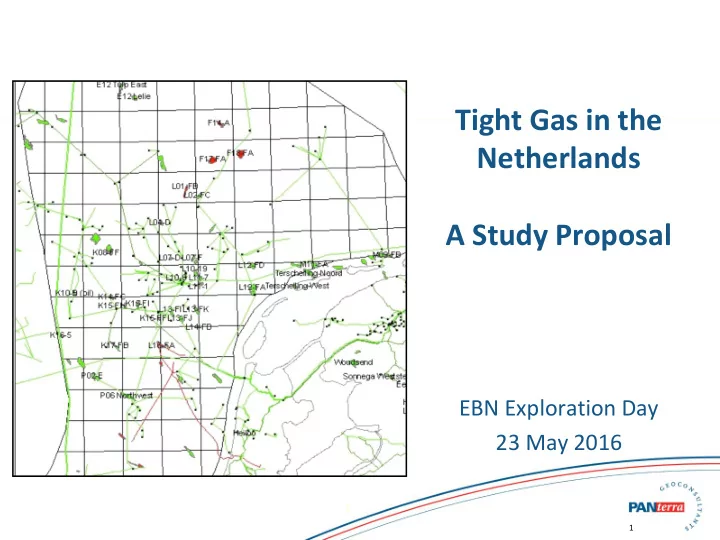
Tight Gas in the Netherlands A Study Proposal

EBN Exploration Day 23 May 2016

slide-2
SLIDE 2

2

2

Why a Tight Gas Study Proposal

  • The Netherlands contains circa 50 discoveries with about

100 – 200 bcm undevelopped gas in tight reservoirs

  • Several successful and unsuccessful tight gas

appraisal/developments have taken place

  • Infrastructure is aging
  • Time is running out for tight gas field appraisal /

development

  • EBN study demonstrates

good commercial

  • pportunities with

tight gas stimulation

EBN Schulte, Lutgert en Asschert, 2012

slide-3
SLIDE 3

3

3

Tight Gas Study Proposal

  • PanTerra proposes to categorize and

map offshore tight gas discoveries and fields in Rotliegend and Bunter reservoirs

  • PanTerra is in a unique position for

this study because of its:

– database and experience with core studies – geological knowledge of the Netherlands – experienced G&G and reservoir engineering department – access to stimulation and other experts

2910 plugs < 1mD

PanTerra database, NLOG data

slide-4
SLIDE 4

4

4

Tight Gas Study Proposal

  • Categorize and describe offshore tight gas discoveries in Rotliegend and Bunter

reservoirs

  • Collect, study and integrate:

– Core descriptions (Depositional system, facies, diagenesis) – Core experiments (mineral and clay content, porosity, permeability, capillary pressure, electrical properties a,m,n)

  • Define burial history (literature, wells and seismic)
  • Petrophysical consistent log evaluation
  • Identify tight rock classes
  • Integrate SCAL data for a hydraulic rock-typing approach

– pore throat radius – relative permeability measurements: What is “mobile gas”?

  • Collect, evaluate and integrate well test, stimulation and production data and

correlate them with the rock types defined above.

  • Describe common tight gas factors and differences

– Can sweet-spots be identified – Recommend which stimulation techniques work best – Define best practice to calculate production forecasts and recovery

slide-5
SLIDE 5

5

5

None Propriatary Study

  • Estimated start: Summer 2016
  • Duration: About one year
  • Workscope: to be framed with sponsors
  • PanTerra seeks sponsors for this project
  • Cost estimate: Pending study framework