SLIDE 1 PLASTIC FILM PERMEABILITY TO SOIL FUMIGANTS Wonsook Ha* and Husein A. Ajwa University of California-Davis, 1636 East Alisal Street, Salinas, CA 93905 Soil fumigants are applied to agricultural fields to control soilborne pathogens and
- weeds. Plastic tarp (film) is usually used to reduce fumigant volatilization from
- soil. Several types of polyethylene tarps, virtually impermeable films (VIF), and
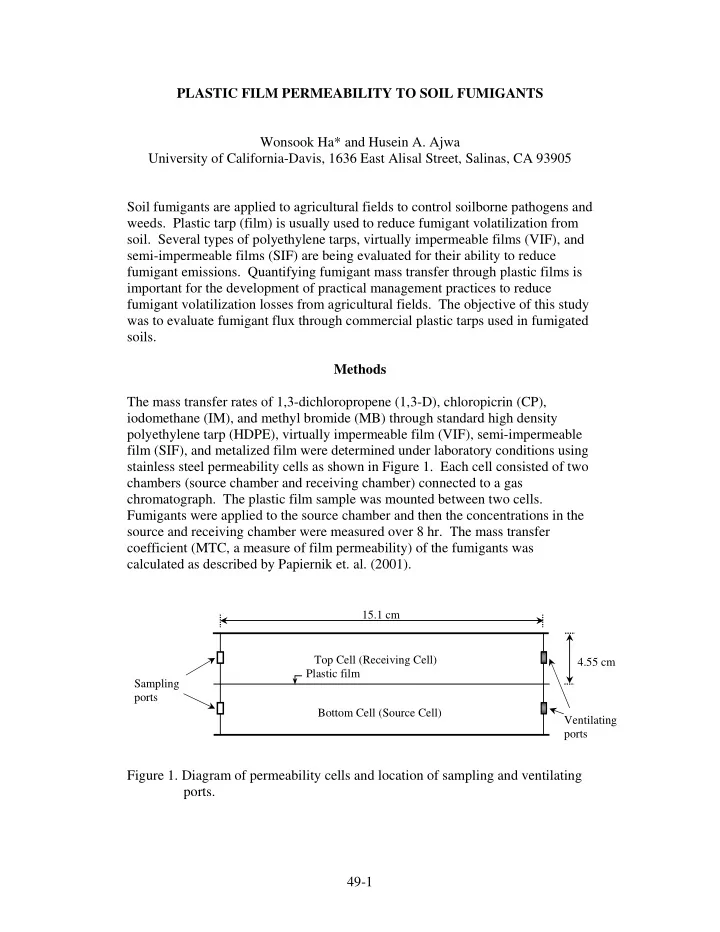
semi-impermeable films (SIF) are being evaluated for their ability to reduce fumigant emissions. Quantifying fumigant mass transfer through plastic films is important for the development of practical management practices to reduce fumigant volatilization losses from agricultural fields. The objective of this study was to evaluate fumigant flux through commercial plastic tarps used in fumigated soils. Methods The mass transfer rates of 1,3-dichloropropene (1,3-D), chloropicrin (CP), iodomethane (IM), and methyl bromide (MB) through standard high density polyethylene tarp (HDPE), virtually impermeable film (VIF), semi-impermeable film (SIF), and metalized film were determined under laboratory conditions using stainless steel permeability cells as shown in Figure 1. Each cell consisted of two chambers (source chamber and receiving chamber) connected to a gas
- chromatograph. The plastic film sample was mounted between two cells.
Fumigants were applied to the source chamber and then the concentrations in the source and receiving chamber were measured over 8 hr. The mass transfer coefficient (MTC, a measure of film permeability) of the fumigants was calculated as described by Papiernik et. al. (2001). Figure 1. Diagram of permeability cells and location of sampling and ventilating ports.
Plastic film Top Cell (Receiving Cell) 15.1 cm Bottom Cell (Source Cell) 4.55 cm Ventilating ports Sampling ports
49-1
SLIDE 2
Results The permeability of nine commercial films to 1,3-D, CP, IM, and MB vapors was measured using static sealed chambers at 22 ± 2oC. Normalized concentration data to the initial concentration were utilized. Relative diffusion of fumigants across the film (example is shown in Figure 2) was used to calculate the MTC (cm h-1) for various plastic tarps. Our research revealed that the MTC for all fumigants studied were greater than 0.2 cm h-1 for standard polyethylene tarps and less than 0.01 for the VIF (Table 1). The average MTC of VIF was 1% of the average MTC of standard tarp. The SIF showed much lower permeability than standard films. The average MTC of SIF was approximately 50% of the average MTC of standard tarp; SIF was 2 times less permeable than standard tarp. The permeability of the metalized film to MB and IM was similar to that of the SIF, but the permeability of the metalized film to 1,3-D and CP was much higher.
10 20 30 40 50 60 70 80 90 100 1 2 3 4 5 6 7 8 Time [hr] Relative concentration [%]
S-Modeled R-Modeled S-Measured R-Measured Source chamber (S) Receiving chamber (R)
Figure 2. Diffusion of methyl bromide (MB) through a Pliant black standard tarp at 22 ± 2oC. 49-2
SLIDE 3
Table 1. Mass transfer coefficients (cm h-1) of methyl bromide (MB), iodomethane (IM), cis and trans 1,3-D, and chloropicrin (CP) for selected plastic films.
Film type MB IM Cis 1,3-D Trans 1,3-D CP Standard PE tarp (1.5 mil) Pliant black (HDPE) 0.25 0.40 0.45 0.60 0.55 Pliant white/black (HDPE) 0.29 0.30 0.45 0.35 0.50 PolyPak (LDPE) 0.23 0.27 0.24 0.33 0.20 Semi-impermeable film PolyPak 2.0 mil SIF 0.10 0.12 0.18 0.12 0.09 Pliant metalized with stripe 0.12 0.09 0.32 0.40 0.28 Canslit metalized “Shiny ” 0.12 0.10 0.30 0.39 0.17 Virtually impermeable film Bromostop black VIF < 0.001 < 0.001 < 0.001 < 0.001 < 0.001 Bromostop white/black VIF < 0.001 < 0.001 < 0.001 < 0.001 < 0.001 IPM VIF (Broadcast film) < 0.001 < 0.001 < 0.01 < 0.01 < 0.01
Reference: Papiernik, S. K., Yates, S. R., and Gan, J., 2001, An approach for estimating the permeability of agricultural films, Environmental Science and Technology, 35, 1240–1246. 49-3