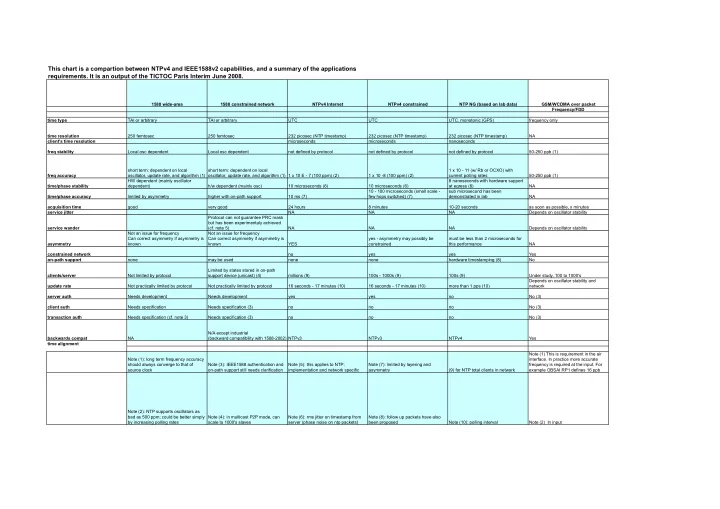

1588 wide-area 1588 constrained network NTPv4 Internet NTPv4 constrained NTP NG (based on lab data) GSM/WCDMA over packet Frequency/FDD time type TAI or arbitrary TAI or arbitrary UTC UTC UTC, monotonic (GPS) frequency only time resolution 250 femtosec 250 femtosec 232 picosec (NTP timestamp) 232 picosec (NTP timestamp) 232 picosec (NTP timestamp) NA client's time resolution microseconds microseconds nanoseconds freq stability Local osc dependent Local osc dependent not defined by protocol not defined by protocol not defined by protocol 50-250 ppb (1) freq accuracy short term: dependent on local
- scillator, update rate, and algorithm (1)
short term: dependent on local
- scillator, update rate, and algorithm (1) 1 x 10 E - 7 (100 ppm) (2)
1 x 10 -8 (100 ppm) (2) 1 x 10 - 11 (w/ Rb or OCXO) with current polling rates 50-250 ppb (1) time/phase stability HW dependent (mainly oscillator dependent) h/w dependent (mainly osc) 10 microseconds (6) 10 microseconds (6) 8 nanoseconds with hardware support at egress (6) NA time/phase accuracy limited by asymmetry higher with on-path support 10 ms (7) 10 - 100 microseconds (small scale - few hops switched) (7) sub microsecond has been demonstrated in lab NA acquisition time good very good 24 hours 8 minutes 10-20 seconds as soon as possible, x minutes service jitter NA NA NA Depends on oscillator stability service wander Protocol can not guarantee PRC mask but has been experimentaly achieved (cf. note 5) NA NA NA Depends on oscillator stability asymmetry Not an issue for frequency Can correct asymmetry if asymmetry is known Not an issue for frequency Can correct asymmetry if asymmetry is known YES yes - asymmetry may possibly be constrained must be less than 2 microseconds for this performance NA constrained network no yes yes Yes
- n-path support
none may be used none none hardware timestamping (8) No clients/server Not limited by protocol Limited by states stored in on-path support device (unicast) (4) millions (9) 100s - 1000s (9) 100s (9) Under study, 100 to 1000's update rate Not practically limited by protocol Not practically limited by protocol 16 seconds - 17 minutes (10) 16 seconds - 17 minutes (10) more than 1 pps (10) Depends on oscillator stability and network server auth Needs development Needs development yes yes no No (3) client auth Needs specification Needs specification (3) no no no No (3) transaction auth Needs specification (cf. note 3) Needs specification (3) no no no No (3) backwards compat NA N/A except industrial (backward compatibility with 1588-2002) NTPv3 NTPv3 NTPv4 Yes time alignment Note (1): long term frequency accuracy should always converge to that of source clock Note (3): IEEE1588 authentication and
- n-path support still needs clarification
Note (5): this applies to NTP; implementation and network specific Note (7): limited by layering and asymmetry (9) for NTP total clients in network Note (1) This is requirement in the air
- interface. In practice more accurate
frequency is required at the input. For example OBSAI RP1 defines 16 ppb Note (2): NTP supports oscillators as bad as 500 ppm; could be better simply by increasing polling rates Note (4): in multicast P2P mode, can scale to 1000's slaves Note (6): rms jitter on timestamp from server (phase noise on ntp packets) Note (8): follow up packets have also been proposed Note (10): polling interval Note (2) In input
This chart is a compartion between NTPv4 and IEEE1588v2 capabilities, and a summary of the applications
- requirements. It is an output of the TICTOC Paris Interim June 2008.