There is a mismatch in the Availability Curve calculation and the - - PDF document

there is a mismatch in the availability curve calculation
SMART_READER_LITE
LIVE PREVIEW

There is a mismatch in the Availability Curve calculation and the - - PDF document

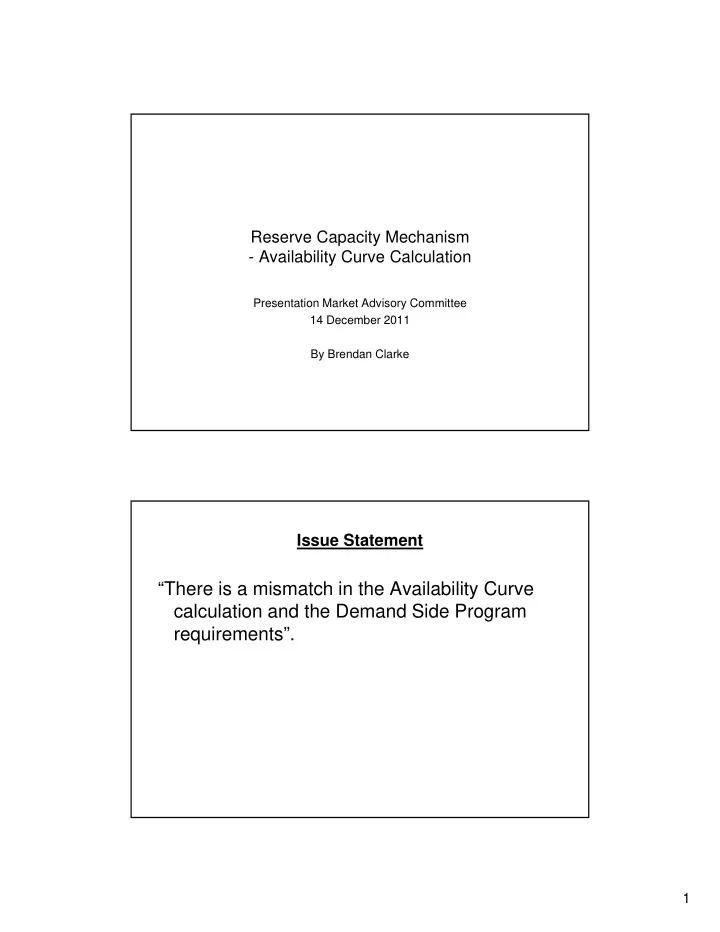
Reserve Capacity Mechanism - Availability Curve Calculation Presentation Market Advisory Committee 14 December 2011 By Brendan Clarke Issue Statement There is a mismatch in the Availability Curve calculation and the Demand Side Program l

slide-1
SLIDE 1

1

Reserve Capacity Mechanism

  • Availability Curve Calculation

Presentation Market Advisory Committee 14 December 2011 By Brendan Clarke

Issue Statement

“There is a mismatch in the Availability Curve l l ti d th D d Sid P calculation and the Demand Side Program requirements”.

slide-2
SLIDE 2

2

Issue

Market rule 4.5.12(c) defines the Availability Curve calculation that assigns the amount

  • f load that can be served by Demand Side Program classes based on 48, 72, 96

hour/year needs “the capacity associated with each Availability Class where:

  • i. the capacity quantity associated with Availability Class 4 is the Reserve Capacity

Target for the Capacity Year less the greater of the quantity specified under paragraph (b) and the quantity specified under paragraph (a) as being required for more than 48 hours per year;” Appendix 3 defines the class availability requirements for each DSP class, based on 24- 48, 48-72, 72-96, >96 hour segments.

Issue

Appendix 3 links the two together to determines how the reserve capacity procurement

  • ffers are accepted and “is used to prevent the IMO accepting bilateral trades that

have insufficient availability to usefully address the Reserve Capacity Requirement” This is an 11 step process. The key step is step 3 Step 3: Accept offers from the set of active offers in order of In the case of testing bilateral schedules, decreasing availability. In the case of the reserve capacity auction, increasing price until the capacity requirements of Availability Class “a” are fully covered or until there are no offers left unaccepted in the set of active offers. This leads to a mismatch in the DSP requirement and the load need This is illustrated in the load duration curve characteristics shown in the following slide

slide-3
SLIDE 3

3

Class 4

  • r 3 2 1

Load (MW) Load that is adequately served by class 4 DSP Class 4 Optional Req Class 4 Min Req

5219MW

MR 4.5.12 Calculation – 2013/14 data

  • r 3,2,1

Class 3

  • r 2,1

Class 2

  • r 1

Load that may not be served by class 4 DSP if all

  • ffers are at 24 hours

4631MW 4694MW 4806MW

24 72 96 48 Hours/year Class 1

4590MW

Proposed Resolution

The Availability curve assigns the amount of load that can be served based on 24, 48, 72 hour/year needs (market rule 4.5.12(c)). y ( ( )) The availability requirements for each DSP class is based on 24-48, 48-72, 72-96, >96 hour segments is unchanged (appendix 3). This removes the mismatch in the DSP requirement and the load duration needed This is illustrated in the load duration curve characteristics shown in the following slide

slide-4
SLIDE 4

4

Class 4

  • r 3,2,1

Load (MW) Load that is serve by class 4 DSP Reduced by 112MW Class 4 Min Req

5219MW

Load that is serve by class 3 DSP Class 3

  • r 2,1

Class 2

  • r 1

4631MW 4694MW 4806MW

Load that is serve by class 3 DSP Increased by 49MW Load that is serve by class 2 DSP Increased by 22MW Load that is serve by class 1 DSP Increased by 41MW 24 72 96 48 Hours/year Class 1

Comment

This does not alter the availability class requirements, class 4 is still 24 to 48 hours and DSP can nominate 24 hours 48 hours and DSP can nominate 24 hours This does not limit the amount of DSP that can be offered

slide-5
SLIDE 5

5

Way Forward

A Pre Rule Discussion Paper is discussed & noted by MAC S t M t b it R l Ch P l ith t f System Management submits a Rule Change Proposal with a request for change prior to the next SOO