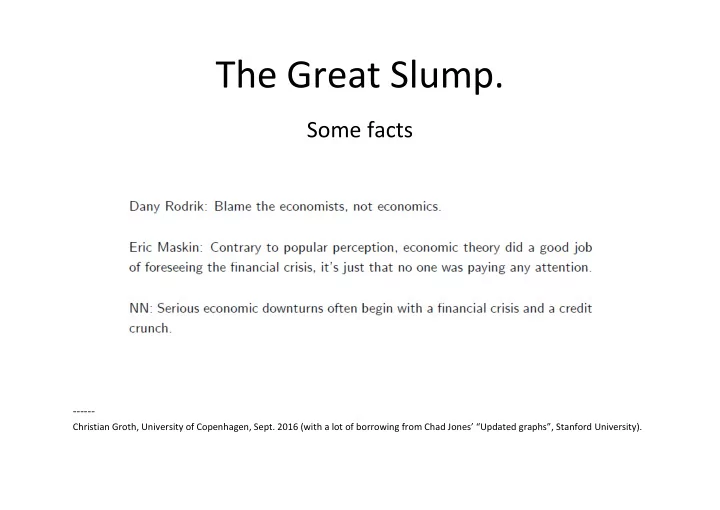
The Great Slump. Some facts ------ Christian Groth, University of - - PowerPoint PPT Presentation

the great slump
SMART_READER_LITE
LIVE PREVIEW

The Great Slump. Some facts ------ Christian Groth, University of - - PowerPoint PPT Presentation

The Great Slump. Some facts ------ Christian Groth, University of Copenhagen, Sept. 2016 (with a lot of borrowing from Chad Jones Updated graphs, Stanford University). The S&P 500 Stock Price Index (real) Real Stock Price Index


slide-1
SLIDE 1

The Great Slump.

Some facts

  • Christian Groth, University of Copenhagen, Sept. 2016 (with a lot of borrowing from Chad Jones’ “Updated graphs”, Stanford University).
slide-2
SLIDE 2
slide-3
SLIDE 3

The S&P 500 Stock Price Index (real)

1920 1930 1940 1950 1960 1970 1980 1990 2000 2010 80 160 320 640 1280 2560 Year Real Stock Price Index (ratio scale)

Source: Robert Shiller, http://www.econ.yale.edu/~shiller/data.htm

Chad Jones, Updated Graphs – January 12, 2015 – p. 25

slide-4
SLIDE 4

Bubbles in the stock market?

1880 1900 1920 1940 1960 1980 2000 5 10 15 20 25 30 35 40 45 Year P/E Ratio Average = 16.3

Source: Robert Shiller, http://www.econ.yale.edu/~shiller/data.htm

Chad Jones, Updated Graphs – January 12, 2015 – p. 26

slide-5
SLIDE 5

Bubbles in housing prices?

1950 1960 1970 1980 1990 2000 2010 100 120 140 160 180 200 Year Real Home Price Index (1953=100, ratio scale) Decline of 35.7 percent peak to trough

Source: Robert Shiller, http://www.econ.yale.edu/~shiller/data.htm

Chad Jones, Updated Graphs – January 12, 2015 – p. 27

slide-6
SLIDE 6
slide-7
SLIDE 7
slide-8
SLIDE 8
slide-9
SLIDE 9

Fig 10.7: U.S. Economic Fluctuations since 2000

Year Short−run output, Ytilde 2000 2005 2010 2015 −8% −7% −6% −5% −4% −3% −2% −1% +1% +2% +3% +4%

Source: Federal Reserve Economic Data

Chad Jones, Updated Graphs – January 12, 2015 – p. 6

slide-10
SLIDE 10

Fig 10.8: U.S. Unemployment Rate

Year Percent 2000 2005 2010 2015 3 4 5 6 7 8 9 10

Source: Federal Reserve Economic Data

Chad Jones, Updated Graphs – January 12, 2015 – p. 7

slide-11
SLIDE 11

1996 1998 2000 2002 2004 2006 2008 2010 2012 70 80 90 100

Denmark Eurozone United States

  • GDP. Denmark, Eurozone, and the US.
slide-12
SLIDE 12

Risk spreads in interbank lending

TED Spread: difference between the 3-month LIBOR rate and the 3-month U.S. treasury yield

http://www.bloomberg.com/apps/cbuilder?ticker1=.TEDSP:IND

Chad Jones, Updated Graphs – January 12, 2015 – p. 20

slide-13
SLIDE 13

Dropping the Fed Funds rate to zero

Year Percent 2000 2005 2010 2015 1 2 3 4 5 6 7

Chad Jones, Updated Graphs – January 12, 2015 – p. 19

slide-14
SLIDE 14

Fig 14.1: Ten Year Bond Spreads

1996 1998 2000 2002 2004 2006 2008 2010 2012 2014 1 2 3 4 5 6 7 8 9 10 Year BAA Corporate Bond Yield 10−Year Treasury Yield Spread

Chad Jones, Updated Graphs – January 12, 2015 – p. 21

slide-15
SLIDE 15

Fig 14.8: The Fed’s Use of Unconventional Policies

Source: http://www.clevelandfed.org/research/data/credit_easing/index.cfm

Chad Jones, Updated Graphs – January 12, 2015 – p. 23

slide-16
SLIDE 16

Fig 10.10: Inflation in the U.S.

Year Percent Excluding food and energy All items 2000 2005 2010 2015 −2 −1 1 2 3 4 5 6

Source: Federal Reserve Economic Data

Dec 2007 = 2.4% Dec 2010 = 0.6% Nov 2014 = 1.7%

Chad Jones, Updated Graphs – January 12, 2015 – p. 9

slide-17
SLIDE 17
slide-18
SLIDE 18

Economic policy in the Great Recession

Laissez-faire implies risk of long duration of the slump, hence:

  • 1. high youth unemployment,
  • 2. high long-term unemployment.

Both have adverse effects not only for people directly harmed, but also for the effective labor supply in the future (dequalification, demotivation). Monetary policy Conventional monetary policy ineffective due to the lower bound on i. Alter- natives:

  • Quantitative easing.
  • Adopting a higher inflation target in the Taylor rule until return to boom?

Makes sense, but: credibility problem because CBs are known for their distaste of inflation.

slide-19
SLIDE 19

Expansionary fiscal policy Is powerful in a liquidity trap, spending multipliers high, both Cp and Ip likely to be raised because:

  • a. no financial crowding out,
  • b. helps to reduce precautionary saving,
  • c. less risk of a Fisher-Tobin-style deflationary spiral.

Adverse effect on the long-run situation, Bg/Y ∗ ? Not necessarily, we have Bg ↑, but also Y ∗ ↑ because of: (i) the problems 1 and 2 from previous page mitigated, (ii) public investment in infrastructure and education may contribute to overall productivity.