
SLIDE 1
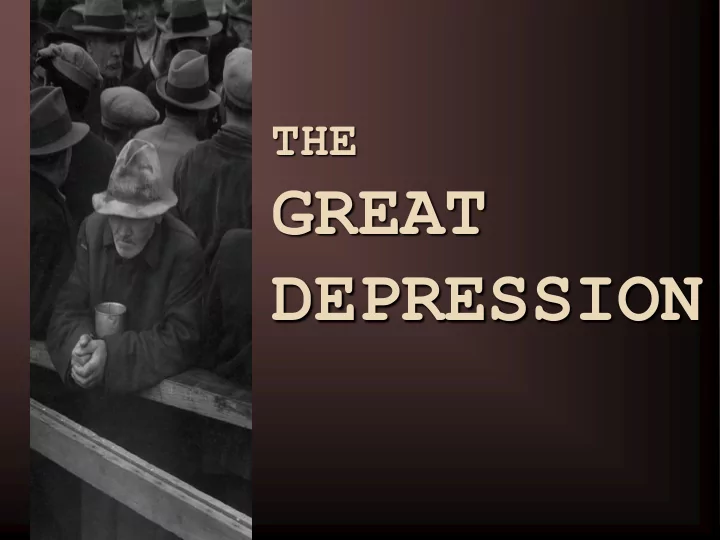
GREAT DEPRESSION THE GREAT CRASH GUIDING QUESTION What caused - - PowerPoint PPT Presentation
THE GREAT DEPRESSION THE GREAT CRASH GUIDING QUESTION What caused the Great Depression? the federal government during the 1920s? STOCK MARKET CRASH Stock Market Prices, 1921 1932 May 1928-September 1929, prices doubled in value
GUIDING QUESTION
the federal government during the 1920s?
STOCK MARKET CRASH
May 1928-September 1929, prices doubled in value beginning in Sept 1929, gradual slide Black Thursday (Oct. 24)
largest sell-off in NYSE history
Black Tuesday (Oct. 29)
$40 billion in stock value lost by Dec.
The Great Depression Response of bankers, Hoover and business leaders
Stock Market Prices, 1921–1932
Black Tuesday Wall Street,
UNDERLYING CAUSES OF THE DEPRESSION
Overproduction - Massive business inventories (up 300% from 1928 to 1929) Lack of diversification in American economy
prosperity of 1920s largely a result of construction & auto industries
Uneven distribution of income and wealth - Poor distribution of purchasing power among consumers
Farm income down 66% in 20s By 1929 the top 10% of the nation's population received 40% of the nation's disposable income
UNDERLYING CAUSES OF THE DEPRESSION
Weakness of Banking Industry
bank failures in late 1920s (farmers) many had small reserves low margins encouraged speculative investment by banks, corporations, and individual investors
total money supply
closing of over 9,000 American banks between 1930 and 1933 Federal Reserve system
Consumer Debt
– middle class installment loans; buying on margin
Overspeculation in Stock Market
– by wealthy and upper middle class
Consumer Debt, 1920–1931
UNDERLYING CAUSES OF THE DEPRESSION
Decline in demand for American goods in international trade
European industry and agriculture gradually recovered from World War I Germany so beset by financial crises/ inflation that could not afford to purchase US goods High American protective tariffs
international debt structure
Effects on Business & Industry
Corporate profits - from $10 billion to $1 billon Business failures: 100,000 between 1929 and 1933 GNP – $104 billion in 1929 to $56 billion in 1933 Total national income – fell by
Effects on Business & Industry
Bank failures
about 20% all banks (over 6000) between 1929 and 1933)
accounts lost($2.5 billion)
Bank Failures, 1929-1933
Depositors gathering outside a bank, April 1933
1932
Effects of the Crash
Great Crash
Investor s Businesses and Workers
Investors lose millions. Businesses lose profits. Consumer spending drops. Workers are laid
Businesses cut investment and production Some fail.
Banks
Businesses and workers cannot repay bank loans. Savings accounts are wiped
Bank runs
. Banks run out
and fail.
World Payments
Overall U.S. production plummets. U.S. investors have little or no money to invest. U.S. investment s in Germany decline. German war payments to Allies fall
Europeans cannot afford American goods. Allies cannot pay debts to United States.
Effect on workers and families
Unemployment ~25% in 1932?
underemployment patterns of reemployment and layoffs
hobos “Depression mentality”
Men Lined Up at the New York City Employment Bureau, 1932
Effect on workers and families
Malnutrition
Disease: tuberculosis, typhoid and dysentery.
City & state relief systems in industrial Northeast and Midwest collapse soup kitchens and bread lines
Soup kitchen, 1931 (Cleveland) Soup kitchen, Chicago, 1930
Dorothea Lange
“White Angel
Breadline“
San Francisco 1933
Effect on workers and families
Women
Working - 25% more New Deal – lower pay Women’s Rights Movement - lowest
point in a century
Families
Housing Stress - divorce Health – disease, suicide Migrants - from South
and Midwest to West
Women in Workplace 1900-1940
Mother and two children living in an abandoned car in Tennessee, 1936
Effects on Farmers
“Dust Bowl” “Okies” Grapes of Wrath
Resettlement Adminstration
Dust Bowl
Dust storm, Springfield, CO, 1935
Dust storm, Elkhart, KS, 1937
The Dust Bowl
Aftermath of dust storms, South Dakota, 1936 Dust Bowl Farm, Texas, 1938
Abandoned house, Kansas, April 1941
Migrants
A Destitute Family in the Ozark Mountains. 1935
“Okies” migrate west in 1939
Dorthea Lange, “Covered Wagon Again” 1935
Migrants in California
Migrant Auto Camp, California, 1936
"Cheap Auto Camp Housing for Citrus Workers“; Dorothea Lange, Tulare County, California, Feb. 1940
“Migrant Mother”
Dorothea Lange 1936
Effects on African Americans
High Unemployment – up to 50%: Last
hired, first fired Competition for jobs Exclusion from relief programs
Help from the New Deal? labor unions Scottsboro Case
Evicted Sharecroppers along U.S. 60 in Missouri, 1939 African American family during Great Depression in Scott’s Run, Virginia
Effects on American Culture
Reactions of most Americans
Effects on basic values (capitalism,
democracy, individualism)
Alternatives: socialism, communism? Whom to blame?
Popular Culture and Escapism
Frank Capra Walt Disney Gone With the Wind
Federal Response Under Hoover
Herbert Hoover (1929-1933)
Philosophy: limited government, individualism Initial response?
public works programs Hawley-Smoot Tariff (1930) Debt moratorium
International Banking Crisis (1931)- gold standard
Reconstruction Finance Corporation (1932)
"Boulder Dam, 1942“, Ansel Adams
Evaluation of Hoover’s Response
Contemporary popular opinion “Hoovervilles”
“Hoover's Farm Relief”
Contemporary Political Cartoon
Response to Hoover’s Response
Farmers
“Farmers Holiday Association”
“Bonus Expeditionary Force”
Bonus Army camp, 1932
"Bonus Marchers" and police battle in Washington, DC, July 1932
Evaluation of Hoover’s Response
Modern Evaluations:
reluctance to spend large amounts of federal funds, expand the role of the federal government.
willing to intervene in the economy to an unprecedented degree.
Bonus Army
Douglas McArthur directing removal of Bonus Army marchers Bonus Army camp in the Anacostia flats U.S. Army soldiers guarding Bonus Army camp
Misery Sweeps Roosevelt into Office
1932 ELECTION
Franklin D. Roosevelt philosophy “New Deal”
Franklin D. Roosevelt, 1920 Vice Presidential nominee for Democratic Party
Roosevelt Campaigning for Office in Kansas 1932
Hoover
“The Worst is Past" "Prosperity is Just Around the Corner"
Results
Electoral Shift, 1928 and 1932
1932 ELECTION
Lame-Duck Period
(Nov. 1932-March 3, 1933)
banking industry collapse. Twentieth Amendment
Bank Failures, 1929-1933
Franklin D. Roosevelt and Herbert Hoover on the way to FDR's inauguration, March 4, 1933
(Library of Congress)
SOURCES
Brinkley, American History: A Survey (10th ed) Wadsworth-Thompson http://www.wadsworth.com/history_d/special_features/ image_bank_US/1929_1939.html Library of Congress American Memory Project Rutgers Univ. Teaching Politics Image Bank http://teachpol.tcnj.edu/amer_pol_hist/.html Divine America Past and Present Revised 7th Ed. Faragher, Out of Many, 3rd Ed.; http://wps.prenhall.com/hss_faragher_outofmany_ap/ Kennedy, American Pageant 13e