The Elizabeth River Tunnels Project Project Update to the Citizen - - PowerPoint PPT Presentation

the elizabeth river tunnels project
SMART_READER_LITE
LIVE PREVIEW

The Elizabeth River Tunnels Project Project Update to the Citizen - - PowerPoint PPT Presentation

The Elizabeth River Tunnels Project Project Update to the Citizen Transportation Advisory Committee July 10, 2014 Introduction Leila Rice, Public Affairs Manager Elizabeth River Crossings & Elizabeth River Tunnels Lauren Hansen,


slide-1
SLIDE 1

Project Update to the Citizen Transportation Advisory Committee July 10, 2014
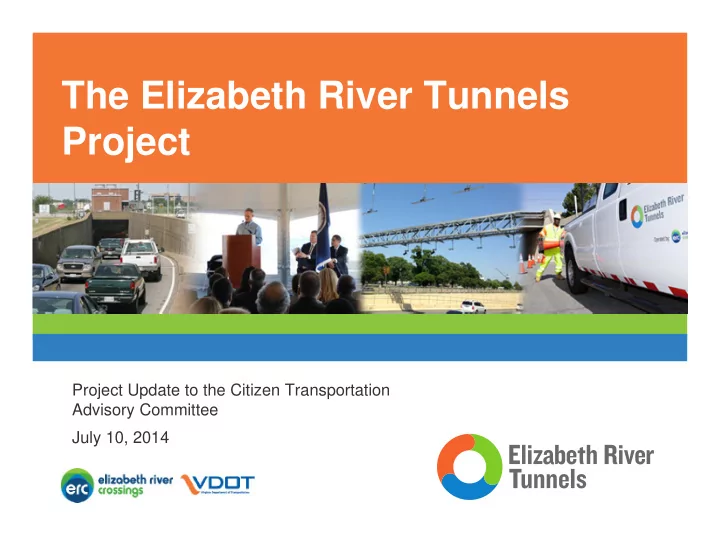
The Elizabeth River Tunnels Project

slide-2
SLIDE 2

Introduction

Leila Rice, Public Affairs Manager Elizabeth River Crossings & Elizabeth River Tunnels Lauren Hansen, Public Information Manager Elizabeth River Tunnels Project

2

slide-3
SLIDE 3

Presentation Agenda

The Elizabeth River Tunnels Project —Rehabilitating the existing Midtown and Downtown tunnels —Building a new Midtown Tunnel —Extending the Martin Luther King Freeway 2014 ERT Survey Results and Key Findings  Q & A

3

slide-4
SLIDE 4

Tunnel Rehabilitation

slide-5
SLIDE 5

Tunnel Rehabilitation – Why, What & When?

5

Why?

  • Ventilation and

fireproofing do not meet current NFPA standards (governing public safety in case of fire)

  • Existing lighting does not

meet FHWA recommendation

  • Structural repairs are

needed to prolong the life

  • f these aging facilities
  • Communications

equipment & Highway Advisory Radio does not function

What?

  • New jet fan ventilation

system

  • Brighter, longer-lasting,

more efficient LED lighting

  • Structural repairs
  • Concrete repairs & tile

replacement

  • Electrical improvements
  • Fire Safety System

upgrades

  • Communications

upgrades

  • $140 Million in

initial upgrades

When?

  • Work in the westbound

Downtown Tunnel is underway (through Summer 2014)

  • EB Downtown Tunnel

work to begin summer 2014 and requires longer schedule to allow for ceiling removal

  • Existing Midtown Tunnel

rehab work will not begin until completion of new Midtown Tunnel

slide-6
SLIDE 6

Tunnel Rehabilitation

slide-7
SLIDE 7

Building a New Midtown Tunnel

slide-8
SLIDE 8

Tunnel Element Fabrication

8

slide-9
SLIDE 9

Bringing the tube sections to Portsmouth

9

slide-10
SLIDE 10

Bringing the tube sections to Portsmouth

10

slide-11
SLIDE 11

Mooring the Elements at PMT

11

slide-12
SLIDE 12

Portsmouth and Norfolk Approaches

12

slide-13
SLIDE 13

Extending the Martin Luther King Freeway

slide-14
SLIDE 14

MLK Extension – I-264 Enhancements

14

slide-15
SLIDE 15

15

slide-16
SLIDE 16

16

slide-17
SLIDE 17

The 2014 ERT Project Survey

slide-18
SLIDE 18

Background

  • A baseline survey was conducted in April 2013, prior

to the beginning of tolling and prior to the extensive public outreach that was conducted to educate the public about the Project and to encourage people to acquire an E-ZPass.

  • The 2014 ERT Survey presents findings from the

March 2014 survey which took place after tolling began on February 1, 2014 and allows for a comparison across the two time periods.

18

slide-19
SLIDE 19

Purpose and Methodology of the Survey

Purpose

  • The 2014 survey provides data on a number of issues

important to the public education, marketing, and

  • utreach that was/is being conducted.
  • Topic areas covered in the survey include:
  • Travel behavior related to use of ERT
  • Knowledge of how tolling works
  • Support for tolling the MTT and DTT
  • Familiarity with E-ZPass
  • Satisfaction with the tolling account setup process
  • Changes in travel behavior now that tolling has started
  • Assessment of the public education/ advertising

campaigns

  • Communication mediums for keeping the public

informed

  • Tunnel user demographics
  • Future waves of this survey will allow for additional

comparisons as the Project progresses to assess trends in public understanding and support for the Project.

Methodology

  • PRR conducted a statistically valid telephone survey

from March 3, through March 24, 2014, using the following methods:

  • Used landline and cell phone sample targeted to a 30-

mile radius relative to the tunnels

  • Surveyed 600 adults (18 years of age or older) who

use one or both tunnels in a personal vehicle at least

  • ne day a month
  • Set sampling quotas for 300 Midtown Tunnel users

and 300 Downtown Tunnel users

  • The margin of error is +/- 4%
  • The average length to complete the questionnaire was

13.5 minutes

  • The response rate was 4%*
  • The cooperation rate was 23% ǂ
  • All reported relationships are statistically significant at

the .05 level or better at the 95% confidence level

* Using the approved American Association of Public Opinion Research approach, response rate is defined as the number of completed surveys plus partial or suspended surveys divided by the number of completed surveys, plus partial or suspended surveys, plus qualified refusals, plus break‐offs, plus no answer, plus busy signal, plus answering machine, plus soft refusals, plus hard refusals, plus scheduled callbacks, plus unspecified callbacks. ǂ Cooperation rate is defined as the number of completed surveys divided by the number of completed surveys plus refusals plus break-offs. Therefore, it is the percent of those contacted who qualified and who completed the survey.

5

slide-20
SLIDE 20

Sample Profile

  • Gender
  • Male - 51%
  • Female - 49%
  • Age
  • 18 to 24 – 4%
  • 25 to 34 – 14%
  • 35 to 44 – 21%
  • 45 to 54 – 25%
  • 55 to 59 – 9%
  • 60 to 64 – 9%
  • 65 to 74 – 12%
  • 75 and older – 6%
  • Hispanic/Latino background – 5%
  • Race
  • Black/African American – 29%
  • White/Caucasian – 60%
  • American Indian or Alaska Native – 1%
  • Native Hawaiian or other Pacific Islander – 1%
  • Asian – 1%
  • Other race or combination – 8%
  • Income
  • Below $35,000 – 17%
  • $35,000 and above – 83%

20

slide-21
SLIDE 21

Key Findings

  • Travel behaviors
  • Reported congestion levels in the Elizabeth River Tunnels (ERT) are reduced compared to 2013.
  • Trip purposes have remained about the same since 2013, many of which are non-discretionary, such as

traveling to and from work (44%), medical appointments (35%), and non-commute work-related travel (33%).

  • The vast majority are still driving alone (83%) and/or carpooling with household members (32%).
  • Almost a third (32%) reported changing their time of travel to avoid the higher toll amount.
  • Knowledge and attitudes toward tolling at ERT
  • Knowledge that E-ZPass is the name of the electronic tolling system increased significantly from 24% in 2013

to 67% in 2014.

  • Familiarity with E-ZPass increased significantly so that by 2014, 50% report being quite familiar or extremely

familiar.

  • Knowledge of Project facts have also increased significantly. Those more knowledgeable were more likely to

remember hearing/seeing information about the Project and/or to be aware of and have used the Project website.

  • Support for tolling the Tunnels increased somewhat, with 42% reporting medium or strong support in 2014,

compared to 34% in 2013.

  • Among those without an E-ZPass, 40% indicated they are likely or very likely to get one. More than half

(52%) of those with a registered Pay by Plate account are likely or very likely to get an E-ZPass.

21

slide-22
SLIDE 22

Key Findings (continued)

  • Satisfaction with account set-up process
  • The majority (60%) were satisfied or very satisfied with the E-ZPass account set-up process. Only

14% were dissatisfied or very dissatisfied.

  • Fewer (40%) were satisfied or very satisfied with the registered Pay by Plate account set-up
  • process. Only 16% were dissatisfied or very dissatisfied.
  • Advertising and communications
  • More than four-fifths (82%) remembered hearing or seeing information about tolling of the Tunnels since

November 2013.

  • Most remembered hearing or seeing this information on television (79%) or radio advertisements (36%).
  • The most remembered information was that tolling starts in February, that E-ZPass is available, and tolls will

be charged.

  • More than a third (35%) were aware of the Project website and of those, 43% had used the website.
  • Among those who had used the website, the vast majority found the information helpful (83%) and had no

difficulty finding the information they were looking for (85%).

  • Television (54%), print newspaper (25%), and radio (18%) remain the most preferred ways to get information

about the Project.

22

slide-23
SLIDE 23

41.3% 36.0% 48.0% 42.0% 74.3% 35.3% 36.5% 39.0% 54.0% 44.0% 89.0% 90.0% 80.0% 97.0% 88.0% 47.0% 39.0% 0% 10% 20% 30% 40% 50% 60% 70% 80% 90% 100% A new Midtown Tunnel will be constructed as part of the Project (true) Improvements to the existing Downtown Tunnel are not part of the Project (false) Drivers will stop at toll booths to pay the tolls (false) People without an E-Zpass will pay the same as people with an E-ZPass (false) Toll amounts will be the same all day long (false) Without EZ-Pass account, license plate is photographed and you are sent a bill (true) Tolling starts in the month of February in 2014 (true) The Project will result in faster and safer trips through the Tunnels (true) The Commonwealth maintains ownership of the tunnels (true)

Knowledge of Project Facts

Base = all survey respondents (2014, n=600; 2013, n=400)

How Knowledgeable Are They About the Project?

23

In general, those more likely to get answers correct were those who:

  • Have E-ZPass or

registered Pay by Plate

  • Are aware of the

Project website and have used it

  • Remember hearing/

seeing information about tolling at ERT In general, those more likely to get answers correct were those who:

  • Have E-ZPass or

registered Pay by Plate

  • Are aware of the

Project website and have used it

  • Remember hearing/

seeing information about tolling at ERT

slide-24
SLIDE 24

6.8% 2.3% 5.3% 4.8% 10.8% 19.5% 22.8% 19.3% 44.3% 61.3% 7.0% 1.0% 3.0% 6.0% 13.0% 15.0% 17.0% 21.0% 56.0% 58.0%

0% 10% 20% 30% 40% 50% 60% 70% Other Vanpool Take transit Work at home/telework/telecommute Carpool Change destination Forgo the trip altogether Change travel time to a time of day when the toll amount is lower Drive your vehicle and pay the toll Take another route

Most Likely to Do Now That ERT is Tolled

Base = all survey respondents (2014, n=600; 2013, n=400) (Multiple responses allowed. Percentages may add up to more than 100.) 2014 2013

How Are They Traveling Now that Tolling Has Started?

24

‘Other’ included “change jobs,”

“relocate,” and “travel less.”

‘Other’ included “change jobs,”

“relocate,” and “travel less.”

slide-25
SLIDE 25

What Time of Day Do They Use ERT?

25

10.0% 28.0% 49.0% 45.0% 45.0%

0% 10% 20% 30% 40% 50% 60%

Overnight time (after 10 pm to before 5 am) Evening (after 7 pm to 10pm) Afternoon (3 pm to 7 pm) Mid-day (after 9 am to before 3 pm) Morning (5 am to 9 am)

Typical Time of Day When Using ERT

Base = all respondents who used DTT or MTT (n=600) (Multiple responses allowed. Percentages may add up to more than 100.)

slide-26
SLIDE 26

13% 14% 32% 53% 48% 48% 16% 22% 13% 18% 16% 7%

0% 10% 20% 30% 40% 50% 60% 70% 80% 90% 100% 2013 - Midtown Tunnel (n=306) 2013 - Downtown Tunnel (n=338) 2014 - Both Tunnels (n=593)

Congestion Level During Last Weekday Trip

Base = all survey respondents using DTT or MTT

Not congested at all Moderately congested Seriously congested Very seriously congested

How Congested is ERT?

26

Reported congestion is lower in 2014 Reported congestion is lower in 2014

slide-27
SLIDE 27

2.0% 44.0% 19.8% 22.3% 12.0% 2.0% 39.2% 17.3% 26.7% 14.8%

0% 5% 10% 15% 20% 25% 30% 35% 40% 45% 50% Don’t know No support at all Low support Medium support Strong support

Support for Charging Toll on Existing DTT and MTT to Pay for Project

Base = all survey respondents (2014, n=600; 2013, n=400)

2014 2013

How Much Do They Support Tolling?

27

* Binary logistic regression is a type of regression analysis used for predicting the outcome of a dichotomous variable based on one or more predictor variables.

8% more support in 2014 8% more support in 2014

slide-28
SLIDE 28

How Do They Pay ERT Tolls?

28

72% 4% 24%

How ERT Tolls Are Paid

Base = all survey respondents (n=600) E-Zpass Registered Pay by Plate Unregistered Pay by Plate

slide-29
SLIDE 29

How Do They Pay ERT Tolls?

29

12.0% 20.0% 16.0% 24.0% 28.0%

2.0% 33.0% 25.0% 17.0% 23.0% 0% 5% 10% 15% 20% 25% 30% 35% Don’t know Very unlikely Unlikely Likely Very likely

Likelihood to Get an E-ZPass

Base = all survey respondents without an E-ZPass

If unregistered Pay by Plate (n=169) If registred Pay by Plate (n=25)

Registered Pay by Plate more likely to shift to E-ZPass Registered Pay by Plate more likely to shift to E-ZPass

slide-30
SLIDE 30

Conclusions

In general, the marketing and education about the Project and the tolling of the MTT and DTT has been successful. This is supported by the following:

  • Support for tolling has increased somewhat.
  • The vast majority remembered hearing or seeing information about tolling the MTT and DTT.
  • About a third are aware of the Project website and among those that use it, the vast majority found it

helpful and easy to navigate.

  • Knowledge has increased dramatically, including:
  • That E-ZPass is the name of the electronic tolling system
  • Familiarity with E-ZPass has increased
  • Knowledge about how tolling works and about the Project has increased
  • Respondents report several changes in their travel since tolling began:
  • Less congestion in the MTT and DTT
  • About a third have changed their time of travel through the MTT and DTT in order to pay a lower toll
  • Satisfaction with the account set-up process was fairly high, especially for those with an E-ZPass.
  • Many of those with a Pay by Plate account or who use unregistered Pay by Plate plan to get an E-ZPass.

23

slide-31
SLIDE 31

The Elizabeth River Tunnels Project

slide-32
SLIDE 32

How Frequently Do They Use ERT?

  • 49% reported using the Downtown Tunnel one or more times a week.
  • 48% reported using the Midtown Tunnel one or more times a week.

32

In 2014, respondents reported using the MTT slightly more frequently (24% used it 4 or more days a week) compared to the DTT (21%), but is within the margin of error. This is

  • pposite compared to

results from the 2013

  • survey. This is also opposite
  • f actual volume counts for

each of the tunnels in 2014, and may simply be a result

  • f normal sampling error.

In 2014, respondents reported using the MTT slightly more frequently (24% used it 4 or more days a week) compared to the DTT (21%), but is within the margin of error. This is

  • pposite compared to

results from the 2013

  • survey. This is also opposite
  • f actual volume counts for

each of the tunnels in 2014, and may simply be a result

  • f normal sampling error.

18% 9% 15% 8% 40% 37% 38% 44% 9% 11% 9% 11% 15% 19% 15% 17% 18% 24% 24% 21%

0% 10% 20% 30% 40% 50% 60% 70% 80% 90% 100% 2013 Midtown Tunnel (n=377) 2013 Downtown Tunnel (n=375) 2014 Midtown Tunnel (n=533) 2014 Downtown Tunnel (n=563)

Typical Tunnel Use Frequency

Base = all survey respondents using either tunnel

Less than 1 time per month 1-3 times per month 1 time per week 2-3 times per week 4 or more times per week