
SLIDE 1
The effect of subcooling on critical heat flux along a slightly inclined downward-facing heater plate
Uiju Jeonga and Sung Joong Kimb*
aKHNP Central Research Institute, 1312 70-gil Yuseong-daero, Yuseong-gu, Daejeon 34101, Korea bDepartment of Nuclear Engineering, Hanyang University, 222 Wangsimni-ro, Seongdong-gu Seoul 04763, Korea *Corresponding author: sungjkim@khnp.co.kr
- 1. Introduction
Compared to inconsistent reports on nucleate boiling characteristics, it has been consistently reported that liquid subcooling enhances critical heat flux (CHF). CHF can be presented as a linear function of liquid
- subcooling. Such a linear relationship between liquid
subcooling and the CHF was observed in numerous experimental studies when various fluids were adopted, such as water, HFE7100, PF5060, FC72, FC86, R113, methanol, and isopropanol, and when several heater configurations were adopted, such as an upward-facing heater, vertical plate, and horizontal wire. Positive linearity between the liquid subcooling and resulting CHF could also be confirmed in case of downward-facing heater. Note that El-Genk and Parker [1] studied the combined effect of heater orientation and liquid subcooling and showed that the subcooling effect was rapidly diminished when the heater
- rientation changed from 30o to 0o (downward-facing
horizontal surface). However, it should be noted that aforementioned works used either very small or curved
- heaters. Thus, their work might obfuscate the complex
physics associated with heater size. Only Sulatskii et al. [2] thoroughly investigated the effect of subcooling on the CHF at various subcooling degrees on a large downward-facing flat heater with a slight inclination. Interestingly, a nonlinear characteristic between subcooling and the CHF was
- bserved in their work. They discovered a regime in
which subcooling negatively affected the CHF. This unusual instance of CHF dependence on subcooling was simulated in their CHF model by incorporating the negative influence of subcooling on local mass flow rate along the heater surface. Specifically, a term representing single-phase heat transfer to the subcooled liquid was added in calculation of the vapor mass flow
- rate. Their CHF model could successfully predict the
anomalous dependence of subcooling on the CHF
- bserved in their experiments. Note that the anomalous
dependence can be interpreted as a weak contribution
- f the additional sensible energy needed to heat the
subcooled liquid to a saturated state. Another interpretation may be thought of as a strong contribution of vapor layer motion on the CHF. It is apparent that a strong vapor layer motion contribution comes from the large geometry of the heater surface. The purpose of this work is to present experimental data for the CHF on a flat, downward-facing surface at various subcooling conditions to investigate the influence of subcooling on boiling heat transfer. An effort was made to examine the two-phase instability including the condensation induced water hammer (CIWH) observed in the present study, and also to investigate their influence on the CHF. Detailed research content can be found in the paper of Jeong and Kim [3].
- 2. Experimental apparatus
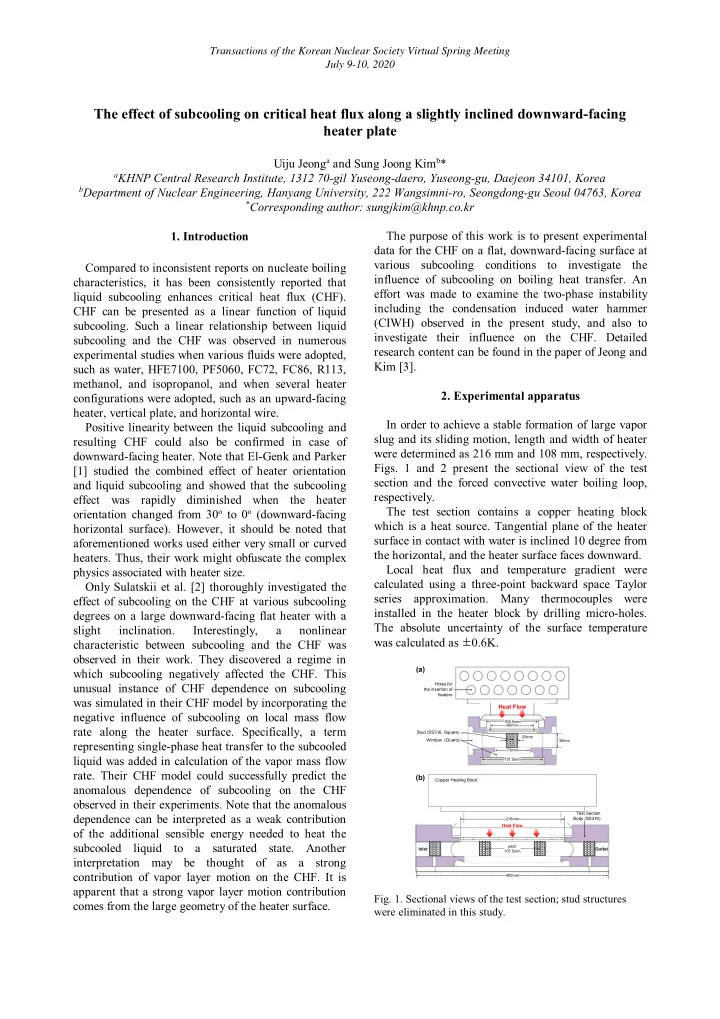
In order to achieve a stable formation of large vapor slug and its sliding motion, length and width of heater were determined as 216 mm and 108 mm, respectively.
- Figs. 1 and 2 present the sectional view of the test
section and the forced convective water boiling loop, respectively. The test section contains a copper heating block which is a heat source. Tangential plane of the heater surface in contact with water is inclined 10 degree from the horizontal, and the heater surface faces downward. Local heat flux and temperature gradient were calculated using a three-point backward space Taylor series approximation. Many thermocouples were installed in the heater block by drilling micro-holes. The absolute uncertainty of the surface temperature was calculated as ±0.6K.
Inlet Outlet Copper Heating Block Test Section Body (SS316) Window (Quartz) Holes for the insertion of heaters 216mm 400mm 108.5mm 131.5mm 30mm Heat Flow
Heat Flow
(a)
Stud (SS316, Square)
(b)
90mm pitch 107.5mm 25mm
- Fig. 1. Sectional views of the test section; stud structures