The course is now over. Theorem ALL NFA is PSPACE-complete. Thank - - PDF document

the course is now over
SMART_READER_LITE
LIVE PREVIEW

The course is now over. Theorem ALL NFA is PSPACE-complete. Thank - - PDF document

PSPACE-Completeness Definition (PSPACE-Completeness) Computability and Complexity A language B is PSPACE-complete iff 1 B PSPACE (containment in PSPACE), and Lecture 15 2 for every A PSPACE we have A P B (PSPACE-hardness). Test


slide-1
SLIDE 1

Computability and Complexity

Lecture 15

Test PSPACE-completeness Summary and Exam Info

given by Jiri Srba

Lecture 15 Computability and Complexity 1/16

PSPACE-Completeness

Definition (PSPACE-Completeness) A language B is PSPACE-complete iff

1 B ∈ PSPACE (containment in PSPACE), and 2 for every A ∈ PSPACE we have A ≤P B (PSPACE-hardness).

Theorem If B is PSPACE-complete, B ≤P C, and C ∈ PSPACE, then C is PSPACE-complete. Proof: Because ≤P is transitive.

Lecture 15 Computability and Complexity 2/16

ALBA Is PSPACE-Complete

ALBA

def

= {M, w | M is an LBA such that M accepts w } Theorem ALBA is PSPACE-complete. Proof: Containment in PSPACE: ”On input M, w: simulate M on w”. This takes only linear space, so it belongs to PSPACE. PSPACE-hardness: Let L ∈ PSPACE. We show L ≤P ALBA.

Because L ∈ PSPACE then there is a decider M running in space nk such that L(M) = L. Poly-time reduction: On input w: output M, w(⊔)|w|k. Clearly, w ∈ L iff M accepts w(⊔)|w|k. M runs in space nk, so M on input w(⊔)|w|k acts as LBA.

The technique used in this reduction is called padding.

Lecture 15 Computability and Complexity 3/16

TQBF Is PSPACE-Complete

Quantified Boolean formula (QBF): ψ def = ∀x1∃x2∀x3∃x4 . . . ∀xk−1∃xk.φ where φ is a Boolean formula over the variables x1, . . . , xk. Any given QBF ψ is either true or false. TQBF def = {ψ | ψ is a true QBF } Theorem TQBF is PSPACE-complete. Proof: See the book (not part of the syllabus).

Lecture 15 Computability and Complexity 4/16

ALLNFA Is PSPACE-Complete

Problem: ”Does a given NFA accept all strings from Σ∗?” Theorem ALLNFA is PSPACE-complete. Proof: Not part of the syllabus.

Lecture 15 Computability and Complexity 5/16

The Course Is Over

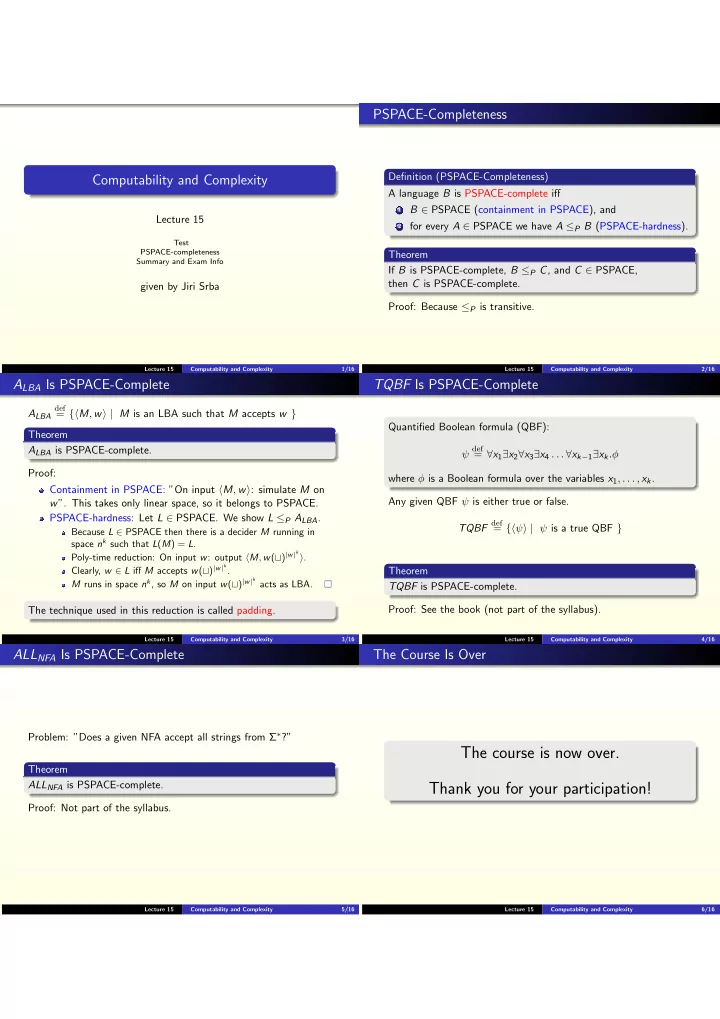
The course is now over. Thank you for your participation!

Lecture 15 Computability and Complexity 6/16

slide-2
SLIDE 2

Decision Problems

Decision Problem ”Given an instance of the problem, is it a positive instance or a negative instance?” Language Formulation L = {P | P is a positive instance of the problem } Questions: Computability Theory: Is a given problem algorithmically solvable? (Is the corresponding language decidable?) Complexity Theory: How difficult is to solve a given problem? (What is the time/space complexity of the corresponding language?)

Lecture 15 Computability and Complexity 7/16

Turing Machine — A Model of a Computer

Church-Turing Thesis ”The Turing machine model captures exactly the informal notion

  • f algorithm.”

Polynomial Time Equivalence of Deterministic Models (Thesis) ”All reasonable deterministic models of computation are polynomial time equivalent to deterministic single-tape Turing machine.”

Lecture 15 Computability and Complexity 8/16

Variants of TMs and Time vs. Space Complexity

Let t(n) be a function s.t. t(n) ≥ n. Theorem (Multi-Tape TM) Every k-tape TM M has an equivalent 1-tape TM M′. If M is running in time t(n) then M′ is running in time O(t2(n)). Theorem (Nondeterministic TM) Every nondeterministic TM M has an equivalent determin. TM M′. If M is running in time t(n) then M′ is running in time 2O(t(n)). If M is running in space t(n) then M′ is running in space O(t2(n)). Theorem (Time vs. Space Complexity) Every TM running in time t(n) is running in O(t(n)) space. Every TM running in space t(n) is running in time 2O(t(n)).

Lecture 15 Computability and Complexity 9/16

Classes of Languages

P: class of all languages decidable in polynomial time on deterministic TMs. NP: class of all languages decidable in polynomial time on nondeterministic TMs. co-NP: class of all languages which complements belong to NP. PSPACE: class of all languages decidable in polynomial space

  • n (deterministic or nondeterministic) TM.

EXPTIME: class of all languages decidable in exponential time on deterministic TMs. Decidable: class of all languages that are recognized by TMs which are deciders. Recognizable: class of all languages that are recognized by TMs. Co-recognizable: class of all languages which complements are recognized by TMs.

Lecture 15 Computability and Complexity 10/16

Crucial Results

Theorem (Turing — Undecidability of ATM) The acceptance problem of a Turing machine is undecidable. Theorem (Cook-Levin — NP-Completeness of SAT) The satisfiability problem for Boolean formulae is NP-complete. Other undecidable or computationally hard problems were derived using reductions: for undecidability we used mapping reductions, and for NP-hardness we used polynomial time reductions.

Lecture 15 Computability and Complexity 11/16

Languages Studied in Computability Theory

Decidable: ADFA, ANFA, ENFA, EQNFA, ACFG, ECFG, ALBA. Recognizable but not decidable: ATM, HALTTM, ETM, ELBA, ALLCFG, EQCFG, PCP, BPCP. Co-recognizable but not decidable: Complements of all languages from the above category. Neither recognizable nor co-recognizable: EQTM, REGULARTM, TOTALTM.

Lecture 15 Computability and Complexity 12/16

slide-3
SLIDE 3

Languages Studied in Complexity Theory

In P: PATH, RELPRIME, any context-free language. NP-complete: SAT, CNF-SAT, 3SAT, HAMPATH, UHAMPATH, CLIQUE, SUBSET-SUM, VERTEX-COVER. PSPACE-complete: ALBA, TQBF, ALLNFA.

Lecture 15 Computability and Complexity 13/16

Closure Properties

Class of Languages ∩ ∪

decidable YES YES YES YES YES recognizable YES YES YES YES NO P YES YES YES YES YES NP YES YES YES YES ??? PSPACE YES YES YES YES YES EXPTIME YES YES YES YES YES Intersection: Run two Turing machines in sequence. Union: Run two Turing machines in sequence, in parallel, or nondeterministically choose one. Concatenation: Try all possible splitting points, or guess the point nondeterministically. Kleene star: Try all possible splittings (exponentially many, or use dynamic programming), or guess them. Complement: Swap accept and reject state (works only for deterministic TMs that never loop).

Lecture 15 Computability and Complexity 14/16

Exam Information

Individual, written, graded exam. On the exam day bring only a pen (or rather two). No notes, no books, no slides, no calculator, ... :-( No empty sheets of paper (they will be provided to you). Read very carefully the tasks. Answer all you are asked to do, but don’t do anything more! Work in the order from the easiest to the most difficult task. Double check your solutions. Your hand-writing must be readable (make drafts on the provided paper, do not hand them in). Return only the sheets of paper you want us to consider for the exam. On each sheet write your full name and question number you solve there.

Lecture 15 Computability and Complexity 15/16

How to Prepare for the Exam

Assumption You already read the suggested reading in the book and solved all compulsory exercises during the semester. If not: do it as soon as possible!!! Go lecture by lecture through the slides. If something is unclear, read the corresponding text in the book. Go through allcompulsory exercises, recall the solutions on your own and then compare them with the provided ones. Go through the checklist on Course Info page, make sure you

can precisely write down all the main definitions, formulate in written and understand the main theorems recall definitions of the languages (write them down) and refresh into which class they belong.

Try to solve the tests 1 to 4 one more time. You are now ready for the exam, good luck and all the best!

Lecture 15 Computability and Complexity 16/16