Course Specifications/Detailed Course Outline Course code : STA 331 - - PDF document

course specifications detailed course outline
SMART_READER_LITE
LIVE PREVIEW

Course Specifications/Detailed Course Outline Course code : STA 331 - - PDF document

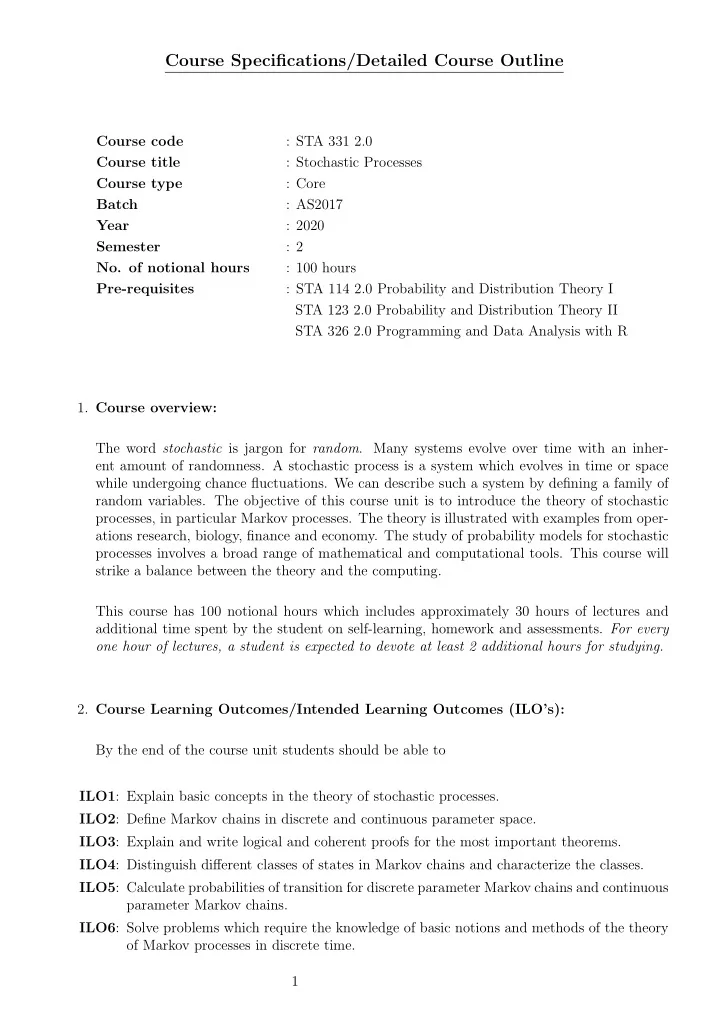
Course Specifications/Detailed Course Outline Course code : STA 331 2.0 Course title : Stochastic Processes Course type : Core Batch : AS2017 Year : 2020 Semester : 2 No. of notional hours : 100 hours Pre-requisites : STA 114 2.0


slide-1
SLIDE 1

Course Specifications/Detailed Course Outline

Course code : STA 331 2.0 Course title : Stochastic Processes Course type : Core Batch : AS2017 Year : 2020 Semester : 2

  • No. of notional hours

: 100 hours Pre-requisites : STA 114 2.0 Probability and Distribution Theory I STA 123 2.0 Probability and Distribution Theory II STA 326 2.0 Programming and Data Analysis with R

  • 1. Course overview:

The word stochastic is jargon for random. Many systems evolve over time with an inher- ent amount of randomness. A stochastic process is a system which evolves in time or space while undergoing chance fluctuations. We can describe such a system by defining a family of random variables. The objective of this course unit is to introduce the theory of stochastic processes, in particular Markov processes. The theory is illustrated with examples from oper- ations research, biology, finance and economy. The study of probability models for stochastic processes involves a broad range of mathematical and computational tools. This course will strike a balance between the theory and the computing. This course has 100 notional hours which includes approximately 30 hours of lectures and additional time spent by the student on self-learning, homework and assessments. For every

  • ne hour of lectures, a student is expected to devote at least 2 additional hours for studying.
  • 2. Course Learning Outcomes/Intended Learning Outcomes (ILO’s):

By the end of the course unit students should be able to ILO1: Explain basic concepts in the theory of stochastic processes. ILO2: Define Markov chains in discrete and continuous parameter space. ILO3: Explain and write logical and coherent proofs for the most important theorems. ILO4: Distinguish different classes of states in Markov chains and characterize the classes. ILO5: Calculate probabilities of transition for discrete parameter Markov chains and continuous parameter Markov chains. ILO6: Solve problems which require the knowledge of basic notions and methods of the theory

  • f Markov processes in discrete time.

1

slide-2
SLIDE 2

ILO7: Solve problems which require the knowledge of basic notions and methods of the theory

  • f Markov processes in continuous time.

ILO8: Conduct proper calculations using R programming language. ILO9: Select a proper Markov model for a given research or applied problems. ILO10: Actively participate in the online discussion by raising questions, replying to the ques- tions and giving peer feedback. ILO11: Demonstrate capacity for reading and understanding texts and research papers on related topics.

  • 3. Course content:

1 Introduction to Stochastic Processes 1.1 Introduction 1.2 Definitions and notations 1.3 Probability theory vs stochastic theory 1.4 Parameter space and State space 1.5 Classification of processes 1.6 Some applications 2 Discrete Parameter Markov Chains 2.1 Introduction 2.2 One-step transition probabilities 2.3 Estimating transition probabilities 2.4 Chapman-Kolmogorov equations 2.5 Higher transition probabilities 2.6 Classification of states 2.7 Limiting probabilities 2.8 Applications 3 Continuous Parameter Markov Chains 3.1 Introduction 3.2 Distribution of length of stay 3.3 Transition probabilities 3.4 Poisson processes 3.5 Birth and death processes 3.6 Applications

  • 4. Topic Learning Outcomes/Lesson Objectives:

By the end of each topic, students should achieve the following learning outcomes: T1: Introduction to Stochastic Processes Obj.1.1 State definitions related to Stochastic processes. 2

slide-3
SLIDE 3

Obj.1.2 Explain notations for discrete parameter stochastic process, continuous parameter stochastic process and transition probabilities. Obj.1.3 Describe the connection between the theory of stochastic processes and time series analysis. Obj.1.4 Classify a stochastic process according to whether it operates in continuous or dis- crete parameter space and whether it has a continuous or a discrete state space, and give examples of each type process. T2: Discrete Parameter Markov Chains Obj.2.1 Explain the concept of a homogeneous Markov chain. Obj.2.2 Explain what it means for a state to be absorbing, periodic, persistent, transient or ergodic and give examples of each type. Obj.2.3 Classify the states of a Markov chain. Obj.2.4 Describe the gambler’s ruin problem in terms of a discrete-time Markov chain. Obj.2.5 Describe a time-homogeneous Markov chain and its simple application. Obj.2.6 Calculate transition probabilities and transition probability matrix. Obj.2.7 Explain and write the proof of Chapman-Kolmogrov equations. Obj.2.8 Apply Chapman-Kolmogrov equations to compute n - step transition probabilities. Obj.2.9 State and prove theorems related to discrete parameter Markov chains. Obj.2.10 Derive limit probabilities in discrete parameter Markov chains. Obj.2.11 Select appropriate methods to model some real phenomena and answer related ques- tions. Obj.2.12 Use R programming language to write a general function to compute transition probabilities T3: Continuous Parameter Markov Chains Obj.3.1 Explain the difference between a discrete-time and a continuous-time Markov chain. Obj.3.2 State and prove theorems related to continuous parameter Markov chains. Obj.3.3 Calculate transition probabilities related to continuous parameter Markov chains. Obj.3.4 Calculate the expected length, inter-arrival times, and waiting time for a queue in which arrivals form a Poisson process. Obj.3.5 Derive limit probabilities in continuous parameter Markov chains. Obj.3.6 Analyse birth-and-death processes and various queueing models and assess their applicability in practice. Obj.3.7 Select an appropriate Markov chain model for a given research or applied problem and conduct proper calculations. Obj.3.8 Use R programming language to perform related calculations. Obj.3.9 Select research papers on related topics and critically evaluate their methods, results and conclusions.

  • 5. Delivery Method/Teaching Learning Activities (TLA’s):

TLA1: Teacher-Student interaction/ lectures TLA2: Student-Centered learning 3

slide-4
SLIDE 4

TLA3: Problem Solving/Practice on logical reasoning TLA4: Discussions

  • 6. Practical: (if applicable)

Not applicable.

  • 7. Attendance policy:

An attendance of 80% is required to be eligible to sit for the final examination.

  • 8. Method of Assessment (AS):

AS Percentage AS1: Individual assignments 15% AS2: Quizzes 5% AS3: Mid-Semester Examination 20% AS4: Final Examination (AS4) 60 %

  • 9. Recommended readings:

❼ Title: Introduction to probability models Author: Sheldon M. Ross. Publisher: Academic press inc.

  • 10. Office hours:

❼ Friday 8-10am ❼ By an appointment (To schedule an appointment email ttalagala@sjp.ac.lk)

  • 11. Academic Integrity:

Academic Integrity Students are expected to be honest and ethical in their academic activities. If a student deliberately does the copying, cheating or plagiarizing, he or she may be penalized based on the University rules and regulations concerning such acts of academic misconduct. Please read the FAS code of conduct related to academic integrity. The FAS has firm rules governing academic misconduct and there are substantial penalties that can be applied to students who are found in breach of these rules. Academic misconduct includes, but is not limited to: 4

slide-5
SLIDE 5

❼ Plagiarism; ❼ Unauthorized collaboration; ❼ Cheating in examinations; ❼ Theft of another students’ work. Additionally, any material submitted for assessment purposes must be work that has not been submitted previously, by any person, for any other unit at Department or elsewhere.

  • 12. Student Feedback:

At the end of the lecture series and practical series, students are requested to fill a standard questionnaire to obtain the feedback on lecturers and laboratory classes.

  • 13. Programme Learning Outcomes (PLO’s):

B.Sc. Honours Degree Programme Upon successful completion of the B.Sc. Honours degree programme of the USJ, a graduate will be able to, PLO 1: Demonstrate advanced knowledge and understanding of underlying concepts of respective subject areas PLO 2: Acquire high levels of competence in practical/technical knowledge and skills for profes- sional growth PLO 3: Enhance ability to communicate acquired knowledge, information, ideas and solutions with clarity and coherence. PLO 4: Enhance emotional intelligence through social engagement, networking and teamwork which leads to improved leadership qualities, respect for diverse points of view and empathy and develop strategies to adapt to changing circumstances. PLO 5: Develop cognitive and creative skills in identifying, collecting and critically analysing data and in solving problems independently. PLO 6: Exercise personal integrity through responsibility and accountability and acquire profes- sional integrity through inculcated entrepreneurial, managerial and time- management skills. PLO 7: Demonstrate positive and healthy attitudes and values and engage in lifelong learning for the betterment of society. 5

slide-6
SLIDE 6
  • 14. Course Blueprint:

PLO’s PLO1-2 PLO5 PLO1-2 PLO5 PLO3-4 PLO6 PLO4 PLO6 PLO2 PLO4-5 PLO6 PLO3 PLO5 PLO4 PLO6 PLO4 PLO6-7 PLO2 PLO4 PLO6-7 PLO2 PLO4 PLO6-7 PLO2 PLO7 SLQF Learning Outcomes Theoretical knowledge Practical knowledge Communication Team work and leadership Critical thinking problem solving Managerial and enterprenuership Information usage and management Networking and social skills Adaptability and flexibility Attitudes values and professionalism Vision for life Updating self / lifelong learning ILO’s ILO1 ILO2 ILO3 ILO4 ILO5 ILO6 ILO7 ILO10 ILO11 ILO10 ILO8 ILO9 ILO11 ILO10 ILO10 T1 Obj.1.1 TLA1 AS2/ AS3/ AS 4 Obj.1.2 TLA1 AS2/ AS3 /AS4 Obj.1.3 TLA1 AS1 Obj.1.4 TLA2 AS1/ AS2/ AS3/ AS4 T2 Obj.2.1 TLA1 AS1/ AS3/ AS4 Obj.2.3 TLA1 TLA2 AS1/ AS3/ AS4 Obj.2.7 TLA1 TLA2 AS1/ AS3/ AS4 Obj.2.9 TLA1 TLA2 AS1/ AS3/ AS4 Obj.2.2 TLA2 TLA3 AS1/ AS2/ AS3/ AS4 Obj.2.5 TLA2 TLA4 AS1/ AS3/ AS4 Obj.2.10 TLA1 TLA2 AS1/ AS2/ AS3/ AS4 Obj.2.11 TLA1 TLA2 TLA3 TLA4 AS1/ AS2/ AS3/ AS4 Obj.2.12 TLA2 TLA4 AS1 Obj.2.12 TLA2 TLA4 AS1 Obj.2.4 TLA1 TLA3 AS3 Obj.2.8 TLA1 TLA2 TLA4 AS1/ AS3/ AS4 Obj.2.6 TLA1 TLA2 AS1 AS2 AS3 AS4 Obj.2.12 TLA2 TLA4 AS1

Continues on next page ... 6

slide-7
SLIDE 7
  • 15. Course Blueprint (cont.):

PLO’s PLO1-2 PLO5 PLO1-2 PLO5 PLO3-4 PLO6 PLO4 PLO6 PLO2 PLO4-5 PLO6 PLO3 PLO5 PLO4 PLO6 PLO4 PLO6-7 PLO2 PLO4 PLO6-7 PLO2 PLO4 PLO6-7 PLO2 PLO7 SLQF Learning Outcomes Theoretical knowledge Practical knowledge Communication Team work and leadership Critical thinking problem solving Managerial and enterprenuership Information usage and management Networking and social skills Adaptability and flexibility Attitudes values and professionalism Vision for life Updating self / lifelong learning ILO’s ILO1 ILO2 ILO3 ILO4 ILO5 ILO6 ILO7 ILO10 ILO11 ILO10 ILO8 ILO9 ILO11 ILO10 ILO10 T3 Obj.3.1 TLA1 TLA2 AS2/ AS3/ AS4 Obj.3.2 TLA1 TLA2 AS3/ AS4 Obj.3.3 TLA1 TLA2 TLA3 AS2/ AS3/ AS4 Obj.3.4 TLA1 TLA2 TLA3 AS2/ AS3/ AS4 Obj.3.5 TLA1 TLA2 TLA3 TLA4 AS2/ AS3/ AS4 Obj.3.8 TLA2 TLA3 TLA4 AS1 Obj.3.7 TLA1 TLA2 TLA3 TLA4 AS2/ AS3/ AS4 Obj.3.6 TLA1 TLA2 TLA3 TLA4 AS1 AS2 AS3 AS4 Obj.3.9 TLA1 TLA2 TLA3 TLA4 AS4 Obj.3.9 TLA1 TLA2 TLA3 TLA4 AS4

Prepared by Dr Thiyanga Talagala Lecturer-in-charge: Dr Thiyanga Talagala 7