The Clinical Diagnosis of Epilepsy: Is it All in the History? - - PowerPoint PPT Presentation

the clinical diagnosis of epilepsy is it all in the
SMART_READER_LITE
LIVE PREVIEW

The Clinical Diagnosis of Epilepsy: Is it All in the History? - - PowerPoint PPT Presentation

2/9/2017 Disclosures The Clinical Diagnosis of Epilepsy: Is it All in the History? Susannah Cornes, MD Associate Professor of Clinical Neurology University of California, San Francisco Antiepileptic drugs: The more things change Making a


slide-1
SLIDE 1

2/9/2017 1

The Clinical Diagnosis of Epilepsy: Is it All in the History?

Susannah Cornes, MD Associate Professor of Clinical Neurology University of California, San Francisco

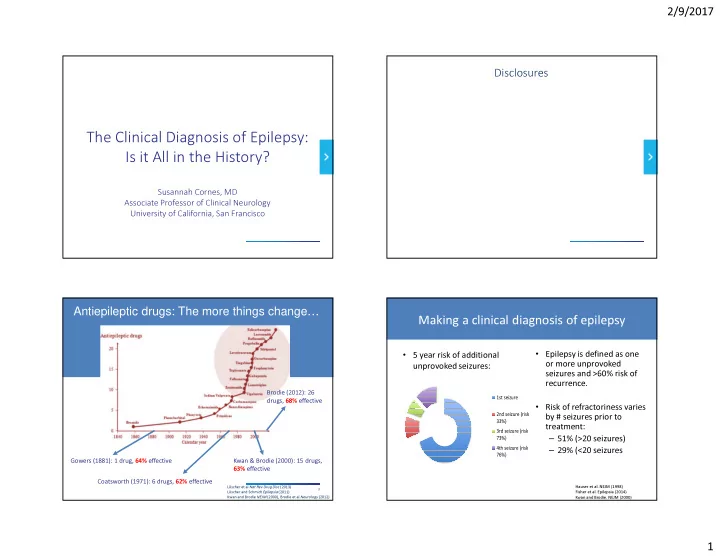
Disclosures Antiepileptic drugs: The more things change…

3 Löscher et al Nat Rev Drug Disc (2013) Löscher and Schmidt Epilepsia(2011) Kwan and Brodie NEJM (2000), Brodie et al Neurology (2012)

Gowers (1881): 1 drug, 64% effective Coatsworth (1971): 6 drugs, 62% effective Kwan & Brodie (2000): 15 drugs, 63% effective Brodie (2012): 26 drugs, 68% effective

Hauser et al. NEJM (1998) Fisher et al. Epilepsia (2014) Kwan and Brodie. NEJM (2000)

Making a clinical diagnosis of epilepsy

  • Epilepsy is defined as one
  • r more unprovoked

seizures and >60% risk of recurrence.

  • Risk of refractoriness varies

by # seizures prior to treatment: – 51% (>20 seizures) – 29% (<20 seizures

  • 5 year risk of additional

unprovoked seizures:

5 year seizure risk a er first unprovoked seizure

1st seizure 2nd seizure (risk 33%) 3rd seizure (risk 73%) 4th seizure (risk 76%)

slide-2
SLIDE 2

2/9/2017 2

“The smartest neurologist is the last neurologist to see the patient.”

  • Bob Fishman

Is there a delay to diagnosis?

Case 1: 56yo RH M with history of episodes of a rising sensation from his stomach and a false presence presented to the ER w/ paresthesias, nausea and “weird neuro sx’s.” Diagnosed with gastroenteritis.

  • “…hears a familiar but

incomprehensible voice associated with a mental image of a vaguely familiar man…”

  • Almost like a memory.
  • Entirely stereotyped.
  • EEG normal.

R hippocampal FLAIR hyperintensity resolves revealing asymmetric atrophy. 10/15 1/16

Case 2: 30yo RH M p/w first GTC 1/16 with R head turn. History of “dizzy spells…really hard to describe,” but like a head rush and increased with lack of sleep. Believed related to fatigue. No AEDs pending EEG and MRI.

  • Minor injuries following

second GTC 4/16.

  • Further history reveals

same feeling prior to both larger events.

  • EEG normal.

Left Mesial Temporal Sclerosis

Case 3: 45 yo RH M s/p AVM rupture 9/11 presented with first GTC 9/16 preceded by L visual change. History of episodes of “tuning into odd frequencies” or “digital sounds” and appearance of “steam rising” in L visual field every 1 – 3 months. Believed to be migraine.

Right temporal encephalomalacia. Right temporal slowing and breach.

slide-3
SLIDE 3

2/9/2017 3

Hippocrates on Aura

“[The people who] are habituated to their disease have a presentiment when an attack is imminent, and run away from men, home, if their house be near, if not, to the most deserted spot, where the fewest people will see the fall, and immediately hide their heads. This is the result of shame at their malady, and not, as the many hold, of fear of the divine.”

  • Hippocrate. De la maladie sacree, livre 6.

Galen on Aura

“…visited a 13 year-old boy. The patient told them that the condition originated in the lower leg, and that ‘from here it climbed upwards in a straight line through the thigh and further through the flank and side to the neck and as far as the head; but as soon as it had touched the latter he was no longer able to follow’…like a cold breeze.”

  • Temkin. The Falling Sickness: A History of Epilepsy from the Greeks to the Beginning of Modern Neurology

How far we’ve come? Pitfalls of Epilepsy Self-Diagnosis

Pitfalls of Epilepsy Self-Diagnosis

slide-4
SLIDE 4

2/9/2017 4

How far we’ve come?

www.Epilepsy.com

I know exactly what you are going through. I have had the intense Deja Vu feeling for 15 years and almost black out. Sometimes I hear music and sometimes I lose my memory after… I had told my doctor about this feeling and he just laughed, but it wasn't until I was rushed by ambulance to an emergency room that they suggested I go see a

  • neurologist. Maybe you should do the same.

I believe auras are also simple partial seizures, and what happens after is complex partial or beyond. But they are only called auras, if something happens after them like a grand mal or complex partial. With me, it seems my auras (which are generally depersonlization) might be a migraine variant function, but while having an EEG and having what I believed to be an aura at the time, it showed up as epileptic activity. So I don't know! hahaha.

So if everyone thinks the auras are seizures if I have these symptoms all the time does that mean I have the seizures all the time???

Re: Are auras actually seizures? Or are they just “warnings”?

What is HEP?

  • A multicenter prospective observational study of

patients with newly treated focal epilepsy

  • Goal: identify biomarkers of drug resistance, disease

progression, and comorbidity development

  • Methods

– Electronic seizure diaries – Annual visits with blood and urine collection – Mood and cognitive assessments – MRI and EEG

  • Currently 300 enrolled globally (30 at UCSF)

What is HEP?

  • Inclusion/Exclusion Criteria

– Age 12-60 – High suspicion for focal epilepsy (not IGE) – At least 1 seizure in past 12 months – Must be on an AED, but for less than 4 months – No big or progressive lesions (e.g. severe TBI, tumors) – No major psychiatric or medical comorbidities (e.g. autism, substance abuse, HIV, CKD, etc)

  • If you have a potential candidate, email:

manu.hegde@ucsf.edu

  • Visit www.humanepilepsyproject.org for more info

Time to treatment and seizure count by initial seizure type

# of pts 1st seizure to tx (days) 2nd seizure to tx (days) Total seizures to tx Seizure type median mean range median mean range median mean range 1st & 2nd SGTC. 64 76 224 0–2803 4 100

  • 119–

2346 2 6 1–133 1st SGTC &. 2nd non- SGTC. 17 510 768 8–3347 192 393 4–1685 7 61 2–571 CPS. 76 272 897 0–9340 233 817

  • 41–9309

17 128 1–5322 SPS. 74 450 1691 1–15798 399 1617 0–15798 27 215 2–5362

slide-5
SLIDE 5

2/9/2017 5

47 5 3 7 2 17

1st & 2nd seizures SGTC

No delay Delay PU DU ED UNK 6 6 1 1 3 11

Initial SGTC then non-GTC

No delay Delay PU DU PU/DU UNK 17 27 15 5 8 4 59

1st seizure CPS

No delay Delay PU DU ED PU/DU UNK 8 40 9 4 9 4 66

1st seizure SPS

No delay Delay PU DU ED PU/DU UNK

Reasons for delay to treatment

Case 4: 29yo RH W with FH of epilepsy p/w intermittent “vivid flashbacks” with increasing frequency for which referred by PMD for epilepsy evaluation. Epilepsy diagnosed and AED recommended. Patient elected to obtain EEG and MRI results prior.

  • MRI normal.
  • EEG normal.
  • At follow-up, began Lamotrigine and titrated

to XR 200mg nightly.

  • No additional auras….

Take home points

  • The delay to diagnosis varies according to the seizure type.
  • Patients and physicians have a hard time identifying the

symptoms of aura or SPS.

  • Delay may have broad consequences (morbidity, mortality,

refractoriness, risks of incorrect treatments, loss of work etc…)

  • Be vigilant about seizure symptoms, including-

– Typical aura symptoms (including nausea, deja vu) – Stereotyped symptoms in patient with first GTC or known lesion

  • Educate our patients and colleagues to do the same.

Acknowledgements

20

UCSF Epilepsy Center

Dan Lowenstein, MD Paul Garcia, MD Robert Knowlton, MD Heidi Kirsch, MD Tina Shih, MD Susannah Cornes, MD Manu Hegde, MD, PhD Maritza Lopez, RN Edward Chang, MD Mariann Ward, NP

UCSF Epilepsy Center

Dan Lowenstein, MD Manu Hegde, MD, PhD Stacey Balter Rachel Hennessy Jacqueline French, MD Sheryl Haut, MD John Hixson, MD Kamil Detyniecki, MD HEP Investigators