
SLIDE 1
Epilepsy & CBD
The Chain Ganglion: Andre H, Danna O, Emma W
Epilepsy & CBD The Chain Ganglion: Andre H, Danna O, Emma W - - PowerPoint PPT Presentation
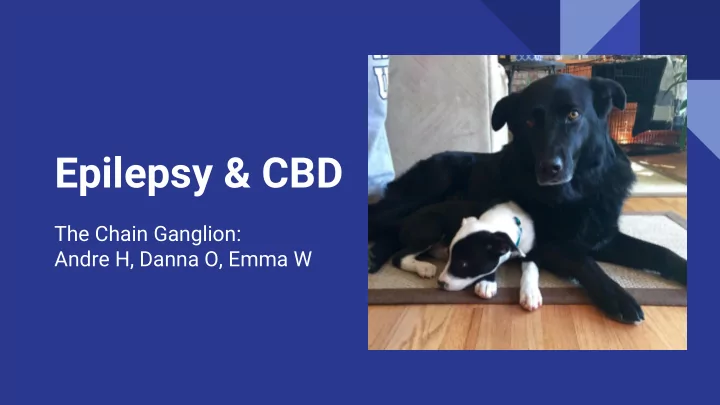
Epilepsy & CBD The Chain Ganglion: Andre H, Danna O, Emma W Meet Bubba! Bubba is a 7 year old German Shepherd mix. He loves long walks, dinner time, chewable sticks, and also Danna ...he is epileptic! Idiopathic epilepsy
The Chain Ganglion: Andre H, Danna O, Emma W
Bubba is a 7 year old German Shepherd mix. He loves long walks, dinner time, chewable sticks, and also…
Danna
○ ~60% of epilepsy is idiopathic
Phenobarbital
seizures approximately every 2 weeks, which was much more frequent than we had been told to expect.
After a few months of the frequent seizures, we decided to start him on CBD and he improved almost immediately.
(every 14-16 weeks)
medications
○ Huge benefit because traditional epilepsy medications are hard on the liver
○ The Hammurabi Code (1780 BC) limited the rights of epileptics (marriage, oaths, as slaves); the hand of sin ○ Christian perspective of possession; infection through breath
○ People with epilepsy were forbidden to marry in 17 states, until 1956 ○ Last state repealed in 1980
Emma
unpredictable seizures. These seizures can take place without identifiable cause. A cause can only be found in about 1 in 100 people
children
no guarantee how long one may last, this can sometimes lead broken bones and other physical injuries
Andre
○ Used to record electrical activity on skull with 21 electrodes ○ Under normal conditions EEG activity in the brain will be low, but depending on the severity of the seizure the activity gets much bigger and more frequent
○ MRI and CT may be used to find location
○ PET scans may be used to examine blood flow
The majority of epilepsy is de novo and idiopathic. Acquired epilepsy often has an identifiable cause.
Andre
○ Allows Cl⁻ into the cell and K⁺ out of the cell causing hyperpolarization ○ GABAₐ ligand gated ion channel and GABAb a GPCR
○ Increase membrane permeability for Ca, Na, K ○ AMPA receptors, NMDA receptors, and metabotropic glutamate receptors
change inhibitory/excitatory balance
Emma
Top: GABAa receptors in brain Middle: AMPA receptors in brain Bottom: NMDA receptors in brain
spread and become a generalized seizure.
○ Simple focal ○ Complex focal
type of epilepsy, starting in one area and spreading across the entire brain.
○ Tonic-clonic (grand mal) ○ Absence (petit mal) ○ Myoclonic ○ Atonic
Seizures >5 minutes, and results in 42,000 deaths per year in the US.
Andre ç
While triggers may induce seizure, they do NOT cause epilepsy
Danna
MANY genetic markers of epilepsy exist, often indicating dysfunction of channels (channelopathies). General themes include:
A number of these genes are implicated in other disorders, and are related to other genes involving channel subunits. Different mutations can cause different types of epilepsy.
Danna
Involved in the formation of Nav1.1 sodium channel (alpha subunit) Implicated in febrile seizures, Dravet syndrome, and generalized tonic-clonic seizures The type of mutation can determine the severity, ranging from febrile seizures to Dravet syndrome (Severe Myoclonic Epilepsy of Infancy)
Danna
SCN1A is very highly connected to many other genes which also code different protein subunits of sodium
well established in a variety of methods.
(CALM2 is Calmodulin 2, which mediates a large number of enzymes, ion channels, aquaporins and other proteins by Ca2+)
Danna
It’s related with high confidence to a number of genes apart from sodium channels, including other markers of epilepsy like KCNN2 and nitric oxide synthases (which play a controversial role, seeming that overexpression of NOS is common in patients with epileptic history)
Danna
Danna
○ Herbs ○ Surgery ■ Very invasive ■ Split brain surgery, temporal lobe surgery (patient HM), hemispherectomy ■ Large and variable side effects
○ Anticonvulsants ■ Work to increase GABA action, as Na+ channel blockers, and/or Ca2+ channel blockers ■ Going off medication can make seizures worse ○ Keto Diet ○ Biofeedback ○ Counterstimulation ○ Cannabidiol
Emma
epilepsy, oxidative injury, vomiting, and more. Epilepsy occurs when a flood of excitation creates incessant and abnormal firing
the brain stable by keeping neurotransmitter levels balanced.
Andre
Andre
CBD may affect epilepsy through a variety of mechanisms. Some of the pathways may be more direct effects of CBD on receptors and signaling, while others may be indirect mechanisms. Potential mechanisms include:
○ Via 5HT1A serotonergic autoreceptors?
○ Attenuates synaptic transmission ○ Induction of long term depression
○ Anxiolytic properties ○ Improved sleep ○ Hormonal repression
○ Anxiety, depression, migraine, bipolar, Alzheimer’s
Danna
○ 5HT1A receptors are GPCRs
○ CB1 receptors are located mostly throughout the brain ○ CB2 receptors are located in the spleen and in other immune cells
5HT1A receptor (above) and its locations throughout the brain (left)
Emma
Cannabidiol also exerts an inhibitory effect on a variety of cytochrome p450 enzymes. This is an important consideration in thinking about the effect of CBD in tandem with other medications as it may change drug metabolism.
medications, making lower doses more effective?
Danna
CBD is a weak antagonist or negative allosteric modulator at CB1 and a weak agonist at CB2, however it also inhibits the reuptake and breakdown of anandamide, an endogenous cannabinoid which does activate CB receptors. CB1 receptors are prevalent in the CNS, and the relevant effects of their activation may include:
Danna
not ‘no data’)
Image credit: Allen Institute.
Danna
medication ever approved by the FDA
the treatment at the meeting on April 19th, 2018
June of this year
○ Conducted three studies ○ Positive results from all three
Danna
a purified and regulated source
completed or unavailable trials, however none of them have any results posted here.
committee hearing
some information on cannabidiol
○ A negative allosteric modulator of the CB1 receptor, the most abundant GPCR in the body ○ Activation of 5HT1A serotonergic receptors ○ Antagonizes alpha adrenergic receptors and mu opioid receptors
Danna
From the GW Pharmaceuticals website:
“the exact MOA by which CBD produces its anticonvulsant effects is unknown. Cannabidiol is a structurally novel anti-
not limited to neuronal inhibition (synaptic and extrasynaptic GABA channels), modulation of intracellular calcium (TRPV, VDAC, GPR55), and possible anti-inflammatory effects (adenosine). CBD does not directly bind to, nor activate, CB1 and CB2 receptors at concentrations pharmacologically relevant to its anticonvulsant effect.”
The label use is for epileptic conditions which are severe and treatment resistant, although the introduction of this product in to the market introduces the possibility for off-label prescriptions and increased interest in CBD products.
Danna
GW Pharmaceuticals conducted a study to determine if cannabis had any effect
Epidiolex was used during this study. (99% CBD) ❏ Results:
Emma
Through the Entourage Effect!
Refers to the potentiating effects of endocannabinoid metabolic byproducts on endocannabinoid function at CB1Rs and CB2Rs
○ The combined effects of compounds found in phytocannabinoids is greater than each compounds effect individually ○ CBD combined with THC, tetrahydrocannabivarin, cannabigerol, cannabichromene, and terpenes
Emma
○ CBD has a low affinity at CB receptors while THC has a much higher affinity ○ The use of dual pathways may contribute to the mechanism of the entourage effect
○ Considered safe by FDA ○ Β-caryophyllene found in pepper, cinnamon, and other spices ■ Selectively binds to CB2 receptor acting as an agonist
efficacy
Emma
It has been documented that increases in estrogen can induce seizures in epileptic patients.
abnormally elevated. CBD shown to reduce estrogen levels
○ Impacts both estrogen and progesterone
A theory: CBD may indirectly repress BDNF, thereby decreasing hormonally-triggered seizure?
Danna
the (female) HPG axis Depicts only THC effects on the system
effects on both the hypothalamus and anterior pituitary
estrogen’s role in a variety of neural processes
Danna
Brentz, 2016 Scharfman and MacLusky, 2006
○ In many forms of epilepsy, seizures originate in the medial temporal lobe, an area that includes the hippocampus. General seizures continue to spread across the entire brain
hippocampal in vitro through 5HT1A activation and indirect CB1 activation
○ Agonist at 5HT1A ■ Inhibits Cav3 subfamily of calcium channels ■ Modulates intracellular calcium levels ○ Weak antagonist at CB1 ○ Weak inverse agonist at CB2
Danna
potential frequency in cultured hippocampal neurons
○ CBD was without effect on the resting membrane potential at all concentrations tested ○ Effects through Gαi GPCRs ○ Direct activation of 5HT1A receptors + indirect activation of CB1 receptors (via anandamide) ○ 5HT1A receptor antagonism shown to block anxiolytic effects of CBD
Danna
(A) CBD reduces firing frequency in dose-dependent manner (B) CBD inhibited AP frequency more than CB receptor agonists, and effect was diminished by Pertussis toxin, which is a Gαi protein uncoupler.
Danna
seizures
trigger anxiety
○ Treatment with CBD doses of 2.5, 5.0 and 10.0 mg/kg significantly increased the entry ratio (open/total number
○ This increase is seen as CBD working as an anxiolytic ○ CBD at a dose of 20.0 mg/kg was no longer effective ○ None of the doses of CBD used changed total number of entries instead the raito to open arms ■ Change in entries would indicate change in exploratory effect
Emma
Campos and Guimarães, 2008
cell bodies of serotonergic neurons. Its activation attenuates neural firing.
○ CBD is an agonist at 5HT1A ■ Suggested mechanism by which it mediates anxiolytic properties ○ Cannula aimed at dlPAG with CBD solution in elevated plus maze ○ 5HT1A receptor antagonism blocks anxiolytic effects of CBD ○ CB1 antagonism produced no effect on anxiety
Way = 5HT1A antagonist With CBD exploratory behavior was increased, Way abolished anxiolytic properties Danna
As time passes, CBD will probably be more thoroughly explored in a number of other disorders with related mechanisms. On the other hand, cannabis use (though not CBD specifically) has been implicated in schizophrenia and psychotic disorders in at-risk individuals
Danna
A number of these disorders being treated with CBD share genetic markers in common with epilepsy! For example: SCN1A, ATP1A2, CACNA1A: epilepsy, migraine, bipolar
seizures
surrounding nerve cells
○ Clump together to form plaques ○ Block cell signaling and result in immune response
Alzheimer's
more harmful due to their ability to move throughout the brain to cause more damage
Emma
A
B C A) 𝛄 amyloid B) 𝛄 amyloid plaques C) oligomers
inhibit Amyloid precursor protein
mice injected with Aβ. iNOS and IL-1β expression and release were inhibited
○ Limited conclusions can be made due to the small amount of research done
Interactions between 5Ht1a and Amyloid precursor protein
Emma
○ Many different factors to consider (strains, ratios, etc)
○ Especially in states where marijuana is still criminalized ○ 3rd party testing is important
○ Liver enzyme inhibitor, changes the appropriate dose of other drugs
○ CBD seems to act on many different areas of the brain and body ○ Potential unintended consequences such as decreased fertility
Danna
adequately manage epilepsy.
helps prevent the metabolism and reuptake of endogenous cannabinoids
○ Could be many different mechanisms: reducing effects of epileptic triggers and/or changing neuronal excitability
suggested efficacy of CBD in many of them
controlled, severe, and treatment resistant forms of epilepsy
Danna
Sontheimer, H. (2015). Diseases of the nervous system. Academic Press. Epilepsy Ontario, epilepsyontario.org/about-epilepsy/types-of-seizures/. (2003), The History and Stigma of Epilepsy. Epilepsia, 44: 12-14. doi:10.1046/j.1528-1157.44.s.6.2.x http://www.genecards.org/cgi-bin/carddisp.pl?gene=SCN1A Faradji, H., Rousset, C., Debilly, G., Vergnes, M., & Cespuglio, R. (2000). Sleep and epilepsy: a key role for nitric oxide?. Epilepsia, 41(7), 794-801. Zhu, W., Su, J., Liu, J., & Jiang, C. (2015). The involvement of neuronal nitric oxide synthase in the anti-epileptic action of curcumin on pentylenetetrazol-kindled
https://patentimages.storage.googleapis.com/12/39/9c/b41a14e424b241/US9474726.pdf https://www.drugbank.ca/drugs/DB09061 Rosenberg, E. C., Tsien, R. W., Whalley, B. J., & Devinsky, O. (2015). Cannabinoids and epilepsy. Neurotherapeutics, 12(4), 747-768. Fine, P. G., & Rosenfeld, M. J. (2013). The endocannabinoid system, cannabinoids, and pain. Rambam Maimonides medical journal, 4(4). Bauer, J. (2001). Interactions between hormones and epilepsy in female patients. Epilepsia, 42(s3), 20-22. Cai, X., Shi, X., Zhang, X., Zhang, A., Zheng, M., & Fang, Y. (2017). The association between brain-derived neurotrophic factor gene polymorphism and migraine: a meta-analysis. The journal of headache and pain, 18(1), 13. Fischer, M., Wille, G., Klien, S., Shanib, H., Holle, D., Gaul, C., & Broessner, G. (2012). Brain-derived neurotrophic factor in primary headaches. The journal of headache and pain, 13(6), 469-475. Brents, L. K. (2016). Marijuana, the Endocannabinoid System and the Female Reproductive System. The Yale Journal of Biology and Medicine, 89(2), 175–191. Kellert, B. A., Nguyen, M. C., Nguyen, C., Nguyen, Q. H., & Wagner, E. J. (2009). Estrogen rapidly attenuates cannabinoid-induced changes in energy
Guimarães, F. S., Chiaretti, T. M., Graeff, F. G., & Zuardi, A. W. (1990). Antianxiety effect of cannabidiol in the elevated plus-maze. Psychopharmacology, 100(4), 558-559. Scuderi, C., Steardo, L., & Esposito, G. (2014). Cannabidiol promotes amyloid precursor protein ubiquitination and reduction of beta amyloid expression in SHSY5YAPP+ cells through PPARγ involvement. Phytotherapy research, 28(7), 1007-1013.
Emma
Ashton, C. H., Moore, P. B., Gallagher, P., & Young, A. H. (2005). Cannabinoids in bipolar affective disorder: a review and discussion of their therapeutic potential. Journal of Psychopharmacology, 19(3), 293–300. https://doi.org/10.1177/0269881105051541 Brents, L. K. (2016). Marijuana, the Endocannabinoid System and the Female Reproductive System. The Yale Journal of Biology and Medicine, 89(2), 175–191. Campos, A. C., Brant, F., Miranda, A. S., Machado, F. S., & Teixeira, A. L. (2015). Cannabidiol increases survival and promotes rescue of cognitive function in a murine model of cerebral malaria. Neuroscience, 289, 166–180. https://doi.org/10.1016/j.neuroscience.2014.12.051 Campos, A. C., & Guimarães, F. S. (2008). Involvement of 5HT1A receptors in the anxiolytic-like effects of cannabidiol injected into the dorsolateral periaqueductal gray of rats. Psychopharmacology, 199(2), 223. https://doi.org/10.1007/s00213-008-1168-x D’Souza, D. C., Pittman, B., Perry, E., & Simen, A. (2009). Preliminary evidence of cannabinoid effects on brain-derived neurotrophic factor (BDNF) levels in humans. Psychopharmacology, 202(4), 569–578. https://doi.org/10.1007/s00213-008-1333-2 Escamilla, M. A., & Zavala, J. M. (2008). Genetics of bipolar disorder. Dialogues in Clinical Neuroscience, 10(2), 141–152. Freund, T. F., Katona, I., & Piomelli, D. (2003). Role of Endogenous Cannabinoids in Synaptic Signaling. Physiological Reviews, 83(3), 1017–1066. https://doi.org/10.1152/physrev.00004.2003 González-Hernández, T., García-Marín, V., Pérez-Delgado, M. M., González-González, M. L., Rancel-Torres, N., & González-Feria, L. (2000). Nitric oxide synthase expression in the cerebral cortex of patients with epilepsy. Epilepsia, 41(10), 1259–1268. Guo, J., & Ikeda, S. R. (2004). Endocannabinoids Modulate N-Type Calcium Channels and G-Protein-Coupled Inwardly Rectifying Potassium Channels via CB1 Cannabinoid Receptors Heterologously Expressed in Mammalian Neurons. Molecular Pharmacology, 65(3), 665–674. https://doi.org/10.1124/mol.65.3.665 GW Pharmaceuticals. (2016, September 21). For Patients. Retrieved April 23, 2018, from https://www.gwpharm.com/epilepsy-patients- caregivers/patients
Danna
GW Pharmaceuticals. (n.d.). Search of: epidiolex - List Results - ClinicalTrials.gov. Retrieved April 23, 2018, from https://clinicaltrials.gov/ct2/results?cond=&term=epidiolex&cntry=&state=&city=&dist= Hill, M. N., McLaughlin, R. J., Bingham, B., Shrestha, L., Lee, T. T. Y., Gray, J. M., … Viau, V. (2010). Endogenous cannabinoid signaling is essential for stress adaptation. Proceedings of the National Academy of Sciences, 107(20), 9406–9411. https://doi.org/10.1073/pnas.0914661107 Holland, J., Doughty, R., Agius, M., & Zaman, R. (2012). Bipolar disorder, migraine and epilepsy - a shared pathogenesis? European Psychiatry, 27(1), 1. Kegel, M. (2017, January 23). Epilepsy in Mice Triggered by Low Levels of Protein in Bipolar Disorder. Retrieved April 23, 2018, from https://epilepsynewstoday.com/2017/01/23/low-levels-of-protein-in-bipolar-disorder-triggers-epilepsy-in-mice/ Kellert, B. A., Nguyen, M. C., Nguyen, C., Nguyen, Q. H., & Wagner, E. J. (2009). Estrogen rapidly attenuates cannabinoid-induced changes in energy
Kondratieva, N., Azimova, J., Skorobogatykh, K., Sergeev, A., Naumova, E., Kokaeva, Z., … Klimov, E. (2016). Biomarkers of migraine: Part 1 – Genetic
Ledgerwood, C., Greenwood, S., Brett, R., Pratt, J., & Bushell, T. (2011). Cannabidiol inhibits synaptic transmission in rat hippocampal cultures and slices via multiple receptor pathways. British Journal of Pharmacology, 162(1), 286–294. https://doi.org/10.1111/j.1476-5381.2010.01015.x Perrone, M. (2018, April 20). Marijuana-Based Drug Gets Positive FDA Review. Retrieved April 23, 2018, from https://uw- media.usatoday.com/video/embed/33937755?sitelabel=reimagine&continuousplay=true&placement=uw- smallarticleattophtml5&keywords=epilepsy%2Cfear%2Coverall-negative%2Cdisease%2Cmarijuana%2Cus-food-and-drug- administration&simpleTarget=Chevron_Environment&simpleExclusion=&pagetype=story Pollack, A. (2018, April 20). Marijuana-Based Drug Found to Reduce Epileptic Seizures. The New York Times. Retrieved from https://www.nytimes.com/2016/03/15/business/marijuana-based-drug-found-to-reduce-epileptic-seizures.html
Danna
Puente, N., Cui, Y., Lassalle, O., Lafourcade, M., Georges, F., Venance, L., … Manzoni, O. J. (n.d.). Polymodal activation of the endocannabinoid system in the extended amygdala - ProQuest. Retrieved April 26, 2018, from https://search-proquest- com.colorado.idm.oclc.org/docview/926187758?pq-origsite=summon Rogawski, M. A. (2012). Migraine and Epilepsy—Shared Mechanisms within the Family of Episodic Disorders. In J. L. Noebels, M. Avoli, M. A. Rogawski, R. W. Olsen, & A. V. Delgado-Escueta (Eds.), Jasper’s Basic Mechanisms of the Epilepsies (4th ed.). Bethesda (MD): National Center for Biotechnology Information (US). Retrieved from http://www.ncbi.nlm.nih.gov/books/NBK98193/ Scharfman, H. E. (2005). Brain-derived Neurotrophic Factor and Epilepsy—A Missing Link? Epilepsy Currents, 5(3), 83. https://doi.org/10.1111/j.1535-7511.2005.05312.x Scharfman, H. E., & MacLusky, N. J. (2006). Estrogen and brain-derived neurotrophic factor (BDNF) in hippocampus: Complexity of steroid hormone- growth factor interactions in the adult CNS. Frontiers in Neuroendocrinology, 27(4), 415–435. https://doi.org/10.1016/j.yfrne.2006.09.004 Seidenberg, M., Pulsipher, D. T., & Hermann, B. (2009). Association of epilepsy and comorbid conditions. Future Neurology, 4(5), 663–668. https://doi.org/10.2217/fnl.09.32 Twitchell, W., Brown, S., & Mackie, K. (1997). Cannabinoids Inhibit N- and P/Q-Type Calcium Channels in Cultured Rat Hippocampal Neurons. Journal
NRSC 4072 Vigers class slides
Danna