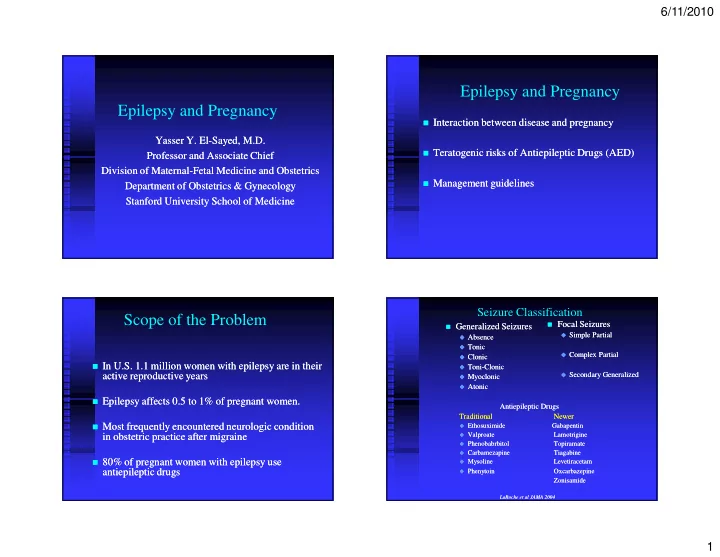
Epilepsy and Pregnancy Epilepsy and Pregnancy Interaction between - - PowerPoint PPT Presentation

epilepsy and pregnancy epilepsy and pregnancy
SMART_READER_LITE
LIVE PREVIEW

Epilepsy and Pregnancy Epilepsy and Pregnancy Interaction between - - PowerPoint PPT Presentation

6/11/2010 Epilepsy and Pregnancy Epilepsy and Pregnancy Interaction between disease and pregnancy Interaction between disease and pregnancy Yasser Y. El Yasser Y. El-Sayed, M.D. Sayed, M.D. Teratogenic risks of Antiepileptic Drugs


slide-1
SLIDE 1

6/11/2010 1

Epilepsy and Pregnancy

Yasser Y. El Yasser Y. El-Sayed, M.D. Sayed, M.D. Professor and Associate Chief Professor and Associate Chief Division of Maternal Division of Maternal-Fetal Medicine and Obstetrics Fetal Medicine and Obstetrics Department of Obstetrics & Gynecology Department of Obstetrics & Gynecology Stanford University School of Medicine Stanford University School of Medicine

Epilepsy and Pregnancy

  • Interaction between disease and pregnancy

Interaction between disease and pregnancy

  • Teratogenic risks of Antiepileptic Drugs (AED)

Teratogenic risks of Antiepileptic Drugs (AED)

  • Management guidelines

Management guidelines

Scope of the Problem

  • In U.S. 1.1 million women with epilepsy are in their

In U.S. 1.1 million women with epilepsy are in their active reproductive years active reproductive years

  • Epilepsy affects 0.5 to 1% of pregnant women.

Epilepsy affects 0.5 to 1% of pregnant women.

  • Most frequently encountered neurologic condition

Most frequently encountered neurologic condition in obstetric practice after migraine in obstetric practice after migraine

  • 80% of pregnant women with epilepsy use

80% of pregnant women with epilepsy use antiepileptic drugs antiepileptic drugs

Seizure Classification

  • Generalized Seizures

Generalized Seizures

  • Absence

Absence

  • Tonic

Tonic

  • Clonic

Clonic

  • Toni

Toni-

  • Clonic

Clonic

  • Myoclonic

Myoclonic

  • Atonic

Atonic Antiepileptic Drugs Antiepileptic Drugs Traditional Traditional Newer Newer

  • Ethosuximide

Ethosuximide Gabapentin Gabapentin

  • Valproate

Valproate Lamotrigine Lamotrigine

  • Phenobabrbitol

Phenobabrbitol Topiramate Topiramate

  • Carbamezapine

Carbamezapine Tiagabine Tiagabine

  • Mysoline

Mysoline Levetiracetam Levetiracetam

  • Phenytoin

Phenytoin Oxcarbazepine Oxcarbazepine Zonisamide Zonisamide

LaRoche et al JAMA 2004 LaRoche et al JAMA 2004

  • Focal Seizures

Focal Seizures

  • Simple Partial

Simple Partial

  • Complex Partial

Complex Partial

  • Secondary Generalized

Secondary Generalized

slide-2
SLIDE 2

6/11/2010 2

  • Older reports: up to 75% of women experience

Older reports: up to 75% of women experience increased seizure frequency increased seizure frequency

  • Recent reports: 15% of experience reduced

Recent reports: 15% of experience reduced seizure control seizure control

  • Possible risk factor: High seizure frequency

Possible risk factor: High seizure frequency antedating pregnancy antedating pregnancy

Contributing Factors

  • High levels of estrogen

High levels of estrogen

  • Increased nausea and vomiting

Increased nausea and vomiting

  • Changes in plasma volume

Changes in plasma volume

  • Altered gastric motility

Altered gastric motility

  • Altered protein binding

Altered protein binding

  • Increased metabolic capacity of the maternal liver

Increased metabolic capacity of the maternal liver

  • Placental/Fetal Metabolism

Placental/Fetal Metabolism

  • Poor compliance

Poor compliance

  • Increased life stressors

Increased life stressors

Seizures in Pregnancy

  • Profound alterations in maternal acid

Profound alterations in maternal acid-base base equilibrium with grand mal seizure equilibrium with grand mal seizure

  • Maternal serum lactate concentration may

Maternal serum lactate concentration may rise 10 fold, pH drop as low as 6.9 rise 10 fold, pH drop as low as 6.9

  • Changes in maternal acid

Changes in maternal acid-base equilibrium base equilibrium rapidly mediated through placenta to fetus rapidly mediated through placenta to fetus

  • Tonic

Tonic-clonic convulsion clonic convulsion

  • Blood pressure elevated

Blood pressure elevated

  • Redistribution of blood flow to brain and

Redistribution of blood flow to brain and muscles, and away from visceral organs muscles, and away from visceral organs

  • Increased intra

Increased intra-abdominal pressure abdominal pressure reduces uterine circulation further reduces uterine circulation further

slide-3
SLIDE 3

6/11/2010 3

  • Maternal Trauma from Seizure activity

Maternal Trauma from Seizure activity

  • Term with grand mal seizure

Term with grand mal seizure

  • Fracture of left acetabulum

Fracture of left acetabulum

  • Subsequent seizure resulted in right

Subsequent seizure resulted in right acetabular fracture and fracture of left acetabular fracture and fracture of left proximal humerus proximal humerus

Ovesen J et al. Ugeskr Laeger 1998 Ovesen J et al. Ugeskr Laeger 1998

  • Maternal Mortality

Maternal Mortality

  • In U.K. 1985

In U.K. 1985-1999: 1000 deaths from 11 1999: 1000 deaths from 11 million pregnancies million pregnancies

  • 50 of these deaths were to women with epilepsy

50 of these deaths were to women with epilepsy (WWE) (WWE)

  • Most of these deaths seizure related

Most of these deaths seizure related

  • Epilepsy third most common cause of indirect

Epilepsy third most common cause of indirect death in pregnancy (behind cardiac deaths and death in pregnancy (behind cardiac deaths and stroke). stroke).

Barrett and Richens. Epilepsy Research. 2003. Barrett and Richens. Epilepsy Research. 2003.

  • Fetal Consequences

Fetal Consequences

  • Bradycardia

Bradycardia

  • Acidosis

Acidosis

  • Abruption

Abruption

  • Stillbirth

Stillbirth

  • Single brief tonic

Single brief tonic-clonic seizure clonic seizure

  • Depression of fetal heart rate for more than 20

Depression of fetal heart rate for more than 20 minutes minutes

Teramo et al. J. Perinat Med 1979 Teramo et al. J. Perinat Med 1979

  • Complex partial seizure during labor

Complex partial seizure during labor

  • Prolonged uterine contraction and 3.5 minutes

Prolonged uterine contraction and 3.5 minutes fetal bradycardia fetal bradycardia Nei et al. Neurology 1998

Nei et al. Neurology 1998

  • Recurrent maternal epileptic seizures

Recurrent maternal epileptic seizures

  • Fetal intracranial hemorrhage and

Fetal intracranial hemorrhage and hydrocephalus hydrocephalus

Ohba et al. J Mat Ohba et al. J Mat-Fet Invest 1998 Fet Invest 1998

slide-4
SLIDE 4

6/11/2010 4

  • Status Epilepticus

Status Epilepticus

  • One seizure that lasts 30 minutes or more OR a

One seizure that lasts 30 minutes or more OR a series of very closely spaced seizures, without series of very closely spaced seizures, without regaining consciousness regaining consciousness

  • Up to 1.8% incidence in pregnancy

Up to 1.8% incidence in pregnancy

  • 30

30-50% risk of fetal death 50% risk of fetal death

  • Risk of maternal trauma, aspiration, brain

Risk of maternal trauma, aspiration, brain damage and death damage and death

  • Higher incidence during the third trimester

Higher incidence during the third trimester

Epilepsy: Perinatal Complications

  • Preeclampsia

Preeclampsia

  • Maternal hemorrhage

Maternal hemorrhage

  • Placental abruption

Placental abruption

  • Cesarean delivery

Cesarean delivery

  • Preterm delivery

Preterm delivery

  • Intrauterine growth restriction

Intrauterine growth restriction

  • Microcephaly and mental retardation

Microcephaly and mental retardation

  • Congenital malformations

Congenital malformations

  • Perinatal mortality

Perinatal mortality

  • Preeclampsia and hemorrhage double unmatched

Preeclampsia and hemorrhage double unmatched control group, and increased risk of preterm labor control group, and increased risk of preterm labor

Bjerkedal and Bahna. Acta Obstet Gynecol Scand 1973 Bjerkedal and Bahna. Acta Obstet Gynecol Scand 1973

  • Increased risks of stillbirth, microcephaly and

Increased risks of stillbirth, microcephaly and mental retardation mental retardation

Nelson and Ellenberg. Neurology 1982 Nelson and Ellenberg. Neurology 1982

  • 204 births to epileptic mothers to 612 unmatched

204 births to epileptic mothers to 612 unmatched controls controls - 2.8 fold risk low birth weight, 3.7 fold 2.8 fold risk low birth weight, 3.7 fold risk low APGAR scores or asphyxia risk low APGAR scores or asphyxia

Yerby et al. Epilepsia. 1985 Yerby et al. Epilepsia. 1985

  • Population based cohort study in Norway1995

Population based cohort study in Norway1995-2005 2005

  • 2,805 WWE vs. 362,302 without epilepsy

2,805 WWE vs. 362,302 without epilepsy

  • WWE on AED

WWE on AED

  • Mild preeclampsia (1.3

Mild preeclampsia (1.3-2.4) 2.4)

  • Gestational Hypertension (1.0

Gestational Hypertension (1.0-2.2) 2.2)

  • Bleeding (1.1

Bleeding (1.1-3.2) 3.2)

  • PTD <34 weeks (1.1

PTD <34 weeks (1.1-2.0) 2.0)

  • No difference for WWE not on AEDs

No difference for WWE not on AEDs

Borthen et al. BJOG. 2009 Borthen et al. BJOG. 2009

slide-5
SLIDE 5

6/11/2010 5

  • 180 pregnancies in WWE & 150 matched controls

180 pregnancies in WWE & 150 matched controls

  • No difference

No difference

  • Preeclampsia, Preterm labor,Vaginal

Preeclampsia, Preterm labor,Vaginal bleeding, Perinatal mortality bleeding, Perinatal mortality

Hillesma et al. Am J Obstet Gynecol 1985 Hillesma et al. Am J Obstet Gynecol 1985

  • 51 WWE and 50 unmatched controls

51 WWE and 50 unmatched controls

  • No difference

No difference

  • Toxemia, Birth weight, Prematurity

Toxemia, Birth weight, Prematurity

Watson and Spellacy. Obstet Gynecol 1971 Watson and Spellacy. Obstet Gynecol 1971

  • Largely retrospective literature

Largely retrospective literature

  • With or without matched controls

With or without matched controls

  • Pregnancy and birth registry data to identify

Pregnancy and birth registry data to identify pregnancies complicated by epilepsy pregnancies complicated by epilepsy

  • Variable study duration and follow

Variable study duration and follow-up up

  • Variable seizure control

Variable seizure control

  • Limited information on confounding variables

Limited information on confounding variables

  • Maternal age

Maternal age

  • Social status

Social status

  • Genetic background

Genetic background

  • Other diseases or exposures

Other diseases or exposures

  • Women with Epilepsy taking AEDs

Women with Epilepsy taking AEDs

  • No substantially increased risk

No substantially increased risk

  • Cesarean delivery or Abruption

Cesarean delivery or Abruption

  • Possible increased risk

Possible increased risk

  • preterm labor and delivery for epileptic

preterm labor and delivery for epileptic women who smoke women who smoke

  • SGA

SGA

  • Apgar <7 at one minute

Apgar <7 at one minute

Report of the Quality Standards Subcommittee of the American Report of the Quality Standards Subcommittee of the American Academy of Neurology and the American Epilepsy Society 2009 Academy of Neurology and the American Epilepsy Society 2009

Congenital Malformations

  • Perinatal deaths not significantly different in

Perinatal deaths not significantly different in WWE as compared to background WWE as compared to background

  • 5.3% had congenital malformations compared to

5.3% had congenital malformations compared to 1.5% in controls 1.5% in controls

Sabers A et al. Acta Neurol Scand 1998 Sabers A et al. Acta Neurol Scand 1998

  • No difference in pregnancy complications except

No difference in pregnancy complications except for higher cesarean section rate for higher cesarean section rate

  • 2.7 fold increased risk of congenital

2.7 fold increased risk of congenital malformations malformations

Olafsson E et al. Epilepsia 1998 Olafsson E et al. Epilepsia 1998

slide-6
SLIDE 6

6/11/2010 6

  • Malformations in offspring of women with

Malformations in offspring of women with untreated epilepsy not higher than among untreated epilepsy not higher than among nonepileptic controls nonepileptic controls

Fried et al Drug Safety 2004 Fried et al Drug Safety 2004

  • Major malformations in 3.8% of AED exposed

Major malformations in 3.8% of AED exposed fetuses and in 0.8% of unexposed fetuses and in 0.8% of unexposed

  • Major malformations not associated with seizures

Major malformations not associated with seizures in the first trimester in the first trimester

Kaaja et al. Neurology 2003 Kaaja et al. Neurology 2003

  • AED and malformations: First report 1963

AED and malformations: First report 1963

  • Mephenytoin

Mephenytoin

  • microcephaly,

microcephaly,

  • Cleft palate

Cleft palate

  • Speech defect

Speech defect

  • IQ 60

IQ 60

Mullers Mullers-

  • Kuppers,

Kuppers, Acta Paedopsychiatr Acta Paedopsychiatr 1963 1963

Spectrum of Major Malformations

  • Congenital heart disease

Congenital heart disease

  • Cleft lip and palate

Cleft lip and palate

  • Neural tube defects

Neural tube defects

  • Urogenital defects

Urogenital defects

Spectrum of Minor Anomalies

  • Fetal Antiepileptic Drug Syndrome

Fetal Antiepileptic Drug Syndrome

  • Shallow orbits

Shallow orbits

  • Small nose

Small nose

  • Distal phalangeal hypoplasia

Distal phalangeal hypoplasia

  • Overlapping fingers

Overlapping fingers

  • Hypertelorism

Hypertelorism

  • Low set of ears

Low set of ears

  • Flat nasal bridge

Flat nasal bridge

  • Nail hypoplasia

Nail hypoplasia

slide-7
SLIDE 7

6/11/2010 7

Smith’s Recognizable Patterns of Human Malformations, 4 Smith’s Recognizable Patterns of Human Malformations, 4th

th edition

edition

  • 4

4-9% risk of birth defects with AED use 9% risk of birth defects with AED use

  • 2

2-3 times general population risk (2 3 times general population risk (2-3%) 3%)

  • Valproic Acid 6.2

Valproic Acid 6.2 - 11.1% and OR 2.2 11.1% and OR 2.2-12.7 12.7

  • Phenytoin 3.7

Phenytoin 3.7 - 9.1% 9.1%

  • Carbamezapine 2.2

Carbamezapine 2.2 - 5.7% 5.7%

  • Phenobarbital 5.1

Phenobarbital 5.1- 6% 6%

  • Polytherapy 6

Polytherapy 6 - 25% (four or more) 25% (four or more)

  • Not clearly associated with seizure frequency

Not clearly associated with seizure frequency

Kaneko et al. Epilepsy Res. 1999 Kaneko et al. Epilepsy Res. 1999 North American AED Pregnancy Registry Holmes et al 2004 North American AED Pregnancy Registry Holmes et al 2004 UK Epilepsy and Pregnancy Register Morrow et al. 2006 UK Epilepsy and Pregnancy Register Morrow et al. 2006 Jentink et al. NEJM June 2010 Jentink et al. NEJM June 2010

slide-8
SLIDE 8

6/11/2010 8

  • Third Generation New AEDs:

Third Generation New AEDs:

  • Polytherapy, inconsistent pattern malformations

Polytherapy, inconsistent pattern malformations

  • Lamotrigine (n=647) 3.2%

Lamotrigine (n=647) 3.2%

  • Levetiracetam (n=22) 0%

Levetiracetam (n=22) 0%

  • Gabapentin (n=31) 3.2%

Gabapentin (n=31) 3.2% Morrow et al 2006 Morrow et al 2006

  • Oxcarbazepine (n=248) 2.4%

Oxcarbazepine (n=248) 2.4% Montouris 2005 Montouris 2005

  • Lamotrigine

Lamotrigine

  • Earlier reports suggested increased risk, but not

Earlier reports suggested increased risk, but not confirmed: confirmed:

  • International Registry (n=831) 2.8%

International Registry (n=831) 2.8%

  • UK Registry (n= 647) 3.2%

UK Registry (n= 647) 3.2%

  • North American Registry (564) 2.7%

North American Registry (564) 2.7%

  • No association between dose & anomalies

No association between dose & anomalies Cunnington et al. 2007 Cunnington et al. 2007

AEDs and Congenital Malformations

  • If possible avoid valproic acid as part of

If possible avoid valproic acid as part of monotherapy and polytherapy in first trimester monotherapy and polytherapy in first trimester

  • If possible avoid use of polytherapy in first

If possible avoid use of polytherapy in first trimester trimester

  • If possible avoid phenytoin, carbamezapine and

If possible avoid phenytoin, carbamezapine and phenobarbitol in first trimester to reduce risk of phenobarbitol in first trimester to reduce risk of specific major anomalies specific major anomalies

Report of the Quality Standards Subcommittee of the American Report of the Quality Standards Subcommittee of the American Academy of Neurology and the American Epilepsy Society 2009 Academy of Neurology and the American Epilepsy Society 2009

Mechanisms of AED Teratogenesis

  • Reactive oxidative metabolites

Reactive oxidative metabolites

  • Drug bioactivation and reactive oxygen species

Drug bioactivation and reactive oxygen species formation likely occurs within the embryo formation likely occurs within the embryo

  • Bind to nucleic acids in embryo

Bind to nucleic acids in embryo

  • Result in oxidative chromosomal damage and

Result in oxidative chromosomal damage and embryopathies embryopathies

slide-9
SLIDE 9

6/11/2010 9

  • Folate deficiency

Folate deficiency

  • Folate cofactor for methionine synthetase (crucial

Folate cofactor for methionine synthetase (crucial for DNA biosynthesis) for DNA biosynthesis)

  • Processes involving closure of neural tube

Processes involving closure of neural tube involve folic acid involve folic acid

  • AEDs Effect on Folate

AEDs Effect on Folate

  • Displace folate from enzymes

Displace folate from enzymes

  • Block enzymatic reactions in which folate

Block enzymatic reactions in which folate participates participates

  • Increase degradation of folic acid

Increase degradation of folic acid

  • Inhibition of folate synthesis

Inhibition of folate synthesis

  • Decreased intestinal absorption

Decreased intestinal absorption

  • Drug induced embryonic arrhythmia

Drug induced embryonic arrhythmia

  • Blockage of rapid component of delayed

Blockage of rapid component of delayed rectifying K ion current in the embryonic heart rectifying K ion current in the embryonic heart

  • Resultant arrhythmia

Resultant arrhythmia

  • interrupted oxygen supply

interrupted oxygen supply

  • Highly toxic reactive oxygen species in

Highly toxic reactive oxygen species in embryonic tissues during embryonic tissues during reoxygenation/reperfusion phase reoxygenation/reperfusion phase

Intelligence & Psychomotor Development

  • Conflicting results

Conflicting results - parental intelligence, poor psychosocial parental intelligence, poor psychosocial environment confounders environment confounders

  • Cognition probably not reduced if not exposed to AED

Cognition probably not reduced if not exposed to AED

  • Valproic Acid

Valproic Acid probably probably associated associated

  • 6-9 IQ points < compared to lamotrigine, phenytoin, CBZ

9 IQ points < compared to lamotrigine, phenytoin, CBZ

  • Phenobabitol and Phenytoin

Phenobabitol and Phenytoin possibly possibly associated associated

  • Polytherapy appears to be a risk factor

Polytherapy appears to be a risk factor

Report of the Quality Standards Subcommittee of the American Academy of Report of the Quality Standards Subcommittee of the American Academy of Neurology and the American Epilepsy Society 2009 Neurology and the American Epilepsy Society 2009 Meador KJ et al N Engl J Med 2009 Meador KJ et al N Engl J Med 2009

Management of AEDs in Pregnancy

  • Withdrawal of antiepileptic drug therapy

Withdrawal of antiepileptic drug therapy

  • No seizure activity during the past 2

No seizure activity during the past 2-5 years 5 years

  • A single type of seizure

A single type of seizure

  • A normal EEG with treatment

A normal EEG with treatment

  • A normal neurologic exam

A normal neurologic exam

  • Completed 6 months prior to planned

Completed 6 months prior to planned conception conception

slide-10
SLIDE 10

6/11/2010 10

  • Monotherapy

Monotherapy

  • Single most effective drug at minimum

Single most effective drug at minimum effective dose effective dose

  • Successful control in one third of patients

Successful control in one third of patients undergoing polytherapy withdrawal undergoing polytherapy withdrawal

  • 1

1st

st and 2

and 2nd

nd Generation AED

Generation AED – Tomson 1994 Tomson 1994

  • Carbamezapine

Carbamezapine

  • Total fraction decreased by 12% in 3

Total fraction decreased by 12% in 3rd

rd trimester

trimester

  • No change in free levels

No change in free levels

  • Phenytoin

Phenytoin

  • Total fraction decreased by 61% in 3

Total fraction decreased by 61% in 3rd

rd trimester

trimester

  • Free fraction decreased by 18% in 3

Free fraction decreased by 18% in 3rd

rd trimester

trimester

  • No relationship AED level change & clinical effect

No relationship AED level change & clinical effect

  • Phenobarbitol, Valproic Acid, Primidone, Ethosuximide

Phenobarbitol, Valproic Acid, Primidone, Ethosuximide

  • Sufficient monotherapy data not available

Sufficient monotherapy data not available

Report of the Quality Standards Subcommittee 2009 Report of the Quality Standards Subcommittee 2009

  • Third generation AED

Third generation AED

  • Lamotrigine (Pennell 2008)

Lamotrigine (Pennell 2008)

  • Total and free clearance increased ~90%

Total and free clearance increased ~90%

  • 39% increase in seizures

39% increase in seizures

  • Predicted by 65% decline in level

Predicted by 65% decline in level

  • Toxicity postpartum

Toxicity postpartum

  • Oxcarbazepine (Tomson 2007)

Oxcarbazepine (Tomson 2007)

  • Marked decrease in pregnancy

Marked decrease in pregnancy – increased seizures increased seizures

  • Marked increase postpartum

Marked increase postpartum

  • Levetiracetam (Tomson 2007)

Levetiracetam (Tomson 2007)

  • Renal clearance increased in pregnancy

Renal clearance increased in pregnancy

  • 60% reduction in serum levels 3

60% reduction in serum levels 3rd

rd trimester

trimester

  • Gabapentin, Topiramate, Zonisamide

Gabapentin, Topiramate, Zonisamide

  • Limited data in pregnancy

Limited data in pregnancy

Antiepileptic Drug Monitoring in Pregnancy

  • Levels before conception

Levels before conception

  • Beginning of each trimester

Beginning of each trimester

  • Monthly for lamotrigine and oxcarbazepine

Monthly for lamotrigine and oxcarbazepine

  • Last month of pregnancy and through 8th postpartum week

Last month of pregnancy and through 8th postpartum week

  • More closely for lamotrigine and oxcarbazepine

More closely for lamotrigine and oxcarbazepine

  • For older generation AED

For older generation AED

  • Avoid arbitrary increases in drug doses in pregnancy

Avoid arbitrary increases in drug doses in pregnancy

  • Wide variation, poor clinical correlation

Wide variation, poor clinical correlation

  • Increase dose if seizures or marked decline in free fraction

Increase dose if seizures or marked decline in free fraction

  • Avoid high peak levels (3 or 4 divided doses)

Avoid high peak levels (3 or 4 divided doses)

  • If available follow Free Fraction

If available follow Free Fraction

slide-11
SLIDE 11

6/11/2010 11

Folate Supplementation

  • Deficiency strongly associated with increased risk of

Deficiency strongly associated with increased risk of NTDs NTDs

  • Supplementation provides risk reduction ranging

Supplementation provides risk reduction ranging from 60 from 60-100% 100%

  • Supplementation studies not conducted on women

Supplementation studies not conducted on women taking AEDs and efficacy unclear taking AEDs and efficacy unclear

  • Amount of folic acid supplementation extrapolated

Amount of folic acid supplementation extrapolated from general population from general population

  • Pre

Pre-conception folic acid vs. later or none conception folic acid vs. later or none

  • 1935 WWE vs. 2375 WWE

1935 WWE vs. 2375 WWE

  • Pre

Pre-conception folic acid did not reduce conception folic acid did not reduce

  • NTDs, clefts, hypospadias, cardiac defects

NTDs, clefts, hypospadias, cardiac defects Morrow J, 2008 Morrow J, 2008

  • Failure of high dose preconception folic acid to

Failure of high dose preconception folic acid to prevent NTD in patient on Valproate prevent NTD in patient on Valproate Craig J 1999 Craig J 1999

  • The risk of congenital anomalies is possibly

The risk of congenital anomalies is possibly decreased by folic acid supplementation decreased by folic acid supplementation

  • Recommend at least 0.4 mg daily prior to and

Recommend at least 0.4 mg daily prior to and during pregnancy during pregnancy

  • Insufficient data to address protective effect of

Insufficient data to address protective effect of higher doses higher doses

Report of the Quality Standards Subcommittee of the American Report of the Quality Standards Subcommittee of the American Academy of Neurology and the American Epilepsy Society 2009 Academy of Neurology and the American Epilepsy Society 2009

Folate: Current Recommendations

  • U.S. Public Health Service

U.S. Public Health Service

  • 0.4mg/day for all women in U.S. capable

0.4mg/day for all women in U.S. capable

  • f becoming pregnant
  • f becoming pregnant
  • 1996 American College of Obstetricians

1996 American College of Obstetricians and Gynecologists and Gynecologists

  • 4mg/day would “seem appropriate” for

4mg/day would “seem appropriate” for patients taking AEDs patients taking AEDs

slide-12
SLIDE 12

6/11/2010 12

  • Neonatal administration of 1mg IM Vitamin K

Neonatal administration of 1mg IM Vitamin K

  • Antenatal oral supplementation

Antenatal oral supplementation

  • Vitamin K 10mg/day in last month of pregnancy

Vitamin K 10mg/day in last month of pregnancy

  • Reduction in PIVKA

Reduction in PIVKA - decarboxylated forms of decarboxylated forms of Vitamin K dependant coagulation factors Vitamin K dependant coagulation factors

  • No reduction in neonatal hemorrhage

No reduction in neonatal hemorrhage

  • Insufficient evidence to support or refute antenatal

Insufficient evidence to support or refute antenatal Vitamin K Vitamin K

  • Report of the Quality Standards Subcommittee of the American

Report of the Quality Standards Subcommittee of the American Academy of Neurology and the American Epilepsy Society 2009 Academy of Neurology and the American Epilepsy Society 2009

Obstetrical Management

  • Prenatal Diagnosis

Prenatal Diagnosis

  • 18

18-20 week comprehensive ultrasound 20 week comprehensive ultrasound

  • Fetal echocardiography

Fetal echocardiography

  • Serum alpha

Serum alpha-fetoprotein fetoprotein

  • Amniotic fluid alpha

Amniotic fluid alpha-fetoprotein and fetoprotein and acetylcholinesterase level acetylcholinesterase level

  • Antepartum management

Antepartum management

  • Fetal growth ultrasounds

Fetal growth ultrasounds

  • nonstress tests

nonstress tests

  • Doppler studies

Doppler studies

  • AFI

AFI

  • No clear consensus

No clear consensus

  • Individualize care

Individualize care

  • Intrapartum management

Intrapartum management

  • Team approach

Team approach - obstetrics, neurology, anesthesia,

  • bstetrics, neurology, anesthesia,

pediatrics pediatrics

  • A safe and successful vaginal delivery in majority

A safe and successful vaginal delivery in majority

  • f women with epilepsy
  • f women with epilepsy
  • Tonic

Tonic-clonic seizure in labor in 1 clonic seizure in labor in 1-2% of women 2% of women with epilepsy and in another 1 with epilepsy and in another 1-2% up to 24 hours 2% up to 24 hours after delivery after delivery

  • Continue administration of AED

Continue administration of AED - consider consider intravenous or intramuscular administration intravenous or intramuscular administration

slide-13
SLIDE 13

6/11/2010 13

  • Postpartum Management

Postpartum Management

  • AED levels may rise in the immediate

AED levels may rise in the immediate postpartum period postpartum period

  • Dose reduction frequently necessary to avoid

Dose reduction frequently necessary to avoid toxicity toxicity – especially lamotrigine especially lamotrigine

  • Monitor levels at least through the first two

Monitor levels at least through the first two months postpartum months postpartum

AEDs and Breast Feeding

  • AED use is not a contradiction to breast feeding

AED use is not a contradiction to breast feeding

  • Cross into breast milk

Cross into breast milk

  • Greater for primidone, leveretiracetam,

Greater for primidone, leveretiracetam, gabapentin, lamotrigine gabapentin, lamotrigine

  • Neonatal sedation with phenobarbital, primidone,

Neonatal sedation with phenobarbital, primidone, benzodiazepines? benzodiazepines?

  • No controlled studies to support effect

No controlled studies to support effect

Quality Standards Subcommittee of the American Academy of Quality Standards Subcommittee of the American Academy of Neurology and the American Epilepsy Society 2009 Neurology and the American Epilepsy Society 2009

Epilepsy and Pregnancy

  • Cohort study of 414 women with epilepsy

Cohort study of 414 women with epilepsy compared with 81,759 women without compared with 81,759 women without epilepsy epilepsy

  • Single center between 1978

Single center between 1978-2000 2000

  • Consistent treatment and follow up

Consistent treatment and follow up

Richmond et al. Am J Obstet Gynecol 2004 Richmond et al. Am J Obstet Gynecol 2004

  • Prepregnancy counseling

Prepregnancy counseling

  • Preconceptional folic acid 1 mg per day before 1992 and

Preconceptional folic acid 1 mg per day before 1992 and 3.5 mg per day since 1992 3.5 mg per day since 1992

  • AED levels monitored monthly

AED levels monitored monthly

  • Minimum effective AED dose for seizure control

Minimum effective AED dose for seizure control

  • Frequent communication between epileptologist and

Frequent communication between epileptologist and

  • bstetrician
  • bstetrician
  • Infants examined by a neonatologist after birth and by

Infants examined by a neonatologist after birth and by neurogeneticist/epileptologist in first three months of life neurogeneticist/epileptologist in first three months of life

Richmond et al. Am J Obstet Gynecol 2004 Richmond et al. Am J Obstet Gynecol 2004

slide-14
SLIDE 14

6/11/2010 14

  • Screening with serum alpha

Screening with serum alpha-fetoprotein fetoprotein

  • Fetal anatomic survey

Fetal anatomic survey

  • Echocardiography between 20

Echocardiography between 20-22 weeks 22 weeks

  • Growth scan between 30

Growth scan between 30-34 weeks and if 34 weeks and if indicated toward end of third trimester indicated toward end of third trimester

Richmond et al. Am J Obstet Gynecol 2004 Richmond et al. Am J Obstet Gynecol 2004

  • No difference between groups

No difference between groups

  • Preeclampsia

Preeclampsia

  • Eclampsia

Eclampsia

  • GDM

GDM

  • Placental abruption

Placental abruption

  • Preterm delivery

Preterm delivery

  • Stillbirth

Stillbirth

  • Neonatal death

Neonatal death

Richmond et al. Am J Obstet Gynecol 2004 Richmond et al. Am J Obstet Gynecol 2004

  • With Epilepsy, increased rates

With Epilepsy, increased rates

  • nonproteinuric hypertension

nonproteinuric hypertension -11.4% vs. 8.2% 11.4% vs. 8.2%

  • Induction of labor

Induction of labor - 32.6% vs. 20.7% 32.6% vs. 20.7%

  • Cardiac malformations

Cardiac malformations - 2.17% vs. 0.68% 2.17% vs. 0.68%

  • Polytherapy vs. Monotherapy vs. Untreated

Polytherapy vs. Monotherapy vs. Untreated

  • Major anomalies

Major anomalies - 9.1% vs. 6.2% vs. 4.6% 9.1% vs. 6.2% vs. 4.6%

  • Cardiac anomalies

Cardiac anomalies - 3.9% vs. 2.3% vs. 0% 3.9% vs. 2.3% vs. 0%

  • Microcephaly

Microcephaly - 2.6% vs. 0.8% vs. 0% 2.6% vs. 0.8% vs. 0%

Richmond et al. Am J Obstet Gynecol 2004 Richmond et al. Am J Obstet Gynecol 2004

Epilepsy and Pregnancy

“ . . . women with a seizure disorder are not at “ . . . women with a seizure disorder are not at increased risk for obstetric complications, increased risk for obstetric complications, provided appropriate care is available during provided appropriate care is available during preconception, pregnancy, labor, delivery, and preconception, pregnancy, labor, delivery, and after delivery. We can reassure women with after delivery. We can reassure women with epilepsy of a good fetomaternal outcome, epilepsy of a good fetomaternal outcome, comparable to that of the general population, comparable to that of the general population, except with respect to congenital malformations.” except with respect to congenital malformations.”

Richmond et al. Am J Obstet Gynecol 2004 Richmond et al. Am J Obstet Gynecol 2004

slide-15
SLIDE 15

6/11/2010 15

Main Points

  • Partner with a neurologist

Partner with a neurologist

  • Monotherapy

Monotherapy

  • If possible avoid Valproic Acid

If possible avoid Valproic Acid

  • Refer for genetic counseling and prenatal

Refer for genetic counseling and prenatal diagnosis diagnosis

  • Folic acid supplementation

Folic acid supplementation – 4 mg/day 4 mg/day

Main Points

  • Vitamin K

Vitamin K – 10 mg/day in last month? 10 mg/day in last month?

  • Treat patient not plasma drug concentration

Treat patient not plasma drug concentration

  • Exception lamotrigine and oxcarbazepine

Exception lamotrigine and oxcarbazepine

  • Don’t forget to give medicine in labor

Don’t forget to give medicine in labor

  • Breastfeeding is OK

Breastfeeding is OK