Disclosures CHOOSING THE RIGHT I am President of the Epilepsy - - PowerPoint PPT Presentation

disclosures
SMART_READER_LITE
LIVE PREVIEW

Disclosures CHOOSING THE RIGHT I am President of the Epilepsy - - PowerPoint PPT Presentation

2/15/2018 Disclosures CHOOSING THE RIGHT I am President of the Epilepsy Study Consortium. All consulting is done on behalf of the consortium, and fees are paid to the consortium. The NYU Comprehensive Epilepsy Center receives salary


slide-1
SLIDE 1

2/15/2018 1

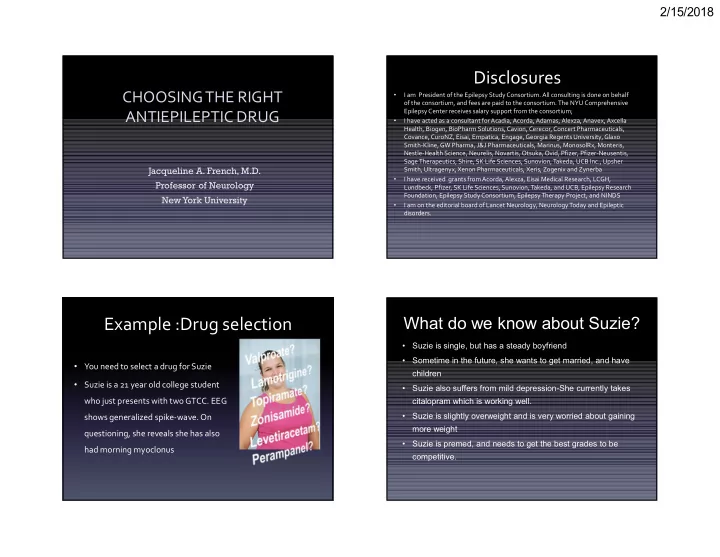
CHOOSING THE RIGHT ANTIEPILEPTIC DRUG

Jacqueline A. French, M.D. Professor of Neurology New York University

Disclosures

  • I am President of the Epilepsy Study Consortium. All consulting is done on behalf
  • f the consortium, and fees are paid to the consortium. The NYU Comprehensive

Epilepsy Center receives salary support from the consortium;

  • I have acted as a consultant for Acadia, Acorda, Adamas, Alexza, Anavex, Axcella

Health, Biogen, BioPharm Solutions, Cavion, Cerecor, Concert Pharmaceuticals, Covance, CuroNZ, Eisai, Empatica, Engage, Georgia Regents University, Glaxo Smith-Kline, GW Pharma, J&J Pharmaceuticals, Marinus, MonosolRx, Monteris, Nestle-Health Science, Neurelis, Novartis, Otsuka, Ovid, Pfizer, Pfizer-Neusentis, Sage Therapeutics, Shire, SK Life Sciences, Sunovion, Takeda, UCB Inc., Upsher Smith, Ultragenyx, Xenon Pharmaceuticals, Xeris, Zogenix and Zynerba

  • I have received grants from Acorda, Alexza, Eisai Medical Research, LCGH,

Lundbeck, Pfizer, SK Life Sciences, Sunovion, Takeda, and UCB, Epilepsy Research Foundation, Epilepsy Study Consortium, Epilepsy Therapy Project, and NINDS

  • I am on the editorial board of Lancet Neurology, Neurology Today and Epileptic

disorders.

Example :Drug selection

  • You need to select a drug for Suzie
  • Suzie is a 21 year old college student

who just presents with two GTCC. EEG shows generalized spike-wave. On questioning, she reveals she has also had morning myoclonus

What do we know about Suzie?

  • Suzie is single, but has a steady boyfriend
  • Sometime in the future, she wants to get married, and have

children

  • Suzie also suffers from mild depression-She currently takes

citalopram which is working well.

  • Suzie is slightly overweight and is very worried about gaining

more weight

  • Suzie is premed, and needs to get the best grades to be

competitive.

slide-2
SLIDE 2

2/15/2018 2

Antiepileptic Drugs: 2018

u

Phenytoin

u

Carbamazepine

u

Sodium Valproate

u

Phenobarbital

u

Primidone

1st Generation

u

Gabapentin

u

Lamotrigine

u

Topiramate/

u

Tiagabine

u

Oxcarbazepine

u

Levetiracetam

u

Felbamate

2nd Generation

u

Zonisamide

u

Pregabalin

u

Lacosamide

u

Rufinamide

u

Vigabatrin

u

Clobazam

u

Ezogabine

u

Perampanel

u

Eslicarbazepine

u

Brivaracetam

3rd Generation

Should Choices Be The Same For Everyone?

Is there a drug of first choice?

How about using evidence-based guidelines/RCT data to select?

 Evidence-based guidelines can provide some specific instructions for specific situations, but cannot select a specific drug for a specific patient  RCT’s are “idealized situations, and many of the unique characteristics of patients that would guide treatment choice would have excluded that patient from clinical trials!

– (eg psychiatric disorders, desire for pregnancy, concomitant medical condition)

Typical Randomized Controlled Trials vs Real Life

Restricted ages No other medical Problems No psychiatric disease No pregnancy

slide-3
SLIDE 3

2/15/2018 3

What we learn in other ways What we Know from RCT’s

Using evidence-based guidelines/RCT data to select

  • The evidence is incomplete
  • What is the class I evidence that

any AED, old or new, is effective as monotherapy in Juvenile Myoclonic Epilepsy?

EXTRAPOLATION

  • FDA now accepts that

drugs that work as add-

  • n in a given syndrome

will also work when used as monotherapy (and you should too!)

slide-4
SLIDE 4

2/15/2018 4

Making choices

  • Best to consider a number
  • f questions, in order of

importance

  • Eventually, number of

appropriate drugs will be whittled down to one or two

Question # 1: What is the epilepsy syndrome?

  • Classification extremely important
  • Need to at least subdivide into:

– Generalized

  • Genetic (absence, myoclonic, GTCC) (formerly

Idiopathic )

– Focal (formerly partial)

  • Focal Aware (FA), focal with impaired awareness

(FIA)(formerly simple partial and complex partial seizures)1

  • Focal seizures to bilateral tonic-clonic convulsion

(formerly secondarily generalized TCC) 1

  • 1. Operational Classification of Seizure Types by the International League Against Epilepsy

Fisher et al, Epilepsia 2017 in press

Question # 1: What is the epilepsy syndrome?1

– Combined Generalized and Focal Epilepsies

  • Usually associated with epileptic encephalopathy.

Both generalized seizures (tonic, atonic) and focal seizures can occur. Formerly “Symptomatic generalized” e.g. Lennox-Gastaut

– Unknown Onset

  • An important category-for example tonic-clonic

seizures occurring in isolation with a normal EEG.

  • 1. ILAE Classification of the Epilepsies:Position Paper of the ILAE Commission for

Classification and Terminology. Scheffer et al. Epilepsia 2017 in press

u Broad-spectrum

agents a better choice in these pts

u Valproic acid u Topiramate u Lamotrigine u Levetiracetam u Zonisamide u Perampanel

Generalized/Combined/Unknown onset

  • Different AED choices needed for pts with

generalized/combined epilepsy or cannot be classified at time of diagnosis

– Often, TCC, unclear if focal or generalized

u Several AEDs may

exacerbate, or fail to treat generalized seizures:

u Carbamazepine u Oxcarbazepine u Tiagabine u Gabapentin/pregabalin

slide-5
SLIDE 5

2/15/2018 5

Question # 2: How well does the drug work

  • Efficacy in newly diagnosed patients
  • Relative efficacy in treatment resistant

patients

  • Seizure free rate in treatment resistance

Monotherapy 2018

  • In the past, few AEDs FDA approved for use as monotherapy,

because monotherapy trials (very difficult)were required to

  • btain approval
  • Fall 2017: Change in FDA perspective, trials no longer

necessary (efficacy can be extrapolated). Once add-on studies are completed, PK and safety studies in monotherapy are sufficient for monotherapy approval.

  • This means monotherapy approval will be available quickly

for new AEDs

  • Eslicarbazepine (AptiomTM) Lacosamide (VimpatTM),

perampanel (FycompaTM), Brivaracetam (BriviactTM) already approved for monotherapy

  • Notably Levetiracetam (KeppraTM) still not approved as

monotherapy

ACTIVE-CONTROL COMPARISON STUDY STILL REQUIRED IN EUROPE FOR MONOTHERAPY

BASELINE TITRA- TION TREATMENT TREATMENT A TREATMENT B

Equivalence To A “Standard” (Carbamazepine, Lamotrigine) Demonstrated In Newly Diagnosed Patients (gtcc or focal seizures)

  • YES

– Oxcarbazepine – Lamotrigine – Gabapentin – Topiramate – Levetiracetam – Zonisamide – Eslicarbazepine1 – Lacosamide

  • NO (NOT EQUIVALENT)

– Pregabalin (? Inferior) – Vigabatrin (? Inferior)

  • NO (NOT DONE)

– Tiagabine – Ezogabine – Perampanel – Brivaracetam

  • 1. Published in abstract form only
slide-6
SLIDE 6

2/15/2018 6

Seizure Freedom In Randomized Controlled Add-on Trials*

*Based on completer ITT, Gazzola et al Epilepsia 2007 Jul;48(7):1303-7 Chung et al CNS Drugs. 2010;24(12):1041-54,Kramer et al, Epilepsia. 2014 ;55(3):423-31, personal communication Sunovion

Eslicarbazepine

AED Dose Sz Free

Gabapentin Lamotrigine Topiramate Oxcarbazepine Levetiracetam Zonisamide Pregabalin 200-1000 mg 5% (pooled) 600-1800 mg up to 1.1% 300-500 mg .8% 600-2400 mg 2.2% 1000-3000 mg up to 6.4% 500 mg 1.7% 50-600 mg up to 1.1% Perampanel 600mg 3.0 % 12 mg 1.9 % Lacosamide 2400 mg 2.0 %

Question # 3: What Are The Adverse Reactions Associated With The Drug?

It is important to consider side effects when selecting an AED, and avoid potential issues in advance Dose-related Idiosyncratic-minor Idiosyncratic-Major Exacerbation of co-morbidities Teratogenicity

More Common Adverse Events

  • Dose-Related

– May occur at any dose, but likelihood goes up as dose goes up – May happen during titration, then abate

  • Psychiatric/Behavioral
  • Body changes

– Hormonal changes, bone changes

  • Laboratory

– Change in laboratory values

Specific Adverse Reactions Should Drive AED Choice:

  • Risk of Hyponatremia (on diuretics, elderly): avoid

carbamazepine, oxcarbazepine, eslicarbazepine

  • Risk/Hx of Renal calculi: Avoid topiramate, zonisamide
  • Hx eating disorder: Avoid drugs that impact weight
  • Increase in cardiovascular risk factors (High cholesterol,
  • ther risk factors present): Avoid carbamazepine,

phenytoin

slide-7
SLIDE 7

2/15/2018 7

Drugs That Are More Likely To Impact Psychiatric Function*

May Worsen

  • Levetiracetam
  • Topiramate
  • Zonisamide
  • Tiagabine
  • Phenobarbital
  • Perampanel

May Improve

  • Carbamazepine
  • Valproate
  • Lamotrigine
  • Pregabalin (anxiety)

*This is only the most common-sometimes each can do the

  • pposite!

All AEDs may be associated with suicidality

WEIGHT

  • Some antiepileptic

drugs increase or decrease weight

  • Only happens to a

portion of those taking drug, not all.

ANTIEPILEPTIC DRUGS THAT AFFECT WEIGHT

INCREASE

Valproate (Depakote TM) Gabapentin (NeurontinTM) Carbamazepine (TegretolTM, Carbatrol

TM)

Pregabalin (Lyrica TM) Ezogabine (Potiga TM) Perampanel (Fycompa TM)

ANTIEPILEPTIC DRUGS THAT AFFECT WEIGHT

DECREASE Topiramate Zonisamide Felbamate

slide-8
SLIDE 8

2/15/2018 8

Combination Side Effects

Lamictal as add-on (N=76) Lamictal alone (N=43)

Dizziness 20% 7% Nausea 16% 7% Headache 13% 7% Dyspepsia 0% 3% Somnolence 8% 0% Asthenia 12% 2% Coordination ABN 12% 2%

*Gilliam et al, Neurology 1998

Major Idiosyncratic Adverse effects: Older AEDs

+ + Valproic Acid + Phenobarbital + + + Phenytoin + + + Carbamazepine +

Bone Pancreatitis Marrow Failure Liver Failure Serious Rash

+

Major Idiosyncratic side effects: New Drugs

 Felbamate (Felbatol TM): Bone marrow, liver failure, serious rash  Lamotrigine (Lamictal TM): Serious rash, aseptic meningitis  Topiramate (Topamax TM): Kidney stones, glaucoma, Heat stroke (Kids)  Oxcarbazepine (Trileptal TM)/Eslicarbazepine (AptiomTM): Serious rash, ? Bone marrow failure, very low blood sodium  Zonisamide (Zonegran TM): Serious rash, Bone Marrow failure, Kidney Stones, Heat Stroke (kids)  Vigabatrin (Sabril TM): Visual Field defects  Ezogabine (Potiga TM):Blue skin discoloration; retinal discoloration, urinary retention

 Lacosamide (Vimpat TM): Heart block

 Perampanel: Severe aggression/homicidal ideation Levetiracetam (Keppra TM), Brivaracetam (BriviactTM)Gabapentin (Neurontin TM), Pregabalin (Lyrica TM), None reported so far.

Question #4: What are the drug characteristics?

  • Ability to initiate rapidly
  • Drug Interactions
slide-9
SLIDE 9

2/15/2018 9

Typical Fastest Initiation Of AEDs

AED INITIATION

phenytoin IV/oral load carbamazepine Gradual initiation /1-2 weeks valproate Immediate therapeutic dose topiramate Gradual initiation /4-6 weeks gabapentin Immediate therapeutic dose lamotrigine Gradual initiation /4-10 weeks levetiracetam IV/Oral load zonisamide Gradual initiation/4-6 weeks

  • xcarbazepine Gradual initiation /4-6 weeks

pregabalin Immediate therapeutic dose lacosamide perampanel eslicarbazepine brivaracetam IV/Gradual 2-4 weeks Gradual initiation/4-6 weeks Gradual initiation/1-2 weeks Immediate therapeutic dose Oxcarbazepine Levetiracetam Zonisamide Pregabalin Lacosamide Perampanel Eslicarbazepine Brivaracetam Topiramate Gabapentin Lamotrigine Phenobarbital Valproic Acid Phenytoin Carbamazepine

Low High Enzyme OCP bioavail pro- Ind/Inh interactions ability binding ++ ++ ++ ++ ++ ++ ++ ++ ++ ++

Risk Of Drug Interactions

+ + + + + + +

HEPATIC INDUCTION

  • Increases metabolism

through selected pathways

  • All substrates affected

– Hormones – Vitamins – Other drugs

FACTS ABOUT INDUCTION

  • Some of the most powerful hepatic

inducing agents are antiepileptic drugs (phenytoin, carbamazepine, phenobarbital)

  • Induction is usually widespread, affecting

many hepatically metabolized drugs

slide-10
SLIDE 10

2/15/2018 10

FACTS ABOUT INDUCTION

  • Will shorten the plasma half-lives of inducible

drugs

  • May increase conversion to an active metabolite

– CarbamazepineCBZ epoxide

  • Caused by increased synthesis of enzyme, which

takes time (up to 3 weeks)

ENZYME INDUCTION IN WOMEN

  • Alteration in estrogen levels
  • Increase in Vitamin D metabolism

– Osteomalacia

  • Reduce oral contraceptive efficacy

– Carbamazepine, phenytoin, primidone, phenobarbital – Topiramate, oxcarbazepine, eslicarbazepine

  • Lower vitamin K during pregnancy

ACUTE LYMPHOBLASTIC LEUKEMIA

Forty children (out of 716) on enzyme-inducing AEDs had a worse

  • utcome in terms of

Hazard Ratio 95% CI P Value CNS relapse 2.90 1.01-8.280.047 Hematological relapse 3.40 1.69-6.880.0006 Event-free survival 2.67 1.50-4.760.0009

Relling MV, Pui C-H, Sandlund JT, et al. Lancet. 2000;356:285-290.

Question # 5 : Are there specific health issues that reduce the suitability of certain drugs?

  • Issues to consider

– Hypersensitivity – History of hepatic, cardiac or renal dysfunction – Requirement for concomitant medication

slide-11
SLIDE 11

2/15/2018 11

Example: Drug selection

  • Suzie is a 21 year old college student who just

presents with two GTCC. EEG shows generalized spike-wave. On questioning, she reveals she has also had morning myoclonus

Available AEDs

u

Phenytoin

u

Carbamazepine

u

Sodium Valproate

u

Phenobarbital

u

Primidone

u

Gabapentin

u

Lamotrigine

u

Topiramate/

u

Tiagabine

u

Oxcarbazepine

u

Levetiracetam

u

Felbamate

2nd Generation

u

Zonisamide

u

Pregabalin

u

Lacosamide

u

Rufinamide

u

Vigabatrin

u

Clobazam

u

Ezogabine

u

Perampanel

u

Eslicarbazepine

u

Brivaracetam

3rd Generation

GTCC and Myoclonus

u

Phenytoin

u

Carbamazepine

u

Sodium Valproate

u

Phenobarbital

u

Primidone

u

Gabapentin

u

Lamotrigine

u

Topiramate/

u

Tiagabine

u

Oxcarbazepine

u

Levetiracetam

u

Felbamate

2nd Generation

u

Zonisamide

u

Pregabalin

u

Lacosamide

u

Rufinamide

u

Vigabatrin

u

Clobazam

u

Ezogabine

u

Perampanel

u

Eslicarbazepine

u

Brivaracetam

3rd Generation

Newly Diagnosed

u

Phenytoin

u

Carbamazepine

u

Sodium Valproate

u

Phenobarbital

u

Primidone

u

Gabapentin

u

Lamotrigine

u

Topiramate/

u

Tiagabine

u

Oxcarbazepine

u

Levetiracetam

u

Felbamate

2nd Generation

u

Zonisamide

u

Pregabalin

u

Lacosamide

u

Rufinamide

u

Vigabatrin

u

Clobazam

u

Ezogabine

u

Perampanel

u

Eslicarbazepine

u

Brivaracetam

3rd Generation

slide-12
SLIDE 12

2/15/2018 12

Woman of Childbearing Age

u

Phenytoin

u

Carbamazepine

u

Sodium Valproate

u

Phenobarbital

u

Primidone

u

Gabapentin

u

Lamotrigine

u

Topiramate

u

Tiagabine

u

Oxcarbazepine

u

Levetiracetam

u

Felbamate

2nd Generation

u

Zonisamide

u

Pregabalin

u

Lacosamide

u

Rufinamide

u

Vigabatrin

u

Clobazam

u

Ezogabine

u

Perampanel

u

Eslicarbazepine

u

Brivaracetam

3rd Generation

Mood disorder

u

Phenytoin

u

Carbamazepine

u

Sodium Valproate

u

Phenobarbital

u

Primidone

u

Gabapentin

u

Lamotrigine

u

Topiramate

u

Tiagabine

u

Oxcarbazepine

u

Levetiracetam

u

Felbamate

2nd Generation

u

Zonisamide

u

Pregabalin

u

Lacosamide

u

Rufinamide

u

Vigabatrin

u

Clobazam

u

Ezogabine

u

Perampanel

u

Eslicarbazepine

u

Brivaracetam

3rd Generation

Good Choices

u

Phenytoin

u

Carbamazepine

u

Sodium Valproate

u

Phenobarbital

u

Primidone

u

Gabapentin

u

Lamotrigine

u

Topiramate

u

Tiagabine

u

Oxcarbazepine

u

Levetiracetam

u

Felbamate

2nd Generation

u

Zonisamide

u

Pregabalin

u

Lacosamide

u

Rufinamide

u

Vigabatrin

u

Clobazam

u

Ezogabine

u

Perampanel

u

Eslicarbazepine

u

Brivaracetam

3rd Generation ?

SUMMARY

  • There is no one size

fits all in epilepsy therapy

  • Need to assess needs
  • f individual patients