Epilepsy Patient Perspectives on Generic Bioequivlance Angela M. - - PowerPoint PPT Presentation

epilepsy patient perspectives on generic bioequivlance
SMART_READER_LITE
LIVE PREVIEW

Epilepsy Patient Perspectives on Generic Bioequivlance Angela M. - - PowerPoint PPT Presentation

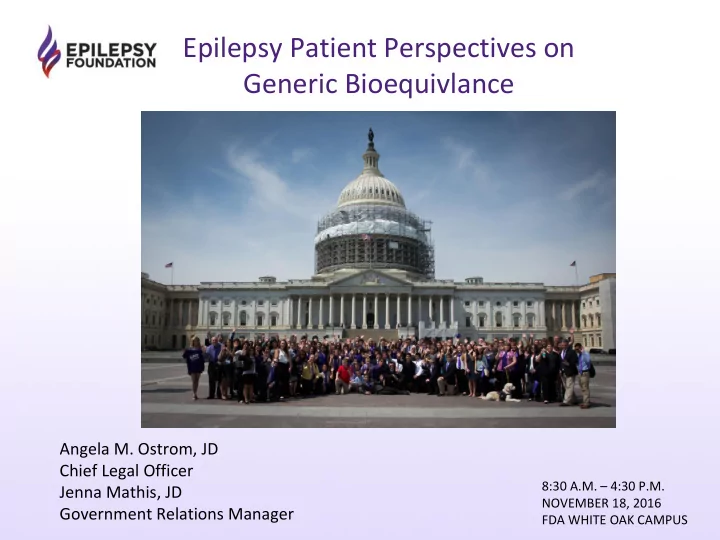
Epilepsy Patient Perspectives on Generic Bioequivlance Angela M. Ostrom, JD Chief Legal Officer 8:30 A.M. 4:30 P.M. Jenna Mathis, JD NOVEMBER 18, 2016 Government Relations Manager FDA WHITE OAK CAMPUS Our Mission To lead the fight to


slide-1
SLIDE 1

Epilepsy Patient Perspectives on Generic Bioequivlance

8:30 A.M. – 4:30 P.M. NOVEMBER 18, 2016 FDA WHITE OAK CAMPUS

Angela M. Ostrom, JD Chief Legal Officer Jenna Mathis, JD Government Relations Manager
slide-2
SLIDE 2

Our Mission

To lead the fight to overcome the challenges of living with epilepsy and to accelerate therapies to stop seizures, find cures, and save lives.

slide-3
SLIDE 3

3,400,000 individuals living with epilepsy in the United States1 2,900,000 adults; 500,000 children 65,000,000 individuals living with epilepsy worldwide2 1 in 26 individuals will develop epilepsy3 Thousands of individuals die from SUDEP each year worldwide (3,000 in US, 75,000 worldwide)4

  • 1. Centers for Disease Control and Prevention
  • 2. International League Against Epilepsy (ILAE)
  • 3. Institute of Medicine Report 2012
  • 4. Orrin Devinsky, MD- NYU Medical Center

Challenges of Epilepsy

slide-4
SLIDE 4

Understanding the Challenges

slide-5
SLIDE 5

First, seizure control can be an all-or-nothing proposition.

  • Changes in the amount of medication received by a person with

epilepsy can mean the difference between a fully controlled condition and breakthrough seizures. Second, the consequences of a breakdown in a well-functioning seizure- control regimen can be catastrophic — consequences of a breakthrough seizure can be extreme:

  • seizures increase the likelihood of serious bodily injury and death
  • seizures often result in significant social, legal and developmental

consequences

  • seizures can impact an individual’s employment and access to

community services and social opportunities due to loss of the patient’s driver’s license

  • seizures can lead to loss of employment and loss of self-esteem.

Bioequivalence - why does it matter to epilepsy patients and families?

slide-6
SLIDE 6
slide-7
SLIDE 7

For most individuals and conditions, generic substitution has worked. Many patients have switched from name-brand to generic medications to control high cholesterol or blood pressure, for instance, with little or no problems—and at significant cost savings. The Foundation saw a growing volume of evidence, concern from patients, and questions from clinicians suggesting that, for at least some individuals, the same has not been true for anti-epileptic drugs (AEDs). The scientific literature contained:

  • clinical confirmation that switching between “equivalent” formulations of the same AED, whose

differing effects in the body are not considered “significant” by the FDA, caused serious adverse consequences in patients,

  • case studies affirmatively establishing that switching between “equivalent” AEDs can lead to

breakthrough seizures, and

  • case studies documenting that epilepsy patients on the brand name and generic versions of

“equivalent” AED medications had different levels of therapeutic medication in their blood, and

  • population data revealing that epilepsy patients have “switch[ed] back” to brand-name

medication at significantly higher rates than patients who have switched to generic drugs to treat other long-term conditions.

Bioequivalence - a growing concern

slide-8
SLIDE 8
slide-9
SLIDE 9

Calling on Community to Get Engaged

slide-10
SLIDE 10

Sharing Information and Resources

slide-11
SLIDE 11

Call to FDA

The Epilepsy Foundation led efforts to call attention to concerns from the patient and provider community.

  • Called upon FDA leadership to meet and discuss

bioequivalence and AEDs.

  • In conjunction with leading clinicians and AES,

called upon NIH and FDA to consider research.

  • Educated congressional leadership to support

funding and research.

slide-12
SLIDE 12

Investment in Research

slide-13
SLIDE 13

Sharing Results & Information

slide-14
SLIDE 14

Understanding the Challenges

slide-15
SLIDE 15

Personal & Policy Impact

Confidence in generic products and FDA is important and can benefit patients economically, helping to lower costs We cannot ignore the cost burdens and barriers that are being placed on physician directed care

  • Patients are now facing many “fail first” 5 times policies

where access to even generic products are restricted

  • Therapeutic substitution, while distinct from generic

substitution, is expanding—plans are making physician decisions for patients It is important for health policy community to understand that bioequivalence standards and the research completed thus far does not mean that all AEDs are interchangeable

slide-16
SLIDE 16

Goals for Epilepsy Foundation

Share the research and promising news on generic substation studies Continue to advocate for access to physician directed care without unreasonable limitation or financial burden Support continuing funding for additional research through FDA

slide-17
SLIDE 17

Research Recommendations

FDA should continue to support further research

  • areas in studies where questions remain or

patient populations where sensitivity or “brittle patient” status may exist

  • medications where key leaders or patient

reports indicate a need for research on substitution by FDA

  • XR formulations
slide-18
SLIDE 18

Patient Recommendations

FDA communications to consumers should be realistic and not completely dismiss any possible individual patient problems

  • patients should be advised to understand medication

substitution and talk with their pharmacist and physician

  • patients should be advised that not all substitutions

are generic substitutions

  • FDA should advise the broader community that

generic substitution only includes the bioequivalent generic; i.e. not XR versions, not therapeutic substitutions