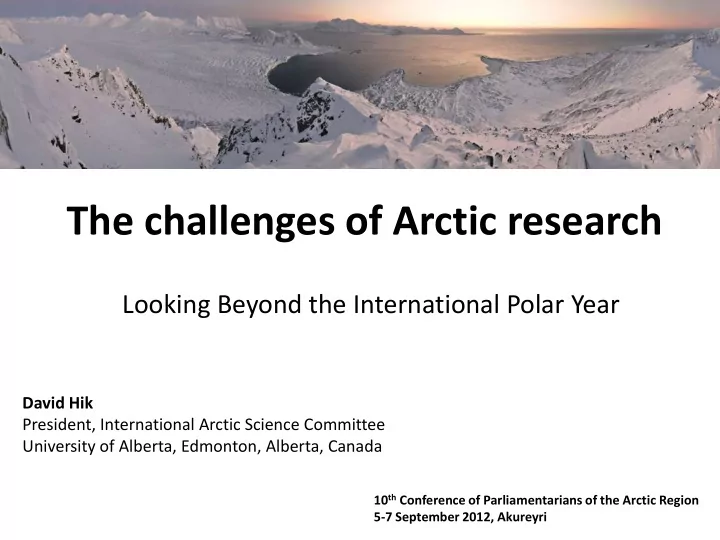
The challenges of Arctic research Looking Beyond the International - - PowerPoint PPT Presentation

the challenges of arctic research
SMART_READER_LITE
LIVE PREVIEW

The challenges of Arctic research Looking Beyond the International - - PowerPoint PPT Presentation

The challenges of Arctic research Looking Beyond the International Polar Year David Hik President, International Arctic Science Committee University of Alberta, Edmonton, Alberta, Canada 10 th Conference of Parliamentarians of the Arctic Region


slide-1
SLIDE 1

David Hik President, International Arctic Science Committee University of Alberta, Edmonton, Alberta, Canada

The challenges of Arctic research

Looking Beyond the International Polar Year

10th Conference of Parliamentarians of the Arctic Region 5-7 September 2012, Akureyri

slide-2
SLIDE 2

 A few words about IASC  Influence of International Polar Year (IPY)  Engaging Global Science with Local Communities in the Arctic  Opportunities for the Next Decade

slide-3
SLIDE 3

International Arctic Science Committee (IASC)

a non-governmental, international scientific organization established in 1990 by the eight Arctic countries; IASC encourages and facilitates cooperation in all aspects of Arctic research, in all countries engaged in Arctic research and in all areas of the Arctic region; promoting and supporting leading-edge multi-disciplinary research to foster a greater scientific understanding of the Arctic region and its role in the Earth system.

slide-4
SLIDE 4
slide-5
SLIDE 5
slide-6
SLIDE 6

IASC Partner Organizations

slide-7
SLIDE 7

International Polar Year (IPY)

  • IPY 2007-2008 was an intense, internationally

coordinated campaign of research intended to initiate a new era in polar science

http://www.arcticportal.org/ipy-joint-committee

slide-8
SLIDE 8

International Polar Year 2007-2008

….uniquely positioned the polar science community to address important societal issues…

 228 projects  50,000 participants  63 nations

Status Change Global Connections New Frontiers Vantage Points Human Dimensions

slide-9
SLIDE 9

Urgent, Significant

IPY PROJECT

International Partnerships Builds Connections Preserve, Share Data Education, Outreach Expand Polar Community

Characteristics of IPY Projects

slide-10
SLIDE 10

International Polar Year 2007-2008

….results are still being compiled and communicated…

IPY Summary Report published in May 2011

(720 pages, 250 contributing authors)

  • Implementing IPY
  • Early Science Results
  • Observing Systems and Data Management
  • Education and Outreach
  • Legacy

http://www.arcticportal.org/ipy-joint-committee

slide-11
SLIDE 11

International Polar Year 2007-2008

….IPY inspired and supported collaboration across diverse communities of practice.

”Perhaps IPY was our ‘dreamtime’, when the sciences danced with humanities, when the research community embraced education for the future of the Arctic and Antarctica.”

page 591 (Patti Virtue, University of Tasmania) ‘

slide-12
SLIDE 12
  • Scientific legacy: observational systems and

networks; technologies; baseline data sets; understanding of the Earth System.

  • Collaborative Legacy: enhanced collaboration

and joint funding; information sharing.

  • Human Legacy: next generation of researchers

and leaders; involvement of Arctic residents; public awareness and interest.

The IPY Legacies

How can we sustain International Polar Research and Cooperation?

slide-13
SLIDE 13

Research in the Arctic region is uniquely positioned to be a leader in new Earth System Sustainability programs:

  • Sustain interdisciplinary observational networks
  • Ensure data preservation, exchange, availability and effective use
  • Better models for predicting future climate
  • Facilitate active and equal engagement of Indigenous People
  • Engage the next generation of scientists
  • Strengthen partnerships with main stakeholders
  • Integrate education and outreach
slide-14
SLIDE 14

Forecasting

Improve the usefulness of forecasts of future environmental conditions and their consequences for people

A1B (by 2090-2099)

slide-15
SLIDE 15
slide-16
SLIDE 16

Observed Tree and Shrub Expansion

State of the Arctic Report

slide-17
SLIDE 17

Observed Tree and Shrub Expansion

State of the Arctic Report

1987 2009

slide-18
SLIDE 18

Observing

Develop, enhance, and integrate the observation systems needed to manage global and regional environmental change

Observing and Monitoring Underpins Services

slide-19
SLIDE 19

Sustaining Arctic Observing Networks

The goal of SAON is to enhance Arctic-wide

  • bserving

activities by facilitating partnerships and synergies among existing

  • bserving and data networks, and promoting

sharing and synthesis

  • f

data and information. SAON jointly sponsored by Arctic Council www.arcticobserving.org

slide-20
SLIDE 20

Arctic Global Observing

Arctic and Global Value-added Services & Societal Benefits

Decision- Making Policy- Making Scientific Research & Education Forecasting & Prediction Data Products

Arctic Observing

Operational Observing (international and national)

Research Observing

Community-based Observing; Local & Traditional Knowledge

Pool of Collective Knowledge/Wisdom

SAON addresses the need to sustain and enhance our collective capacity to acquire, retain and use knowledge

slide-21
SLIDE 21
  • Emphasis on ensuring inclusion of

community based monitoring and local/traditional knowledge activities;

  • Collaboration with indigenous peoples
  • rganizations in the Arctic.

Community-Based Monitoring

slide-22
SLIDE 22

Confining

Determine how to anticipate, recognize, avoid and manage disruptive global environmental change Ice Sheets likely the dominant contributor to sea level rise in the next Century

slide-23
SLIDE 23

Total melt area of the Greenland ice sheet from passive microwave satellite data

Greenland Surface Melt

updated from Steffen et al., 2008

slide-24
SLIDE 24

This summer? Approximately 97% of the ice sheet surface had thawed by July 12, 2012

Nicolo E. DiGirolamo, SSAI/NASA GSFC, and Jesse Allen, NASA

slide-25
SLIDE 25

Satellite gravity measurements

  • weighing the whole ice sheet

Velicogna, 2010

Antarctica Greenland

summer/winter cycle

slide-26
SLIDE 26

20 million people 3 million people 9 million people 72 million people

The impact of a one metre sea-level rise (displaced people in Asia)

Altitude above current sea level

slide-27
SLIDE 27

Responding

Determine what institutional, economic and behavioral changes can enable effective steps toward global sustainability

slide-28
SLIDE 28

Innovating

Encourage innovation in developing technological, policy, and social responses to achieve global sustainability

Closer integration of Natural and Social Sciences…. New sensors…provide simultaneous biological and physical measurements; satellites for measurement and communications...

slide-29
SLIDE 29

Closer integration of Natural and Social Sciences…. Interdisciplinary engagement with communities

From “Science from above” to “Science in the community”

slide-30
SLIDE 30
slide-31
SLIDE 31

“Leaders of the community of Old Crow had the vision to engage with researchers collaboratively to identify the effects and consequences of climate warming on their traditional territory, although convergence of community interest, researcher expertise, and funding opportunity cannot be

  • veremphasized.”
slide-32
SLIDE 32

2004 2006 2008 2010 2012 2014 2016 2018

Observing Systems Data Access Scientific Cooperation Next Generation

IPY

ICSU & WMO

IPI (WMO, AC + others) ?

Major Arctic Conf. Major Antarctic Conf. Major IPY Conf.

ICSU Grand Challenges

International Polar Research Activity

The Future of Polar Science: IPY Legacy – a new decadal initiative?

slide-33
SLIDE 33

Concept Note Steering Group: Co-Chairs of the Workshop D. Hik, J.-G. Winther, Vice: O. Hov, Secretary: V. Ryabinin AMAP APECS EPB-ESF IASC IASSA ICSU UNESCO/IOC SCAR WMO UArctic UNEP

?

Polar Decade???

?

IPY We need something else!!!

slide-34
SLIDE 34

A sustained ‘International Polar Initiative’

  • address the emerging challenges identified within

the IPY;

  • optimizing and better coordinating existing

resources and facilities;

  • developing mechanisms for concerted investments

in areas where activities are lacking.

  • deliver better, more reliable scientific information

for risk management and policy-making and other societal relevant activities in the Polar Regions.

http://www.iasc.info/files/IPI_Concept2012.pdf Feedback and Comments Welcome!

slide-35
SLIDE 35

Arctic Research is about people:

  • The People who do the research …

and The People for whom the research is done

slide-36
SLIDE 36

You are here Thank You Takk

slide-37
SLIDE 37