Population Movements in a Crisis Context within the Rabat Process - - PowerPoint PPT Presentation

population movements in a crisis context within the rabat
SMART_READER_LITE
LIVE PREVIEW

Population Movements in a Crisis Context within the Rabat Process - - PowerPoint PPT Presentation

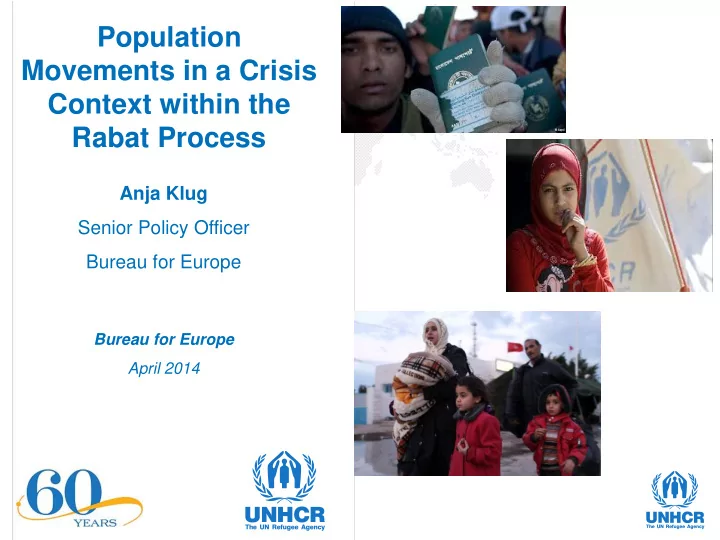
Population Movements in a Crisis Context within the Rabat Process Anja Klug Senior Policy Officer Bureau for Europe Bureau for Europe April 2014 Population Movements in a Crisis Context within the Rabat Process What is a crisis? - UNHCRs


slide-1
SLIDE 1

Bureau for Europe April 2014

Anja Klug Senior Policy Officer Bureau for Europe

Population Movements in a Crisis Context within the Rabat Process

slide-2
SLIDE 2

What is a crisis? - UNHCR’s definition of emergency

Population Movements in a Crisis Context within the Rabat Process Any situation in which the life or well-being of refugees and persons of concern to UNHCR will be threatened unless immediate and appropriate action is taken, and which demands an extraordinary response and exceptional measures.

slide-3
SLIDE 3

What is a crisis? - need to differentiate different scenarios

Population Movements in a Crisis Context within the Rabat Process

Questions which need to be responded to:

  • What constitutes the crisis and what has triggered it?
  • Is the crisis likely to be short term or could it be longer term?
  • Who is affected?
  • Has it triggered internal or also cross border movement?
slide-4
SLIDE 4

Need to differentiate different scenarios

Population Movements in a Crisis Context within the Rabat Process

  • Crisis situations of different kinds affecting primarily nationals
  • refugee outflows, ie cross border displacement of nationals fleeing persecution, serious human rights

violations, risks resulting from the indiscriminate violence in the context of conflict

  • Internal displacement
  • temporary lack of governance and availability of services resulting in larger outflows of nationals

for the purposes to seek employment and/or access to services in another country

  • natural disasters resulting in temporary internal or cross border displacement
  • Crisis situations of different kinds in host countries affecting both nationals and non-

nationals

  • Humanitarian crises en route created by accidents, abuses by smugglers/traffickers (for ex.

distress at sea)

  • Crisis situations created by large numbers of arrivals in transit/destination countries and

the lack of capacities of host countries to appropriately address their needs.

slide-5
SLIDE 5

Refugee crises (Cote d’Ivoire; Mali: CAR) – UNHCR response

Population Movements in a Crisis Context within the Rabat Process

  • Legal basis: UNHCR’s mandated responsibility for refugees
  • Emergency preparedness: emergency response team roster, contingency planning,

participation in IASC WG on Preparedness, and the Inter-Agency Rapid Response Mechanisms Technical and Steering Group, capacity building and training

  • Emergency response:
  • Initial life saving support within the first 72 hours of an emergency being declared
  • Deployment of staff with different expertise and relief supplies through network of 7

regional supply hubs

  • Capacity to assist half a million people of concern
  • Fundraising
slide-6
SLIDE 6

Refugee crises (Cote d’Ivoire; Mali: CAR) – UNHCR response – protection and solutions

Population Movements in a Crisis Context within the Rabat Process

Immediate:

  • address essential need,
  • protect against violations of human rights, including protection against refoulement
  • specific support for people with specific needs,
  • Age/Gender/Diversity sensitivity
  • Call for protection against refoulement; temporary protection

Medium term:

  • Advocate for the granting of refugee status and asylum/possibility for continued stay

Longer term: advocate for durable solutions: voluntary repatriation, local integration into host societies, resettlement

slide-7
SLIDE 7

Refugee crises – UNHCR response contn. – Partnership and cooperation

Population Movements in a Crisis Context within the Rabat Process

  • Close cooperation with host governments is key, in the longer term possibly also with country of
  • rigin in the context of repatriation operations
  • Within the UN system: Refugee coordination mechanisms under UNHCR’s global leadership and

broader humanitarian coordination, provider of last resort if all else fails; conclusion of MoU with key partners

  • With international and national NGOs: continued strengthening of capacity to assist UNHCR in

delivering

  • With governmental agencies: German THW, Sweden’s MSB, Lux
  • International Humanitarian Partnership
  • All need to have clearly defined responsibilities within a single overall operation.
  • Need for establishment of an appropriate coordinating structure at various levels to ensure that

duplication of effort and gaps are avoided.

slide-8
SLIDE 8

Internal displacement emergencies (Libya: Cote d’Ivoire; Mali) – UNHCR response

Population Movements in a Crisis Context within the Rabat Process

  • Legal basis: mandate only under certain conditions. UNHCR only gets engaged upon

request from a Government or the UN SG

  • Partnership:

UNHCR’s contribution forms part of a broader interagency commitment under the cluster leadership approach, UNHCR has leadership for the Global Protection Cluster, the Global Camp Coordination and Camp Management Cluster (together with IOM) and the Global Shelter Cluster (together with IFRC) Transformative agenda of the IASC to improve the coordination mechanisms and responses of the inter-agency cluster system in complex, large-scale emergencies

slide-9
SLIDE 9

Mixed situations: internal and external displacement – UNHCR response

Population Movements in a Crisis Context within the Rabat Process

  • Need for effective linkage between coordination of refugee operations and the humanitarian

coordinator system

  • Complement Regional Humanitarian Coordinator by a Regional Refugee Coordinator
slide-10
SLIDE 10

Mixed situations: emergencies affecting nationals and non-nationals, including refugees

Population Movements in a Crisis Context within the Rabat Process

  • Emergencies may, in addition to nationals affect non-nationals of various

backgrounds, regularly or irregularly, these can include:

  • Labour migrants, regular or irregular, with or without their families
  • Asylum-seekers, refugees other individuals in need of international

protection

  • Individuals in transit, temporarily staying or those with permanent

residence

  • Individuals with specific needs and vulnerabilities
slide-11
SLIDE 11

Transit/destination countries affected by humanitarian crises

Population Movements in a Crisis Context within the Rabat Process

  • All civilian population affected, regardless of nationality or status:
  • humanitarian needs (food, shelter, medical needs)
  • internal/cross border displacement
  • population trapped not able to flee
  • But: humanitarian interventions often did not sufficiently into account the non-

nationals affected by the crisis

  • Since Libya crisis increased attention that
  • Non nationals are equally affected
  • May need specific responses
slide-12
SLIDE 12

Example: Libya operation

Population Movements in a Crisis Context within the Rabat Process

  • 1 million people left Libya in 2011, 80% to neighbouring countries

(Tunisia and Egypt)

  • 45% were foreigners, representing 120 different nationalities
  • 8,000 recognized refugees and over 3,000 registered asylum-

seekers lived in Libya plus many more unregistered

slide-13
SLIDE 13

Example: Libya operation - responses

Population Movements in a Crisis Context within the Rabat Process

  • UNHCR/IOM humanitarian evacuation programme
  • Two principal camps in Tunisia and Egypy, initially as transit camps for migrants,

later also hosted refugees, nationalities not separated.

  • Repatriation of migrants
  • RSD of asylum seekers and resettlement
slide-14
SLIDE 14

Lessons learnt - immediate responses

Population Movements in a Crisis Context within the Rabat Process

  • Address immediate needs irrespective of status
  • Cooperation of different agencies irrespective of mandate

(UNHCR/IOM airlift in Libya)

  • humanitarian needs (food, shelter, medical needs) in country
  • Evacuation from conflict, dangerous situations
  • Initial reception in neighbouring countries
  • Mitigate the risk of human trafficking
slide-15
SLIDE 15

Lessons learnt - longer term responses - need to differentiate

Population Movements in a Crisis Context within the Rabat Process

  • Questions which need to be looked at:
  • Is return to host country a likely option?
  • As regards migrant workers, is return to the country of origin the best option?
  • Are there refugees or other people in need of international protection who

would face serious risks upon return?

  • Are there recognized refugees? Individuals who would like to seek asylum?
  • Are there individuals with specific needs?
slide-16
SLIDE 16

Lessons learnt - reception arrangements

Population Movements in a Crisis Context within the Rabat Process

  • Need for registration and disaggregated data to identify specific needs
  • Need for an early differentiation of different categories and groups and specific

needs

  • Possible separate reception arrangements for different groups
  • Mechanisms:
  • Profiling and referral mechanisms (provision of information, interview, counseling)
  • Asylum procedure / UNHCR mandate refugee status determination procedure
slide-17
SLIDE 17

Lessons learnt – interagency cooperation

Population Movements in a Crisis Context within the Rabat Process

  • Need for cooperation between agencies with different expertise and mandate
  • Clear division of labour
  • Clear mechanisms of cooperation (joint SOPs, joint reporting forms etc)
slide-18
SLIDE 18

International efforts to address the situation of non-national affected by a crisis

Population Movements in a Crisis Context within the Rabat Process

  • Declaration of the 2013 High-level Dialogue on International Migration

and Development “23. Recognize the importance of coordinated efforts of the international community to assist and support migrants stranded in vulnerable situations and facilitate, and cooperate on when appropriate, their voluntary return to their country of origin, and call for practical and action-oriented initiatives aimed at identifying and closing protection gaps;”

  • Crisis migration project of Georgetown University
  • Efforts to develop “Guidelines” consisting of principles and effective

practices

slide-19
SLIDE 19

Temporary protection or stay arrangements

Population Movements in a Crisis Context within the Rabat Process

  • Temporary protection has been developed in the 1990ties:
  • as a procedural device for situation of mass arrivals
  • where it is apparent that many people are in need of international

protection,

  • where individual status determination would overwhelm the capacity
  • f national asylum systems
  • is timebound
  • does not differentiate between individuals fleeing persecution in the

context of conflict and those fleeing the indiscriminate violence

  • does not exclude the possibility to apply for asylum after end of TP

regime

  • Guarantees access to certain rights
  • Example: EU Temporary Protection Directive
slide-20
SLIDE 20

Temporary protection or stay arrangements

Population Movements in a Crisis Context within the Rabat Process

will include:

  • Permission of entry and reception arrangements (identification,

registration, documentation, addressing immediate needs)

  • Agreed minimum standards of treatment (ExCom Conclusion No

22)

  • Rules for termination, solutions and possibly transition to longer

term protection status where required

  • International cooperation, burden an responsibility sharing
  • Consultation and coordination
slide-21
SLIDE 21

Temporary protection or stay arrangements

Population Movements in a Crisis Context within the Rabat Process

  • discussions on whether a TP regime could also be

applied as an initial response in other situations:

  • Humanitarian crises triggering complex or mixed

cross-border movements

  • Fluid or transitional context needing a short term

response

  • Exceptional and temporary conditions in the country
  • f origin necessitating international protection
  • Protection response for States non party to the 1951

Convention

slide-22
SLIDE 22

Questions?

Photo/Joe Athialy

slide-23
SLIDE 23

Thank you

For more information, please contact:

Anja Klug: klug@unhcr.org