Checkerspot butterflies: Checkerspot butterflies: Movements across - - PDF document

checkerspot butterflies checkerspot butterflies movements
SMART_READER_LITE
LIVE PREVIEW

Checkerspot butterflies: Checkerspot butterflies: Movements across - - PDF document

Charismatic mega- -vertebrate vertebrate Charismatic mega Checkerspot butterflies: Checkerspot butterflies: Movements across Coyote Movements across Coyote Valley Valley Stuart B. Weiss, Ph.D. Stuart B. Weiss, Ph.D. Jan 29 2007 Jan 29


slide-1
SLIDE 1

1

Charismatic mega Charismatic mega-

  • vertebrate

vertebrate

Checkerspot butterflies: Checkerspot butterflies: Movements across Coyote Movements across Coyote Valley Valley

Stuart B. Weiss, Ph.D. Stuart B. Weiss, Ph.D. Jan 29 2007 Jan 29 2007 Sierra Azul Workshop Sierra Azul Workshop

slide-2
SLIDE 2

2

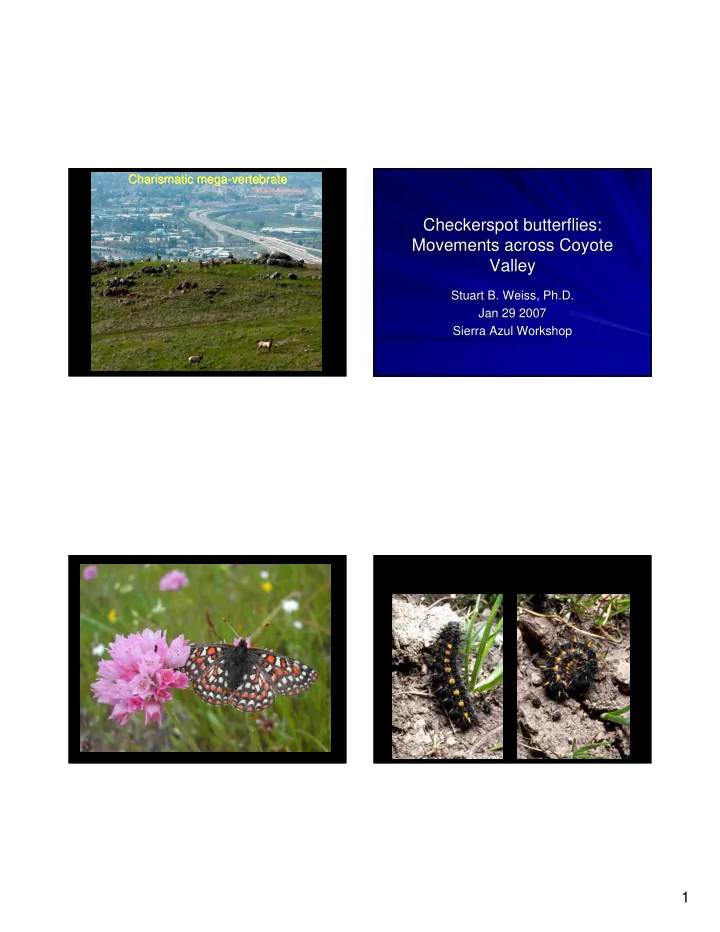
Hostplants and Nectar Sources

Serpentinite forms discrete patches

  • f habitat
slide-3
SLIDE 3

3

Observations

  • Bay checkerspots have (at least) 2 modes of

Bay checkerspots have (at least) 2 modes of movement movement

  • Everyday movement

Everyday movement – – “ “random walk random walk” ” among among nectar sources, hostplants, mates, thermal nectar sources, hostplants, mates, thermal environment environment

  • Dispersal

Dispersal-

  • mode

mode – – more directional, fewer turns, more directional, fewer turns, faster flight faster flight

“Reluctance Reluctance” ” to leave true habitat, but switch to leave true habitat, but switch modes when outside serpentine grassland modes when outside serpentine grassland

  • Dispersal through suburbia is unknown

Dispersal through suburbia is unknown

Pattern and inference

  • Core

Core-

  • satellite metapopulation, Coyote Ridge and

satellite metapopulation, Coyote Ridge and smaller patches smaller patches

  • Small patches went extinct during 1975

Small patches went extinct during 1975-

  • 1977

1977 drought drought

  • Distance to core best predictor of occupancy in

Distance to core best predictor of occupancy in 1987, also size and topography 1987, also size and topography

  • Population sizes ranged from 10 to 400,

Population sizes ranged from 10 to 400, proportional to size and topography proportional to size and topography

  • Inferred recolonization across Coyote Valley

Inferred recolonization across Coyote Valley

  • Harrison et al. 1988

Harrison et al. 1988

Edgewood Edgewood

slide-4
SLIDE 4

4

Data 1

  • Bay checkerspot sedentary within continuous

Bay checkerspot sedentary within continuous habitat habitat -

  • <5% transfer over 500 m, <0.1% over

<5% transfer over 500 m, <0.1% over 1500m (12,000 butterflies handled on Coyote 1500m (12,000 butterflies handled on Coyote Ridge 1986) Ridge 1986)

  • < 5% transfer rate between JRH and JRC (500m

< 5% transfer rate between JRH and JRC (500m apart separated by chaparral and oak woodland, apart separated by chaparral and oak woodland, some grassland some grassland

  • Butterflies cross I

Butterflies cross I-

  • 280 at Edgewood, transfer at

280 at Edgewood, transfer at “ “expected expected” ” rates between patches of serpentine rates between patches of serpentine grassland separated by open grassland and grassland separated by open grassland and chaparral chaparral

  • Thomas Sisk Dissertation (1992, Stanford

Thomas Sisk Dissertation (1992, Stanford University) University)

Data 2

  • Releases near Gilroy in agricultural lands,

Releases near Gilroy in agricultural lands, dispersal to find isolated patch of serpentine, dispersal to find isolated patch of serpentine, 1/100 butterflies found on patch from 10 km 1/100 butterflies found on patch from 10 km away, higher fractions from closer releases away, higher fractions from closer releases (Harrison 1989) (Harrison 1989)

  • Recolonization of Tulare Hill observed in 1995

Recolonization of Tulare Hill observed in 1995 (went extinct in 1990 (went extinct in 1990-

  • 1991 during drought)

1991 during drought) – – likely source was North Metcalf likely source was North Metcalf “ “core population core population” ”

  • Tulare population was ~2500 larvae in 2002

Tulare population was ~2500 larvae in 2002 (population recovered), but near extinction as of (population recovered), but near extinction as of 2006 (lack of grazing on most of habitat) 2006 (lack of grazing on most of habitat)

Corridor design

  • Butterfly is a creature of open grassland

Butterfly is a creature of open grassland

  • Low vegetation, simple structure

Low vegetation, simple structure (grassland, row crops) better than trees (grassland, row crops) better than trees and urban development and urban development

  • Open corridors

Open corridors

  • Will cross freeways

Will cross freeways

  • Nectar?

Nectar?

slide-5
SLIDE 5

5

Metcalf Canyon Jewelflower