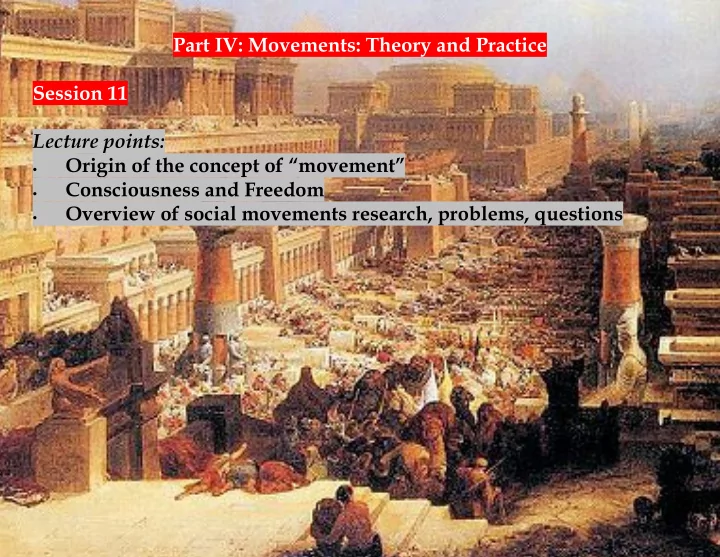
SLIDE 1 1
Part IV: Movements: Theory and Practice Session 11 Lecture points:
- Origin of the concept of “movement”
- Consciousness and Freedom
- Overview of social movements research, problems, questions
SLIDE 2
2
Exodus: Movement of the People
http://www.youtube.com/watch?feature=player_embedded&v=XctwfpqHWgQ
[select extracts from the lyrics]
Exodus: Movement of Jah people! ……. So we gonna walk – all right! – through the roads of creation: We the generation (Tell me why!) (Trod through great tribulation) trod through great tribulation. Exodus: Movement of Jah people! Oh, yeah! Uh! Open your eyes and look within: Are you satisfied (with the life you’re living)? Uh! We know where we’re going, uh! We know where we’re from. We’re leaving Babylon, We’re going to our Father land. Exodus: movement of Jah people! Move! Move! Move! Move! Move! Move! Move! Jah come to break downpression, Rule equality, Wipe away transgression, Set the captives free. Move! Move! Move! Move! Move! Move! Uh-uh-uh-uh! Move(ment of Jah people)!
SLIDE 3
3
resistance, attrition, passive, active activism: alive and animated, astir, bustling, exertive, flowing, functioning… going, impelling, mobile, movable, moving, progressive, traveling, walking... The archetype of the Jewish exodus story Michael Walzer’s Exodus and Revolution (New York: Basic Books, 1985) “I have found the Exodus almost everywhere….the escape from bondage, the wilderness journey, the Sinai covenant, the promised land: all these loom large in the literature of revolution. Indeed, revolution has often been imagined as an enactment of the Exodus and the Exodus has often been imagined as a program for revolution” (p. ix).
SLIDE 4 4
Benjamin Franklin, Great Seal
- f the United States, 1776,
“Rebellion to tyrants is obedience to God.” Exodus: “an idea of great presence and power in Western political thought, the idea of a deliverance from suffering and
redemption, liberation, revolution…” Exodus has become “a paradigm of revolutionary politics” (p. 7). “This story made it possible to tell other stories” (p. 7).
SLIDE 5
5
The Exodus pattern “a classic narrative, with a beginning, a middle, and an end: problem, struggle, resolution— Egypt, the wilderness, the promised land” (pps. 10-11) “A political history with a strong linearity, a strong forward movement, the Exodus gives permanent shape to Jewish conceptions of time; and it serves as a model, ultimately, for non-Jewish conceptions too. We can think of it as the crucial alternative to all mythic notions of eternal recurrence—and hence to those cyclical understandings of political change from which our word ‘revolution’ derives. The idea of eternal recurrence connects the social to the natural world and gives to political life the simple.” (p. 12)
SLIDE 6 6
Movement and Revolution: Arrival at a New (Political) “Place” From revolution as restoration, to revolution as arrival at a fundamentally new place. “The strength of the narrative is given by the end, though it is also crucial that the end be present at the beginning, as an aspiration, a hope, a
- promise. What is promised is radically different from what is: the end is
nothing like the beginning. This is an obvious but critical point.” (p. 11) “the movement across space is readily reconstructed as a movement from one political regime to another” (p. 14) vanguard politics, revolution (in its current sense), movement itself “Exodus is a literal movement…an advance through space and time, the original form of (or formula for) progressive history” (p. 15).
SLIDE 7 7
“Thus, when utopian socialists, most of them resolutely hostile to religion, argued about the problems of the ‘transitional period,’ they still cast their arguments in familiar terms: the forty years in the wilderness.” (p. 134) ‘If we take the Exodus as our theme, we do so because in it Latin American theology finds a focal point . . . and an inexhaustible light.’ (p. 4) [See J. Severino Croatto, Exodus: A Hermeneutics of Freedom,
- trans. Salvator Attanasio ( Maryknoll, N.Y.: Orbis, 1981), p. iv.]
Croatto: ‘Have we paid sufficient attention to the fact that the first, exemplary liberation event, which ‘reveals’ the God of salvation, was political and social?’ (p. 7). The Exodus reference is very common in the political history of the West (p. 5)
SLIDE 8
8
“oppression, liberation, social contract, political struggle, new society (danger of restoration)” “a strong forward movement” (p. 133). Questions, Problems in Explaining and Understanding “Movements” Ralph Nicholas: the Exodus story as the archetypal movement of the Western cultural tradition—passage from bondage, to the promised land, led by Moses. “movement”: nineteenth-century conditions of factory labour and urban life Sociologists and 1968; preceded by anthropologists
SLIDE 9 9
Sociologists: A) Are movements expressive of conflicts? B) Do movements have collective cultural identities? How do they cohere? C) Which values, interests, and ideas are turned into collective action, and what are the roles of identities and symbols, emotions,
- rganizations, and networks, in explaining the start and persistence of
collective action? D) How do wider contexts in which movements develop affect their development?
SLIDE 10
10
What is a movement? In the view of anthropologists: Moral collectivity A collective body Common ideological commitment Credible, persuasive, authoritative ideologies Direction, intentional action toward change Conscious, deliberate, organized efforts (nativistic movements—Ralph Linton; revitalization movements—Anthony F.C. Wallace) Opposition to the established order Leader: an extraordinary figure, legitimacy rests on charisma The time of movements, their liminality: separation, transition, integration into a new social order “Relative deprivation”—discrepancy between expectation and actuality Cultural dissatisfaction, seeking new synthesis and meaning (Aberle, Heberle, Lanternari, Smelser, Wilkinson, Wallace) Why “social” movement?
SLIDE 11
11
Question: if it is limited to reform, is it a movement or an “interest group”? Question: are all forms of politicized, collective action definable as social movements? Mario Diani: social movements are a distinct social process: are involved in conflictual relations with clearly identified opponents; are linked by dense informal networks; share a distinct collective identity. must be oppositional…but is it necessary to have protest? What kinds of change? Alberto Melucci, Jürgen Habermas, opposition to state and market
SLIDE 12 12
“Consciously Seeking Freedom”
“The Varieties of Human Freedom.” In The Concept of Freedom in Anthropology, Edited By David Bidney. The Hague: Mouton & Co., 1963, pps. 11-34.
Ideas of freedom, consciousness, intentionality, and rationality ACTION AND WILL/Voluntarism/Agency INTENTIONALITY/Action WHAT DEFINES A FREE AGENT? WHAT IS INVOLVED IN CHOICE? In sociology: Anthony Oberschall (1973; 1980), Charles Tilly (1978)— social movements as rational, purposeful, and organized; calculation
- f the costs and benefits; resources
PROBLEM: overdoing the comparison between social movements and interest groups
SLIDE 13
13
THUS: needs and desires, values and norms—action is not rational, but reasonable: Bourdieu feelings and emotions…fear, moral indignation, anger La rage: http://youtu.be/r1Co1mfz23U “libidinal economy of movements” – community, identity, companionship, cooperation, conversation
SLIDE 14
14
Reading Questions: Conclusion: Exodus Politics, pp. 133-149. In: Walzer, Michael. (1985). Exodus and Revolution. New York: Basic Books. 1. What is “the revolutionary process” and what does “movement” have to do with it? 2. How does Walzer explain the impact of the Exodus story as a paradigm? 3. How are the Exodus and messianism entangled, and yet distinct? 4. Why is revolution not sudden? Nicholas, Ralph W. (1973). “Social and Political Movements.” Annual Review of Anthropology, 2, 63-84. 1. According to the author, when did “movement” first come into use in English political terminology, in what context, and with reference to which phenomena? 2. What role does the Exodus play in the author’s overview of the origins and application of “movement”? 3. What characterizes a political movement as an organized entity? 4. This author devotes considerable attention to the distinction (if any) between “religion” and “politics”. What is the purpose and value of that discussion? How might you relate the discussion to “exodus politics”? 5. Note the references/explanation to the properties of “bodies” in explaining “movements”. 6. Thinking of the various generalizing schemes that have been used to conceptualize and analyze movements, what are the frequently most recurring elements? When does the author, for example, assert that this or that is a definite characteristic of a movement?
SLIDE 15 15
Chapter 1: The Study of Social Movements: Recurring Questions, (Partially) Changing Answers,
- pp. 1-29. In: Della Porta, Donatella, and Diani, Mario (Eds.). (2006). Social Movements: An
- Introduction. 2nd ed. Oxford, UK: Blackwell.
1. Where, when, and why did social movements first emerge? 2. What were the dominant theoretical paradigms that first shaped social movements research, and what was important about the criticisms of these paradigms? 3. Sociology is the focus of the research review in this chapter. In terms of “resource mobilization”/”rational calculation” theories, what are the primary elements of their explanation for the formation and role of movements? What have been some of the main criticisms of these approaches? How do “political process” theories differ? 4. Why should be wary of identifying all sorts of different forms of “collective action” as “social movements”?