Mental health and psychosocial support in emergencies Dr Fahmy - - PowerPoint PPT Presentation

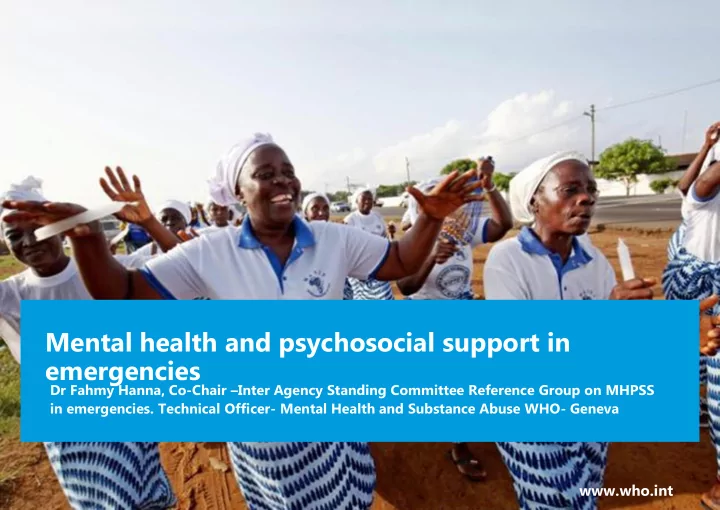
mental health and psychosocial support in
SMART_READER_LITE
LIVE PREVIEW

Mental health and psychosocial support in emergencies Dr Fahmy - - PowerPoint PPT Presentation

Mental health and psychosocial support in emergencies Dr Fahmy Hanna, Co-Chair Inter Agency Standing Committee Reference Group on MHPSS in emergencies. Technical Officer- Mental Health and Substance Abuse WHO- Geneva www.who.int What do you


slide-1
SLIDE 1

www.who.int

Mental health and psychosocial support in emergencies

Dr Fahmy Hanna, Co-Chair –Inter Agency Standing Committee Reference Group on MHPSS in emergencies. Technical Officer- Mental Health and Substance Abuse WHO- Geneva
slide-2
SLIDE 2

2 |

What do you think?

⚫ Should internationally endorsed inter-agency mental health and psychosocial support guidelines apply to your country?

slide-3
SLIDE 3

3 |

Some typical answers from other workshops "Yes, but . . ."

⚫ Should be culturally sensitive/adaptable ⚫ Should take local situation and resources into account ⚫ Should cover/not cover/ go beyond traumatic stress responses ⚫ Should cover staff welfare ⚫ Should warn about harmful interventions ⚫ Should discuss coordination

slide-4
SLIDE 4

4 |

Key global policies and resources

Sphere (2011), IASC (2007, 2010)

slide-5
SLIDE 5

5 |

Needs are diverse

⚫ Pre-existing problems

– Social problems – Psychological (incl. psychiatric) problems

⚫ Emergency-induced problems

– Social problems – Psychological (incl. psychiatric) problems

  • Psychological problems may involve realistic appraisal (no mental

disorder) or distortions (possible mental disorder)

⚫ Humanitarian aid-induced problems

– Social problems – Psychological (incl. psychiatric) problems

slide-6
SLIDE 6

6 |

BEFORE DISASTER: 12-month prevalence AFTER DISASTER: 12-month prevalence Severe disorder (e.g., psychosis, severe depression, severely disabling form of anxiety disorder) 2-3% 3-4% Mild or moderate mental disorder (e.g., mild and moderate forms of depression and anxiety disorders) 10% 15% - 20% (usually reduces over time) "Normal" stress reactions (no disorder) No estimate Large percentage (usually reduces over time)

Impact of Disasters on Prevalence of Mental Disorders: (expected medians across countries & level of adversity exposure)

Source: van Ommeren et al. BMJ; 330:1160-1; 2005, http://www.bmj.com/content/330/7501/1160/suppl/DC1

slide-7
SLIDE 7

7 |

Traditional usage of the term psychosocial support varies with sector

⚫ Health sector staff: non-biological interventions for people with mental disorder (eg CBT) ⚫ Protection, social & community services: any non- clinical support for any person with/ without disorder (eg child friendly spaces) Lack of common language confusion

slide-8
SLIDE 8

8 |

Launch of the IASC Guidelines at the United Nations in New York, 2007

  • a multi-sectoral, inter-agency

(UN-NGO) framework

  • that enables coordination,
  • that identifies useful practices,
  • that flags harmful practices
  • that clarifies how different

approaches to mental health and psychosocial support complement one another.

slide-9
SLIDE 9

9 |

IASC Guidelines: Inclusive framework: mental health and psychosocial support covers both

Composite definition

  • protecting or promoting psychosocial well-being

and/or

  • preventing or treating mental disorder.

MH PS

slide-10
SLIDE 10

Underlying Core Principles IASC Guidelines

Human rights and equity of all affected persons Participation of local affected population Do no harm Building on available resources and capacities Integrated support systems Multi-layered supports – Intervention pyramid.

slide-11
SLIDE 11

11 |

Basic services and security Community and family supports

Clinical services Focused psychosocial supports Strengthening community and family supports Social considerations in basic services and security

Advocacy for good humanitarian practice: basic services that are safe, socially appropriate and that protect dignity Activating social networks Supportive child-friendly spaces Basic emotional and practical support to selected individuals or families Clinical mental health care (whether by PHC staff or by mental health professionals)

Intervention pyramid (Adapted from IASC 2007)

Examples:

slide-12
SLIDE 12

Co-Chairs WHO & IFRC

Health Protection Education CCCM Nutrition IASC Disability TT IASC Gender Sphere 2018 Zika manual IASC Secretariat

MHPSS RG members

MHPSS coordination groups: (IDP, refugee & migrant settings) Global level Country level Expanded membership in 2017 48 full members │ 9 Observers │ 4 Donor organisations

slide-13
SLIDE 13

13 |

ACTION BY THE HEALTH SYSTEM

slide-14
SLIDE 14

14 |

Sphere Handbook mental health standard: 9 key actions

  • 1. Coordinate mental health and psychosocial support

across sectors

slide-15
SLIDE 15

Health sector Education and other sectors Protection sector

(with Child protection Sub-sector)

MHPSS Cross-sector Technical Working Group (with focal points in each of the sectors and with accountability in sectors, with MHPSS activities as relevant in Appeal chapters under health, protection and education, rather than in a separate Appeal chapter)

Humanitarian Coordinator / Government leader

Reaching agreement on model for coordinating Mental Health and Psychosocial Support (MHPSS)

Inter-sector Coordination Group

slide-16
SLIDE 16

16 |

Sphere Handbook mental health standard: 9 key actions

  • 2. Ensure interventions are developed on the basis of

identified needs and resources.

slide-17
SLIDE 17

17 |

Desk reviews during emergencies

slide-18
SLIDE 18

18 |

Sphere Handbook mental health standard: 9 key actions

  • 3. Enable community members including marginalized

people to strengthen community self-help and social support

  • 4. Ensure that community workers, including volunteers, as

well as staff at health services offer psychological first aid to people in acute distress after exposure to extreme stressors

slide-19
SLIDE 19

19 |

What is PFA?

⚫ Humane, supportive and practical assistance to fellow human beings who recently suffered exposure to serious stressors, and involves:

– Non-intrusive, practical care and support – Assessing needs and concerns – Helping people to address basic needs (food, water) – Listening, but not pressuring people to talk – Comforting people and helping them to feel calm – Helping people connect to information, services and social supports – Protecting people from further harm

slide-20
SLIDE 20

20 |

What PFA is NOT?

⚫ It is NOT something only professionals can do ⚫ It is NOT professional counselling ⚫ It is NOT “psychological debriefing” – No detailed discussion of the distressing event ⚫ It is NOT asking people to analyze what happened or put time and events in order ⚫ Although PFA involves being available to listen to people’s stories, it is NOT pressuring people to tell you their feelings or reactions to an event

slide-21
SLIDE 21

21 |

Sphere Handbook mental health standard: 9 key actions

  • 5. Ensure that there is at least one staff member at every

health facility who manages diverse, severe mental health problems in adults and children.

slide-22
SLIDE 22

22 |

Sphere Handbook mental health standard: 9 key actions

  • 6. Make psychological interventions available when

possible for people impaired by prolonged distress

slide-23
SLIDE 23

23 |

Sphere Handbook mental health standard: 9 key actions

  • 7. Address the safety, basic needs and rights of people

with mental health problems in institutions.

  • 8. Minimize harm related to alcohol and drugs
slide-24
SLIDE 24

24 |

Sphere Handbook mental health standard: 9 key actions

  • 9. As part of early recovery, initiate plans to develop a

sustainable community mental health system. ⚫ Afghanistan ⚫ Burundi ⚫ Indonesia ⚫ Iraq ⚫ Jordan ⚫ Kosovo ⚫ Somalia ⚫ Sri Lanka ⚫ Timor-Leste ⚫ West Bank and Gaza Strip

slide-25
SLIDE 25

Lisbon- May 18th , 2017

slide-26
SLIDE 26

Lisbon- May 18th , 2017

GOAL: Reduce suffering and improved mental health and psychosocial well-being

slide-27
SLIDE 27

Lisbon- May 18th , 2017

slide-28
SLIDE 28

28 |

In conclusion

⚫ Clear guidelines and technical instruments are available ⚫ The response can be largely delivered by non-specialised workers ⚫ Emergencies can be used as opportunities for mental health system reform