Mental Health Services Act Mental Health Services Act (MHSA) Purpose - - PowerPoint PPT Presentation

mental health services act
SMART_READER_LITE
LIVE PREVIEW

Mental Health Services Act Mental Health Services Act (MHSA) Purpose - - PowerPoint PPT Presentation

Mental Health Services Act (MHSA) MHSA Component Funding Guidelines and Decision Tree Mental Health Services Act Mental Health Services Act (MHSA) Purpose The MHSA is intended to expand and transform mental health services in California to provide


slide-1
SLIDE 1

Mental Health Services Act (MHSA) MHSA Component Funding Guidelines and Decision Tree Prepared by RESOURCE DEVELOPMENT ASSOCIATES February 2018 | 1

Mental Health Services Act

Mental Health Services Act (MHSA) Purpose

The MHSA is intended to expand and transform mental health services in California to provide a better coordinated and more comprehensive system of care for those with serious mental illness, and to define an approach to the planning and the delivery of mental health services that are embedded in the MHSA Values.

MHSA History

More than 2 million people in California are affected by potentially disabling mental illnesses every year. Thirty years ago, the State cut back on services in state hospitals for people with serious mental illnesses but did not provide adequate funding for community-based mental health

  • services. Cuts to federal Medicaid (Medi-Cal) during the

1980s further devastated the public mental health system. These cuts prevented tens of thousands of Californians from accessing much-needed mental health care, which led to increased homelessness, hospitalizations, and incarceration. To address the gap in services, voters passed the Mental Health Services Act (MHSA) in 2004. The MHSA places a 1% tax on personal income above $1 million. Since then, it has generated approximately $8 billion for the public mental health care system.

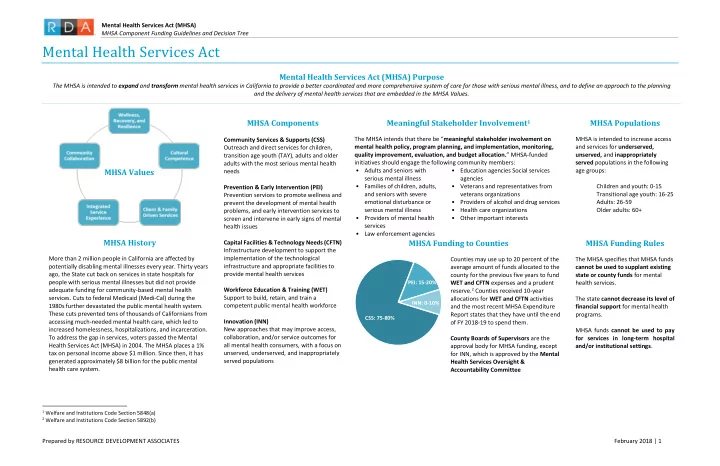
MHSA Components

Community Services & Supports (CSS) Outreach and direct services for children, transition age youth (TAY), adults and older adults with the most serious mental health needs Prevention & Early Intervention (PEI) Prevention services to promote wellness and prevent the development of mental health problems, and early intervention services to screen and intervene in early signs of mental health issues Capital Facilities & Technology Needs (CFTN) Infrastructure development to support the implementation of the technological infrastructure and appropriate facilities to provide mental health services Workforce Education & Training (WET) Support to build, retain, and train a competent public mental health workforce Innovation (INN) New approaches that may improve access, collaboration, and/or service outcomes for all mental health consumers, with a focus on unserved, underserved, and inappropriately served populations

Meaningful Stakeholder Involvement1

The MHSA intends that there be “meaningful stakeholder involvement on mental health policy, program planning, and implementation, monitoring, quality improvement, evaluation, and budget allocation.” MHSA-funded initiatives should engage the following community members:

MHSA Populations

MHSA is intended to increase access and services for underserved, unserved, and inappropriately served populations in the following age groups: Children and youth: 0-15 Transitional age youth: 16-25 Adults: 26-59 Older adults: 60+

  • Adults and seniors with

serious mental illness

  • Families of children, adults,

and seniors with severe emotional disturbance or serious mental illness

  • Providers of mental health

services

  • Law enforcement agencies
  • Education agencies Social services

agencies

  • Veterans and representatives from

veterans organizations

  • Providers of alcohol and drug services
  • Health care organizations
  • Other important interests

MHSA Funding to Counties MHSA Funding Rules

Counties may use up to 20 percent of the average amount of funds allocated to the county for the previous five years to fund WET and CFTN expenses and a prudent reserve.2 Counties received 10-year allocations for WET and CFTN activities and the most recent MHSA Expenditure Report states that they have until the end

  • f FY 2018-19 to spend them.

County Boards of Supervisors are the approval body for MHSA funding, except for INN, which is approved by the Mental Health Services Oversight & Accountability Committee The MHSA specifies that MHSA funds cannot be used to supplant existing state or county funds for mental health services. The state cannot decrease its level of financial support for mental health programs. MHSA funds cannot be used to pay for services in long-term hospital and/or institutional settings.

1 Welfare and Institutions Code Section 5848(a) 2 Welfare and Institutions Code Section 5892(b)

CSS: 75-80% PEI: 15-20% INN: 0-10%

MHSA Values

slide-2
SLIDE 2

Mental Health Services Act (MHSA) MHSA Component Funding Guidelines and Decision Tree Prepared by RESOURCE DEVELOPMENT ASSOCIATES February 2018 | 2

Community Services & Support (CSS)3

Purpose MHSA Funding for CSS Populations Served

Provide all necessary mental health services to seriously mentally ill children, adults, and seniors for whom services under any other public or private insurance or other mental health or entitlement program is inadequate or unavailable.  At least 51% of MHSA allocations to counties must be dedicated to Full Service Partnerships (FSP).  Many CSS services are also eligible to bill to Medi-Cal.  MHSA funds can also be used for non-Medi-Cal eligible expenses such as non-mental health services.  Children with severe emotional disturbance and their families  Transitional age youth, adults, and older adults with serious mental illness CSS Funding Categories DIRECT SERVICES COSTS Eligible for CSS Funding4 NON-DIRECT SERVICES COSTS Eligible for CSS Funding Activities NOT Eligible for CSS Funding

Full Service Partnerships (FSP) Individuals (and sometimes their families) enroll in a voluntary program that provides a broad range of supports to accelerate their recovery. FSP includes a “whatever-it-takes” commitment to progress on concrete recovery goals. Serves clients that meet System Development (SD) criteria AND are un- or underserved and at risk of homelessness, incarceration, or hospitalization5 NOTE: Some FSP-funded costs overlap with SD costs, but are distinct from SD in the population served and in funding non-mental health services Full spectrum of community services including, but not limited to:  Mental health treatment, including alternative and culturally specific treatments  Peer support  Supportive services to assist the client, and when appropriate the client’s family, in obtaining and maintaining employment, housing, and/or education  Wellness centers  Alternative treatment and culturally specific treatment approaches  Personal service coordination/case management to assist the client, and when appropriate the client’s family, to access needed medical, educational, social, vocational rehabilitative and/or other community services  Needs assessment  ISSP development  Crisis intervention/stabilization services  Family education services Non-mental health services and supports within the full spectrum of community services including, but not limited to:  Food  Clothing  Housing, including, but not limited to, rent subsidies, housing vouchers, house payments, residence in a drug/alcohol rehabilitation program, and transitional and temporary housing  Cost of health care treatment  Cost of treatment of co-occurring conditions, such as substance abuse  Respite care  Wrap-around services to children  Needs assessment  Efforts to improve the county mental health service delivery system for all clients and their families  Developing strategies to reduce ethnic/racial disparities.  Mental health programs and/or services that were in existence on November 2, 2004, except to expand services

  • r program capacity

beyond what was previously provided.  To replace state or county funding for programs that were already in existence as of FY 2004-05  Long-term hospitalizations or institutionalization  Building and acquisition

  • f housing

System Development (SD) Develop and operate programs to provide mental health services to 1) severely emotionally disturbed children or adolescents, 2) adults and

  • lder adults who have a serious mental disorder,

3) adults or older adults who require or are at risk

  • f requiring acute psychiatric inpatient care,

residential treatment, or outpatient crisis intervention because of a mental disorder with symptoms of psychosis, suicidality, or violence Mental health treatment, including alternative and culturally specific treatments:  Peer support  Supportive services to assist the client, and when appropriate the client’s family, in obtaining employment, housing, and/or education  Wellness centers  Personal service coordination/case management/personal service coordination to assist the client, and when appropriate the client’s family, to access needed medical, educational, social, vocational rehabilitative or other community services  Needs assessment  Individual Services and Supports Plan development  Crisis intervention/stabilization services  Family education services  Improve the county mental health service delivery system for all clients and their families  Develop and implement strategies for reducing ethnic/racial disparities Outreach and Engagement (OE) Identifying those in need, reaching out to target populations, and connecting those in need to appropriate treatment  Reaching out to target populations or community-based partners  Food, clothing, and shelter, but only when the purpose is to engage unserved individuals (and their families when appropriate) in the mental health system  If in collaboration with other non-mental health community programs, only the costs directly associated with providing the mental health services and supports Administrative N/A Costs or consulting fees related to conducting a needs assessment or evaluation, and facilitating the Community Planning Process

3 Adapted from the following sources: Mental Health Services Act as Revised September 2016; California Code of Regulations, Title 9, Division 1, Chapter 14, Section 3620 - 3650; Fresno County MHSA 101:

http://www.co.fresno.ca.us/uploadedFiles/Departments/Behavioral_Health/MHSA/Mental%20Health%20Services%20Act%20101%20revised%20-%208-2-13.pdf

4 California Code of Regulations, Title 9, Division 1, Chapter 14, Section 3620 5 California Code of Regulations, Title 9, Division 1, Chapter 14, Section 3620.05

CSS = 75-80%

County MHSA Funding

slide-3
SLIDE 3

Mental Health Services Act (MHSA) MHSA Component Funding Guidelines and Decision Tree Prepared by RESOURCE DEVELOPMENT ASSOCIATES February 2018 | 3

Prevention & Early Intervention (PEI)6

Purpose MHSA Funding for PEI Populations Served

  • Engage persons prior to development of serious mental illness or

emotional disturbance

  • Alleviate the need for additional mental health treatment
  • Transition those with identifiable need to extended mental health

treatment

At least 51 % of PEI budget must be dedicated to individuals who are between the ages of 0 and 25 (small counties are exempt from this requirement)7 Counties must have a program within each of the funding categories below except for Suicide Prevention, which is optional. Persons prior to onset or development OR at risk of developing serious mental illness or severe emotional disturbance including:  Underserved cultural populations  Individuals experiencing onset of serious psychiatric illness  Children/youth in stressed families  Trauma-exposed individuals  Children/youth at risk for school failure  Children/youth at risk of or experiencing juvenile justice involvement  Parents, caregivers, and other family members of the person with early onset of a mental illness

PEI Funding Categories Costs Eligible for PEI Funding Activities NOT Eligible for PEI Funding

  • Prevention. Programs to prevent the occurrence, severity, and

consequences of serious mental illness for individuals with identified risk factors or for members of a group with demonstrated greater average vulnerability to mental illness A set of related activities to reduce risk factors for developing a potentially serious mental illness and to build protective factors. The goal of this Program is to bring about mental health including reduction of the applicable negative outcomes as a result of untreated mental illness for individuals and members of groups or populations whose risk

  • f developing a serious mental illness is greater than average and, as applicable, their parents, caregivers, and other family members. Services may include relapse prevention

for individuals in recovery from a serious mental illness and universal prevention if there is evidence to suggest that the universal prevention is an effective method for individuals and members of groups or populations whose risk of developing a serious mental illness is greater than average. Prevention programs shall be designed, implemented, and promoted in ways that improve timely access to mental health services for individuals and/or families from underserved populations.  Filling gaps in treatment and recovery services for individuals who have been diagnosed with a serious mental illness or severe emotional disturbance  Workforce education and training  Capital projects or housing  Technology projects  Broad social marketing campaigns (State-administered projects will support this activity)  Development of new training curricula (State-administered projects will support this activity)

  • Early Intervention Program services

shall not exceed eighteen months, unless the individual receiving the service is identified as experiencing first onset of a serious mental illness or emotional disturbance with psychotic features, in which case early intervention services shall not exceed four years Early Intervention. Time-limited services for individuals with early

  • nset of serious mental illness to promote mental health outcomes

including recovery, wellness, and resilience, and to assist people in quickly regaining productive lives Treatment and other services and interventions, including relapse prevention, to address and promote recovery and related functional outcomes for a mental illness early in its emergence, including the applicable negative outcomes that may result from untreated mental illness.8 Early intervention program services may include services to parents, caregivers, and other family members of the person with early onset of a mental illness, as applicable. Early intervention programs shall be designed, implemented, and promoted in ways that improve timely access to mental health services for individuals and/or families from underserved populations. Outreach for increasing recognition of early signs of mental illness. Conduct outreach to families, employers, primary care health care providers, and others to recognize early signs of potentially severe and disabling mental illness Programs designed for engaging, encouraging, educating, and/or training, and learning from potential responders about ways to recognize and respond effectively to early signs

  • f potentially severe and disabling mental illness.9 Outreach for Increasing Recognition of Early Signs of Mental Illness Program may be provided through other Mental Health

Services Act components as long as it meets all of the requirements.10 Stigma and discrimination reduction. Activities to reduce negative feelings, attitudes, beliefs, perceptions, stereotypes and/or discrimination related to being diagnosed with a mental illness, having a mental illness, or to seeking mental health services and to increase acceptance, dignity, inclusion, and equity for individuals with mental illness, and members of their families Direct activities to reduce negative feelings, attitudes, beliefs, perceptions, stereotypes and/or discrimination related to being diagnosed with a mental illness, having a mental illness, or to seeking mental health services and to increase acceptance, dignity, inclusion, and equity for individuals with mental illness, and members of their families. Examples

  • f Stigma and Discrimination Reduction Programs include, but are not limited to: social marketing campaigns, speakers’ bureaus and other direct-contact approaches, targeted

education and training, anti-stigma advocacy, web-based campaigns, efforts to combat multiple stigmas that have been shown to discourage individuals from seeking mental health services, and efforts to encourage self-acceptance for individuals with a mental illness. Stigma and Discrimination Reduction Programs shall include approaches that are culturally congruent with the values of the populations for whom changes in attitudes, knowledge, and behavior are intended. Access and linkage to treatment. Create access and linkage to medically necessary care provided by county mental health programs Set of related activities to connect children with serious mental illness and adults and seniors with serious mental illness as early in the onset of these conditions as practicable, to medically necessary care and treatment, including, but not limited to: care provided by county mental health programs. Examples of Access and Linkage to Treatment Programs, include but are not limited to: Programs with a primary focus on screening, assessment, referral, telephone help lines, and mobile response. The County is also required to offer Access and Linkage to Treatment as a Strategy within all PEI programs. Suicide Prevention Organized activities that the County undertakes to prevent suicide as a consequence of mental illness. This category of programs does not focus on or have intended outcomes for specific individuals at risk of or with serious mental illness. Suicide prevention activities that aim to reduce suicidality for specific individuals at risk of or with early onset of a potentially serious mental illness can be a focus of a Prevention or Early Intervention program. Suicide Prevention Programs include, but are not limited to: public and targeted information campaigns, suicide prevention networks, capacity building programs, culturally specific approaches, survivor-informed models, screening programs, suicide prevention hotlines or web-based suicide prevention resources, and training and education. Administration Subcontracts such as professional services for training or program evaluation

6 Adapted from the following sources: Mental Health Services Act as Revised September 2016, Riverside County Mental Health Department MHSA website: http://www.rcdmh.org/MHSA, California Code of Regulations, Title 9, Division 1, Chapter 14, Section 3620: https://www.dhhs.saccounty.net/BHS/Documents/Advisory-Boards-

Committees/Mental-Health-Services-Act-Committee/GI-MHSA-in-California-Code-of-Regulations.pdf; Fresno County MHSA 101: http://www.co.fresno.ca.us/uploadedFiles/Departments/Behavioral_Health/MHSA/Mental%20Health%20Services%20Act%20101%20revised%20-%208-2-13.pdf

7 As of March 2016, California Code of Regulations, Section 3200.260 defines “small county” as a county in California with a total population of less than 200,000:

https://govt.westlaw.com/calregs/Document/I71B47700D45311DEB97CF67CD0B99467?viewType=FullText&originationContext=documenttoc&transitionType=CategoryPageItem&contextData=(sc.Default)

8 Outcomes are listed in Welfare and Institutions Code Title 9, Division 1, Chapter 14, Article 7, Section 5840, subdivision (d) 9 Potential responders are defined in Welfare and Institutions Code Title 9, Division 1, Chapter 14, Article 7, Section 3715, subdivision (c) 10 Requirements listed in Welfare and Institutions Code Title 9, Division 1, Chapter 14, Article 7, Section 3715

PEI = 10-15%

County MHSA Funding
slide-4
SLIDE 4

Mental Health Services Act (MHSA) MHSA Component Funding Guidelines and Decision Tree Prepared by RESOURCE DEVELOPMENT ASSOCIATES February 2018 | 4

Innovation (INN)11 Purpose MHSA Funding for INN Populations Served

Innovation projects are designed to:  Increase access to underserved groups  Increase the quality of services, including better outcomes  Promote interagency collaboration  Increase access to services INN projects contribute to learning rather than a primary focus on providing a service. Counties can “try out” new approaches that can contribute to learning by: introducing new mental health practices that have never been done before, changing an existing mental health practice or adapting it for a new setting, or introducing a new application of a promising community-driven practice or one that has been successful in non-mental health contexts or settings. It is expected that innovations will evolve and that some elements of a project might not work as

  • riginally envisioned. Such learning and adaptations

are likely to be key contributions of the INN project. If a project is terminated early, any unspent distributed funds must be identified in the County’s Revenue and Expenditure Report for the fiscal year.12 INN provides funding for 3-5 years to try the innovative practice. INN projects may address issues faced by:  Children  Transition age youth  Adults  Older adults  Families (self-defined)  Neighborhoods  Tribal and other communities  Counties, multiple counties, or regions. INN Funding Categories DIRECT SERVICE COSTS Eligible for INN Funding NON-DIRECT SERVICE COSTS Eligible for INN Funding Activities NOT Eligible for INN Funding Increase access to mental health services to underserved groups An INN project may introduce a novel, creative, and/or ingenious approach to a variety

  • f mental health practices, including those aimed at prevention and early intervention.

As long as the INN project contributes to learning and maintains alignment with the MHSA values,13 it may affect virtually any aspect of mental health practices or assessment of a new application of a promising approach to solving persistent, seemingly intractable mental health challenges. To illustrate the breadth of possibilities

  • utside of practices/approaches currently considered part of mental health, proposed

INN projects may have an impact on (for example):  Advocacy  Education and training for service providers (including non- traditional mental health practitioners)  Outreach, capacity building and community development  Public education efforts  Services and/or treatment interventions  A county may submit an INN work plan that adds a strategy to a currently approved CSS or PEI work plan, keeping in mind that the addition must meet all of the criteria for an INN project.  Administrative/governance/organizational practices, processes or procedures  Planning  Research  Policy and system development  Prevention, early intervention  A mental health practice or approach that has already demonstrated its effectiveness is not eligible for funding as an INN project unless the County provides documentation about how and why the County is adapting the practice or

  • approach. For example, the change can include specific

adaptation(s) to respond to unique characteristics of the County or a community within the County such as an adaptation for a rural setting of a mental health practice that has demonstrated its effectiveness in an urban setting, or vice versa.14 Addressing an unmet need is not alone sufficient to receive funding under this component.15  Longitudinal studies  Ongoing services that would be more appropriately funded from CSS or PEI funds Increase the quality of mental health services Promote interagency and community collaboration Increase access to mental health services Administration N/A

Subcontracts such as professional services for training or program evaluation

11 Adapted from the following sources: Mental Health Services Act as Revised September 2016, Riverside County Mental Health Department MHSA website: http://www.rcdmh.org/MHSA, California Code of Regulations, Title 9, Division 1, Chapter 14, Section 3620 12 Adapted from Department of Health Care Services Innovation Guidelines: http://www.dhcs.ca.gov/formsandpubs/MHArchives/InfoNotice09-02_Enclosure_1.pdf 13 California Code of Regulations, Title 9, Division 1, Chapter 14, Section 3320 14 California Code of Regulations, Title 9, Division 1, Chapter 14, Section 3910 15 Department of Health Care Services Innovation Guidelines: http://www.dhcs.ca.gov/formsandpubs/MHArchives/InfoNotice09-02_Enclosure_1.pdf

INN = 0-10%

County MHSA Funding

slide-5
SLIDE 5

Mental Health Services Act (MHSA) MHSA Component Funding Guidelines and Decision Tree Prepared by RESOURCE DEVELOPMENT ASSOCIATES February 2018 | 5

Workforce Education & Training (WET)16

Purpose MHSA Funding for WET Populations Served

Develop and provide programs that enhance the recovery-oriented treatment skills of the public mental health system (PMHS) and to develop recruitment and retention strategies for qualified professionals serving community mental health. WET programs aim to address workforce shortages and deficits in the PMHS. The WET component provides funding to both counties and the Office of Statewide Health Planning and Development (OSHPD) to enhance the public mental health workforce. In 2008, counties received $216 million for local WET programs and have through FY 2017-18 to expend these funds.  Prospective public mental health system employees, contractors, and volunteers.  Current public mental health system employees, contractors, and volunteers. WET emphasizes hiring employees in the public mental health system who are underrepresented17 and share the racial/ethnic, cultural and/or linguistic characteristics of consumers, family members of consumers. WET Funding Categories Costs Eligible for WET Funding18 Activities NOT Eligible for WET Funding Mental Health Career Pathways Programs to recruit, employ, and support consumers, family members of consumers, and community members traditionally underrepresented19 in the mental health workforce in the PMHS  Programs or coursework to prepare clients and/or family members of clients for employment and/or volunteer work in the PMHS.  Career counseling, training and/or placement programs designed to increase access to employment in the PMHS among underrepresented groups  Focused outreach and engagement to provide equal employment opportunities for those who share the racial/ethnic, cultural, and linguistic characteristics of consumers  Supervision of PMHS employees in a Mental Health Career Pathway Program  Address the workforce recruitment and retention needs of systems other than the public mental health system, such as criminal justice, social services, and

  • ther non-mental health systems

 Pay for staff time spent providing direct public mental health services

  • However, staff time spent supervising interns

and/or residents who are providing direct public mental health services through an internship or residency program may be funded  Offset lost revenues that would have been generated by staff who participate in WET programs Financial Incentive Programs Scholarships, stipends, and loan assumption programs for education expenses that prepare individuals to work in the PMHS  Scholarships and stipends to pay or reimburse individuals for expenses associated with participation in programs or activities under a program under any of the WET funding categories  Stipends for salary of a PHMS employee pursuing a degree that identifies addressed needs in the Workforce Needs Assessment Financial incentives to encourage recruitment of those who can fill identified occupational shortages Workforce Staffing Support Staff time to plan, recruit, coordinate, support, or evaluate WET activities not funded through other categories, support regional partnerships to address the PMHS staffing shortages, provide employment and educational counseling to include individuals from underrepresented groups  PMHS staff to plan, recruit, coordinate, administer, support, and or evaluate WET programs and activities when staff is not funded through any of the

  • ther WET funding categories

 Staff to: 1) support regional partnerships, 2) provide ongoing employment and educational counseling to PMHS employees, 3) provide education and support to assist with integration of consumers and/or family members into the PMHS  Required WET coordinator position20 Residency & Internship Programs Time and program expenses for staff, university faculty to supervise psychiatric residents or post-graduate interns training to work in the PHMS  Time required of staff or university faculty to: supervise 1) psychiatric residents or 2) postgraduate interns, and 3) psychiatric technicians and physician assistants training to work in the PMHS (only faculty time spent supervising interns in programs designed to lead to licensure is eligible)  Staff time spent supervising interns and/or residents who are providing direct public mental health services through an internship or residency program  Addition of a mental health specialty to a physician assistant program.  Time spent by residents, interns and/or supervisors when providing direct services to clients  Funds may only be used for staff and program expenses required to address the occupational shortages identified in the County’s Workforce Needs Assessment. Training and Technical Assistance Programs that increase the ability of the public mental health system workforce to: promote and support the MHSA Values, support the participation of clients and family members of clients in public mental health, increase collaboration and partnerships, promote cultural and linguistic competence.  Payment to trainers to deliver training, technical assistance, and consulting  Collaboration and partnerships among PMHS staff and individuals and/or entities that provide or support PMHS services develop curricula and providing training to entities such as the following: consumers and their family members, underrepresented in the PMHS, and other unserved and underserved communities  Development of curricula above and preparation to conduct training, including costs such as materials, supplies, and room and equipment rental costs  Travel expenses of the trainer and participants  Evaluation of the effectiveness of training  Personnel, operating, and administrative costs of employees, contractors and volunteers in non-mental health systems for this participation  The employer cannot be reimbursed for the time an employee takes from their job to attend training Administration N/A  Subcontracts such as professional services for training

  • r program evaluation

16 Adapted from the following sources: Mental Health Services Act as Revised September 2016, Riverside County Mental Health Department MHSA website: http://www.rcdmh.org/MHSA, Fresno County MHSA 101:

http://www.co.fresno.ca.us/uploadedFiles/Departments/Behavioral_Health/MHSA/Mental%20Health%20Services%20Act%20101%20revised%20-%208-2-13.pdf

17 Underrepresentation is defined in Section 11139.6 of the Government Code. 18 California Code of Regulations, Title 9, Division 1, Chapter 14, Sections 3840-3856 20 California Code of Regulations, Title 9, Division 1, Chapter 14, Section 3810(b)

$

slide-6
SLIDE 6

Mental Health Services Act (MHSA) MHSA Component Funding Guidelines and Decision Tree Prepared by RESOURCE DEVELOPMENT ASSOCIATES February 2018 | 6

Capital Facilities and Technological Needs (CFTN)21

Purpose22 MHSA Funding for CFTN Populations Served Acquire, construct, and/or renovate facilities that provide services and/or treatment for those with serious mental illness or that provide administrative support to MHSA funded programs. Funding for technological needs is to be used to fund county technology projects with the goal of improving access to and delivery of mental health services.

The CFTN component provided funding from FY 2007-08 and FY 2008-09 to enhance the infrastructure needed to support implementation of the . Counties received $453.4 million for CFTN projects and have through FY 2017-18 to expend these funds.18

After FY 2007-08, counties may use up to 20% of the average amount of CSS funds allocated to that county for the previous five years to fund capital facilities and ongoing technological needs.23

Capital Facilities and Technological Needs projects that benefit more than only the mental health system must include revenues from other funding sources so that the net cost to the MHSA is reflective

  • f the benefit received by the mental health system.24

CFTN activities may benefit consumers, providers, and employees in the public mental health system. The CFTN component emphasizes providing the capital facilities and technology to enhance counties’ ability to provide the community-based services and increase access to services that are culturally and linguistically appropriate. CFTN Funding Categories Costs Eligible for CFTN Funding25 Activities NOT Eligible for CFTN Funding Capital Facilities Funds to acquire and develop land and/or construct or renovate building(s) in which MHSA administrative activities, services and/or supports are provided  Acquire building and acquire build upon land that will be County-owned  Construct or renovate buildings that will be County-owned  Renovate buildings that are County-owned or privately-owned  Establish and maintain a Capitalized Repair/Replacement  Pay predevelopment costs  Capital facilities funds may only be used for building(s) with a restrictive setting26 only when:

  • There is an unmet need for a restrictive setting in order to adequately serve individuals with serious mental illness and/or severe emotional

disturbance within the County

  • The needs of individuals with serious mental illness and/or severe emotional disturbance cannot be met in a less restrictive or more integrated

setting

  • It is not feasible to acquire the restrictive setting with non-MHSA funds
  • The County has pursued and not obtained other sources of funding
  • Housing

Technology Needs Uses and strategies and/or of community-based facilities which support integrated service experiences that are culturally and linguistically appropriate  Electronic Health Record (EHR) system projects  Infrastructure, Security, Privacy  Practice Management  Clinical Data Management  Computerized Provider Order Entry  Full EHR with Interoperability Components  Client and Family Empowerment Projects  Client/Family Access to Computing Resources Projects  Client/Family Access to Computing Resources Projects  Personal Health Record (PHR) System Projects  Online Information Resource Projects (Expansion / Leveraging information sharing services)  Other Technology Projects That Support MHSA Operations  Telemedicine and other rural/underserved service access methods  Pilot projects to monitor new programs and service outcome improvement  Data Warehousing Projects / Decision Support  Imaging / Paper Conversion Projects Administration Subcontracts such as professional services for training or program evaluation

21 Adapted from the following sources: Mental Health Services Act as Revised September 2016, Riverside County Mental Health Department MHSA website: http://www.rcdmh.org/MHSA, Fresno County MHSA 101:

http://www.co.fresno.ca.us/uploadedFiles/Departments/Behavioral_Health/MHSA/Mental%20Health%20Services%20Act%20101%20revised%20-%208-2-13.pdf

22 Mental Health Services Act Expenditure Report – Governor’s May Revise Fiscal Year 2016-2017: http://www.dhcs.ca.gov/formsandpubs/Documents/Legislative%20Reports/Mental%20Health/MHSAExpendReport_June%202016.pdf 23 Welfare and Institutions Code Section 5892(b). The 20% of county MHSA funds can also fund WET programs and a prudent reserve. 24 Department of Health Care Services CFTN Guidelines: http://www.dhcs.ca.gov/formsandpubs/MHArchives/InfoNotice08-09_Enclosure_1.pdf

25 California Code of Regulations, Title 9, Division 1, Chapter 14, Sections 3840-3856

26 Restrictive setting is defined in California Code of Regulations, Title 9, Division 1, Chapter 14, Sections section 3200.257

slide-7
SLIDE 7

Mental Health Services Act (MHSA) MHSA Component Funding Guidelines and Decision Tree Prepared by RESOURCE DEVELOPMENT ASSOCIATES February 2018 | 7 Reconsider whether this is the right funding category or if this should be funded by MHSA.

*MHSA funding for housing requires a separate process to request and is not discussed in this document.

Choosing the Right MHSA Funding Category

What’s the right MHSA funding category to fund this mental-health related activity?

Solid line represents “Yes” Dotted line represents “No” Did the community help plan it?

Is it a direct service?

Has it ever been done before for people with mental health problems?

Does it serve people with SED/SMI?

CSS Is the purpose to engage people in services?

Outreach and Engagement Does it serve people who meet FSP criteria? Full Service Partnership Does it serve people with SED/SMI who do not meet FSP criteria or does it improve the MH system for all consumers? System Development

PEI Does it serve people at risk

  • f or prior to

developing a mental illness?

Prevention Does it serve consumers or their families at early onset

  • f mental illness?

Early Intervention

Is the primary purpose to prevent suicide?

Suicide Prevention

Does it provide

  • utreach for

potential responders to recognize signs

  • f early onset

mental illness?

Outreach for Increased Recognition Early Signs of Mental Illness

Does it focus on reducing stigma and discrimination related to mental health?

Stigma and Discrimination Reduction

INN

Is the primary purpose to increase access? Does it focus

  • n

underserved consumers?

Increase Access to Mental Health Services for Underserved Consumers Does it focus on increasing access for all MH consumers? Increase Access to Services

Is the purpose to increase quality of mental health services?

Increase Access to Mental Health Services Is the purpose to promote MH collaboration among agencies and with the community? Promote Interagency and Community Collaboration Has it ever been done before for people with mental health problems?

INN

Is the purpose to develop facilities/buildings

  • r technology

infrastructure?

Does it provide housing? Housing* CFTN

Does it create/renovate new facilities? Capital Facilities

Does it develop technology infrastructure?

Technology Needs Does it develop the public mental health system workforce?

WET

Does it pay for training/education for MH providers?

Does it focus on training, hiring, and supporting consumers or underrepresented groups?

Mental Health Career Pathways Does it provide stipend or cover education costs for those entering the public mental health system workforce? Financial Incentives

Does it provide experience to people first entering the public mental health system workforce?

Residency and Internships

Does it provide

  • ngoing training

for people already working in the public mental health system?

Training and Technical Assistance

Does it involve coordinating, planning, or evaluating WET activities?

Workforce Staffing Support