SLIDE 1
The Building Blocks of Nature
PCES 4.61
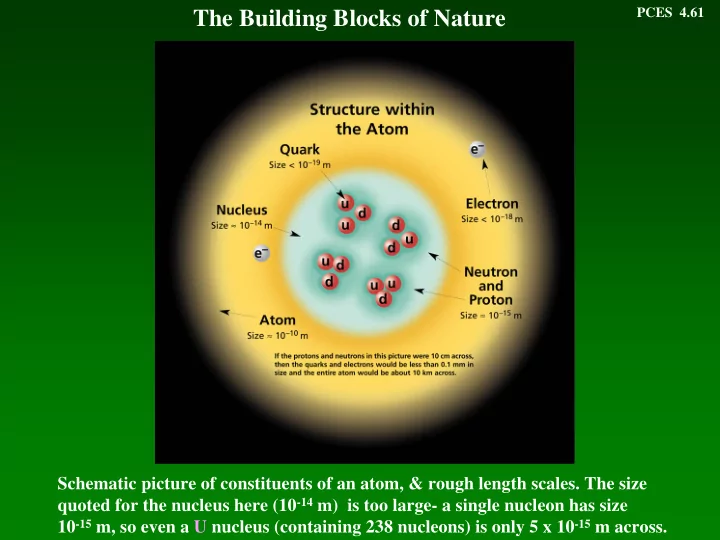
Schematic picture of constituents of an atom, & rough length scales. The size quoted for the nucleus here (10-14 m) is too large- a single nucleon has size 10-15 m, so even a U nucleus (containing 238 nucleons) is only 5 x 10-15 m across.
SLIDE 2 Identical Particles: BOSONS & FERMIONS
PCES 4.62
Another amazing result of QM comes because if we have, eg., 2 electrons, then we can’t tell them apart- they are ‘indistinguishable’. Suppose these 2 particles meet and interact- scattering off each
- ther through some angle θ.
Two processes can contribute, in which the deflection angle is either θ or π − θ .
This means of course that both paths must be included at an equal level. Now suppose we simply EXCHANGE the particles- this would be accomplished by having θ = 0. Now you might think that this means the wave-function doesn’t change because the particles are indistinguishable. But this is not true- in fact we only require that ie., the probabilities are the same, for the 2 wave-functions. We then have 2 choices: If we add the 2 paths G (θ) & G(π−θ) above we must also use these signs:
G = G (θ) + G(π−θ) or G = G(θ) −G(π−θ) | Ψ (1,2) | 2 = | Ψ (2,1) | 2 Ψ (2,1) = + Ψ (1,2) BOSONS Ψ (2,1) = − Ψ (1,2) FERMIONS
One possible path for the scattering between 2 particles with a deflection angle θ. Another path contributing to the same process, assuming the particles are identical.
E Fermi (1901-1954) S Bose (1894-1974)
SLIDE 3
FERMIONS MATTER
PCES 4.63
The result on the last slide is fundamental to the structure of all matter. Suppose we try & put 2 fermions in the SAME state. These could be 2 localised states, centred on positions r1 & r2, and then let r2 r1; or 2 momentum states with momenta p1 & p2 , with p2 p1 . These are indistinguishable particles, so that if we now swap them the equation for fermions on the last page becomes which is only valid if
Ψ (1,1) = − Ψ (1,1) Ψ (1,1) = 0 (PAULI EXCLUSION PRINCIPLE)
The Pauli exclusion principle says that the amplitude and the probability for 2 fermions to be in the state is ZERO- one cannot put 2 fermions in the same state. This result is what stops matter collapsing – what makes it ‘material’ in the first place. Without the exclusion principle, we could put many atoms on top of each other- putting them all in the same state. All matter is made from elementary fermions. There are various kinds of fermionic particle in Nature, including electrons, protons, neutrons, and a host of other more exotic particles to be discussed in the following slides. The fundamental definition of matter, sought since the Greeks, is thus to be found in the very abstract properties of individual quantum states.
On the other hand bosons LIKE to be in the same state- we see very shortly what this leads to….
W Pauli (1900-1958)
SLIDE 4 PARTICLES & ANTI-PARTICLES
At the beginning of the 1930’s, 3 basic fermionic particles were known- the -ve charged electron, called e-, the +ve charged proton, called p+, and the newly discovered neutron, called n. The proton & neutron live in the nucleus, and have a mass some 1850 times larger than the electron’s.
However a remarkable theoretical result fundamentally changed this picture. P.A.M. Dirac, in 1931, reconciled Einstein’s special relativity with quantum mechanics, but with a startling result- all particles must have an ‘anti-particle’, with the same mass but
- pposite charge. It turns out we can imagine the
‘vacuum’ or ground state is actually a ‘Dirac sea’ of quantum states, all occupied. Exciting the system to higher levels is equivalent to kicking particles out of the Dirac sea, leaving empty states behind- these are the anti-particles! We never see the vacuum- only the excited particles and anti-particles.
If a particle and anti-particle meet, they mutually annihilate, with the excess energy emitted as bosons- in the case of an electron and anti-electron, as high- energy photons (actually gamma rays).
The Dirac vacuum, with 1 electron excited
- ut, leaving a positron (the empty state).
The discovery of the positron (C. Anderson, 1932), identified by its track. PCES 4.64
PAM Dirac (1902-1984)
SLIDE 5 Proton-neutrino scattering (Z0 exchange) TOP: Scattering between a proton (3 quarks) and an electron, via photon exchange
BOSONS FORCES
We hav We have seen that the seen that the elementar elementary quantum o quantum of EM EM radiation – radiation – of the EM field f the EM field – is the photon, which is a s the photon, which is a
- boson. The exchange of photons between charged
- boson. The exchange of photons between charged
particles like electr particles like electrons is,
in a q a quantum theo antum theory, what , what causes the electric and magnetic for causes the electric and magnetic forces between them. es between them. To give a proper mathemati To give a proper mathematical quantum theor cal quantum theory of the
combin mbined system o ed system of elect electron
s & photons – & photons – what is called t is called ‘Quantum Electrod ‘Quantum Electrodynamics’, ynamics’,
- r ‘QED’ –
- r ‘QED’ – turned out to be
turned out to be ver very difficult – difficult – it was finally t was finally accomplished in the accomplished in the perio eriod 1946-1951, with the key d 1946-1951, with the key contribution butions made by the 4 theor s made by the 4 theorists shown sts shown at left. at left. The resulting theory w as very important, because it provided a blueprint for all theories of interacting fermion and boson fields – w hat came to be called ‘Quantum Field Theory’. Its most distinctive feature is the ‘Feynman diagram’. Particle physics since then– Particle physics since then– until recently - until recently - has been an as been an elaboration of quantum field elaboration of quantum field theory to cover a l eory to cover a large vari rge variety ety
nic part articles cles interacting via various interacting via various bosonic bosonic fields. We now turn to
this stor this story….
(1) (2) (3) (4)
The found The founders of rs of QED: QED: (1 (1) S Tomonaga S Tomonaga (1906-1979) (1906-1979) (2) (2) FJ FJ Dyson son (1923 (1923- ) (3) (3) RP RP F Feyn ynman man (1920 (1920-1987)
(4) J Schwi ) J Schwinger (1918 (1918-1994)
PCES 4.65
SLIDE 6 PCES 4.66
CONSTITUENTS of MATTER
Matter is made from fermions- and it is the Pauli principle, preventing these from overlapping, that gives matter its volume and structure. We now know of many fermions, but at the most basic level yet established, they are made from QUARKS and LEPTONS. The quarks come in 18 varieties, which are given funny names- one has 3 “colours” (red,blue, green), and then 6 flavours. Heavy fermionic particles (protons, neutrons, mesons, etc.) are made from combinations of
- quarks. Quarks were first postulated by Gell-Mann and Zweig.
The light fermions are called leptons- also shown above. Note the leptons are ordinary spin-1/2 fermions with charge 1 or 0 (in units
- f electric charge), but the quarks have charges in units of 1/3 of an
electron charge. The quarks can never appear freely- if we try to pull them apart, the force binding them gets even stronger (one has to create more massive particles). Physical particles like baryons are ‘colourless’- made from 3 quarks, one
baryons can be made with different triplets
Quark composition of p, n, and Ω−
M Gell-Mann (1929- )
SLIDE 7 PCES 4.67
QUANTUM FIELD THEORY pushed to the Limit
The underlying framew ork of all these theories of modern particle physics is quantum field theory – the idea of a hierarchy of fields w hich w ill ultimately be unified into one very complicated ‘master field’. This dream, w hich derives originally from Einstein (w ho how ever w as interested in a cl class assical cal unified field theory, not a quantum one), made huge progress in the period 1967-77. First came the unification in 1967 of the w eak and EM forces into an ‘electrow eak’ field theory, by Salam & Weinberg. This theory w as thought to be inconsistent (technically, to be ‘non-renormalisable’) & w as ignored until 1970, w hen ‘t Hooft, then a student, show ed that it w as indeed a viable theory, and he & his supervisor Veltman show ed how to do calculations w ith it. The next step, taken in an unpublished w ork by ‘t Hooft in 1972 & in papers by Gross & Wilczek, and Politzer in 1973, w as to address the strong interactions. It w as found that a field theory of quarks interacting via ‘gluons’ had a remarkable feature w hich w as called ‘asymptotic freedom’ – the attractive force betw een the quarks does not decrease as they separate, and so it w ould take an infinite energy to separate them (in fact, as they separate a string
- f ‘quark/anti-quark pairs’ is produced, and this costs energy proportional to the
length of the string). Instead the quarks stay very close to each other w here they can behave much like a gas of free particles. This set of basic ideas w as quickly assembled into a unified theory of the w eak, strong, and EM fields, now called the ‘Standard Model’. tandard Model’. This theory has been tested in many w ays since its inception 30 yrs ago – not only does it w ork quantitatively, but most have predictions have been verified (the most important outstanding prediction being that of the Higgs boson, not yet found). On the next page a more detailed picture is given of how these 3 interactions are unified, and the particles or quanta that are associated w ith this unified set of boson fields. This theoretical framew ork is a remarkable and very pow erful extension of QED to a much broader quantum field theory of ‘elementary particles’.
A Salam (1926-1996) S Weinberg (1933- ) David Gross (1941- ) Frank Wilczek (1951- ) Gerard ‘t Hooft (1947- )
SLIDE 8
PCES 4.68
FUNDAMENTAL INTERACTIONS
The fundamental bosons are divided into 4 classes- these bosons cause interactions between fermions, and give rise to 4 fundamental forces in Nature- the strong, weak, electromagnetic, and gravitational interactions. At very high energies things change. All interactions (with their associated particles), except the gravitational one, merge into a single complex field described by the ‘standard model’. To unify gravity with this is a fundamental unsolved problem
Note the strong interaction betw een quarks is mediated by gluons, but gluons (& mesons) are quark pairs.
SLIDE 9 EXPERIMENTS in PARTICLE PHYSICS
The pattern for experimental research on the building blocks of Nature was set by Rutherford, and has hardly varied since- one smashes things together at high energy, to see what comes out. The energy per particle in such experiments has now reached the TeV (1012 eV) level. By comparison, the ionisation energy of a H atom (the energy required to strip the electron off it) is 13.6 eV; & the energy in Rutherford scattering experiments is ~ 1 MeV (106 eV). The modern experiments are huge and very expensive- they are done either in CERN (Geneva) or Fermilab (Chicago). Particles are accelerated in huge underground rings, guided by giant magnets. The result of these particle smashing expts is observed by sensitive
- detectors. A lot of modern
technology (including the world wide web), has come from this work.
PCES 4.69 ABOVE: Fermilab- aerial view The ‘ATLAS’ detector (CERN) p+ - p_ scattering (CERN) Inside the LHC ring (CERN)
SLIDE 10
Search for a unified field theory- STRING THEORY
PCES 4.70
Arguably the most important problem in modern physics is how to unify the standard model (ie., the strong, weak, & EM forces) with gravity. The basic problem is that (i) the fields corresponding to thefirst 3 forces can be ‘quantized’ (producing all the boson excitations we have seen), but (ii) if we try and quantize gravity, we get nonsense- interactions between quantized gravity waves (‘gravitons’) are infinite. The current attempt to solve this problem is called string theory (sometimes rather stupidly called the ‘TOE’, for ‘Theory of Everything’). This theory began over 30 years ago with attempts to control the infinities in quantum gravity. The modern (2006) string theory has an 11- dimensional quantum ‘geometry’ with 7 of the dimensions ‘wrapped up’ very tightly (recall a geometry can be closed or ‘compact’), to form ‘hypertubes’, only 10-35 m in diameter, called strings. Particle excitations (electrons, photons, quarks, etc) are wave oscillation modes of strings. 4-dimensional spacetime is the ‘unwrapped’ part of this. Even without a final theory, it is easy to see that unification can only happen at the Planck length scale of 10-35 m, or at energies of 1029 eV. Thus the theory cannot be tested directly except at particle energies 1016 times greater than modern accelerators- this will never happen.
A string; magnified view below Quantum gravity theory tries to quantize the fluctuating geometry of spacetime
SLIDE 11 Unified Fields, Renormalisation, & ‘REDUCTIONISM’
PCES 4.71
The success of the programme The success of the programme for the unification of
forces/fields has emboldened many in their es/fields has emboldened many in their belief in the quantum belief in the quantum field theor field theory/s /string theory blueprint tring theory blueprint for the ultimate theory for the ultimate theory of the material world
It has als It has also led
to a widespread ad be belief in a philosophical appr lief in a philosophical approach to
- ach to Nature which is sometimes called
Nature which is sometimes called
‘Reductionism’. In physics this is sometimes allied to the idea of ‘Renormalisation’. REDUCTIONISM: Crudely, the belief that Nature can be understood in a sort of ‘lego’ approach, w ith fundamental building blocks, so that everything can be understood if one know s these blocks and the forces betw een them. RENORMALISATION: A technique for producing a low -energy theory (made from large ‘lego blocks’) from a higher energy one (made from small lego blocks), by averaging over the high-energy degrees of freedom.
The 2 biggest problems facing this approach now are both connected with the extrapolation of present theory to the very high Planck scale energies. They are (i) The difficulty in quantizing gravity, which may be solvable by string theory. However There are problems with the string approach, & many (eg. ‘t Hooft, Penrose) feel that a different approach is necessary at or beyond the Planck scale – one which may supercede quantum field theory. (ii) There is no way on earth to ever do experiments at this scale – despite the
- ptimism of graphs like the one at right.
A ‘Livingston plot’ showing particle accelerator energies with time.