
SLIDE 1
The Application & Effects of Sky Models on Hill Shading
Patrick Kennelly – LIU Post, Brookville, New York, USA James Stewart – Queens University, Kingston, Ontario, Canada
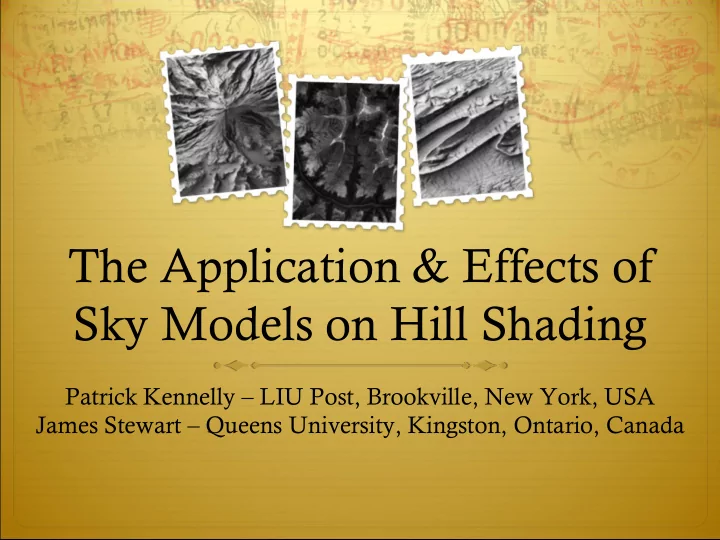
The Application & Effects of Sky Models on Hill Shading Patrick - - PowerPoint PPT Presentation
The Application & Effects of Sky Models on Hill Shading Patrick Kennelly LIU Post, Brookville, New York, USA James Stewart Queens University, Kingston, Ontario, Canada Hill Shading with Point Source Illumination Elevation Grid
Patrick Kennelly – LIU Post, Brookville, New York, USA James Stewart – Queens University, Kingston, Ontario, Canada
Elevation Grid Hill Shaded Grid
Background Objectives Methodology Results Summary
Background Objectives Methodology Results Summary
Background Objectives Methodology Results Summary
Non-Directional
Uniform Overcast
Directional
Clear Sharp Turbid General (1 – 15)
Background Objectives Methodology Results Summary
Background Objectives Methodology Results Summary
Directional Non-Directional
Uniform Overcast Sky Point Source Sharp + Uniform Sharp Clear Day
✔ ✔ ✔
Background Objectives Methodology Results Summary
Begin with large number of sky sample points of equal azimuth spacing for equal increments of inclination. Sky radiance for each sample point is computed. Radiance values of sample points are divided into a given number of standard deviations, each representing a strata. Each stratum allocated approximately the same number of illumination vectors. Illumination vectors iteratively chosen to maximize angular distance from all previously chosen directions.
Background Objectives Methodology Results Summary
Background Objectives Methodology Results Summary x W1 x W2 x W3 x W4 x W5 + + + + +
Point Source Clear Day
Background Objectives Methodology Results Summary
Point Source Clear Day
Background Objectives Methodology Results Summary
Background Objectives Methodology Results Summary
Clear Point
Aspect
m=-0.5072 R2=0.69441 m=-1.0026 R2=0.36791
Point Source Overcast Sky
Background Objectives Methodology Results Summary
Point Source Clear Day
Background Objectives Methodology Results Summary
Background Objectives Methodology Results Summary
Elevation
m=-0.6517 R2=0.00189 m=9.7655 R2=0.05161
Point Source Overcast Sky
Background Objectives Methodology Results Summary
Point Source Overcast Sky
Background Objectives Methodology Results Summary
CIE sky models can be rigorously implemented to hill shade terrain. Sky model illumination can reveals details of terrain that can be lost in weakly or strongly illuminated terrain. Directional sky models preserve the three-dimensional appearance of terrain with predominantly positive relief while more evenly distributing shades of gray with aspect. Non-directional sky models permit more light to illuminate the depths of dissected terrain, allowing for enhanced rendering of landforms such as canyon floors.
Background Objectives Methodology Results Summary
PC Application plus Python script (etc.) http://watkins.cs.queensu.ca/~jstewart/SkyLum.zip
Background Objectives Methodology Results Summary