TEDI Plan for Bear River: T ackling E nvironmental D egradation and I - - PowerPoint PPT Presentation

tedi plan for bear river t ackling e nvironmental d
SMART_READER_LITE
LIVE PREVIEW

TEDI Plan for Bear River: T ackling E nvironmental D egradation and I - - PowerPoint PPT Presentation

TEDI Plan for Bear River: T ackling E nvironmental D egradation and I mpacts Phil McGuire and Tim DAgostino Overview Mission Statement Watershed Characteristics Land Use Water Use History Environmental


slide-1
SLIDE 1

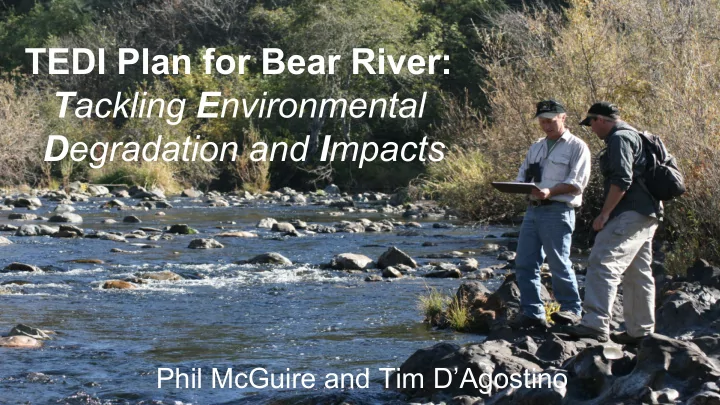
TEDI Plan for Bear River: Tackling Environmental Degradation and Impacts

Phil McGuire and Tim D’Agostino

slide-2
SLIDE 2

Overview

  • Mission Statement
  • Watershed Characteristics
  • Land Use
  • Water Use
  • History
  • Environmental Problems
  • Existing Organizations
  • Problems and Solutions
  • Recommendations
slide-3
SLIDE 3

Mission Statement

The T.E.D.I. Plan for Bear River seeks to restore fishable and swimmable water quality in the Bear River Watershed by 2045.

slide-4
SLIDE 4

Watershed Characteristics

  • Part of the American River Subregion of the

Sacramento River Watershed

  • Comprised of 4 counties (Placer, Sutter,

Nevada, and Yuba)

  • Origin: Sierra Nevada Mountain Range

(Elevation 5,000 ft)

  • Terminus: Feather River (Elevation ~ 100 ft)
  • Area: 220,000 acres
  • Annual Precipitation: 25-45 inches
slide-5
SLIDE 5

Land Use

  • Composition: 990 miles of streams,

creeks, and rivers

  • Development: 2,000 miles of roads

within the watershed (45% of streams are within 100 m of a public road)

  • Urban, Forest, and Cropland are

major land designations

slide-6
SLIDE 6

Water Use

  • Mining - canals and sluice boxes
  • Agricultural growth in 1800s and 1900s

increased irrigation needs

  • Dams built to encourage farming
  • In the late 1880s and early 1900s,

hydroelectric dams were built

  • In 2011, the Nevada Irrigation District

proposed a dam for city drinking water

  • In 2014, a new dam proposal was

introduced

slide-7
SLIDE 7

History

  • First settled ~3,000 BC by Nisenan Native American tribe
  • Region discovered in the 1800s
  • Settlement accelerated with the California Gold Rush
  • Gold mine construction contributed to sediment runoff and mercury

contamination

  • Agriculture later increased irrigation needs in the 1800s and 1900s
  • During the same period, several hydroelectric dams were constructed
slide-8
SLIDE 8

Environmental Problems

  • I. Fishery Destruction
  • II. Water Quality Contamination
  • III. Reduced Water Flow
slide-9
SLIDE 9
  • I. Fishery Destruction
  • Salmon and Steelhead populations
  • No self-sustaining salmon runs exist
  • Restoration of fishery benefits

○ Return of predatory species ○ Economic boost/tourism ○ Funding for additional management

slide-10
SLIDE 10
  • II. Water Quality Contamination
  • Mercury and bacteria
  • Biomagnification
  • Safety monitoring
  • Benefits of improved water quality

○ Swimmable/fishable goal ○ Tourism

slide-11
SLIDE 11
  • III. Reduced Water Flow
  • Greater population demands more water
  • Dam/Reservoir construction
  • Less for downstream communities/habitats
  • Benefits of increased flow

○ Reduced water stress ○ Protection of river for future generations

slide-12
SLIDE 12

Problems and Solutions

Problem Number (P) Goal Number (G) Solution Number (S) P1: Fishery Destruction G1.1: Mitigate Effects of Dams G1.2: Minimize Methylmercury Contamination S1.1.1: Fishways/Ladders/Elevators S1.1.2: Halt Dam Construction S1.2.1: Limit Eutrophication S1.2.2: Monitor Contamination P2: Water Quality G2.1: Mercury Remediation G2.2: Healthy Vegetative Cover S2.1.1: Thermal Desorption S2.1.2: Phytoextraction S2.2.1: Riparian Buffers S2.2.2: Controlled Burns P3: Reduced Water Flow G3.1: Reduce Water Consumption G3.2: Increase Groundwater Storage S3.1.1: Public Education S3.1.2: County Ordinances S3.2.1: Reduce Impervious Cover S3.2.2: Employ Aquifer Storage

slide-13
SLIDE 13

Existing Programs and Organizations

  • CABY
  • SRWP
  • Sierra Watch
  • Sierra Water Workgroup
  • Placer Land Trust
  • Bear Yuba Land Trust
slide-14
SLIDE 14

Conclusions and Recommendations

  • Implementation of T.E.D.I. Plan for

Bear River Watershed

  • Establishment of an overseeing

committee

  • Grassroots outreach and collaboration

with political leaders

  • Monitoring of progress
slide-15
SLIDE 15