Bear Essentials Bear Essentials Rangers in the Classroom - - PDF document

bear essentials bear essentials
SMART_READER_LITE
LIVE PREVIEW

Bear Essentials Bear Essentials Rangers in the Classroom - - PDF document

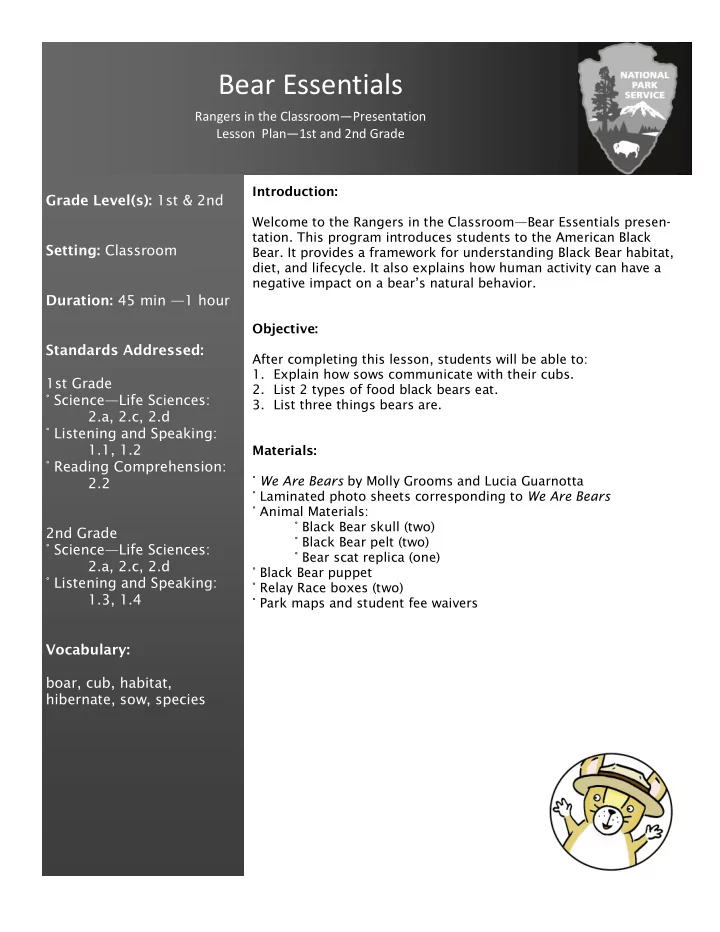
Bear Essentials Bear Essentials Rangers in the Classroom Presentation Rangers in the Classroom Presentation Lesson Plan 1st and 2nd Grade Lesson Plan 2nd Grade Introduction: Grade Level(s): 1st & 2nd Welcome to the Rangers in


slide-1
SLIDE 1

Bear Essentials

Rangers in the Classroom—Presentation Lesson Plan—2nd Grade

Bear Essentials

Rangers in the Classroom—Presentation Lesson Plan—1st and 2nd Grade Grade Level(s): 1st & 2nd Setting: Classroom Duration: 45 min —1 hour Standards Addressed: 1st Grade ° Science—Life Sciences: 2.a, 2.c, 2.d ° Listening and Speaking: 1.1, 1.2 ° Reading Comprehension: 2.2 2nd Grade ° Science—Life Sciences: 2.a, 2.c, 2.d ° Listening and Speaking: 1.3, 1.4 Vocabulary: boar, cub, habitat, hibernate, sow, species

Introduction: Welcome to the Rangers in the Classroom—Bear Essentials presen-

  • tation. This program introduces students to the American Black
  • Bear. It provides a framework for understanding Black Bear habitat,

diet, and lifecycle. It also explains how human activity can have a negative impact on a bear’s natural behavior. Objective: After completing this lesson, students will be able to:

  • 1. Explain how sows communicate with their cubs.
  • 2. List 2 types of food black bears eat.
  • 3. List three things bears are.

°°Science: Materials: ° We Are Bears by Molly Grooms and Lucia Guarnotta ° Laminated photo sheets corresponding to We Are Bears ° Animal Materials: ° Black Bear skull (two) ° Black Bear pelt (two) ° Bear scat replica (one) ° Black Bear puppet ° Relay Race boxes (two) ° Park maps and student fee waivers

slide-2
SLIDE 2

Bear Essentials

Rangers in the Classroom—Presentation Lesson Plan—2nd Grade

Bear Essentials

Rangers in the Classroom—Presentation Lesson Plan—1st and 2nd Grade Presentation:

Introduction Bears capture our imagination as few other animals do. They have inspired stories and cultural icons such as Winnie the Pooh, Yogi bear, Paddington bear, Goldilocks and the Three Bears, Smokey Bear, and teddy bears. They appeal to many of our emotions and values: fear, humor, grace and strength. Seeing a bear in the wild is an unforgettable experience. Sequoia and Kings Canyon National Parks—right in your backyard—is home to the American black bear, which is one of the 8 species

  • f bears found in the world. Black bears are found only in North America. Today, we will learn

about these fascinating bears and how our behavior influences bear behavior and how bear behavior influences us. Read We Are Bears by Molly Grooms and Lucia Guarnotta aloud to the class. Bears are described as many things in this story. Can you name one?

  • A. Climbers—In the story, the cubs scampered up the tree when mama bear gave a warning signal.

Mama bears/females are called sows.

  • 1. What was her signal? A snort. She might also whine, woof like a dog or grunt to

communicate with her cubs. How does your mom signal danger?

  • 2. Bears are natural climbers. (They do not have to be taught.) They will climb to escape

danger, to eat, to rest and to play.

  • 3. What special feature do black bears have that allows them to climb trees so easily? Claws.
  • 4. Show pelt with claws. Two inch long, curved claws allow them to grip the tree. Could you

climb a tree with just your fingernails?

  • B. Searchers—In the story, what did the mama bear and cubs use to find food? They used their long
  • noses. Do you use your nose to find food?
  • 1. Bears have a much keener sense of smell than humans.
  • 2. Show skull. Note the length of nose and internal “webbing.”
  • 3. This excellent sense of smell helps them detect their cubs, other bears, humans and, of

course, food. They can detect smells three miles away. Give an example of this distance, so the students can imagine how far this is.

  • C. Swimmers—In the story, where did the cubs and mama bear go when the bees were chasing

them? They went into the lake. Do you know how to swim?

  • 1. Bears will swim for pleasure and purpose. Water provides a way to escape from insects,

to cool off, to feed (insects, frogs, fish), to relieve itching, to play, float, scratch, soak and splash.

  • 2. Bears swim “doggy paddle” fashion and shake off water like a dog.
  • 3. Show pelt with paws. Big paws help them swim.
  • D. Diggers—In the story, what did mama bear do when the cubs were hungry after swimming? She

dug up roots and reeds. Do you dig up your food?

  • 1. Bears use their claws to dig up roots, to turn over rocks for food underneath and to find
slide-3
SLIDE 3

Bear Essentials

Rangers in the Classroom—Presentation Lesson Plan—2nd Grade

Bear Essentials

Rangers in the Classroom—Presentation Lesson Plan—1st and 2nd Grade

insects in hollow logs.

  • 2. Show pelt with claws. Each bear paw has five toes and five sharp claws.
  • 3. Bears also use their long, sticky tongue to pick up the insects they find.
  • E. Teachers—In the story, why was mama bear proud of her cubs? She was proud of them for

learning so much during their first day out of the den.

  • 1. Sows spend the first summer teaching their cubs what food to eat and where to find it.
  • 2. Problem: they may teach their cubs bad habits like stealing food from cars, camp sites,

trash cans or feeding from bird feeders. When this happens, we have a nuisance bear or problem bear.

  • a. Since bears are curious and have a good memory, it is hard to break them of the

habit of stealing human food once they have a taste for it.

  • b. They learn to associate humans with an easy food supply. This causes conflicts

between humans and bears.

  • c. They lose the good habits they developed for life in the wild and pick up habits that

are bad for both the bears and humans, such as destruction of property. If the bad habits become persistent, the problem bear must sometimes be destroyed.

  • e. People need to take special precautions to ensure that bears never get to taste

human food.

  • F. Sleepers—In the story, what did the cubs do once they were full of their mother’s milk? They

took a nap. Do you get sleepy when your belly is full?

  • 1. Generally, bears eat and sleep throughout the day.
  • 2. When winter is on its way, the mother bear and her cubs will find a new den. During the

first winter, the cubs will hibernate with their mother. They are very flexible with the type of den they use. They may use hollowed out logs or trees or make a nest out of thick ground cover.

  • 3. Hibernation is a state of dormancy and inactivity used by bears and other animals to

adapt to scanty food supplies during winter. It is not in response to the cold, but to seasonal food shortages.

  • 4. To prepare for hibernation, bears will eat about twenty thousand calories each day. That

is like eating forty-two hamburgers. Could you eat that many hamburgers in one day? Bears are also:

  • G. Guardians—Sows are very protective of their cubs. Do you get reminded to look both ways

before crossing the street?

  • 1. Sows are always looking out for potential danger. It is their job to keep cubs safe.
  • 2. Papa bears are called boars and do not stay to help raise the cubs. Boars may actually eat

the young cubs, so the sow keeps her cubs away from other bears.

  • H. Siblings—Sows average two cubs per litter. Do you have any brothers and/or sisters?
  • 1. Each bear has its own personality and coloration. Do you look like either of your parents
  • r your siblings?
  • 2. Bear brothers and sisters sometimes continue to live together after they leave their

mother during their second summer. By their third summer, they each go their own way to live their solitary life.

slide-4
SLIDE 4

Bear Essentials

Rangers in the Classroom—Presentation Lesson Plan—2nd Grade

Bear Essentials

Rangers in the Classroom—Presentation Lesson Plan—1st and 2nd Grade

Bear Activities for 2nd Grade (time permitting) #1 Bear Song (5—10 minutes) Directions:

  • 1. This activity takes place in the classroom.
  • 2. Have the students spread out so they have room to maneuver.
  • 3. The song is set to the “Farmer in the Dell” tune.
  • 4. The ranger will sing the first line and the students should join in for the repeat of that line and

the chorus.

  • 5. Explain to the students that they should move their bodies to match what the bear is doing in

the song and demonstrate the movements. The Bear in the Forest The bear stretches his legs (ranger), the bear stretches his legs (everyone), hi ho the berry-oh the bear stretches his legs (everyone) The bear scratches his back (ranger), the bear scratches his back (everyone), hi ho the berry-

  • h the bear scratches his back (everyone)

The bear swims the river (ranger), the bear swims the river (everyone), hi ho the berry-oh the bear swims the river (everyone) The bear runs through the woods (ranger), the bear runs through the woods (everyone), hi ho the berry-oh the bear runs through the woods (everyone) The bear climbs a tree (ranger), the bear climbs a tree (everyone), hi ho the berry-oh the bear climbs a tree (everyone) The bear digs for grubs (ranger), the bear digs for grubs (everyone), hi ho the berry-oh the bear digs for grubs (everyone) The bear takes a nap (ranger), the bear takes a nap (everyone), hi ho the berry-oh the bear takes a nap (everyone) #2 Relay Race (20—30 minutes) Directions:

  • 1. This activity takes place outside. Make sure the students are dressed for the weather.
  • 2. If the weather is too bad to play outside, this activity can be modified for an indoor version

similar to Jeopardy. See below #10.

  • 3. Divide the students into two teams and have them pick a team name.
  • 4. Take the two teams outside and select a start line. Place the two relay boxes about twenty to

thirty feet away from the start line.

slide-5
SLIDE 5

Bear Essentials

Rangers in the Classroom—Presentation Lesson Plan—2nd Grade

Bear Essentials

Rangers in the Classroom—Presentation Lesson Plan—1st and 2nd Grade

  • 5. Have the teams make two straight lines behind the start line.
  • 6. Explain the rules to the students:
  • a. The ranger will read a question about bears to the first two students on each team.
  • b. When the ranger gives the signal, these two students will run down to the relay box to

find the right answer.

  • c. Once the student finds the answer, s/he will then run back and give the answer to the
  • ranger. The answer card will be returned to the relay box by the next player.
  • d. If a student returns with the wrong answer, the ranger will reread the question and have

the student run back to the relay box to try again.

  • e. When the question has been answered correctly by both teams, these players will go to

the back of the line and the ranger will read a question to the next two players. Make sure they have the answer cards from the previous players to return to the box.

  • f. The relay will continue until every student has had a chance to answer a question.

Repeat questions, if necessary, to make sure every student gets to play.

  • g. The team with the least number of wrong answers wins the game.
  • 7. Once the relay race is over, have the players return to their straight lines.
  • 8. Pick a volunteer from each team to retrieve the relay boxes.
  • 9. When the students are quiet and paying attention, walk them back to their classroom.
  • 10. If the weather is too rough for playing outside, have the two teams line up inside the
  • classroom. Instead of racing to the relay box, set the boxes near each team for safe and easy
  • access. Proceed with the game as described above.

RELAY QUESTIONS:

  • 1. Bears are climbers. What do bears use to climb trees? Claws.
  • 2. Bears are searchers. What does a bear use to sniff out food? Nose or snout.
  • 3. Where does a bear go to hibernate? Den or Cave.
  • 4. What kind of bear do we have here in California? American black bear.
  • 5. What do you call a baby bear? Cub.
  • 6. What do you call a mama bear? Sow.
  • 7. What do you call a papa bear? Boar.
  • 8. Bear bodies are covered with what? Fur.
  • 9. Bears are climbers. What can bears climb to get away from danger? A tree.
  • 10. What juicy fruit found on bushes do bears like to eat? Berries.
  • 11. What sticky sweet treat do bears like to eat? Honey.
  • 12. What do bears with bad habits like to eat? Human food.
  • 13. Where do black bears live? The forest.
  • 14. Bears are swimmers. Where can bears go to cool off? Lake or river.
  • 15. What do bears use to pick up insects? Tongue.

Conclusion Bears are many things: climbers, searchers, swimmers, diggers, teachers and sleepers. We hope that you will come visit us in the parks where you may get lucky and see a black bear. Explain student fee waiver and encourage students to come to the park.

slide-6
SLIDE 6

Bear Essentials

Rangers in the Classroom—Presentation Lesson Plan—2nd Grade

Bear Essentials

Rangers in the Classroom—Presentation Lesson Plan—1st and 2nd Grade

Vocabulary Boar—noun—adult male black bears Cub—noun—a young black bear from birth to around age one Habitat—noun—the natural environment of an organism Hibernate—verb—to pass the winter in an inactive or dormant state. Black bears are not true

  • Hibernators. Their “hibernation” is a period of semi-dormancy.

Sow—noun—adult female black bear Species—noun—a class of individuals having some common characteristics or qualities; the basic category of biological classification composed of related individuals that resemble one another and are able to breed among themselves.

slide-7
SLIDE 7

Bear Essentials

Rangers in the Classroom—Presentation Lesson Plan—2nd Grade

Bear Essentials

Rangers in the Classroom—Presentation Lesson Plan—1st and 2nd Grade

Bibliography Anderson, Margaret, Nancy Field and Karen Stephenson. Discovering Black Bears. Middleton, WI: Dog-Eared Publications LLC, 2007. Brown, Gary. The Great Bear Almanac. New York, NY: Lyons & Burford, Publishers, 1993. Feeney, Kathy. Black Bears. Minnetonka, MN: NorthWord, 2000. Martarano, Steve. “The Bear Facts on Black Bear Biology and Ecology.” Outdoor California, Volume 63: No. 4 (July—August 2002): 3—45. Wexo, John Bonnett. Zoobooks Bears. Poway, California: Wildlife Education, Ltd., 2005. http://www.zoobooks.com http://www.greatbear.org http://www.billybear4kids.com http://www.defenders.org http://www.sierrawildbear.net http://animals.nationalgeographic.com/animals/mammals/black-bear.html