SLIDE 1
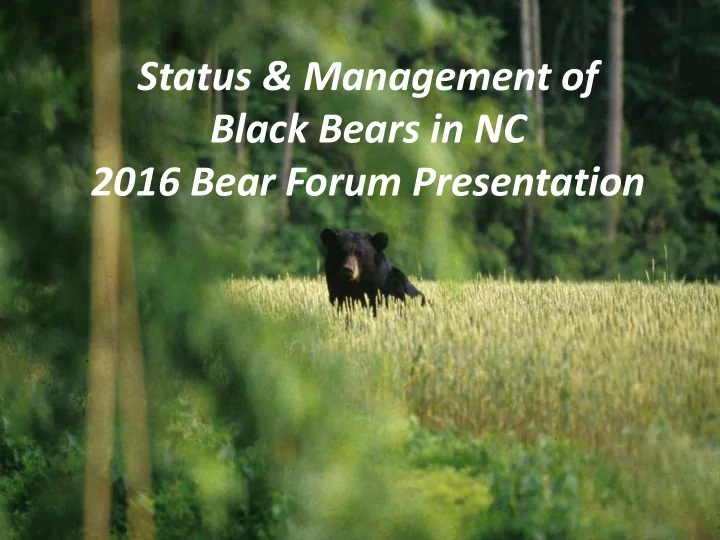
Status & Management of Black Bears in NC 2016 Bear Forum Presentation
SLIDE 2
So What is Tonight About?
1. Briefly review the NC Black Bear Management Plan. 2. Share data and information about our bear populations. 3. Describe development of “Zones” in the Coastal Bear Management Unit. 4. Discuss with hunters the status and opportunities regarding bear hunting rules, seasons, future needs and desires. 5. Get input from you on the future of bear management!
SLIDE 3 We are going high tech!
Each attendee was given an electronic device that they could use to anonymously answer questions throughout the night. The statewide summary of audience answers are included in this presentation.
SLIDE 4 Are you a hunter? (for any species)
91% 9%
0% 20% 40% 60% 80% 100%
Yes No
SLIDE 5 Please tell us your age range…
9% 23% 27% 31% 9%
0% 10% 20% 30% 40%
24 & Under 25-40 41-55 56-70 71+
SLIDE 6 How far did you travel to get to this meeting?
20% 41% 28% 8% 3% 0% 10% 20% 30% 40% 50% <10 Miles 10-25 Miles 26-50 Miles 51-100 Miles >100 Miles
SLIDE 7
Review of North Carolina Black Bear Management Plan
SLIDE 8 Plan Approach
- History
- Current Status
- Future management
- Biologically-sound principles
- Formalizes Process:
- Goal
- Objectives
- Addressing bear issues
SLIDE 9 “Use science-based decision making and biologically-sound management principles to manage black bear populations in balance with available habitats and human expectations to assure long-term existence and hunting
Plan Goal
SLIDE 10
Plan Objectives
Seven Statewide Management Objectives
SLIDE 11 The Plan Identifies Three Regional Black Bear Management Units (BMU)
Population objectives were developed for each unit.
Piedmont BMU Coastal BMU Mountain BMU
SLIDE 12
www.ncwildlife.org/bear
SLIDE 13
Review of North Carolina Bear Population Data and Information
SLIDE 14
What are “Data”?
Facts or information (measurements or statistics) used to calculate, analyze, or plan something. Examples: Number of bears harvested Number of Hunters Square miles of huntable land in each county
SLIDE 15
Where Do We Get Our Data?
Most of it comes from you, our Bear Hunters!
SLIDE 16
We know we send you lot’s of stuff……
SLIDE 17 Why Do We Need Data?
We need data to effectively measure, monitor, and manage our bear populations.
- Monitor Population trends
- Determine effects of hunting regulations
- Manage people (response, defense of hunting, etc.)
SLIDE 18 We’re working for you, so please:
- Report your bear harvest
- Respond to mail surveys
- Submit a tooth from the bear you harvest
SLIDE 19 Do you consider yourself a bear hunter?
72% 28%
0% 20% 40% 60% 80%
Yes No
SLIDE 20 If you are a bear hunter, do you hunt species other than bear?
90% 10%
0% 20% 40% 60% 80% 100%
Yes No
SLIDE 21 If you hunt, on average, how many days do you hunt bear each year?
28% 16% 17% 38% 59% 21% 13% 7%
0% 10% 20% 30% 40% 50% 60% 70% 1-5 6-10 11-20 More than 20 Bear Forums e-Stamp Survey
*e-Stamp Survey – Survey of all NC bear e-Stamp license holders *
SLIDE 22 How many days did you hunt bears?
64% 19% 13% 5% 57% 22% 13% 8%
0% 10% 20% 30% 40% 50% 60% 70% 1 to 5 6 to 10 11 to 20 More than 20
(2015 e-Stamp Survey)
With Dogs Still/Stand
SLIDE 23
Statewide Harvest Data
SLIDE 24 What do you think the statewide bear harvest was in 2015?
A. < 500 B. 500 - 1000 C. 1000 - 2000 D. 2000 – 3000 E. > 3000
18% 27% 29% 16% 10% 0% 5% 10% 15% 20% 25% 30% 35% A B C D E
3118
SLIDE 25 2015 Statewide Black Bear Harvest
121 325 1080 1663
500 1000 1500 2000 2500 3000 3500
Total Harvest
3118
SLIDE 26 If you bear hunted last season, did you kill a bear?
34% 66%
0% 10% 20% 30% 40% 50% 60% 70% Yes, I did No, I did not
SLIDE 27 2014-2015 Hunter Harvest Survey Hunter Success Statewide
84% 16%
0% 10% 20% 30% 40% 50% 60% 70% 80% 90%
0 Bears 1 Bear
SLIDE 28 Statewide Hunter Success #s
84% 16%
0% 20% 40% 60% 80% 100%
0 Bears 1 Bear
Bear Hunter Success
54% 46% 0% 20% 40% 60% 80% 100%
Deer Hunter Success
0 Deer 1+ Deer
SLIDE 29 If you bear hunted last season, could you have killed a bear but chose not to shoot it?
65% 35%
0% 20% 40% 60% 80% Yes, I could have. No, I did not have the
SLIDE 30 If you chose not to shoot, Why?
- A. I was waiting for a larger bear (saving
my “tag”).
- B. I let another adult shoot it.
- C. I let a youth hunter shoot it.
- D. Several of these applied to me.
- E. Other reasons.
SLIDE 31 If you chose not to shoot, why?
16% 2% 14% 37% 31%
0% 10% 20% 30% 40%
Waiting for a Larger Bear Let another adult shoot it Let a youth hunter shoot it Several of these apply to me Other Reasons
SLIDE 32 If your bag limit had been two bears, would you have chosen to shoot a bear?
46% 41% 13%
0% 10% 20% 30% 40% 50% Yes, Probably No, the bag limit didn't matter Maybe, I'm not sure
SLIDE 33 Last season, did you participate in a bear hunt using dogs?
64% 36%
0% 10% 20% 30% 40% 50% 60% 70% Yes No
0.0% 20.0% 40.0% 60.0% 80.0% Hunt with Dogs Still/Stand Hunt
2015 e-Stamp Survey 36% 64% Statewide Attendees Response
SLIDE 34 32.0% 68.0%
0.0% 20.0% 40.0% 60.0% 80.0%
No Dogs With Dogs
Use of Dogs for Harvesting Bears
(2013-2015 Reported Harvest)
SLIDE 35 Successful Bear Hunters Statewide
(2015 e-Stamp Survey)
Used bait as
hunting methods Never used bait as a hunting method
Used Bait as a Hunting Method 42% 58%
SLIDE 36 Use of Bait by Method
(2015 e-Stamp Survey)
64% 60% 36% 40%
0% 10% 20% 30% 40% 50% 60% 70% 80% 90% 100%
Hunters Using Dogs Stand/Still Hunters
No Use of Bait Use of Bait
SLIDE 37 Sow harvest is important to population management!
In general, 40 - 44% of the harvest can be females before experiencing population declines.
SLIDE 38 40% 60%
0% 10% 20% 30% 40% 50% 60% 70%
Female Male
Sex Ratio of Harvested Bears
(2013-2015)
SLIDE 39 Regional Black Bear Management Units
Piedmont BMU Coastal BMU Mountain BMU
SLIDE 40 Which Bear Unit(s) do you hunt in?
A. Mountain B. Piedmont C. Coastal D. Coastal and Mountain E. Different combinations
Piedmont BMU Coastal BMU Mountain BMU
24% 4% 48% 19% 4%
0% 10% 20% 30% 40% 50%
Statewide Attendee Responses
SLIDE 41
Bear Management Unit Population Objective Statements
Mountain Objective
Stabilize the Mountain Bear Population at the current level.
Piedmont Objective
Manage the PBMU as a “limited bear population zone”.
Coastal Objective
Maintain the Coastal Bear Population at current levels.
SLIDE 42 So, let’s talk briefly about Bear Population Management!
Based on the current “best science” to maintain a stable population:
- We can harvest approximately 22-27% of our minimum
bear population estimate annually (huntable population*).
- 40-44% of the harvest level can be females (sows)
before we expect to experience population declines.
*Huntable population represents the estimate of bears in areas where they can be legally hunted. Examples of bears not represented in this estimate are bears found on National Parks, Wildlife Refuges, large black bear sanctuaries and significant urban areas.
SLIDE 43 So, for NC’s best current data that translates to:
Mountain Region 2014 Minimum Huntable Population Estimate: 5,917
- Current 3 yr. average harvest = 1,013 (17%)
- Current 3 yr. average female harvest is: 39%
Coastal Region 2014 Minimum Huntable Population Estimate: 11,259
- Current 3 yr. average harvest = 1,842 (16%)
- Current 3 yr. average female harvest is: 40%
SLIDE 44 So, using our best current data:
Mountain Region 2014 Minimum Huntable Population Estimate: 5,917
- Possible 289-585 more bears in the harvest (3 yr. avg.)
- Of which, 116-234 can be female bears
Coastal Region 2014 Minimum Huntable Population Estimate: 11,259
- Possible 635-1198 more bears in the harvest (3 yr. avg.)
- Of which, 254-479 can be female bears
SLIDE 45 Recent Regulatory Changes
- Baiting (hunting with the aid of unprocessed foods)
- New county seasons
- 75 lbs. cub weight law (statutory change)
SLIDE 46
Piedmont Bear Management Unit (PBMU)
Objective: To manage the PBMU as a “limited bear population zone”
SLIDE 47
Piedmont Bear Management Unit Bear Hunting Seasons
SLIDE 48 5 10 15 20 25 30 35 40 Piedmont Unit
4
PBMU Reported Harvest
39
SLIDE 49 2015 Reported Bear Harvest in the PBMU
1 1 1 3 3 4 1 3 2 8 7 1 4
SLIDE 50 2015 Piedmont Hunting Methods
- With Dogs = 4 (Franklin, Granville, Person and Warren)
SLIDE 51 2013-2015 Harvest Sex Ratios PBMU
19% 81%
0% 10% 20% 30% 40% 50% 60% 70% 80% 90% FEMALE MALE
SLIDE 52 Mountain Bear Management Unit (MBMU) and Bear Hunting Season
Estimated Huntable Population: 5,917
SLIDE 53 Mountain Bear Management Unit Reported Harvest
59 187 334 590 1199
200 400 600 800 1000 1200 1400
Mountain Unit Fluctuation in harvest due primarily to mast crops. Abundant mast typically results in lower harvest
SLIDE 54 Mountain Bear Management Unit Reported Harvest (5 Yr. Trend)
500 600 700 800 900 1000 1100 1200 1300
2011 2012 2013 2014 2015
Mountain Unit Linear (Mountain Unit)
2014 was the highest recorded mast crop on record!
SLIDE 55 2013-2015 Harvest Sex Ratios MBMU
39% 61%
0% 10% 20% 30% 40% 50% 60% 70%
FEMALE MALE
SLIDE 56 Fall 2014 Hunter Success MBMU
(Hunter Harvest Survey)
90% 10%
0% 20% 40% 60% 80% 100% 0 Bear 1 Bear 2014 had the highest mast crop on record for the mountain area and subsequently the lowest bear harvest since 2005.
SLIDE 57 Fall 2013 Hunter Success MBMU (Hunter Harvest Survey)
85% 15%
0% 20% 40% 60% 80% 100% 0 Bear 1 Bear
If we look at success in a more “normal” mast year (2013) it mirrors statewide and coastal success rates.
SLIDE 58 MBMU by Hunting Method
(2015 e-Stamp Survey)
53% 47%
0% 20% 40% 60% 80%
Still/Stand With Dogs
Hunters who indicated that they participated in at least 1 hunt using these methods.
SLIDE 59 MBMU Harvest by Hunting Method (3 Year Average Reported Harvest)
25% 75%
0% 20% 40% 60% 80%
Still/Stand With Dogs
SLIDE 60 Coastal Bear Management Unit (CBMU)
Estimated Huntable Population: 11,259
SLIDE 61
Coastal Bear Management Unit 2016 Hunting Seasons
SLIDE 62 Coastal Bear Management Unit Reported Bear Harvest
62 138 745 1073
1880
200 400 600 800 1000 1200 1400 1600 1800 2000 Coastal Unit
SLIDE 63 Coastal Bear Management Unit Reported Harvest (5 (5 Yr. Trend)
1500 1600 1700 1800 1900 2000 2011 2012 2013 2014 2015
Coastal Unit Linear (Coastal Unit)
SLIDE 64 2013-2015 Harvest Sex Ratios CBMU
40% 60%
0% 10% 20% 30% 40% 50% 60% 70%
FEMALE MALE
SLIDE 65 Fall 2014 Hunter Success CBMU (Hunter Harvest Survey)
85% 15%
0% 20% 40% 60% 80% 100% 0 Bears 1 Bear
SLIDE 66 CBMU Hunting Method (2015 e-Stamp Survey)
64% 36%
0% 20% 40% 60% 80%
Still/Stand With Dogs
Hunters who indicated that they participated in at least 1 hunt using these methods.
SLIDE 67 CBMU Harvest by Hunting Method
(3 Year Average Reported Harvest)
36% 64%
0% 20% 40% 60% 80%
Still/Stand With Dogs
SLIDE 68
Development of Zones in the Coastal Bear Management Unit
SLIDE 69
Coastal Bear Management Unit (CBMU)
SLIDE 70 Why Develop CBMU Zones?
Biologists, commissioners, and hunters have all recognized there are major differences across the Coastal Bear Management Unit.
- Bear Population Levels
- Land Use (Available Habitat)
- Hunter Desires and Management Preferences
- Levels of Human / Bear Conflicts (Agriculture)
SLIDE 71
2015 CBMU Bear Seasons
SLIDE 72 Development of CBMU Zones
- These 5 bear seasons are not bear management
areas or units.
- Instead, they reflect season dates established over
time that were based on:
- Bear Population Recovery / Expansion
- Hunter Access
- Hunter Desire and Input
- Local Law
SLIDE 73
Development of CBMU Zones
So, to create zones we needed to start from scratch…….
SLIDE 74
Development of CBMU Zones
So, to create zones we needed to start from scratch……. Because: The existing bear seasons should not drive us toward a conclusion.
SLIDE 75
Development of f CBMU Zones
We needed to conduct a cluster (or grouping) analysis based on variables that impact bear management and that are available for each county within the CBMU. So, what is a cluster analysis?
SLIDE 76
Development of f CBMU Zones
In simplest terms: A cluster analysis is an formula that determines similarities and differences between items based on identified variables and then groups them accordingly. So, let’s look at a simple cluster analysis.…..
SLIDE 77
Sampled Males Over 500 lbs.
SLIDE 78 Development of f CBMU Zones
- 1. What are most important variables with regard to
bear management?
- 2. And, which ones are available at the county level?
We made a list……..
SLIDE 79 Development of f CBMU Zones Available Variables
Four Broad Categories of Variables
- Biological
- Harvest
- Habitat
- Hunter Access and “Bear Refugia”
SLIDE 80 Development of f CBMU Zones Available Variables
Four Broad Categories of Variables
- Biological (5)
- Harvest (6)
- Habitat (1)
- Hunter Access and “Bear Refugia” (4)
16 potential variables were identified for consideration
SLIDE 81
We ran 62 different cluster analyses with different combinations of the 16 available variables, and cluster groups ranging from 2 to 5. We determined that only 5 of the 16 available variables were providing meaningful results in cluster analysis. We did not allow the process to force geographic clustering.
SLIDE 82 Development of f CBMU Zones Evaluated Variables
The 5 variables that demonstrated the ability to significantly influence clustering of counties were:
- Bear land cover
- Harvest per huntable area
- Ratio of sanctuary to non-sanctuary
- Average weight of sampled males
- Hunter success rate
SLIDE 83 Development of f CBMU Zones Evaluated Variables
- Bear Land Cover:
- Deciduous forest
- Mixed forest
- Wetland
* Agriculture influence on the landscape ???
SLIDE 84 Development of f CBMU Zones Evaluated Variables
- Bear Land Cover:
- Deciduous forest
- Mixed forest
- Wetland
- “Edible” planted crop (3-year average)
SLIDE 85
Percent Bear Land Cover
SLIDE 86
Harvest per Huntable Area (kill/sq. mile)
SLIDE 87
Bear Sanctuaries
SLIDE 88
Percent Sanctuary
SLIDE 89
We ran multiple cluster analysis and found that Dare County was heavily influencing the clusters. So we removed it and ran the analyses again. So let’s look at the one that fit the best…..
Final Zone Development
SLIDE 90 * Our BEST Analysis was 3 Clusters with 3 Variables: Bear Land Cover, Harvest per Huntable Area, and Percent Sanctuary
Final Zone Development
*The only Anova with pairwise testing resulting in 9 out of 9 (100%) of cluster comparisons being significantly different (P<0.05).
SLIDE 91
Science and Statistics can’t tell you the complete answer to every question…..
SLIDE 92 This map was next evaluated using expert elicitation of WRC biological staff. We asked them to provide recommendations based on their management knowledge and field experience in these counties.
Final Zone Development
To Produce a Final Map of CBMU Zones
SLIDE 93 BEST Analysis 3 Clusters with 3 Variables:
Final Zone Development
SLIDE 94 BEST Analysis 3 Clusters with 3 Variables:
Final Zone Development
SLIDE 95 BEST Analysis 3 Clusters with 3 Variables:
Final Zone Development
SLIDE 96 BEST Analysis 3 Clusters with 3 Variables:
Final Zone Development
SLIDE 97 BEST Analysis 3 Clusters with 3 Variables:
Final Zone Development
SLIDE 98
CBMU Biological Zones
SLIDE 99 Do you think these zones look like reasonable bear management zones for our coastal unit?
- A. Yes.
- B. No.
- C. I’m Not Sure.
SLIDE 100 Do you think these zones look like reasonable bear management zones for our coastal unit?
76% 3% 21%
0% 10% 20% 30% 40% 50% 60% 70% 80%
Yes No I'm Not Sure.
SLIDE 101
So, now let’s talk about information for each of these zones!
1 2 4 3
SLIDE 102 Which CBMU Zone do you most hunt in?
25% 54% 10% 6% 5%
0% 10% 20% 30% 40% 50% 60%
Mostly Zone 1 Mostly Zone 2 Mostly Zone 3 Mostly Zone 4 Equally in more than 1 Zone
SLIDE 103
2016 CBMU Bear Seasons
SLIDE 104 How our current bear seasons
- verlay on the CBMU Zones!
3 1 2 4
SLIDE 105
Zone Number of Counties Total Land Area (Square Miles) Huntable Land (Square Miles)
3 1,459 635 (44%) 15 9,275 8,141 (88%) 13 7,959 7,252 (91%) 6 1,486 1,289 (87%)
2 3 4 1
SLIDE 106 7% 42% 47% 4% 11% 10% 55% 23%
0% 10% 20% 30% 40% 50% 60%
Zone 4 Zone 3 Zone 2 Zone 1
% of Total CBMU Bear Harvest % CBMU Huntable Land
CBMU Zone Comparisons
(3 Year Average Reported Harvest)
SLIDE 107 CBMU Zone Comparisons
(3 Year Average Reported Harvest)
0.16 0.03 0.13 0.68
0.1 0.2 0.3 0.4 0.5 0.6 0.7 0.8
Zone 4 Zone 3 Zone 2 Zone 1
Kill/Sq. Mile of Huntable Area
SLIDE 108 CBMU Zone Comparisons
1.45 0.42 1.18 4.12
1 2 3 4 5 Zone 4 Zone 3 Zone 2 Zone 1
Hunters Per Sq. Mile
(2015 e-stamp)
SLIDE 109 Which CBMU Zone do you hunt most in?
1 2 4 3
- A. Mostly Zone 1
- B. Mostly Zone 2
- C. Mostly Zone 3
- D. Mostly Zone 4
- E. Equally in more than 1 Zone
SLIDE 110 CBMU Zone 1 Harvest Trend
221 239 499
100 200 300 400 500 600
16% of the 2015 Statewide Harvest! 27% of the 2015 CBMU Harvest!
SLIDE 111 Zone 1 Hunting Methods
(2015 e-Stamp Survey)
62% 38%
0% 20% 40% 60% 80%
Still/Stand With Dogs
SLIDE 112 Zone 1 Harvest by Hunting Methods
(2015 Reported Harvest)
47% 53%
0% 20% 40% 60% 80%
Still/Stand With Dogs
SLIDE 113 Zone 1 Harvested Bears by Method (2009-2015)
0% 10% 20% 30% 40% 50% 60% 70% 80% 2009 2010 2011 2012 2013 2014 2015
Still Dogs
SLIDE 114 CBMU Zone 2 Harvest Trend
53 133 415 665 996
200 400 600 800 1000 1200
SLIDE 115 Zone 2 Hunting Methods
(2015 e-Stamp Survey)
61% 39%
0% 20% 40% 60% 80%
Still/Stand With Dogs
SLIDE 116 Zone 2 Harvest by Hunting Methods
(2015 Reported Harvest)
34% 66%
0% 20% 40% 60% 80%
Still/Stand With Dogs
SLIDE 117 Zone 2 Harvested Bears by Method
(2009-2015)
0% 20% 40% 60% 80%
2009 2010 2011 2012 2013 2014 2015
Still Dogs
SLIDE 118 CBMU Zone 3 Harvest Trend
3 5 43 168
50 100 150 200 250 300 350
SLIDE 119 Zone 3 Hunting Methods
(2015 e-Stamp Survey)
69% 31%
0% 20% 40% 60% 80%
Still/Stand With Dogs
SLIDE 120 Zone 3 Harvest by Hunting Methods
(2015 Reported Harvest)
35% 65%
0% 20% 40% 60% 80%
Still/Stand With Dogs
SLIDE 121 Zone 3 Harvested Bears by Method
(2009-2015)
0% 20% 40% 60% 80% 2009 2010 2011 2012 2013 2014 2015 Still Dogs
SLIDE 122 CBMU Zone 4 Harvest Trend
98 126
217
50 100 150 200 250
SLIDE 123 Zone 4 Hunting Methods
(2015 e-Stamp Survey)
52% 48%
0% 20% 40% 60% 80%
Still/Stand With Dogs
SLIDE 124 Zone 4 Harvest by Hunting Methods
(2015 Reported Harvest)
33% 67%
0% 20% 40% 60% 80%
Still/Stand W/Dogs
SLIDE 125 Zone 4 Harvested Bears by Method
(2009-2015)
0% 20% 40% 60% 80% 2009 2010 2011 2012 2013 2014 2015 Still Dogs
SLIDE 126
Discussion and Input Time!
SLIDE 127 Where you hunt the most…….
A. The bear population is INCREASING B. The bear population is DECREASING C. The bear population is STABLE D. I’m NOT SURE
59% 8% 22% 11%
0% 20% 40% 60% 80% A B C D
SLIDE 128 How our current bear seasons
- verlay on the CBMU Zones!
3 1 2 4
SLIDE 129 Should Coastal Bear Seasons be aligned with the new Zones?
61% 20% 19%
0% 10% 20% 30% 40% 50% 60% 70%
Yes No Not Sure
SLIDE 130 Should we examine the mountain bear unit for biological Zones?
50% 31% 18%
0% 10% 20% 30% 40% 50% 60% 70%
Yes No Not Sure
SLIDE 131 On a given bear hunt, which is more important to you?
42% 58% 0% 10% 20% 30% 40% 50% 60% 70%
The size and quality of the bear I harvest Chasing and/or seeing a lot of bears
SLIDE 132 24% 16% 60%
0% 20% 40% 60% 80%
A B C
Which is more important to you?
- A. More time to hunt but fewer bears.
(maybe lower harvest success rate)
- B. Less time to hunt but more bears.
(maybe higher harvest success rate)
- C. Something in the middle.
SLIDE 133 Where you hunt the most…….
- A. The bear population should be INCREASED
- B. The bear population should be DECREASED
- C. The bear population should be LEFT AS IS
- D. I’m NOT SURE
28% 22% 44% 5%
0% 10% 20% 30% 40% 50%
A B C D
SLIDE 134 If necessary, what do you think would be the best way to increase the bear harvest?
31% 19% 16% 29% 5% 0% 5% 10% 15% 20% 25% 30% 35%
Increase Bag Limit to 2 Bears (no charge) Purchase another
harvest the 1st bear Increase the limit only in certain areas Increase the season length Something Else
SLIDE 135 Would you support this idea?
74% 22% 4%
0% 20% 40% 60% 80%
Yes No I don't know Allow any appropriately licensed hunter that is actively participating in a hunt to validate and reporting the harvest of a bear shot by an other appropriately licensed hunter participating in the same hunt (applies to both dog and still/stand hunts).
SLIDE 136 If a specific zone was allotted a “quota” of bears, would you prefer:
11% 9% 80%
0% 20% 40% 60% 80% 100%
A B C A. To establish harvest quotas for specific zones and require hunters to check total reported harvests
- nline before hunting, and then stop hunting when
quota is met. B. Require the issuance (sale) of a set number of authorizations per area/zone. C. I don’t like the idea of quotas at all!
SLIDE 137 If you hunt with a group, what is the average number of hunters in your group?
28% 39% 27% 4% 2%
0% 10% 20% 30% 40% 50% <5 6-10 11-20 21-30 >30
SLIDE 138 Two Sanctuary Questions
Asked in Sylva, Morganton, Thomasville and Raleigh
- 1. Do you support the idea of opening bear
sanctuaries to hunting?
53% 42% 6%
0% 10% 20% 30% 40% 50% 60% Yes No I'm not sure
SLIDE 139
- 2. If we opened selected sanctuaries
would you prefer:
45% 55%
0% 10% 20% 30% 40% 50% 60%
Open up the sanctuary to permit hunts indefinitely Rotate permit hunt opportunities on different sanctuaries every couple of years
SLIDE 140
One Last Thing…
SLIDE 141 Is this type of forum helpful?
92% 2% 7%
0% 20% 40% 60% 80% 100% Yes No Not Sure
SLIDE 142 Would you like to see more forums or something similar?
93% 2% 5%
0% 20% 40% 60% 80% 100% Yes No Not Sure