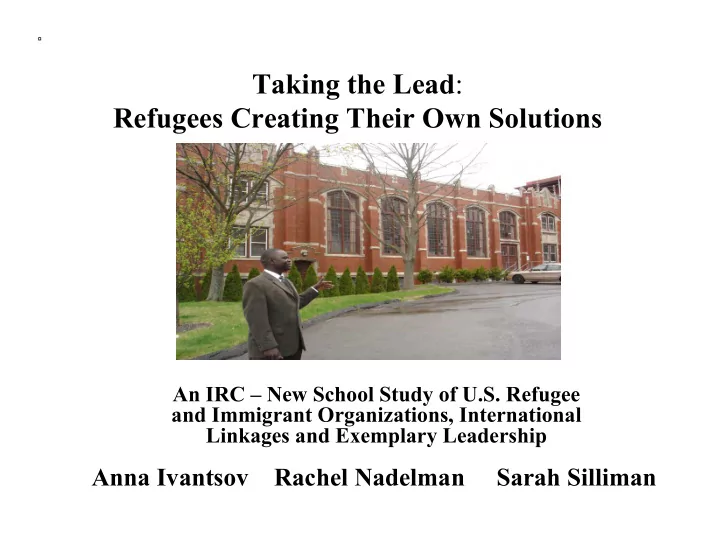
Taking the Lead : Refugees Creating Their Own Solutions An IRC New - - PowerPoint PPT Presentation

taking the lead refugees creating their own solutions
SMART_READER_LITE
LIVE PREVIEW

Taking the Lead : Refugees Creating Their Own Solutions An IRC New - - PowerPoint PPT Presentation

Taking the Lead : Refugees Creating Their Own Solutions An IRC New School Study of U.S. Refugee and Immigrant Organizations, International Linkages and Exemplary Leadership Anna Ivantsov Rachel Nadelman Sarah Silliman Project


slide-1
SLIDE 1

Taking the Lead: Refugees Creating Their Own Solutions

Anna Ivantsov Rachel Nadelman Sarah Silliman

An IRC – New School Study of U.S. Refugee and Immigrant Organizations, International Linkages and Exemplary Leadership

slide-2
SLIDE 2

Project Purpose

  • Create a community-based organization database
  • f refugee focused service providers
  • Identify organizations that collaborate with or

contribute to organizations in their home country

  • Identify outstanding refugee organizations and

leaders for potential collaboration with IRC program departments

slide-3
SLIDE 3

Southern Sudan** Democratic Republic of Congo

**Southern Sudan was the only country study focused on region rather than nation, because of nature of conflict and composition of U.S. refugee population.

Focus Populations: Africa

Sierra Leone Liberia

slide-4
SLIDE 4

Afghanistan Burma/Myanmar**

**Myanmar is official country name, but international bodies who

do not recognize ruling military junta (such as U.S.) use the name “Burma.”

Focus Populations: Asia

slide-5
SLIDE 5

Research: Methodology

  • CBOs identified through:

– Web-based research – Previous New School student study – CBO leadership/staff referrals

  • Findings based on:

– Data collected through surveys and phone interviews – In-person organizational assessments – CBO-produced print and electronic materials – News reports about CBOs

slide-6
SLIDE 6

Survey Design

The Survey addressed:

  • Why established, scope, programs and focus
  • Leadership (board, staff and volunteers)
  • Member and beneficiary characteristics
  • Collaborations & linkages

– U.S.-based – Home countries – Countries of first asylum

slide-7
SLIDE 7

Organizational Assessment Tools

Sigmoid Curve IRC Self-Assessment

  • Management (program,
  • rganizational & financial)
  • Leadership
slide-8
SLIDE 8

Research: Scope

  • 97 CBOs identified as Refugee/Immigrant-run in 20 states
  • 43 CBOs interviewed
  • 8 CBOs visited:

– Maine – Massachusetts – New York – Pennsylvania – Virginia

slide-9
SLIDE 9

CBO Main Functions

  • Serve U.S.-based refugee/immigrant populations

(locally, regionally and nationally)

  • Assist with development, reconstruction and social

services in home countries/countries first asylum

  • Advocate on behalf of community and ensure

information dissemination

slide-10
SLIDE 10

Work in the U.S.

  • Education (after school programs,

literacy, ESL, seminars/conferences, college prep, vocational training)

  • Health Service Provision (trauma

counseling, health fairs, medical assistance)

  • Legal Assistance and Referrals
  • Community Outreach/Development
  • Art and Culture
  • Youth Leadership
  • Peer Networking
slide-11
SLIDE 11

Linkages to Home Countries & Countries of First Asylum

  • Education (build/manage schools,

provide volunteer teachers, scholarships and supplies)

  • Development and Reconstruction
  • Emergency Relief Aid
  • Medical and Mental Health Services
  • Exchange Programs (cultural,

technical, development)

  • Leadership Support
slide-12
SLIDE 12

Advocacy

  • Public Organizing (rallies, political demonstrations and

festivals)

  • Lobbying Government (in U.S. and abroad)
  • Media Outreach (electronic and print)
  • Conferences and Lectures
slide-13
SLIDE 13

Particular social, political, economic conditions…

…directly shape each

population’s CBO efforts

slide-14
SLIDE 14

Common CBO Experiences

  • Funding Challenges
  • ‘Mission Creep’
  • Focus on Education
slide-15
SLIDE 15

Unique Characteristics of CBOs

  • Afghan – Financial and security issues, post 9-11

challenges in U.S; focus on immigrants, not refugees

  • Burmese – Prioritizes independence for Burma and

assisting refugees in countries of 1st asylum, offering only minimal social service for U.S.-based refugees

  • Congolese – Non-English speaking struggles, strong
  • rganization of the Diaspora (across U.S. – globally),

significant advocacy work

slide-16
SLIDE 16

Unique Characteristics of CBOs

  • Liberian – Colonial relationship with the U.S.; History
  • f organizing U.S. population before the conflict, advocacy

work

  • Sierra Leonean – Few organizations focus only in

U.S., because regional nature of conflict many CBOs are Pan African service providers

  • Southern Sudanese –U.S. refugees primary focus

(comprise majority of U.S. population), few and difficult linkages in Sudan

slide-17
SLIDE 17

Afghan:

*Afghan Communicator – Queens, NY American Society of Afghan Professionals – Alexandria, VA

Congolese:

*Congolese Women’s Association of New England – Jamaica Plain, MA Fondation Shalupe – Braintree, MA

Liberian:

*African Cultural Alliance of North America – Philadelphia, PA

Sierra Leonean:

*Nah We Yone – Harlem, NY

Southern Sudanese:

*Action for Self Reliance Association – Portland. ME *Southern Sudanese Organization – Lynn, MA

Organizational Assessments: CBOs Visited

slide-18
SLIDE 18

Action for Self Reliance Association (ASRELA) – Portland, ME

  • Designed and implemented a youth leadership program
  • U.S.-based programs tackle issues such as tribalism, inter-

family conflict and community building

  • Success in producing large-scale fundraising events for

Uganda school which joins diverse communities in the U.S.

  • Built and manages a K-6 school

in Kiryandongo refugee camp (Uganda) providing education and nutrition

slide-19
SLIDE 19

Afghan Communicator – Queens, NY

  • SLIDE INCOMPLETE
  • Strong connections with U.S.-based Afghan

CBOs and maintains a Kabul office to distribute Western aid

  • Provides immigration assistance and referrals
slide-20
SLIDE 20

African Cultural Alliance of North America (ACANA) – Philadelphia, PA

  • Provides job and health referrals, legal assistance,

educational programs, cultural orientation, support to artists, and a food bank for the community

  • Partners with health care providers for trauma counseling,

government agencies for cultural programs in the U.S.

  • Implementing educational program in Liberia
  • Working to become

‘one-stop’ social service provider for African immigrants and refugees

slide-21
SLIDE 21

Congolese Women’s Association of New England (CWANE) – Jamaica Plain, MA

  • First group to conduct focus-groups of Congolese women

throughout New England to identify their primary needs

  • Advocates for Congolese Women’s needs in the context of

the wider Congolese refugee/asylee community

  • Partners with mainstream social service providers and

Congolese CBOs to produce public events in the U.S. and subsequent workshops throughout New England

  • Raises funds for women’s projects in DRC
slide-22
SLIDE 22

Nah We Yone – Harlem, NY

  • Provides support to refugees in detention centers and resources

for resettlement including housing, job and legal referrals

  • Fosters sustainable service network here beneficiaries give

back as eventual providers

  • Partners with high profile international human rights NGOs

and local hospitals for advocacy and service provision

  • Creates a community of support for

African immigrants and refugees through counseling services, cultural programs, and youth camps

slide-23
SLIDE 23

Southern Sudanese Organization – Lynn, MA

  • Member of Massachusetts Mutual Assistance Coalition, an

alliance of eleven immigrant/refugee groups that provides support programs, seeks funding and partners with mainstream social service agencies

  • frequent partner to NGOs such as the IRC Boston

resettlement office and other refugee support agencies.

  • Creatively serves the community by utilizing skills and

knowledge learned at home to overcome challenges such as unemployment [picture to come]

slide-24
SLIDE 24

Thank you!