Migration in Austria Refugees From the CSSR 1968 (Prague Spring) - - PowerPoint PPT Presentation

migration in austria refugees
SMART_READER_LITE
LIVE PREVIEW

Migration in Austria Refugees From the CSSR 1968 (Prague Spring) - - PowerPoint PPT Presentation

Migration in Austria Refugees From the CSSR 1968 (Prague Spring) Prague Spring Antonin Novotny Alexander Dubek Refugees From Ex-Yugoslavia in the 1990s Refugees from the former Yugoslavia ethnic conflicts fought from 1991 to 2003


slide-1
SLIDE 1

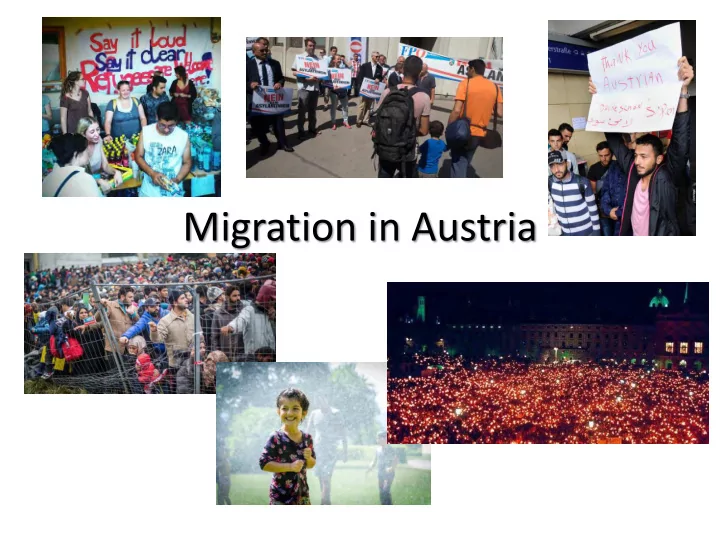
Migration in Austria

slide-2
SLIDE 2

Refugees

From the CSSR 1968 (Prague Spring)

slide-3
SLIDE 3

Prague Spring

slide-4
SLIDE 4

Alexander Dubček Antonin Novotny

slide-5
SLIDE 5

Refugees

From Ex-Yugoslavia in the 1990s

slide-6
SLIDE 6

Refugees from the former Yugoslavia

  • ethnic conflicts fought from 1991 to 2003
  • including:

– Ten-Day-War in Slovenia (1991) – Croatian War of Independence (1991–1995) – Bosnian War (1992–1995) – Kosovo War (1998–1999)

  • wars accompanied the breakup of the country
  • successor states: Bosnia and Herzegovina, Croatia,

Kosovo, Macedonia, Montenegro, Slovenia, Serbia

slide-7
SLIDE 7

Refugees from the former Yugoslavia

  • ethnic conflicts fought from 1991 to 2003
  • including:

– Ten-Day-War in Slovenia (1991) – Croatian War of Independence (1991–1995) – Bosnian War (1992–1995) – Kosovo War (1998–1999)

  • wars accompanied the breakup of the country
  • successor states: Bosnia and Herzegovina, Croatia,

Kosovo, Macedonia, Montenegro, Slovenia, Serbia

slide-8
SLIDE 8
  • Europe's deadliest conflict since World War II
  • 115,000 refugees in Austria

– 13.000 refugees from Croatia – 90.000 refugees from Bosnia and Herzegovina – 12.000 refugees from Kosovo

  • Austria became second country, with the most

refugees from Ex-Yugoslavia

slide-9
SLIDE 9

Refugees

After the fall of the Iron Curtain 1989/90

Magbulje Murati and Mina Yousefzai

slide-10
SLIDE 10
  • Iron Curtain formed a imaginary boundary
  • Eastern Europe and parts of Central Europe found themselves under the

hegemony of the Soviet Union

  • Between 1945 and 1949 the Soviets converted the following areas into

Soviet satellite states:

  • The German Democratic Republic
  • The People's Republic of Bulgaria
  • The People's Republic of Poland
  • The People's Republic of Hungary
  • The Czechoslovak Socialist Republic
  • The People's Republic of Romania
  • The People's Republic of Albania
  • April 1989: People's Republic of Poland legalised the Solidarity
  • rganisation
  • anti-communist candidates won a striking
slide-11
SLIDE 11
  • 19 August 1989, more than 600 East Germans attending the "Pan-

European Picnic"

  • Hungarian border guards had threatened to shoot anyone crossing the

border

  • mass protests in East Germany and the relaxing of border restrictions in

Czechoslovakia

  • the Romanian military sided with protesters and turned on Communist

ruler Nicolae Ceauşescu

  • a new package of regulations went into effect on 3 July 1990
  • hundreds of Albanian citizens gathered around foreign embassies to seek

political asylum and flee from the country

  • the inter-German border had become effectively meaningless
  • In July 1990, the day East Germany adopted the West German currency
slide-12
SLIDE 12

Foreign workers „Gastarbeiter“

In the 1960s

Vanovac Tamara, Puljic Nikolina

slide-13
SLIDE 13
slide-14
SLIDE 14
slide-15
SLIDE 15
slide-16
SLIDE 16