
SLIDE 1
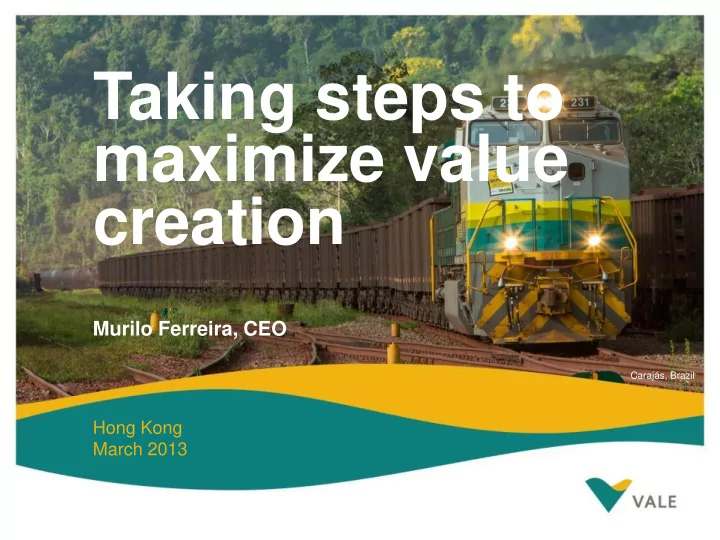
Taking steps to maximize value creation
Murilo Ferreira, CEO
Hong Kong March 2013
Carajás, Brazil
Taking steps to maximize value creation Murilo Ferreira, CEO - - PowerPoint PPT Presentation
Taking steps to maximize value creation Murilo Ferreira, CEO Carajs, Brazil Hong Kong March 2013 Disclaimer This presentation may include statements that present Vale's expectations about future events or results. All statements, when
Murilo Ferreira, CEO
Hong Kong March 2013
Carajás, Brazil
Disclaimer
“This presentation may include statements that present Vale's expectations about future events or results. All statements, when based upon expectations about the future and not on historical facts, involve various risks and uncertainties. Vale cannot guarantee that such statements will prove correct. These risks and uncertainties include factors related to the following: (a) the countries where we
markets; (d) the mining and metals prices and their dependence on global industrial production, which is cyclical by nature; and (e) global competition in the markets in which Vale operates. To obtain further information on factors that may lead to results different from those forecast by Vale, please consult the reports Vale files with the U.S. Securities and Exchange Commission (SEC), the Brazilian Comissão de Valores Mobiliários (CVM), the French Autorité des Marchés Financiers (AMF) and The Stock Exchange of Hong Kong Limited, and in particular the factors discussed under “Forward-Looking Statements” and “Risk Factors” in Vale‟s annual report on Form 20-F.”
2
Delivering on the commitments A better outlook
Agenda
Voisey's Bay, Canadá
Delivering on the commitments
4 PDM, Brazil
Our goal is to maximize shareholder return through the cycles. We are actively pursuing many ways to achieve it
– Enormous progress in environmental permitting and gradual resolution of tax issues.
– Focus on world-class assets: towards a smaller and higher return project portfolio. – Divestiture of non-core assets. – A lot of value to be unlocked from existing operations and projects ramping up. – Deploying capital to our highest return business: iron ore projects coming
cash flow, with a minimal use of the balance sheet.
5
New platforms of value creation are beginning to ramp up as planned
6
Salobo - a world-class asset in the first quartile
and gold
12 Mtpa¹ - 68% physical progress - start-up 1H14.
200,000 t of copper in concentrates plus about 320,000 ozpy of gold by- product.
7
¹ Run-of-mine (ROM).
VNC is proving to be technically feasible
100 t of cobalt (IPCM).
8
Ni = nickel NiO = nickel oxide NHC = nickel hydroxide cake IPCM = intermediate product of cobalt methodology
Product quality has been very good and meets design expectations
Existing base metals operations - nickel & copper - are showing a good performance. The successful ramp-up of projects – Salobo, Lubambe and VNC - is a major source
9
446 613 3Q12 4Q12 25.3 33.9 3Q12 4Q12
¹ Excluding pre-operating, idling expenses and R&D.
Adjusted EBITDA¹
US$ million
Adjusted EBITDA margin¹
SG&A spending is being reigned in
10
727 501 4Q11 4Q12
1 Excludes depreciation and nickel, copper and iron ore adjustment for provisional prices.
1,287 904 1,500 1,994 1,914 2008 2009 2010 2011 2012
SG&A¹
US$ million
Expenses with materials and outsourced services, responsible for almost 40% of COGS, are starting to be curbed
11
1,014 1,091 1,163 995 1Q12 2Q12 3Q12 4Q12 1,096 1,285 1,236 1,153 1Q12 2Q12 3Q12 4Q12
Materials
US$ million
Outsourced services
US$ million
R&D expenditures are being focused on fewer projects with higher value creation potential: 12% less than 2011 and 36% less than budgeted for 2012
12
1,063 1,010 1,136 1,742 1,533 2008 2009 2010 2011 2012
R&D
US$ million
13
Walking the talk: improving working capital management despite the impact of higher iron
Days receivables outstanding
62.3 53.2 56.2 52.7 1Q12 2Q12 3Q12 4Q12 8.545 7.825 7.213 7.312 1Q12 2Q12 3Q12 4Q12
Working capital
US$ billion
The divestment program is creating value: improves capital allocation, generates cash and simplifies the portfolio, focusing on what is really important
– Araucaria nitrogen - US$ 234 million. – Oil & gas exploration assets - US$ 40 million.
14
Total divestiture: US$ 1.471 billion
Unlocking value from existing assets: sale of gold flows, extracted as a by-product, at a very attractive premium
20 years.
US$ 100 million plus US$ 400 per oz upon gold delivery.
– Salobo payable gold by-product valued at US$ 5.32 billion plus NPV of US$ 400 payment flows for each oz of gold delivered. – Estimated capex of Salobo I&II of US$ 4.2 billion with nominal capacity of 200,000 metric tons of copper and the gold by- product.
15
Four major projects - involving total capital expenditures of US$ 13.0 billion¹ - are starting up in 2013 to boost value over the next few years
Iron ore & logistics
Nickel & copper & cobalt
16
¹ Total capex estimated for the four projects to be concluded this year.
Carajás Additional 40 Mtpy: expanding capacity with high quality and low costs
and plant.
2H13.
17
CLN 150 Mtpy: the efficient logistics support to Additional 40 Mtpy
PDM maritime terminal
stacker tested.
concluded.
expected for 1H13. Carajás railway
Total capex: US$ 4.114 billion.
18
Conceição Itabiritos: counteracting the effects
allowing for mine life extension.
@67.7% Fe content.
phase of electromechanical assembly.
19
Long Harbour: using new technology to increase efficiency and to reduce costs in base metals
flowsheet.
copper cathodes and 2,500 tpy of cobalt.
and eliminates SO2 and particular emission.
substantially complete.
physical progress.
20
21
Carajás S11D: a transformational project, the largest in Vale’s history and in the iron ore industry
need for tailing dams and 50% cut in the emission of greenhouse gases.
probable reserves @ 66.7% Fe.
Processing plants 3D Design Modules‟ equipment stockyard
22
Carajás S11D
23
CLN S11D1 – logistics to support S11D
sections with dual tracks, rail terminal and onshore and offshore investments.
Mtpy.
1 This project is subject to the Board of Directors approval
24
PDM Pier IV
A better outlook
25 Clydach, UK
26
After a downtrend in 2011/2012, global IP is resuming growth with a positive impact on the demand for minerals and metals
¹ Seasonally adjusted annualized rates Sources: Vale and J.P. Morgan
Global industrial output %mm, sa¹
1 2
Mar-11 Jun-11 Sep-11 Dec-11 Mar-12 Jun-12 Sep-12 Dec-12
Global manufacturing PMI Index, sa¹
48 49 50 51 52 53 54 55 56
Mar-11 Jun-11 Sep-11 Dec-11 Mar-12 Jun-12 Sep-12 Dec-12
27
There is a trend reversal in steel production as well
1,350 1,400 1,450 1,500 1,550 1,600 Jan-11 Mar-11 May-11 Jul-11 Sep-11 Nov-11 Jan-12 Mar-12 May-12 Jul-12 Sep-12 Nov-12 Jan-13
3mma as²
Global steel output Mt, saar¹
¹ Seasonally adjusted annualized rates ² 3-month moving average. Sources: Vale and World Steel Association
28
Iron ore stocks remain low. China’s economic recovery is underway and investment growth edged up, propelled by infrastructure and property, strengthening the demand for iron ore
Source: Haver Analytics/CEIC
Fixed asset investment % y/y
Manufacturing Construction Infrastructure
5 10 15 20 25 30 35 Feb-12 May-12 Aug-12 Nov-12 Feb-13
29
0.0 2.0 4.0 6.0 8.0 10.0 12.0 14.0 16.0 2000 2001 2002 2003 2004 2005 2006 2007 2008 2009 2010 2011 2012
Consumption Investment Net exports
Chinese growth driver is already shifting from investment to consumption¹. However, demand for investment and infrastructure will remain strong through the decade²
¹ The contribution of consumption expenditures to GDP growth rose to 54.3% in 2011-12 from 44.7% in 2000-10. ² China still has a capital per worker ratio about 9% of the US level, as estimated by the World Bank. Sources: NBS and Vale.
China: contributions to GDP growth %
30
10 20 30 40 50 60 70 80 90 100 1950 1955 1960 1965 1970 1975 1980 1985 1990 1995 2000 2005 2010 2015 2020
Brazil Korea China India
Urbanization rate
%
Source: UN Department of Economic and Social Affairs, “World Urbanization Prospects: the 2009 revision”.
Urbanization of China is projected to continue for another 15-20 years. Urban population is likely to expand by 300 million to 1 billion people
10 20 30 40 50 60 70 80 90 100 1950 1955 1960 1965 1970 1975 1980 1985 1990 1995 2000 2005 2010 2015 2020 China World
31
Source: Demographia World Urban Areas, July 2012
To accommodate massive urbanization, large Chinese cities tend to resemble densely populated Asian cities full
Cities by population and population density
5 10 15 20 25 30 5 10 15 20 25 30 35 40 Density, „000 people per sq km Millions of people
Population Population density
32
0% 20% 40% 60% 80% 100% 2000 2010 2020E
China is estimated to have a rising share of multistory apartment blocks with much higher steel consumption per square meter
Source: McKinsey Global Institute.
> 35 floors 16-35 floors 7-15 floors < 6 floors
33
In addition to the large impact on housing investment, urbanization will continue to produce
34
Source: GaveKal
Upgrading of existing poor quality housing and the alleviation of housing shortage are other important sources of growth
million Urban households Housing stock, units Forecast Housing shortage
35
Chinese car production million units
¹ Steel represents around 70% of light vehicle weight and only 2% of its cost. Sources: CEIC and Haver Analytics
China became the world’s largest car manufacturer, the most metal intensive consumer good¹, but the penetration is still low
Passenger cars per 1,000 people 2010
Source: World Bank
China 36 132 158 167 205 248 325 451 487 World Brazil Mexico Russia Korea Japan United States European Union
4 8 12 16 20 2000 2002 2004 2006 2008 2010 2012