T4 Air Quality Concerns I. Coal Transport Pollution Omitted II. AQ - - PowerPoint PPT Presentation

t4 air quality concerns
SMART_READER_LITE
LIVE PREVIEW

T4 Air Quality Concerns I. Coal Transport Pollution Omitted II. AQ - - PowerPoint PPT Presentation

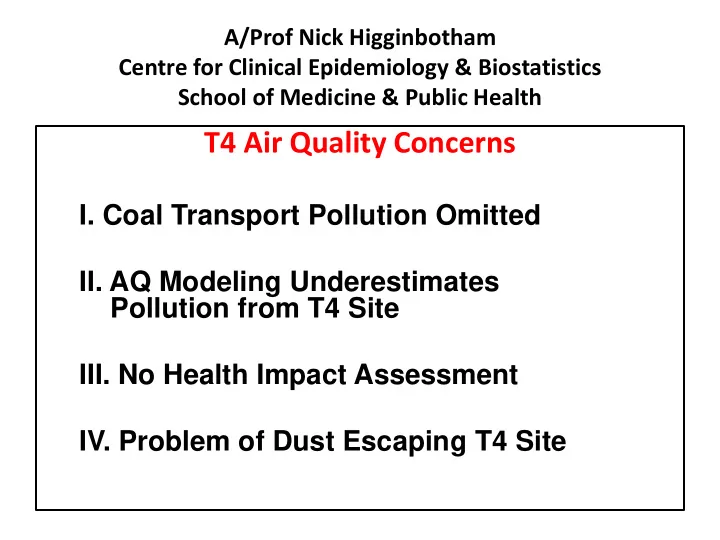
A/Prof Nick Higginbotham Centre for Clinical Epidemiology & Biostatistics School of Medicine & Public Health T4 Air Quality Concerns I. Coal Transport Pollution Omitted II. AQ Modeling Underestimates Pollution from T4 Site III. No


slide-1
SLIDE 1

A/Prof Nick Higginbotham Centre for Clinical Epidemiology & Biostatistics School of Medicine & Public Health

T4 Air Quality Concerns

  • I. Coal Transport Pollution Omitted
  • II. AQ Modeling Underestimates

Pollution from T4 Site

  • III. No Health Impact Assessment
  • IV. Problem of Dust Escaping T4 Site
slide-2
SLIDE 2

Value of Clean Air

  • Access to clean air is a public health necessity.
  • Government effort should be towards protecting clean

air and reducing existing pollution (NEPC, 2014).

  • 2.3% of Australia’s annual deaths caused by urban air

pollution (Begg, 2007)

  • Pollution health costs $11 - $24 billion per year, solely as

a result of mortality (NEPC 2014)

  • WHO now classifies air pollution as ‘carcinogenic to

humans’ (IARC, 2013).

2

slide-3
SLIDE 3
  • I. Pollution Impact of Coal transport to T4
  • T4 Air Quality Assessment failed to consider

pollution impacts on residents near coal rail corridor

  • Potentially significant public health effects
  • mitted from planning review process.
  • Crucial that these effects are considered during

the PAC.

  • 3
slide-4
SLIDE 4

Coal Corridor passes through numerous suburbs 4

slide-5
SLIDE 5

Newcastle Port coal tonnage & daily train movements

Daily

loaded trains

Daily

round trip pass-bys

Annual pass-bys

Current tonnage 150Mt

57.2 114.5 41,792

Current Approved

210Mt

79.8 159.6 58,254

Approved plus T4

280Mt

106.4 212.8 77,672

T4 only

70mt

(26.6)

(53.2) (19,418)

slide-6
SLIDE 6
  • I. Pollution Impact of Coal transport to T4
  • One coal train pass-by every 6.7 minutes
  • Coal trains take 2 or 3 minutes to pass by
  • Result = near continuous rail traffic.
  • Diesel loco coal train passage creates a plume of

pollution

  • Combining cancer causing diesel exhaust with harmful

particulate matter (PM10 and PM2.5).

  • No regulations limit loco diesel exhaust.
  • 6
slide-7
SLIDE 7

Sandgate Station 1:30pm Sunday 10/8/14 7

slide-8
SLIDE 8

Coal Rail Corridor Pollution

From Newcastle Port to Rutherford

Within 500m of the coal corridor:

  • 23,000 children attend

school

  • 32,000 residents

8

slide-9
SLIDE 9
  • I. Pollution Impact of Coal transport to T4

Rail Pollution Health Risks Need Research

  • ARTC & CTAG studies agree particulates increase

with train pass-by

  • CTAG train signature study show PM10 at least

double, & up to 13 times larger vs background levels

  • Mitigate rail pollution at planning stage, should

not be deferred 9

slide-10
SLIDE 10

Unloaded Coal Train passing Beresfield station, 15/7/13 3 locomotives, 98 wagons, 35km/h 10

slide-11
SLIDE 11

Full and Empty Coal Trains near Sandgate 9/8/14 11

slide-12
SLIDE 12
slide-13
SLIDE 13
  • II. T4 Site AQ Modeling Underestimates Pollution

(1) 2010 poor choice as ‘average’: lowest PM10 in past 7 years 2012/13 PM10 levels for Newcastle & Beresfield already above predictions with T4 operating Above WHO & NEPC annual guideline for PM10 13

slide-14
SLIDE 14

Lower Hunter EPA air monitoring sites

(above 20ug/m3 WHO std 2012 - 2013)

slide-15
SLIDE 15
  • II. T4 Site AQ Modeling Underestimates Pollution

(2) PM2.5 emissions underestimated by assuming

  • nly 2 locos per train

(3) T4 modeling assumes trains spend only 2 hrs on site. 2 hours = ideal time, for smooth run (40%) Locomotive diesel engines run continuously (4) Trains standing by at Hexham & Sandgate waiting to dump coal should be included (5) Extreme weather events under climate change exacerbate fugitive emissions 15

slide-16
SLIDE 16
  • III. Absence of Health Impact Assessment (HIA)
  • HIA combines data: pollution + demographics

+ current health status + pollution health risk

  • Vulnerable people = low income;

chronic heart and lung disease; asthmatics; infants; children; elderly pregnant women

16

slide-17
SLIDE 17
  • III. Absence of Health Impact Assessment (HIA)
  • 2011 census – 25,680 residents adjacent to T4
  • Compared to state average:

lower household income higher rate unemployment

  • 1/3rd children <14 yrs & elderly (>65 yrs)
  • 24 schools, preschools & nursing homes

17

slide-18
SLIDE 18

Health Status of Residents

  • Rank highly in hospital emergency visits for

respiratory illness and asthma

  • Hunter residents generally have higher than

state average death rate for all causes & CVD

  • On average, greater days of life expectancy

loss from pollution than people in Sydney

18

slide-19
SLIDE 19
  • III. Absence of Health Impact Assessment (HIA)
  • What is the health cost of T4?

–Attributable deaths? –Years of Life Lost? –Days of lost productivity due to illness?

  • These project costs excluded

& paid for by public

  • Public does not know T4’s full impact

19

slide-20
SLIDE 20
  • IV. Problem of Dust Escaping T4 Site
  • T4 dust suppression techniques 25% - 85%

efficiency

  • 1 tonne TSP/dust daily, construction
  • 0.55 tonne TSP/dust daily, operational 70Mtpa
  • Wind erosion control of stockpile 50%
  • Stockpile should be enclosed

20

slide-21
SLIDE 21
  • IV. Problem of Dust Escaping T4 Site
  • Human & machine error
  • Increased frequency extreme weather under

global warming scenarios

  • El Nino-Southern Oscillation induced droughts

more intense in future

  • Dust containment always successful?
  • PWCS fined for spills into Newcastle harbour

21

slide-22
SLIDE 22
  • IV. Problem of Dust Escaping T4 Site
  • NSW Planning requires AQ monitoring on site
  • Fails to include PM2.5 monitoring
  • Planning requires AQ Mgt Plan
  • Does not mandate chemical suppressants

when use of water fails

  • No requirement to cease operations in high

winds

22

slide-23
SLIDE 23
  • IV. Problem of Dust Escaping T4 Site

Kooragang Island, Newcastle Coal Infrastructure Group, 17 October, 2013, 11am.

slide-24
SLIDE 24

Stockton PM10 50% above Std. on 17 October

24

slide-25
SLIDE 25
  • IV. Problem of Dust Escaping T4 Site
  • NSW Planning: Dust should be minimized to

the greatest extent ‘practicable’

  • No quantitative criteria
  • Given past failures, ‘predictive/reactive

monitoring’ has not proven good enough to protect public health from T4 emissions

25

slide-26
SLIDE 26

T4: Adding further pollution to Newcastle Port