
SLIDE 1
Supporting Transboundary Conservation and Tourism: Tour de Tuli
- Dr. Sue Snyman
Regional Programme Director Children in the Wilderness Wilderness Safaris Regional Community Development
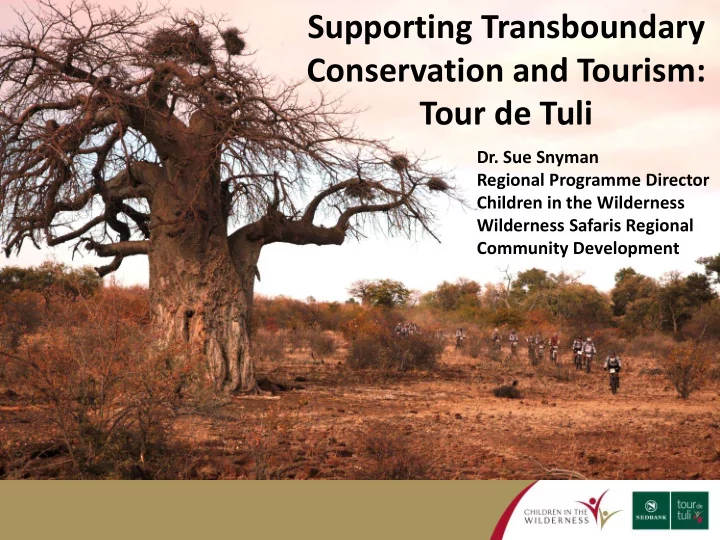
Supporting Transboundary Conservation and Tourism: Tour de Tuli - - PowerPoint PPT Presentation
Supporting Transboundary Conservation and Tourism: Tour de Tuli Dr. Sue Snyman Regional Programme Director Children in the Wilderness Wilderness Safaris Regional Community Development Context Is the major fundraising event of Non-profit
Regional Programme Director Children in the Wilderness Wilderness Safaris Regional Community Development
Sustainable conservation through leadership development
Community school visit Community bar visit Crossing the Limpopo River Tea Stop in the bush every day
networking
interviews, networking evenings, celeb cyclists
Twitter, blogs, websites
movies
tourism to the GMTFCA
logistics and administration
the importance thereof
Bean There Coffee Bicycle Repairs Honorable Minister Khama Cycling in Botswana Honorable Minister Khama’s Opening Speech
All border officials to be well briefed on the Nedbank Tour de Tuli event at all
and camp equipment All borders: Approval for pre-camp team and vehicles to pass through Beitbridge/Platjan and Pont Drift border post Informal border crossing: Approval for a non-gazetted crossing point for cyclists, staff and support staff vehicles from Botswana into Zimbabwe and again from Zimbabwe into South Africa Informal border crossing: Authorisation to get visas issued on site at the informal border crossing point for all non-South African participants, Visa requirements: Waivering of visa fees for non-South African cyclists Import duties, fees and taxes for Beitbridge and Shashe/Limpopo confluence: Waivering of import duties, fees and taxes on consumables and free passage for vehicles and equipment A dedicated TFCA person to facilitate at border crossings and ensuring information is communicated to local levels Allowed to make amendments to the passport manifest up to four weeks in advance
Interacting with communities Wildlife sightings Crossing the Limpopo River back into SA Bicycle prize for environmental poem – CITW Limpopo Valley
in 2013
despite all pre-clearances already done – costs associated with this
recces and for the event, etc.
charged, etc. – no consistency
SA: Honourable Minister of Water and Environmental Affairs, Edna Molewa Bots: Honourable Minister of Environment, Wildlife and Tourism, Mr Tshekedi Khama
Tour de Tuli is CITW’s main fundraising event Cyclist’ numbers have increased over the years- 286 paid cyclists in 2013 and 289 in 2014. The minimum sponsorship per cyclist was R19 800.00 in 2013 and the cost remained the same in 2014 The total sponsorship raised in 2013 through the entries only was +- R5 660 000.00
Raising more funds during the tour
Sponsors’ support
2012 with a sponsorship value of R1 210 495.00. By sponsorship value, we refer to sponsoring of cycling shirts, cyclists gifts, tents, bar etc. It may not always be monetary but may be goods or services
The Tour total income is between R6 500 00.00 and R7 000 000.00
Camp set up - R1 491 543.91 Catering - R 1 204 132.62 Cyclists goodie bags - R672 822.91 (include cyclist shirts, shower gel, Event t-shirts, Consol lights, head lamps etc.) Transport - R628 610.93 (Fuel, Equipment, route planning and site inspections)
Rand/$ exchange rate, the Tour will be making a significantly lower profit
From 2005 to 2013 we have hosted approximately 2369 cyclists & raised R11.6 million through the cycle tours These funds have allowed over 5100 children to attend a Children in the Wilderness camp and over 2500 children to be part of the Eco-Club programme in
future
Sharing the wonder of nature Learning crafts from Elders on camp
Career in Conservation
ECO CLUBS – primary and high school CAMPS – primary and high school YOUTH ENVIRONMENTAL STEWARDSHIP – high school TERTIARY EDUCATION and/or INTERNSHIPS
Career in Tourism/Hospitality
Mentor and Teacher Training
International Co-Ordinator
Jarukanga School Limpopo Primary School Nottingham Primary School Shashi Primary School
well as the Regional CITW/Community Development Workshop in SA
CITW camps are held in Mashatu and CITW runs Eco- Clubs in Alldays, Tuli, and going forward in the Maramani community CITW operates in other TFCAs – funds raised by the Tour de Tuli therefore support environmental education in other TFCAs in Zimbabwe, Zambia and Malawi In total, more than R220 000 is being spent on environmental education camps, Eco- Clubs and mentor training in the GMTFCA area in 2014 – using funds from the Nedbank Tour de Tuli 2013