THE NORTHERN SAGEBRUSH STEPPE INITIATIVE A CURRENT EXAMPLE OF - - PowerPoint PPT Presentation

the northern sagebrush steppe initiative a current
SMART_READER_LITE
LIVE PREVIEW

THE NORTHERN SAGEBRUSH STEPPE INITIATIVE A CURRENT EXAMPLE OF - - PowerPoint PPT Presentation

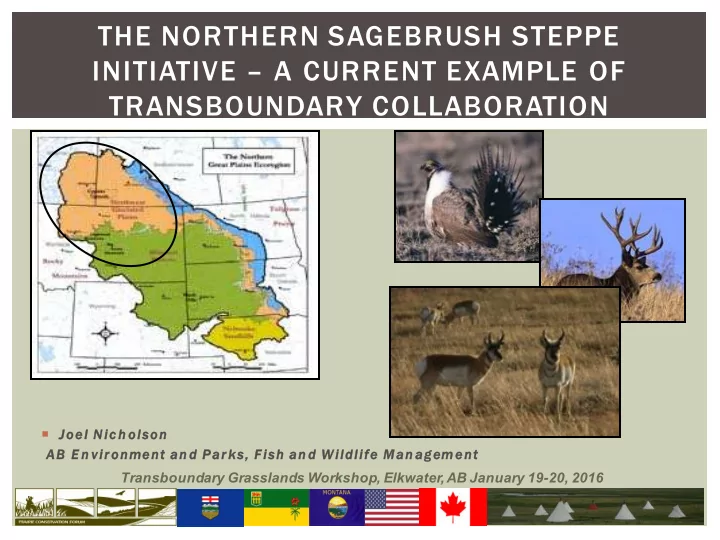
THE NORTHERN SAGEBRUSH STEPPE INITIATIVE A CURRENT EXAMPLE OF TRANSBOUNDARY COLLABORATION Jo Joel Nic h olson AB AB E n vir onment an d Par ks, Fish an d Wildlife Man agement Transboundary Grasslands Workshop, Elkwater, AB January


slide-1
SLIDE 1

¡ Jo Joel Nic h olson AB AB E n vir onment an d Par ks, Fish an d Wildlife Man agement

THE NORTHERN SAGEBRUSH STEPPE INITIATIVE – A CURRENT EXAMPLE OF TRANSBOUNDARY COLLABORATION

Transboundary Grasslands Workshop, Elkwater, AB January 19-20, 2016

slide-2
SLIDE 2

Transboundary Grasslands Workshop, Elkwater, AB January 19-20, 2016

  • Collaboration across boundaries has historically been piecemeal with agency

staff and NGO’s .

  • Beginning in 2006, Alberta, Saskatchewan and Montana Wildlife agencies have

met annually to discus issues of common concern.

  • Agencies sought and received endorsement from WAFWA when an MOU was

developed and signed in 2007 and renewed in 2012.

  • Provides for cooperative partnerships between AB, SK, and MT wildlife agencies

focusing on pronghorn, mule deer, and sage-grouse conservation.

  • Build awareness of common interests and issues in the Northern Sage Brush

Steppe trans-boundary region.

  • Develop collaborative work and research opportunities supporting conservation of

sagebrush dependent species across geographic scales.

TRANS-BOUNDARY WILDLIFE CONSERVATION AND MANAGEMENT

slide-3
SLIDE 3

¡ Formalized MOU h has s specific actions and has allowed staff to at attend regular meetings. ¡ Focal species of Pronghorn, Mule Deer, and S Sage-gr grouse have allowed focused projects (e.g. pronghorn research in a all ju juris isdictions, sage-gr grouse translocation). ¡ Great e effor t h has been u undertaken to d develop common thematic layers for G GIS g giving managers tools t to consider broader la landscape context (Data sharin ing agreements). ¡ Professional relationships have developed over t time t that h help sustain the i initiative and provide resources.

WHAT HAS WORKED WELL AND WHY?

Transboundary Grasslands Workshop, Elkwater, AB January 19-20, 2016

slide-4
SLIDE 4

¡ No program coordinator in place thus agency staff are solely responsible for coordination (added workload). ¡ Can be difficult to initiate and fund projects across borders. ¡ Must frequently remind management of importance of this work as regimes change. ¡ Very agency focused – advantages and disadvantages to this approach. ¡ Intermittent engagement of other agencies and NGO’s.

WHAT HASN’T WORKED SO WELL AND WHY?

Transboundary Grasslands Workshop, Elkwater, AB January 19-20, 2016

slide-5
SLIDE 5

LESSONS: “MUST HAVES” & “MUST AVOID”

¡ Must h haves: ¡ Buy in from agencies and staff. ¡ Meaningful results = perceived value. ¡ Reasonably frequent communication. ¡ Resources. ¡ Must a avoid: ¡ Lack of tangible results and action will cause a slow painful death. ¡ Cannot only be information exchange, must be structured as something to achieve conservation from the beginning.

Transboundary Grasslands Workshop, Elkwater, AB January 19-20, 2016