
SLIDE 1
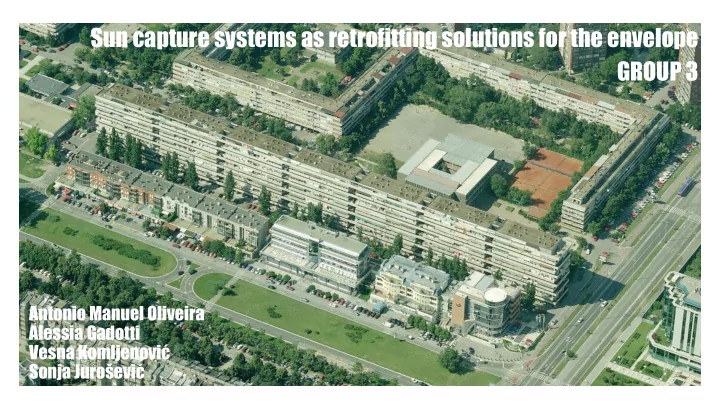
Sun capture systems as retrofitting solutions for the envelope GROUP - - PowerPoint PPT Presentation
Sun capture systems as retrofitting solutions for the envelope GROUP 3 Antonio Manuel Oliveira Alessia Gadotti Vesna Komljenovi Sonja Juroevi Problem statement: Methodology: Orientation of the buildings and the apartments, together -
Problem statement: Orientation of the buildings and the apartments, together with the current state of the facades results in inhabitants managing their own indoor climate. Main question of research: To what extent would turning the south facade into glazed terraces be an energy and cost effective strategy? Methodology:
envelope with systems for solar capture
effectiveness of the current state and glazed solution
Cfa climate zone
(Koppen-Geiger climate classification system)
Climate analysis: Cfa Humid Subtropical Climate
Main characteristics:
Conclusions:
Comfortable ≈24% of time from May until September
Recommende nded d strate tegie gies for this is clim limate zone Cfa (in in gener eral) l): :
/taken from Climate Consultant/
* Sunny wind-protected areas to extend living areas in cool weather * Winter sun should penetrate into daytime used spaces with functions that coincide with solar
* Natural ventilation: night-time "cooling" in high mass interior surfaces (reducing air conditioning needs) * Trees - not in front of passive solar gain windows (neither conifer nor deciduous): but beyond 45 degrees * Extra insulation: increase comfort + cost effective * Buildings and vegetation facing coldest winds as insulating layer * Overhangs + Glazing on the south facades * Window overhangs - operate sunshades * Insulating blinds or heavy draperies - to reduce winter time heat loses
Location analysis:
level:
Build ildin ing le level: l: B8 build ilding ing
SOLAR RADIATION IN SERBIA POTENTIAL
is 16,7%
global radiation for flat surface during winter ranges between 1.1 kWh/m² in the north and 1.7 kWh/m² in the south, and during the summer period between 5.4 kWh/m² in the north and 6.9 kWh/m² in the south
Serbia record a large number
ratio of real radiation and total potential is approximately 50% (SOLAR PHOTOVOLTAIC POWER IN SERBIA, DR LJUBISAV STAMENIĆ, December 2009 )
Example ple: : archit hitecture ecture of Santia tiago go de Compo post stela ela
1. Prefabricated elements panels‐enclosing of the building's load‐bearing structure 2. Poor thermal performance and thermal bridges 3. Condensation problems
Layers Thickness [m] Heat conductivity (λ) [W/mK] Specific heat (c) [J/kgK] Density (ρ) [kg/m
3]
Heat resistance [m
2k/W]
1 Concrete 0.060 1.650 1000 2200 0.04 2 EPS 0.060 0.042 1450 20 1.43 3 Concrete 0.080 1.650 1000 2200 0.05 Total thickness [cm] 20.0 1.7
U-value [W/m2K] Thermal lag [h] 0.59 4.39
45 3 2 1 0.000 500.000 1000.000 1500.000 2000.000 2500.000
9.5 19.5 29.5 39.5
Pressure [Pa] Sd [m] VAPOUR PRESSURES
BIPV – Building Integrated Photovoltaics
Prefabricated timber elements panels as enclosing of the building's load‐bearing structure
TES Energy Facade (NTNU research) IEA SHC Task 47
insulating glass.
constructions.
Layers Thickness [m] Heat conductivity (λ) [W/mK] Specific heat (c) [J/kgK] Density (ρ) [kg/m
3]
Heat resistance [m
2k/W]
Rsi 0.130 1 Plasterboard 0.013 0.210 1050 900 0.06 2 Adaptation layer 0.060 0.033 1030 70 1.82 3 Cellulose 0.240 0.058 1600 85 4.14 4 OSB panel 0.013 0.130 1700 680 0.10 5 Cladding 0.030 0.600 1000 2200 0.05 Rse 0.040 Total thickness [cm] 35.5 6.3 U-value [W/m2K] Thermal lag [h] 0.16 20.39
Solar comb façade (air space + glass ≈ 9mm)
Zone 1 / Widtg Sun Esp a Sul