Design Flood Hydrology Workshop: Speaker Profiles March 28, 2017 - - PowerPoint PPT Presentation

design flood hydrology workshop speaker profiles
SMART_READER_LITE
LIVE PREVIEW

Design Flood Hydrology Workshop: Speaker Profiles March 28, 2017 - - PowerPoint PPT Presentation

Design Flood Hydrology Workshop: Speaker Profiles March 28, 2017 Presentation Outline Speaker Bio Brian Chow , MEng., DFEng., Brian has work with the Ministry of Forests, in its Introduction and Welcome PEng., FEC various incarnations for


slide-1
SLIDE 1

Design Flood Hydrology Workshop: Speaker Profiles

1 March 28, 2017 Speaker Bio

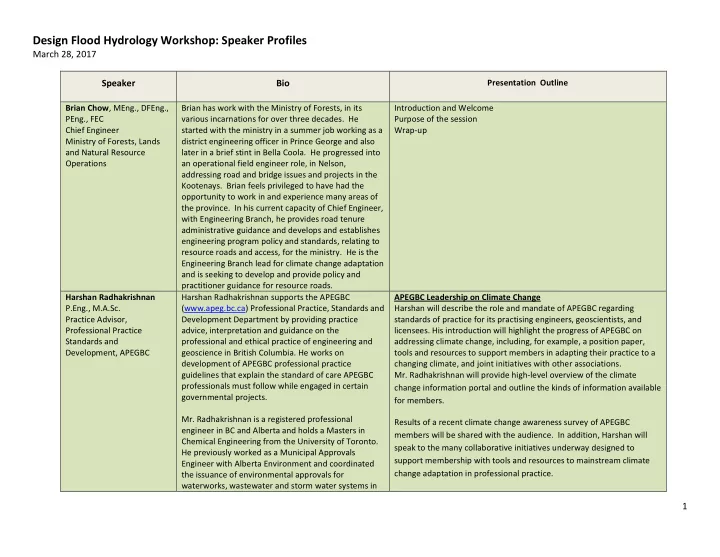
Presentation Outline Brian Chow, MEng., DFEng., PEng., FEC Chief Engineer Ministry of Forests, Lands and Natural Resource Operations Brian has work with the Ministry of Forests, in its various incarnations for over three decades. He started with the ministry in a summer job working as a district engineering officer in Prince George and also later in a brief stint in Bella Coola. He progressed into an operational field engineer role, in Nelson, addressing road and bridge issues and projects in the

  • Kootenays. Brian feels privileged to have had the
  • pportunity to work in and experience many areas of

the province. In his current capacity of Chief Engineer, with Engineering Branch, he provides road tenure administrative guidance and develops and establishes engineering program policy and standards, relating to resource roads and access, for the ministry. He is the Engineering Branch lead for climate change adaptation and is seeking to develop and provide policy and practitioner guidance for resource roads. Introduction and Welcome Purpose of the session Wrap-up Harshan Radhakrishnan P.Eng., M.A.Sc. Practice Advisor, Professional Practice Standards and Development, APEGBC Harshan Radhakrishnan supports the APEGBC (www.apeg.bc.ca) Professional Practice, Standards and Development Department by providing practice advice, interpretation and guidance on the professional and ethical practice of engineering and geoscience in British Columbia. He works on development of APEGBC professional practice guidelines that explain the standard of care APEGBC professionals must follow while engaged in certain governmental projects.

  • Mr. Radhakrishnan is a registered professional

engineer in BC and Alberta and holds a Masters in Chemical Engineering from the University of Toronto. He previously worked as a Municipal Approvals Engineer with Alberta Environment and coordinated the issuance of environmental approvals for waterworks, wastewater and storm water systems in APEGBC Leadership on Climate Change Harshan will describe the role and mandate of APEGBC regarding standards of practice for its practising engineers, geoscientists, and

  • licensees. His introduction will highlight the progress of APEGBC on

addressing climate change, including, for example, a position paper, tools and resources to support members in adapting their practice to a changing climate, and joint initiatives with other associations.

  • Mr. Radhakrishnan will provide high-level overview of the climate

change information portal and outline the kinds of information available for members. Results of a recent climate change awareness survey of APEGBC members will be shared with the audience. In addition, Harshan will speak to the many collaborative initiatives underway designed to support membership with tools and resources to mainstream climate change adaptation in professional practice.

slide-2
SLIDE 2

Design Flood Hydrology Workshop: Speaker Profiles

2

the Province. Megan Hanacek RPF Association of BC Forest Professionals Megan Hanacek is the Forest Stewardship Specialist with the Association of British Columbia Forest Professionals (www.abcfp.ca), the largest professional forestry association in Canada. Her forest stewardship and climate change portfolio includes planning, strategic and operational forest professional guidance and environmental management to help protect the public's interest in BC forests and associated ecosystems. Prior to joining the ABCFP, Megan gained 20 years of experience working for Industry, Government, First Nations, NGO’s and her own company on environmental assessment projects throughout North America; these projects include 3rd party certification and operation applications within the Great Bear Rainforest and remedial work within contaminated sites of the USA. Megan has consistently demonstrated a strong commitment to sound science and consensus building within natural resource development. In 2015, she was the recipient of the Association of Professional Biology’s President Award for exemplary service to the biology profession. She holds dual designations as a Professional Registered Forester (RPF) and Professional Registered Biologist (RPBio) ABCFP Leadership on Climate Change Megan will introduce the role and mandate of the ABCFP to establish, maintain and enforce standards of practice for more than 5300 forest

  • professionals. This includes a unique role to advocate for forest

stewardship and promote the profession of forestry. Ms. Hanacek will share highlights of recent ABCFP work to support forest professionals in adapting their practice to reflect a changing climate. This includes, for example, a position paper on climate change; member surveys, and a variety of tools that the ABCFP has provided to members to support the incorporation of climate change in their professional practice.

  • Ms. Hanacek will outline work with the APEGBC/ABCFP Joint Practice

Board to consider issues involving the education and practice of engineering, geoscience and forestry in the forest sector. In 2016 the ABCFP provided input to the BC Climate Leadership Plan and BC Forest Carbon Strategy. We have been active on various committees and events: GLOBE, Association of United Nations, the Professional Association Adaptation Working Group led by the BC MOE Climate Action Secretariat, and the Climate Risk Network led by the Fraser Basin Council. The ABCFP is committed to raising awareness about the potential impacts of the changing climate as they relate to professional forestry, and to providing information and assistance to ABCFP members. Lee Deslauriers PEng, RPF Principal and Managing Engineer StoneCroft Project Engineering Ltd. Lee Deslauriers PEng, RPF is the Principal of StoneCroft Project Engineering, based in Campbell

  • River. Lee has a bachelor’s degree in Forest

Operations and Forest Engineering from UBC, and has

  • ver 20 years of experience in the resource industry

with major forest licensees, BC Timber Sales and as a

  • consultant. StoneCroft is a consulting professional

engineering firm that has operated in the resource industry since 1989, specializing in bridges and stream crossing structures, technical roads, retaining walls Current Resource Industry Practices in Design Flood Hydrology Lee will outline current context for DFH: Legislative requirements (FPPR) and reference material used for determining design flood hydrology. He will review most commonly used methods for determining design peak flows, including a review of formulae and factors engineers use to judge appropriateness of methods. He will also point to some software available for culvert design. An exercise, co-led with Paul Whitfield, will give participants a chance to

slide-3
SLIDE 3

Design Flood Hydrology Workshop: Speaker Profiles

3

and log transfer facilities. Lee is the Chair of the Division of Engineers and Geoscientists in the Resource Sector (DEGIRS), and is a specialist road and bridge auditor for the Forest Practices Board of BC. discuss Stream Crossing Structure Alternatives and Integration of Resilience in the Context of Climate Change. Lee will review some examples of damage to resource infrastructure as a result of severe flood and debris flow/ flood events. The group will consider a risk- based approach to decision making in crossing structure design, e.g.:  What are design goals/ assumptions and risk tolerance levels identified by the Owner/ CRP?  What is the intended longevity of the structure?  What are the values at risk due to washout, damage or temporary closure of the structure?

  • Mr. Deslauriers will review examples of stream crossing structure types

which are resilient to flooding and debris flows/ floods, and circumstances for crossing sites where they may be appropriate.

  • Dr. Francis Zwiers

Director, President and CEO Pacific Climate Impacts Consortium

  • Dr. Francis Zwiers is director of the Pacific Climate

Impacts Consortium (PCIC) at the University of

  • Victoria. His former roles include chief of the Canadian

Centre for Climate Modelling and Analysis and director

  • f the Climate Research Division, both at Environment

and Climate Change Canada. As a research scientist, his expertise is in the application of statistical methods to the analysis of observed and simulated climate variability and change. Dr. Zwiers is a Fellow of the Royal Society of Canada and of the American Meteorological Society, a recipient of the Patterson Medal and President’s Prize, has served as an IPCC Coordinating Lead Author of the Fourth Assessment Report and as an elected member of the IPCC Bureau for the Fifth Assessment Report. Pacific Climate Impacts Consortium

  • Dr. Zwiers will provide an overview of how the climate is changing, and

describe how the impacts of projected climate change are analyzed, including methods of downscaling from global climate models. He will provide an overview of PCIS’s hydrologic modelling, and hydrologic projections for BC, with implications for riverine flooding. Francis will also describe the resources PCIC can provide, and what relevant information is available to support design flood hydrology. As an authoritative source of climate change modelling affecting BC’s hydrology, he will identify tools useful for the audience of practitioners looking for guidance on design flood hydrology in the context of climate change. Paul Whitfield Since retiring from Environment Canada in 2010, and continuing as an Emeritus Scientist with ECCC, Paul continues to be active in the hydrological and climatological science community as an Adjunct Professor of Earth Sciences at Simon Fraser University, as a Senior Research Fellow in the Centre for Hydrology at the University of Saskatchewan, and a member of the Burns Bog Scientific Advisory Panel. Paul joined the Inland Waters Directorate of Environment Canada in 1975 and his core areas of scientific expertise are applications of statistics to the Climate change and floods Paul will outline the complexity of climate change effects on floods, both now and in the future. Much of the currently held knowledge is based on misinformation. “Floods” constitute a group of complex properties: each individual flood generation process is likely to be affected by future changes in climate, making generalization difficult. How reality differs from classical practice will be covered based upon the latest research. Many aspects of major floods are changing, not necessarily the magnitudes, but the number of events is changing in many watersheds and more rain generated, and rain on snow generated events are observed. Climate is not the only change taking

slide-4
SLIDE 4

Design Flood Hydrology Workshop: Speaker Profiles

4

analysis of environmental data, transient events, the design and implementation of monitoring programs, quality assurance and quality control, hydrological processes, and the hydrology of cold regions. Most recently focused on climate change and changes in land use and the impacts on hydrology and

  • climatology. Current research interests are “focused”
  • n [1] climatic controls flows in intermittent streams,

[2] the sensitivity of ecological processes to climate, particularly the impact of weather and climate on bog hydrology, [3] uncertainty of measurements and model predictions, and, [4] the analysis of trends and changes in floods and flood processes. place; there are more changes in watersheds where both land use/land cover are changing in addition to climate. Classical frequency is based upon assumptions of the event data being independent and identically distributed, yet these assumptions are often violated; the consequences

  • f these violations on practice are discussed. The issues of non-

stationarity, teleconnections, scaling, and homogeneity in analysis will be covered. Changes in floods’ generating processes, land use effects, and other analytical components should affect design methodology since these key assumptions of common practice will be affected. Mike Sullivan, P.Eng. Senior Hydrotechnical Engineer, Ministry of Transportation and Infrastructure (MOTI) Mike Sullivan is a senior hydrotechnical engineer with the Ministry of Transportation and Infrastructure working in the Bridge Engineering Group in Kamloops

  • BC. Mike is responsible for the hydrotechnical design

for bridges and hydraulic structures in the Southern Interior Region. Mike has been working with the Ministry of Transportation for the past three years. Prior to working at the Ministry, he has approximately 20 years of experience working in the private sector as a consulting engineer with various engineering

  • companies. He has also worked with Environment

Canada, Water Survey Branch & the Hydrology Section for approximately 5 years. Mike has a Civil Engineering degree from Queen’s University at Kingston, specializing in water resources as well as a Civil and Structural Engineering Diploma from BCIT also specializing in water resources. How is MOTI addressing Climate Change in the design of Infrastructure Projects? Mike will introduce MOTI Technical Circular T-06/15 – “Climate Change and Extreme Event Preparedness and Resilience in Engineering Infrastructure Design,” which includes the “BC MOTI Design Criteria Sheet for Climate Change Resilience.” He will discuss how MOTI is currently addressing Climate Change, and provide project examples. The level of climate change analysis required depends on the type, location, traffic volume, and design life of the transportation infrastructure, for example:

  • 1. IDF_CC Tool – this tool used for smaller watersheds using the

Rational Method – ‘https://www.idf-cc-uwo.ca’

  • 2. Project Example - Kettle River Bridge Replacement – (Low

Volume Road)

  • 3. Project Example - Salmon River at Salmon Arm – Hwy 1 Bridge

Replacement – (Regular Volume Road) Des Goold P.Eng Northwest Hydraulic Consultants Ltd. Des Goold is a Principal with Northwest Hydraulic Consultants Ltd. (NHC) with 20 years’ experience as a project manager and senior design engineer. He specializes is the assessments of river behaviour, design of stream crossings and design of erosion and scour countermeasures for stream crossings. In recent Design Flood Hydrology Des will provide an overview of how NHC is incorporating climate change into its assessments of design flood hydrology, and the potential effects of climate change on the design of stream crossings. He will discuss examples derived from their work for clients including BC Ministry of Transportation and Highways.

slide-5
SLIDE 5

Design Flood Hydrology Workshop: Speaker Profiles

5

years he has assisted in the development of the Bridge Scour Evaluation Program for the BC MOTI. He also manages and coordinates design services for MOTI’s General Hydrotechnical Services Contracts across BC. Matthias Jakob Ph.D., P.Geo., Principal Geoscientist Matthias Jakob is an internationally recognized specialist on the subject of geohazard and risk

  • assessments. Dr. Jakob has dedicated his career to

bridging academia with industry. He is one of Canada’s leading experts in the hazard and risk assessment of landslides, especially debris floods and debris flows. He has completed such assessments in

  • ver 100 creeks mostly in Canada, but also in Chile,

Argentina, Ecuador, Bolivia, and Austria. He is the project manager and author of a series of papers on Canada’s most involved debris flow fan hazard and risk study: Recently, Dr. Jakob has been involved in studying effects of climate change on the frequency and magnitude of landslides in southern B.C., and has carried out a comprehensive study on long-term changes of rainfall intensity in the Greater Vancouver Regional District.

  • Dr. Jakob has been involved as lead author for the

Professional Practice Guidelines of APEGBC on Legislated Landslide Assessments for Residential Developments (APEGBC, 2010) and Legislated Flood Assessments in a Changing Climate (APEBGC, 2012). Dr. Jakob spearheaded both guidelines, and he is currently engaged in organizing to extend them, as well as provide standards for provincial geohazard and risk maps in collaboration with Emergency Management BC (EMBC). Hydro-geomorphic Effects of Climate Change The presentation will focus on debris flows and debris floods including triggering events such as those primarily affected by climate

  • change. Recognition of such hydro-geomorphic processes is key in

the design of various types of infrastructure, including forest road‐ related infrastructure. The effects of climate change on hydro-geomorphic processes will be described, along with consequences for the stability of steep slopes and implications for engineering design. The talk will also touch on

  • ther debris‐flow generating processes related to climate change,

such as permafrost changes in the periglacial zone. For debris floods, the talk will examine the physics of sediment entrainment, especially flow resistance and bedload transport. The talk will also touch on watershed ecologic changes attributable to climate change, which in turn affect runoff, sediment availability, recharge, transport and the propensity for debris flow initiation. Matthias will suggest ways that anticipated changes in hydro- geomorphic event frequency and magnitude in response to projected climate change could be incorporated in the design of roads, culverts and bridges. He will outline measures that could mitigate the impact to such structures, should the projected changes within the structure’s design life be outside the natural variability inherent in the analysis. Kathy Hopkins RPF Technical Advisor – Climate Change, MFLNRO Kathy Hopkins is a Registered Professional Forester working for the Ministry of Forests, Lands and Natural Resource Operations as a Technical Advisor – Climate

  • Change. The focus of her work for the last decade has

been on building capacity to adapt natural resource management to succeed in a changing climate. Next Steps Kathy will co-facilitate Next Steps in order to identify some practical ways of moving the ball forward on design flood hydrology. This could include, for example, a list of what hydrologic products participants would like to see from PCIC modelling.