Study 354 zyxwvutsrqponmlkjihgfedcbaZYXWVUTSRQPONMLKJIHGFEDCBA The - - PDF document

study 354
SMART_READER_LITE
LIVE PREVIEW

Study 354 zyxwvutsrqponmlkjihgfedcbaZYXWVUTSRQPONMLKJIHGFEDCBA The - - PDF document

USING PETRI-NETS zyxwvutsrqponmlkjihgfedcbaZYXWVUTSRQPONMLKJIHGFEDCBA I TIiE ANALYSIS OF SlRATEGlC COMMUNICATIONS Study 354 zyxwvutsrqponmlkjihgfedcbaZYXWVUTSRQPONMLKJIHGFEDCBA The Task - I Question X2 Master Question X2 - Sponsor: ACDS(C1S)


slide-1
SLIDE 1

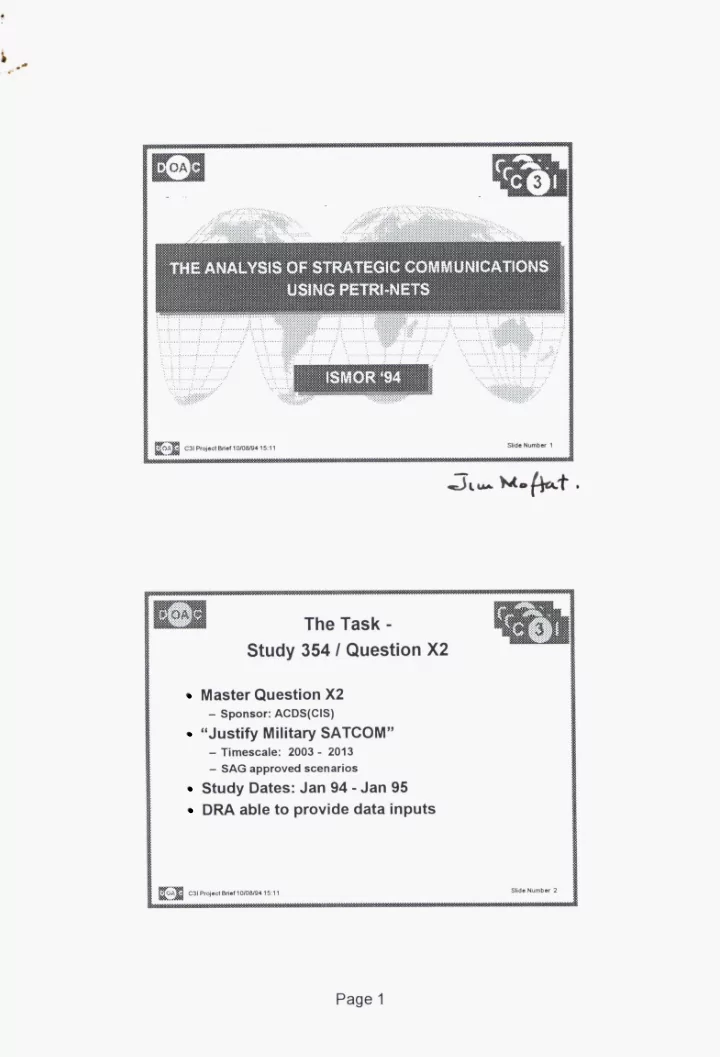
TIiE ANALYSIS OF SlRATEGlC COMMUNICATIONS USING PETRI-NETS zyxwvutsrqponmlkjihgfedcbaZYXWVUTSRQPONMLKJIHGFEDCBA

I

The Task - Study 354 zyxwvutsrqponmlkjihgfedcbaZYXWVUTSRQPONMLKJIHGFEDCBA

I Question X2

Master Question X2 “Justify Military SATCOM”

  • Sponsor: ACDS(C1S)
  • Timescale: 2003 - 2013
  • SAG approved scenarios

Study Dates: Jan 94 -Jan 95 DRA able to provide data inputs Page 1

slide-2
SLIDE 2

The Context zyxwvutsrqponmlkjihgfedcbaZYXWVUTSRQPONMLKJIHGFEDCBA

  • DOAC'S View zyxwvutsrqponmlkjihgfedcbaZYXWVUTSRQPONMLKJIHGFEDCBA
  • f c31

Intelligence

Sitreps

affect combat units

Page 2

slide-3
SLIDE 3

I zyxwvutsrqponmlkjihgfedcbaZYXWVUTSRQPONMLKJIHGFEDCBA

354 and the

c31

Strategy

, J p 1

Represent Key

pjzjiii

Decisions zyxwvutsrqponmlkjihgfedcbaZYXWVUTSRQPONMLKJIHGFEDCBA

and

  • Information

The Role of SATCOM zyxwvutsrqponmlkjihgfedcbaZYXWVUTSRQPONMLKJIHGFEDCBA

0 Provide

long distance c o n " 'Must' be

  • beyond range of terrestrial HFNHF links
  • Secure - not exploitable
  • Survivable - not prone to jamming or disruption
  • Safe to use - enemy not able to locate users
  • Capable of supporting forces worldwide

Versatile Page 3

slide-4
SLIDE 4

Model comms infrastructure in 2010 Identify IERs in specific scenarios Identify the 'background' requirement Determine mismatch between requirement and MOE: Satisfaction of Requirement: zyxwvutsrqponmlkjihgfedcbaZYXWVUTSRQPONMLKJIHGFEDCBA

  • Proportion of Info zyxwvutsrqponmlkjihgfedcbaZYXWVUTSRQPONMLKJIHGFEDCBA

IERs supported

  • Proportion of Context IERs supported
  • Value of Intel IERs supported

capability

I

BrigadelSF ManpackslSubs

I

Tri-service 100+ 'nodes' SATCOM + 6 other comms systems ScenariolTime dependent IERs Petri-Net approach

...

.

. . ..

.

..

. .

. . . . . . . .

. , . . , . .

Page 4

slide-5
SLIDE 5

The Application of Coloured Petri-Nets

9 Coloured Petri-nets are a graphical dynamic

simulation technique with these properties zyxwvutsrqponmlkjihgfedcbaZYXWVUTSRQPONMLKJIHGFEDCBA

  • networks of nodes and links explicitly modelled
  • queues explicitly modelled
  • competition for resources explicitly modelled
  • 'tokens' move from one node to another along links
  • tokens have properties (attributes)
  • nodes can act on tokens depending on their

properties

Approach

Satellite Capacity

Sai: Caoacitv

'ransmitter :Message Queue zyxwvutsrqponmlkjihgfedcbaZYXWVUTSRQPONMLKJIHGFEDCBA

Page zyxwvutsrqponmlkjihgfedcbaZYXWVUTSRQPONMLKJIHGFEDCBA

5

slide-6
SLIDE 6

e zyxwvutsrqponmlkjihgfedcbaZYXWVUTSRQPONMLKJIHGFEDCBA

I

t zyxwvutsrqponmlkjihgfedcbaZYXWVUTSRQPONMLKJIHGFEDCBA

I

  • ur Model

Users and decision nodes = TRANSITIONS Comms bearers = PLACES Data streams (IERs) generated by users from script = TOKENS COMCEN transition

  • checks IER attributes against available bearers
  • checks connection to recipient
  • checks bearer capacity
  • passes IER to most appropriate bearer

Bearer transition allocates capacity and power to IER

Features of the Analysis

5 different satellite options 3 different scenarios

9 Represent effects of
  • jamming
  • EMP

Sensitivity to assumptions on

  • channel allocation
  • loading

Page zyxwvutsrqponmlkjihgfedcbaZYXWVUTSRQPONMLKJIHGFEDCBA

6

slide-7
SLIDE 7

1 zyxwvutsrqponmlkjihgfedcbaZYXWVUTSRQPONMLKJIHGFEDCBA

4 zyxwvutsrqponmlkjihgfedcbaZYXWVUTSRQPONMLKJIHGFEDCBA

Features of the Model

Up to 14 parallel channels per satellite

  • Each channel represented by a separate Transition
  • Transmitters allocated to

channels depending on scenario

  • Different properties at different frequencies, reflecting IER

EHFlUHF and SHF

token attributes

Link budget calculations Dynamic allocation of power between

  • Carried out in

each channel transition when an IER enters

beamslchannels

  • Channel Transitions use up power which may come from a zyxwvutsrqponmlkjihgfedcbaZYXWVUTSRQPONMLKJIHGFEDCBA
CnROlnMII.m#%IS,, Ild.Wm%b" 13

common 'pot'

Further Features of the Model

Users compete for channels with spare capacity Users seek alternative comms bearers

  • COMCEN

transition looks at remaining capacity on each available bearer

  • COMCEN

transition checks all bearers against IER attributes and most efficient use of power

Excess users thrown off the system

  • COMCEN transition may allocate IERs to a Wastebin'

Page 7

slide-8
SLIDE 8

Measures of Effectiveness zyxwvutsrqponmlkjihgfedcbaZYXWVUTSRQPONMLKJIHGFEDCBA

.

  • Typical Comms MOE - 'Delays on

messages' - not relevant at this level Preferred MOE - 'How does SATCOM affect the battle?' - impractical Next best - 'Ability of system@) to meet the [commander's] requirement'

  • Classify unsent IERs by typdpriority
  • Intel IERs used to determine value of

resuiting intelligence to commander

  • Other IERs (operationa1,contextual)

assessed as a straightforward percentage of total requirement

C S , R r l . * M * l ~ I B ? ,

1 zyxwvutsrqponmlkjihgfedcbaZYXWVUTSRQPONMLKJIHGFEDCBA

I

Form of Results zyxwvutsrqponmlkjihgfedcbaZYXWVUTSRQPONMLKJIHGFEDCBA

1

f zyxwvutsrqponmlkjihgfedcbaZYXWVUTSRQPONMLKJIHGFEDCBA

1 1

1111111

.._.__________________________________._

CI

Total Loading

j

:

i

C0dj

x x x

i

:

:

. . . . . . . . . .

~ ~ ~

  • ~

n ~ e

j

: zyxwvutsrqponmlkjihgfedcbaZYXWVUTSRQPONMLKJIHGFEDCBA ; ;

j

:

1

j j

Amount of Requlrement Met :

. . . . . . . . . . . . . . . . . . . . . . . . . . . . . . . . . . . . . . . . . .

"

. . . . . . . . . . . . . . i

Page 8
slide-9
SLIDE 9
  • I
. I

I : zyxwvutsrqponmlkjihgfedcbaZYXWVUTSRQPONMLKJIHGFEDCBA

Progress to Date

Completed:

  • Identified nodes in the HLSG scenarios
  • Obtained approval for Background Scenario
  • Designed Petri-net model
  • Determined zyxwvutsrqponmlkjihgfedcbaZYXWVUTSRQPONMLKJIHGFEDCBA

comms infrastructure

  • Determined IERs
  • Determined design of satellite options
  • Buiit model
  • Analysis (since July)
  • Reporting (from

November)

On-going: Projected

alw.nM.IImIYO.IS11

Challenges

Long timescale

  • f satellite compared to other

comms systems impacts on

  • Quantity and quality of IER data
  • Lack of infrastructure data

Lack of agreed future policy for military Data collection much harder than predicted Long-term aim of measuring influence

  • f

communications

  • n combat effectiveness

SATCOM Page zyxwvutsrqponmlkjihgfedcbaZYXWVUTSRQPONMLKJIHGFEDCBA 9

slide-10
SLIDE 10

Summary zyxwvutsrqponmlkjihgfedcbaZYXWVUTSRQPONMLKJIHGFEDCBA

1 zyxwvutsrqponmlkjihgfedcbaZYXWVUTSRQPONMLKJIHGFEDCBA

I

Task to justify MILSATCOM Joint DOACIDRA study Method zyxwvutsrqponmlkjihgfedcbaZYXWVUTSRQPONMLKJIHGFEDCBA

  • Explicit simulation of all strategic bearers and IERs
  • Petri-Net model

On schedule to report Jan 95 Long term capability to model strategic comms being built up Page 10

slide-11
SLIDE 11

. . . . .. . . . . . . . . . . . . . .

~~ zyxwvutsrqponmlkjihgfedcbaZYXWVUTSRQPONMLKJIHGFEDCBA

LYSlS OF STRATEGIC COMMUNICATIONS USING PETR1-NETS

~~ ~ .~

. . . . . . . . . . . . . . . . . . . .

ISMOR '94

. '

  • The Task -

Study 354 zyxwvutsrqponmlkjihgfedcbaZYXWVUTSRQPONMLKJIHGFEDCBA

I Question zyxwvutsrqponmlkjihgfedcbaZYXWVUTSRQPONMLKJIHGFEDCBA

X 2 Master Question X2 "Justify Military SATCOM"

  • Sponsor: ACDS(C1S)
  • Timescale: 2003 - 2013
  • SAG approved

scenarios

Study Dates: Jan 94 -Jan 95 DRA able to provide data inputs Page 1

slide-12
SLIDE 12

The Context zyxwvutsrqponmlkjihgfedcbaZYXWVUTSRQPONMLKJIHGFEDCBA

  • DOAC's View of C31

Page 2

slide-13
SLIDE 13

I zyxwvutsrqponmlkjihgfedcbaZYXWVUTSRQPONMLKJIHGFEDCBA

354 and the C? Strategy The Role of SATCOM

Provide long distance zyxwvutsrqponmlkjihgfedcbaZYXWVUTSRQPONMLKJIHGFEDCBA

comms

‘Must’ be

  • beyond range zyxwvutsrqponmlkjihgfedcbaZYXWVUTSRQPONMLKJIHGFEDCBA
  • f terrestrial HFNHF links
  • Secure - not exploitable
  • Survivable - not prone to jamming or disruption
  • Safe to use - enemy not able to locate users
  • Capable of supporting forces worldwide

Versatile Page 3

slide-14
SLIDE 14

Method

Model comms infrastructure in 2010 Identify IERs in specific scenarios Identify the 'background' requirement Determine mismatch between requirement and MOE: Satisfaction

  • f Requirement: zyxwvutsrqponmlkjihgfedcbaZYXWVUTSRQPONMLKJIHGFEDCBA
  • Propoltion of Info IERs supported
  • Proportion zyxwvutsrqponmlkjihgfedcbaZYXWVUTSRQPONMLKJIHGFEDCBA
  • f Context IERs supported
  • Value of Intel IERs supported

capability zyxwvutsrqponmlkjihgfedcbaZYXWVUTSRQPONMLKJIHGFEDCBA

. > g

  • qw,
a*:- ,.***..

,&

"T,:..

r"

FromMODHQdownto

1

BrigadelSF ManpackslSubs

h

Tri-service 100+ 'nodes' SATCOM + 6 other comms

I

systems ScenarioKime dependent IERs Petri-Net approach Page 4

slide-15
SLIDE 15

The Application of zyxwvutsrqponmlkjihgfedcbaZYXWVUTSRQPONMLKJIHGFEDCBA

. . . .. zyxwvutsrqponmlkjihgfedcbaZYXWVUTSRQPONMLKJIHGFEDCBA

:E

. ...

  • L

Coloured Petri-Nets

Coloured Petri-nets are a graphical dynamic simulation technique with these properties

  • networks of nodes and links explicitly modelled
  • queues explicitly modelled
  • competiiion for resources explicitly modelled
  • ‘tokens’ move from one node to another along links
  • tokens have properties (attributes)
  • nodes can act on tokens depending on their

properties

Approach

Satellite Capacity Transmitter

(Messme Queue

Manager ‘

I zyxwvutsrqponmlkjihgfedcbaZYXWVUTSRQPONMLKJIHGFEDCBA

Y

Wastebin zyxwvutsrqponmlkjihgfedcbaZYXWVUTSRQPONMLKJIHGFEDCBA

Page 5

slide-16
SLIDE 16

Users and decision nodes zyxwvutsrqponmlkjihgfedcbaZYXWVUTSRQPONMLKJIHGFEDCBA

= TRANSITIONS

Comms bearers = PLACES Data streams (IERs) generated by users from script = TOKENS COMCEN transition

  • checks IER attributes against available bearers
  • checks connection to recipient
  • checks bearer capacity
  • passes IER to most appropriate bearer

Bearer transition allocates capacity and power to IER

I u I Y w m " 11 zyxwvutsrqponmlkjihgfedcbaZYXWVUTSRQPONMLKJIHGFEDCBA

Features of the Analysis

5 different satellite options 3 different scenarios Represent effects of

  • jamming
  • EMP

Sensitivity to assumptions on

  • channel allocation

Page zyxwvutsrqponmlkjihgfedcbaZYXWVUTSRQPONMLKJIHGFEDCBA 6

slide-17
SLIDE 17

Features of the Model

Up to 14 parallel channels per satellite

  • Each channel represented by a separate Transition
  • Transmitters allocated

to channels depending on scenario

  • Different properties at different frequencies, reflecting IER

EHFIUHF and SHF

token attributes

Link budget calculations

Dynamic allocation of power between

  • Carried out In each channel transition when an IER enters

beamdchannels

  • Channel Transitions use up power which may come from a

Further Features of the Model

Users compete for channels with spare capacity Users seek alternative comms bearers Excess users thrown off the system

  • COMCEN transition looks at remaining capacity on each

available bearer

  • COMCEN transition checks all bearers against IER

attributes and most efficient use zyxwvutsrqponmlkjihgfedcbaZYXWVUTSRQPONMLKJIHGFEDCBA

  • f

power

  • COMCEN transition may allocate IERs to a ’wastebln’ zyxwvutsrqponmlkjihgfedcbaZYXWVUTSRQPONMLKJIHGFEDCBA

Page zyxwvutsrqponmlkjihgfedcbaZYXWVUTSRQPONMLKJIHGFEDCBA 7

slide-18
SLIDE 18

Measures of Effectiveness zyxwvutsrqponmlkjihgfedcbaZYXWVUTSRQPONMLKJIHGFEDCBA

. Typical Comms MOE - 'Delays on messages' - not relevant at this level Preferred MOE - 'HOW does SATCOM affect the battle?' - impractical Next best - 'Ability of system@) to meet the [commander's] requirement'

  • Classify unsent IERs by type/priority
  • Intel IERs used to determine value of

resulting intelligence to commander

  • Other IERs (operationa1,contextual)

assessed as a straightforward percentage of total requirement zyxwvutsrqponmlkjihgfedcbaZYXWVUTSRQPONMLKJIHGFEDCBA

c)I-MdI-,III
  • yd."lb. zyxwvutsrqponmlkjihgfedcbaZYXWVUTSRQPONMLKJIHGFEDCBA
IS

Form of Results

11111

Satellite Loading

a l

_ _ _ _ _

Total Loadlng

niin m

ER6 not sent

. . . . . . . . . . . . . . . . . . . . . . . .

"

i

i j

j Cor(/

X X X zyxwvutsrqponmlkjihgfedcbaZYXWVUTSRQPONMLKJIHGFEDCBA i j

i i zyxwvutsrqponmlkjihgfedcbaZYXWVUTSRQPONMLKJIHGFEDCBA

  • 0. 0 .o

i j

i

L .

. . . . .

" ' ~ ~ n c e

'

1 .

!

Amount of Requirement Met i

.. ..

i

i

i i . . .

. . . . . . . . . . . . . . . . .

"

. . . . . . . . . "."

"I

Page 8

slide-19
SLIDE 19 I

. . zyxwvutsrqponmlkjihgfedcbaZYXWVUTSRQPONMLKJIHGFEDCBA

Progress to Date " 1

a

Completed:

  • Identified nodes in the HLSG scenarios
  • Obtained approval zyxwvutsrqponmlkjihgfedcbaZYXWVUTSRQPONMLKJIHGFEDCBA

for Background Scenario

  • Designed Petri-net model
  • Determined comms infrastructure
  • Determined IERs
  • Determined design of satellite options
  • Buik model
  • Analysis (since July)
  • Reporting

(from November)

On-going: Projected

nlW.d%id1M16

11

Challenges

Long timescale of satellite compared to other comms systems impacts

  • n
  • Quantity and quality of IER data
  • Lack zyxwvutsrqponmlkjihgfedcbaZYXWVUTSRQPONMLKJIHGFEDCBA
  • f

intastructure data

Lack of agreed future policy for military Data collection much harder than predicted Long-term aim of measuring influence

  • f

communications

  • n combat effectiveness

SATCOM

Page 9

slide-20
SLIDE 20

. .

I zyxwvutsrqponmlkjihgfedcbaZYXWVUTSRQPONMLKJIHGFEDCBA

Summary

Task to justify MILSATCOM Joint DOACIDRA study Method

  • Explicit simulation of all strategic bearers and IERs
  • Petri-Net model

On schedule to report Jan 95 Long term capability to model strategic comms being built up

Page 10