Studies (continued) Studies (continued) 6. Effective participation - - PDF document

studies continued studies continued
SMART_READER_LITE
LIVE PREVIEW

Studies (continued) Studies (continued) 6. Effective participation - - PDF document

17 Components for General Studies (a.k.a. General Education) 1. Effective written expression of ideas Assessing First-Year Seminar (FYS) 2. Effective oral communication of LACE (Liberal Arts Core Education) 24 th National Conference on 3.


slide-1
SLIDE 1

Assessing First-Year Seminar (FYS)

  • f LACE (Liberal Arts Core Education)

24th National Conference on Students in Transition Cosa Mesa, CA 23 October 2017

17 Components for General Studies (a.k.a. General Education)

  • 1. Effective written expression of ideas
  • 2. Effective oral communication
  • 3. Analysis of assumptions, methods of argumentation, values
  • 4. Problem-solving: defining problems, identifying issues, etc.
  • 5. Understanding personal and group behavior

17 Components for General Studies (continued)

  • 6. Effective participation in a group or organization
  • 7. Sense of history as providing perspective for interpreting human events
  • 8. Sense of literature as reflecting and interpreting human experience
  • 9. Understanding of and appreciation for music and the visual arts
  • 10. Curiosity about and a spirit for investigating the natural universe
  • 11. Ability to recognize patterns of thought used in science and mathematics

17 Components for General Studies (continued)

  • 12. Understanding the impact of advancing technology on human society and culture
  • 13. Understanding social classes and social structures in diverse societies
  • 14. Understanding of contemporary economic, social, and political issues
  • 15. Understanding of criteria and standards to assess personal moral values and ethical judgements
  • 16. Openness to understanding of and respect for philosophical, religious, and ethnic diversity
  • 17. Awareness of the religious and spiritual dimensions of human existence

Immersive Collaborative Re-visioning Process in 2014

2014

*AAC&U 2014 Meeting on Quality, E- Quality, and Opportunity: How Educational Innovations Will Make-Or Break—America’s Global Future, Washington, DC, 22-25 January 2014

  • Feb. 27 – Mar. 1 2014

*AAC&U Conference on General Education and Assessment: Disruptions, Innovations, and Opportunities, Portland, Oregon

June 2 – June 7 2014

*AAC&U Institute on General Education and Assessment, Burlington, Vermont

  • Oct. 20 – Oct. 23 2014

*Academic Impressions: First Year Experience, New Orleans, Louisiana

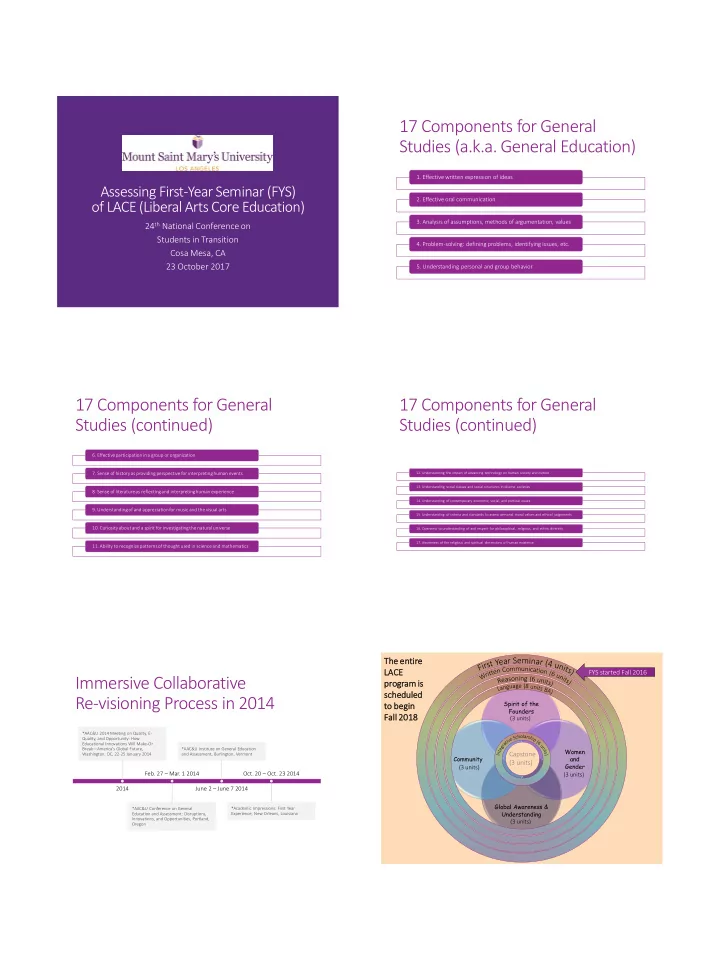
Spirit of the Founders Women and Gender Global Awareness & Understanding Community

The e entir ire LACE program is s sc sched edule led to begin in Fall l 201 2018

FYS started Fall 2016

(3 units) (3 units) (3 units) (3 units)

Capstone (3 units)

slide-2
SLIDE 2

New First Year Seminar (FYS)

FYS 1

Fall semester Extended orientation model Topics include:

  • Time management
  • Study skills
  • Critical thinking

FYS 2

Spring semester Interdisciplinary, team-taught academic model (3 faculty) Thematic topics linked to MSMU mission

  • Women and Gender
  • Community
  • Global awareness
  • Spirit of the Founders

Introduces students to integrative scholarship, a junior year LACE requirement

Student Learning Assessment Was a Challenge

Fall 2016

We had over 20 SLOs for FYS 1.

Spring 2017

We had the WASC 5 Core Competencies (written, oral, critical thinking, quantitative literacy, and information literacy) and the AAC&U Integrative Scholarship SLO

Multiple Forms of Feedback and Institutional Assessment

Because 2016-2017 was our pilot year, we created multiple opportunities to collect information/data from faculty, students, and staff to guide our inclusive re-visioning process.

FY FYS 1 Data Co Colle llectio ion: n: Summer salons Weekly meetings Mid-semester survey Focus group Student course evaluations FY FYS 2 Data Co Colle llectio ion: n: Mid-semester survey Integrative Scholarship Rubric Scoring Party (RSP)

Integrative Scholarship RSP

Explain the process

1

Model an RSP

2

Debrief

3 Results: What Worked and What We Are Changing/Improving

WHAT WORK ORKED ED

  • Students did best of connections

to the discipline and transfer

  • Students struggled the most with

reflection and self-assessment. WHAT TO O CHANGE/ E/IM IMPROVE VE

  • Provide explicit prompts related to

certain categories on the rubric

  • Tweak rubric for parallelism and

the bolding of terms

  • More opportunities/training for

faculty collaboration

  • Faculty should model in-class

integration

FYS 2 Successes: Innovative Project Models

“Wicked” Presentation in Art Gallery TED Talks Weebly Web Sites Water Magazine

slide-3
SLIDE 3

FYS 2 Successes

Academic Symposium Attendance Increase Three Keck Undergraduate Research Scholars Two Keck Mentors Presentation at National Conferences Pilot of FYS Peer Mentor Program Campus-wide Wellness Event

FYS Assessment Takeaways

Build formal FYS assessment on existing institutional processes

 Lends legitimacy and enhances collaboration

Solicit informal feedback early and often Link feedback to FYS evolution Identify, encourage, and support professional development

  • pportunities for students, staff, and faculty in the program,

and advertise those successes If you have any questions or concerns, please contact the FYS Leadership Team at FYSLeadershipTeam@msmu.edu Thank you for continuing on this adventure in designing the new LACE curriculum and the FYS at MSMU, LA! FYS Leadership Team

slide-4
SLIDE 4

INTEGRATIVE LEARNING VALUE RUBRIC

for more information, please contact value@aacu.org The VALUE rubrics were developed by teams of faculty experts representing colleges and universities across the United States through a process that examined many existing campus rubrics and related documents for each learning outcome and incorporated additional feedback from faculty . The rubrics articulate fundamental criteria for each learning outcome, with performance descriptors demonstrating progressively more sophisticated levels of attainment. The rubrics are intended for institutional-level use in evaluating and discussing student learning, not for grading. The core expectations articulated in all 15 of the VALUE rubrics can and should be translated into the language of individual campuses, disciplines, and even courses. The utility of the VALUE rubrics is to position learning at all undergraduate levels within a basic framework of expectations such that evidence of learning can by shared nationally through a common dialog and understanding of student success. Definition Integrative learning is an understanding and a disposition that a student builds across the curriculum and co-curriculum, from making simple connections among ideas and experiences to synthesizing and transferring learning to new , complex situations within and beyond the campus. Framing Language Fostering students’ abilities to integrate learning—across courses, over time, and between campus and community life—is one of the most important goals and challenges for higher education. Initially , students connect previous learning to new classroom learning. Later, significant knowledge within individual disciplines serves as the foundation, but integrative learning goes beyond academic boundaries. Indeed, integrative experiences often occur as learners address real-world problems, unscripted and sufficiently broad, to require multiple areas of knowledge and multiple modes of inquiry , offering multiple solutions and benefiting from multiple perspectives. Integrative learning also involves internal changes in the learner. These internal changes, which indicate growth as a confident, lifelong learner, include the ability to adapt one's intellectual skills, to contribute in a wide variety of situations, and to understand and develop individual purpose, values and ethics. Developing students’ capacities for integrative learning is central to personal success, social responsibility , and civic engagement in today’s global society . Students face a rapidly changing and increasingly connected world where integrative learning becomes not just a benefit...but a necessity . Because integrative learning is about making connections, this learning may not be as evident in traditional academic artifacts such as research papers and academic projects unless the student, for example, is prompted to draw implications for

  • practice. These connections often surface, however, in reflective work, self assessment, or creative endeavors of all kinds. Integrative assignments foster learning between courses or by connecting courses to experientially-based work. Work samples or

collections of work that include such artifacts give evidence of integrative learning. Faculty are encouraged to look for evidence that the student connects the learning gained in classroom study to learning gained in real life situations that are related to

  • ther learning experiences, extra-curricular activities, or work. Through integrative learning, students pull together their entire experience inside and outside of the formal classroom; thus, artificial barriers between formal study and informal or tacit

learning become permeable. Integrative learning, whatever the context or source, builds upon connecting both theory and practice toward a deepened understanding. Assignments to foster such connections and understanding could include, for example, composition papers that focus on topics from biology , economics, or history; mathematics assignments that apply mathematical tools to important issues and require written analysis to explain the implications and limitations of the mathematical treatment, or art history presentations that demonstrate aesthetic connections between selected paintings and novels. In this regard, some majors (e.g., interdisciplinary majors or problem-based field studies) seem to inherently evoke characteristics of integrative learning and result in work samples or collections of work that significantly demonstrate this outcome. However, fields of study that require accumulation of extensive and high-consensus content knowledge (such as accounting, engineering, or chemistry) also involve the kinds of complex and integrative constructions (e.g., ethical dilemmas and social consciousness) that seem to be highlighted so extensively in self reflection in arts and humanities, but they may be embedded in individual performances and less evident. The key in the development of such work samples or collections of work will be in designing structures that include artifacts and reflective writing or feedback that support students' examination of their learning and give evidence that, as graduates, they will extend their integrative abilities into the challenges of personal, professional, and civic life. Glossary The definitions that follow were developed to clarify terms and concepts used in this rubric only.  Academic knowledge: Disciplinary learning; learning from academic study , texts, etc.  Content: The information conveyed in the work samples or collections of work.  Contexts: Actual or simulated situations in which a student demonstrates learning outcomes. New and challenging contexts encourage students to stretch beyond their current frames of reference.  Co-curriculum: A parallel component of the academic curriculum that is in addition to formal classroom (student government, community service, residence hall activities, student organizations, etc.).  Experience: Learning that takes place in a setting outside of the formal classroom, such as workplace, service learning site, internship site or another.  Form: The external frameworks in which information and evidence are presented, ranging from choices for particular work sample or collection of works (such as a research paper, PowerPoint, video recording, etc.) to choices in make-up of the eportfolio.  Performance: A dynamic and sustained act that brings together knowing and doing (creating a painting, solving an experimental design problem, developing a public relations strategy for a business, etc.); performance makes learning observable.  Reflection: A meta-cognitive act of examining a performance in order to explore its significance and consequences.  Self Assessment: Describing, interpreting, and judging a performance based on stated or implied expectations followed by planning for further learning.

slide-5
SLIDE 5

INTEGRATIVE LEARNING VALUE RUBRIC

for more information, please contact value@aacu.org

Definition Integrative learning is an understanding and a disposition that a student builds across the curriculum and cocurriculum, from making simple connections among ideas and experiences to synthesizing and transferring learning to new , complex situations within and beyond the campus. Evaluators are encouraged to assign a zero to any work sample or collection of work that does not meet benchmark (cell one) level performance. Capstone 4 Milestones 3 2 Benchmark 1 Connections to Experience Connects relevant experience and academic knowledge Meaningfully synthesizes connections among experiences outside of the formal classroom (including life experiences and academic experiences such as internships and travel abroad) to deepen understanding of fields of study and to broaden own points of view . Effectively selects and develops examples of life experiences, drawn from a variety of contexts (e.g., family life, artistic participation, civic involvement, work experience), to illuminate concepts/theories/frameworks of fields

  • f study

. Compares life experiences and academic knowledge to infer differences, as well as similarities, and acknowledge perspectives other than own. Identifies connections between life experiences and those academic texts and ideas perceived as similar and related to own interests. Connections to Discipline Sees (makes) connections across disciplines, perspectives Independently creates wholes out of multiple parts (synthesizes) or draws conclusions by combining examples, facts,

  • r theories from more than one field of

study or perspective. Independently connects examples, facts,

  • r theories from more than one field of

study or perspective. When prompted, connects examples, facts, or theories from more than one field

  • f study or perspective.

When prompted, presents examples, facts,

  • r theories from more than one field of

study or perspective. Transfer Adapts and applies skills, abilities, theories, or methodologies gained in one situation to new situations Adapts and applies, independently , skills, abilities, theories, or methodologies gained in one situation to new situations to solve difficult problems or explore complex issues in original ways. Adapts and applies skills, abilities, theories,

  • r methodologies gained in one situation

to new situations to solve problems or explore issues. Uses skills, abilities, theories, or methodologies gained in one situation in a new situation to contribute to understanding of problems or issues. Uses, in a basic way , skills, abilities, theories, or methodologies gained in one situation in a new situation. Integrated Communication Fulfills the assignment(s) by choosing a format, language, or graph (or other visual representation) in ways that enhance meaning, making clear the interdependence of language and meaning, thought, and expression. Fulfills the assignment(s) by choosing a format, language, or graph (or other visual representation) to explicitly connect content and form, demonstrating awareness of purpose and audience. Fulfills the assignment(s) by choosing a format, language, or graph (or other visual representation) that connects in a basic way what is being communicated (content) with how it is said (form). Fulfills the assignment(s) (i.e. to produce an essay , a poster, a video, a PowerPoint presentation, etc.) in an appropriate form. Reflection and Self-Assessment Demonstrates a developing sense of self as a learner, building on prior experiences to respond to new and challenging contexts (may be evident in self-assessment, reflective, or creative work) Envisions a future self (and possibly makes plans that build on past experiences) that have occurred across multiple and diverse contexts. Evaluates changes in own learning over time, recognizing complex contextual factors (e.g., works with ambiguity and risk, deals with frustration, considers ethical frameworks). Articulates strengths and challenges (within specific performances or events) to increase effectiveness in different contexts (through increased self- awareness). Describes own performances with general descriptors of success and failure.

slide-6
SLIDE 6

1 FYS 1B Blue 28 April 2017 Final Integrative Project Overtime, women have turned to silencing due to the way females are projected. In addition, women think that silencing is the only way that can cure their sufferings and struggles. Society has always looked down on women because women are seen as weak figures in society. On the other had, the perspective of men focus on how males are superior, having higher authority and power. Moreover, women have always been treated unequally through education, job occupations, cultures, and past experiences due to having the female gender. The first module focuses on how women are viewed today. Women still have unequal just due to gender. Men also have a better chance in getting hired compared to women. According to Institute For Women’s Policy Research, women earn less than men in every single occupation. Society has always underestimated women without even knowing what females are capable of. Statistics have also shown that, “Female full time, year-round workers made only 80 cents for every dollar earned by men, a gender wage gap of 20 percent.” (Pay Equity and Descrimination) Women until now still get paid less back in the day, women were not meant to work. Females were always seen as housewives, taking care of kids, while the males would be the ones to work. “Hispanic women will have to wait until 2248 and Black women will have to wait until 2124 for equal pay.” (Pay Equity and Discrimination) Not only is gender a factor of unequal pay, but also

  • race. For example, in Figure 1, the graph depicts a representation based on earnings, focusing on

590-P-9

slide-7
SLIDE 7

2 gender and race. The graph clearly shows that men get paid more than women in every race. Additionally, white people and asians are the top paid races while Africans and Hispanics earn

  • less. (How Does Race Affect the Gender Wage Gap?)

In addition to unequal pay, many females are afraid in pursuing STEM. In The Only Woman in the Room: Why Science Is Still a Boys’ Club, Eileen was discouraged when she got to college because men were smarter. “The trouble was, I felt like a failure.” (Pollack 67) For example, the lessons she was learning in class were what boys had already learned in high

  • school. Back in the day, men were the only ones who pursued these majors especially because

“women would not be good at it.” (Fidelman) Along with being an at home mom, women were always known to always cook and do chores, rather than going to school to get an education. Women are also afraid of studying STEM related majors because the majority gender that pursued STEM were males. In the second module, the lessons focused on how women were viewed in Algeria. Storytelling can exhume the silenced voices by sharing the downfalls of the experiences of

Figure 1: How does Race Affect the Gender Wage Gap?

590-P-9

slide-8
SLIDE 8

3 women in Algeria. Djebar displays that by using your voice, you will gain value rather than being silent and afraid. In addition, women are taken under control because their gender are seen as weak and inferior compared to men. In Algerian culture, females were told to either live with husband if already married or live with parents. Women could never do things on their own and were always isolated from society. “Kill me if you're a man! But you aren’t a man, you’re a gouger! I’m not yet a grown woman, but that makes no difference! Kill me, since you love killing!” (Djebar133) Women can gain independence by using the power of voice. Djebar shares about Cherifa’s life, a young thirteen year old who was never afraid. Unlike other women in Algeria, Cherifa was independent, being able to speak up towards the soldiers. Additionally, Cherifa had a strong character, standing up for her beliefs and towards other women in the Algerian culture. Due to how women were afraid and silent in the past, Djebar wanted to make a difference by bringing their voices out, sharing their experiences. Not only has Djebar made an impact towards Algeria, but also towards women, making a stand for the independence and power of females. The third module also reflected on how women were afflicted and went through series of trauma during the time of slavery. “They took [her] milk” (Morrison 17). Her milk was the only thing she had that was hers as well as the only thing she could provide for her child. Not only is this event repetitively stated to show how devastating life was for Sethe, but to also allow readers to become aware of the way women were treated. In Beloved, Sethe was always mistreated by white men by getting her milk stolen and getting raped, where her experiences led to the killing

  • f her child. The reasoning for this was because Sethe did not want her child to go through what

she had gone through along with living the life as a slave. Although this story is a fictional novel,

590-P-9

slide-9
SLIDE 9

4 the story is still based on true life stories that occurred in the past. Without storytelling, women would not be able to be strong and overcome their fears of trauma and silencing. Neither would people become aware of these tragic events back in the day. The three modules are similar through how women have struggled based on how society has their stereotypical perspective of female genders. The first module reflects on how women are insecure of their knowledgeability and gender as a female.because of how society views us. The second module focuses on cultural aspects of women where women feel that they do not have the strength to stand up for themselves. Lastly, the third module refers back to slavery ] where white people would not serve any sort of consequence despite how harmful and disrespectful white people treated women and slaves in general. Overall, these three modules connect to how our world today needs to become more aware of what women have gone through in order to prevent silencing. Women throughout the years have made progress, proving that females are strong and independent. Although speaking up for women has slowly made progress,

  • ur society needs to make a change for equality between men and women. Additionally,

historical, cultural, and modern events bring about how these issues should be heard in order to structure our world for the better.

590-P-9

slide-10
SLIDE 10

5 Works Cited Djebar, Assia. Fantasia, an Algerian Cavalcade. Portsmouth, NH: Heinemann, 1993. Print. Fidelman, Mark. "Here's the Real Reason There Are Not More Women in Technology." Forbes. Forbes Magazine, 15 July 2012. Web. 27 Apr. 2017. "How Does Race Affect the Gender Wage Gap?" AAUW: Empowering Women Since 1881. AAUW, 3 Apr. 2014. Web. 26 Apr. 2017. Morrison, Toni. Beloved: A Novel. New York: Alfred A. Knopf, 1987. Print. "Pay Equity & Discrimination." Institute for Women's Policy Research. N.p., n.d. Web. 26 Apr. 2017. Pollack, Eileen. The Only Woman in the Room: Why Science Is Still a Boys’ Club. Boston:

  • Beacon. 2015. Print

590-P-9

slide-11
SLIDE 11

ASSIGNMENT 590

FYS 1B: Integrative Project: Women and Gender Pillar: “Silenced voices” Prompt: Discuss the similarities and differences about how each discipline viewed the theme of “silenced voices” under the women and gender pillar. Cite specific examples to support your position from the three different modules. In your analysis, include graphs and data to validate your argument. Length: 2-4 pages Font: Times 12 or Times New Roman 12 Margins: 1” throughout the document Double-spaced Include a bibliography Use MLA format.

slide-12
SLIDE 12

Preparing For a Rubric Scoring Party

Before semester begins:  Request course list from Registrar’s Office  Email faculty (cc Charis/directors) about their participation

  • Explain what to put in syllabus
  • Explain that at least one assignment that is aligned to rubric will be needed
  • Attach rubric

Beginning of semester:  Email faculty again about participation

  • Remind about syllabus statement, assignment, rubric
  • Offer help
  • Ask for assignments to be submitted by week 5 or 6 (give date)

Near end of semester:  Select date (need 3.5 hours)  Reserve room  Request rosters for each class from Registrar’s Office (after W date)  Determine percentage need (divide 85 by total students from all classes)  Randomly select percentage of students from each class  Send email to faculty listing names of students that need student work from and give deadline to submit  Collect student work and save in folders on S drive One-Two weeks before:  Order lunch  Print rubrics  Code courses using random three digit numbers  Remove identifiers from student work and assignments  Code student work and assignments  Prepare excel file

  • Enter code for each student
  • Enter student IDs
  • Enter course IDs (look up in Tk20)
  • Enter term codes
  • Enter rubric criteria across top row

 Print copies of assignments (about 5 each)  Print student work

slide-13
SLIDE 13

 Select 2-3 pieces of student work to use as norming papers

  • Make enough copies of those so everyone has a copy
  • Make enough copies of the norming assignments for everyone

 Randomly select 20% of student work to make duplicate copies so they can be read by two evaluators  Create piles of work for each reader making sure they are not reading any of their own students’ work  Set up Data Retreat Form and Trend Data excel file