
SLIDE 1
Today’s Agenda
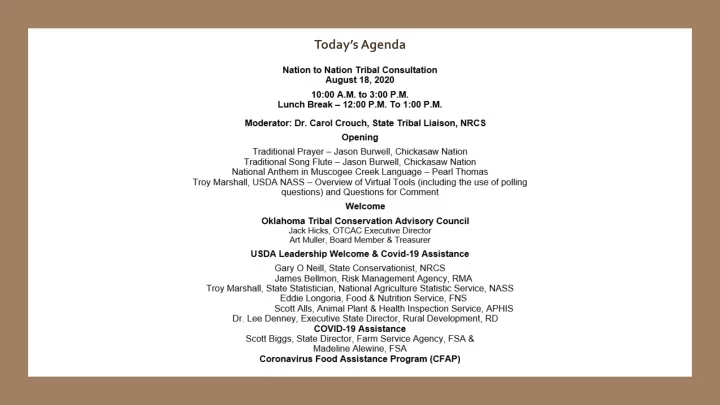
Todays Agenda Todays Agenda Continued Todays Agenda Continued - - PowerPoint PPT Presentation
Todays Agenda Todays Agenda Continued Todays Agenda Continued Save the Date August 17 & 18, 2021 10th Annual Nation to Nation Consultation Host: Chickasaw Nation USDA Leadership & Tribal Leaders Oklahoma NRCS
Today’s Agenda
Today’s Agenda Continued
Today’s Agenda Continued
1 Alan Messenger 405-334-2927 2 Stanley Irving 405-612-4584 3 Michael Roberts 405-612-9206 4 Rusty Norrie 405-612-1771 5 Mark Benton 405-612-8714 6 Larry McBride 405-385-4975 7 Will Brock 405-612-7675 8 Karla Stephens 405-612-7748 9 Russell Peterson 405-332-6604 10 Brandon Burns 405-332-1850 11 Nick Jones 405-385-3862 12 Danielle Metz 405-714-2230 13 Jeff Davis 405-334-7474 14 Dana Davis 405-338-5449 15 Cord Colwell 405-338-8718 16 Michael Ramming 405-385-2927 17 Chris Best 405-385-3032 18 Roderick Dukes 405-780-3016 19 Audra Fenton 405-334-1342 20 Valerie Hannon 405-385-4898 21 Scott Pace 405-338-5207 West Central East
District Conservationist
Texas Osage Ellis Beaver Kay LeFlore Cimarron Caddo McCurtain Woods Grady Grant Atoka Major Kiowa Creek Bryan Pittsburg Harper Custer Blaine Dewey Craig Alfalfa Lincoln Garfield Carter Noble Washita Tillman Garvin Logan Woodward Pushmataha Coal Greer A d a i r Love Payne Tulsa Hughes Mayes Roger Mills Comanche Rogers Jackson Latimer Cotton Beckham Canadian Stephens Choctaw Kingfisher Haskell Jefferson Delaware Pontotoc Muskogee Cherokee McIntosh Nowata Pawnee Johnston McClain Sequoyah Oklahoma Okmulgee Seminole Ottawa Harmon Okfuskee Wagoner Murray Pottawatomie Cleveland Marshall Washington
03 10 14 20 02 21 17 15 01 08 18 11 16 19 04 12 09 05 07 13 06
Ada Jay Hugo Enid Alva Atoka Sayre Altus Tulsa Pryor Dewey Miami Perry Durant Idabel Poteau Okemah Duncan Norman Madill Wewoka Mangum Lawton Hollis Hobart Nowata Vinita Pawnee Beaver Guymon Taloga Arnett Antlers Eufaula Stigler Ardmore Sulphur Shawnee Purcell Waurika Cordell Clinton Walters Wagoner Medford Guthrie Bristow El Reno Newkirk Buffalo Watonga Marietta Anadarko Sallisaw Muskogee Okmulgee Stilwell Pawhuska Chandler Cheyenne Cherokee Fairview Woodward McAlester Wilburton Frederick Claremore Stillwater Kingfisher Boise City Holdenville Pauls Valley Coalgate Chickasha Tahlequah Tishomingo Oklahoma City
6/2020
Legend
Zone TSO County Boundary TeamOklahoma NRCS
West Shelly Oliphant 405-334-2932 Central Brent Pannell 405-385-4443 East Brandon Bishop 405-334-2764
Producers can continue to work with their Approved Insurance Providers, or AIPs, on policies, claims, and agreements. Farmers with crop insurance questions or needs should continue to contact their insurance agents about conducting business by telephone or email. USDA’s Risk Management Agency is working with those insurance providers to provide additional flexibilities in response to COVID-19, including:
marketings for the Livestock Gross Margin for Dairy programs.
programs in certain cases.
certifying agent by their policy’s acreage reporting date.
Electronic Notifications Notifications and information may be sent by phone or electronic methods between policyholders and their crop insurance agents to do the following:
(deadlines to buy crop insurance)
acreage and production
Notice of the policyholder’s election may be provided over the phone with appropriate documentation of the call or using electronic methods followed by their confirmation of such election in writing (via a signed, or e-signed, form) no later than July 15, 2020. Production Reporting Dates For the 2020 crop year, AIPs may accept production reports through the earlier of the acreage reporting date or 30 days after the production reporting date for crops insured under the Common Crop Insurance Policy Basic Provisions with a PRD of March 15, 2020, or later. Generally, the PRD for crops insured under the Common Crop Insurance Policy Basic Provisions is the earlier of the ARD or 45 days after the cancellation date. More Time and Deferred Interest on Payments AIPs are authorized to provide additional time for policyholders to make payment of premium and administrative fees. USDA announced on May 29 that interest accrual on premium payments and administrative fees will be waived to the earliest of an additional 60 days from the scheduled payment due date or the termination date on policies with premium billing dates between March 1, 2020, and July 31,
Written Payment Agreements due between March 1, 2020, and July 31, 2020. Payments may be extended up to 60 days from the scheduled payment due date and considered a timely payment. On August 5, USDA announced that RMA authorizes AIPs to extend deadlines for payments, defer interest accrual, and provide other continued flexibilities to help farmers, ranchers, and insurance providers due to the COVID-19 pandemic. Specifically, RMA authorized AIPs:
date or the termination date on policies with premium billing dates between August 1, 2020, and September 30, 2020.
interest for Written Payment Agreements due between August 1, 2020, and September 30, 2020. Acreage Reporting Corrections The correction time period is extended an additional 30 days for an acreage report or other forms that must be submitted by the acreage reporting date to be consistent with the recent Farm Service Agency acreage reporting 30-day late file fee waiver in Notice CP-757. This will allow producers to make certain that the information they provide for the FSA 578 Report of Acreage form is correct and consistent with the acreage report filed with their crop insurance agent.
Dairy Revenue Protection Sales Period Modification The sales period over weekends is modified for Dairy Revenue Protection (DRP) because of the high volatility of milk prices. Starting June 5, 2020, the sales period will begin no later than 4:30 p.m. Central Time (CT) when the coverage prices and rates are published and will end at 9:00 a.m. CT of the following business day or 9:00 a.m. CT on Sunday, whichever is earlier. The next sales period will begin no later than 4:30 p.m. CT on the following business day. This change only impacts when milk producers can purchase DRP quarterly endorsements, not the timing of indemnity payments. This modification will also be incorporated into the DRP policy for the 2022 crop year. Replant Self-Certification For the 2020 crop year only, AIPs are authorized to allow self-certification replant inspections for up to 100 gross acres (before considering share) per unit in lieu of 50 acres. Authorized crops for self-certification of up to 100 acres for replant include: barley and wheat not covered by the Winter Coverage Endorsement (both initially planted winter and spring crops), buckwheat, canola and rapeseed, corn, dry beans, flax (spring-seeded only), grain sorghum, mustard, oats (spring-seeded
seed. Assignment of Indemnity AIPs are authorized to waive the witness signature requirement for approval of Assignments through July 15, 2020. The insured’s and creditor’s signature on the Assignment will be required in a pen and ink signature and in the hand of the person whose signature is required or an acceptable electronic (digital) signature in accordance with the AIPs' established Electronic Business Implementation Plan and applicable RMA procedures. Adjustments for Dumped Milk COVID-19 shutdowns have caused disruption in the milk market, and dairy producers are dumping milk as a result. For the 2020 calendar year, RMA is allowing AIPs to count dumped milk toward the milk marketings for the Dairy Revenue Protection or actual marketings for the Livestock Gross Margin for Dairy programs regardless of whether the milk was sold. Producers will still have to provide to the AIPs supporting documentation from the cooperative or milk handler verifying the actual pounds dumped and that the milk was dumped. Deadline Extensions for Perennial Inspections:
2020, from June 14.
insurance attaches to the crop.
attaches to the crop.
perennial crop policies with an inspection deadline due on or before May 30, 2020.
Waiving of Inspection Requirements RMA is authorizing AIPs to waive the 2021 crop year inspection requirements when an inspection report exists in the policyholder’s file for the Nursery Crop Provisions and Nursery Value Select for the 2017, 2018, 2019 or 2020 crop years. For the 2022 crop year, AIPs must inspect those policies that had a crop year 2021 waiver. Nursery Value Select is a new program for the 2021 crop year, with a deadline for signup of May 1, 2020, and insurance attaching on June 1. Normally, any inspections should be conducted in May for insurance to begin, as scheduled, on June 1. Organic Certification Flexibilities AIPs may allow organic producers to report acreage as certified organic, or transitioning to organic, for the 2020 crop year if they can show they have requested a written certification from a certifying agent by their policy’s acreage reporting date. In addition, policyholders who have requested but not received an
30 days after the certifying agent informs them of their organic plan or certificate status. The policyholder notification may be made by phone, email, text, or other electronic communication method, and the AIPs must document the policyholder’s notification. Policyholders will be required to either sign digitally at the time of submission or must follow up with properly signed forms no later than July 15, 2020. For more information, visit our website at: www.rma.usda.gov.
Nation to Nation Tribal Consultation Meeting
Virtual Meeting ~ August 18, 2020 Eddie Longoria Time: Approx 10 minutes
these difficult times we’re facing with COVID-19.
and Utah. Including:
administering FDPIR and two administering WIC.
White Mountain Apache, Navajo Nation, and Tohono O’odham Nation, and in Utah - the Ute Tribe.
COVID-19 starting impacting our states. She serves as a conduit between SWRO and your communities on issues related to our 15 nutrition programs.
granting our partners significant program flexibilities and contingencies to best serve program participants across our 15 nutrition assistance programs. The waivers we issued intend to help ease program operations and protect the health of participants.
received $100 million - $50 million for administration (equipment and facility improvements to support social distancing) and $50 million for food.
equipment and facility improvements.
“Bonus Food Packages” that every participant will be eligible to receive.
flexibilities.
increasing remote delivery of care and educational services and decreasing COVID spread by limiting person to person contact in ITO WIC clinics.
where WIC participants will have the added protection of online ordering, remote delivery, and curbside pickup of WIC food items. Five ITO WIC Programs received awards and bonuses ($25k) for their Breastfeeding Promotion this year: ACL, Inter- Tribal Council of Arizona, Navajo Nation, San Felipe, and ITC Oklahoma.
available.
to be expanded by September 30, 2021, to prevent, prepare for, and respond to coronavirus, domestically or internationally. Of the amount provided, $15,510,000,000 is a contingency reserve to be allocated as the Secretary deems necessary to support participation if cost or participation exceed budget estimates to prevent, prepare for, and respond to coronavirus. Key Program Flexibilities worth mentioning include:
households that normally receive less than the maximum benefit.
children who normally receive free or reduced-price school meals.
support social distancing, bringing access to nearly three-quarters of the states, covering 90% of SNAP households.
and USDA food purchases, of which a minimum of $600 million was designated for food purchases.
traditional times to maximize flexibility for meal pick-up, through the 2020-2021 school year.
group settings to support social distancing, through the 2020-2021 school year.
pick-up meals and bring them home to their children, through the 2020-2021 school year.
(DHD).
Collaborative on Hunger and Poverty, McLane Global, and PepsiCo. It began as a summer pilot project in 2019 but has been successfully leveraged as emergency Meals-to-You to address pandemic-related nutrition needs in rural areas. Meals-to- You boxes are delivered directly to children’s homes via the U.S. Postal Service or another delivery service. Children in several tribal communities in our region have been served through this very successful program.
two Southwest tribes, Acoma Pueblo and Cherokee Nation.
USDA foods through the months of April to mid-June.
guide us, customer service, program integrity, and self-sufficiency.
partners on the ways our programs can assist their communities.
must be operated with the utmost integrity. Program integrity efforts protect our programs by ensuring resources are spent: properly, effectively, efficiently, and as intended.
sufficiency by ensuring they have nutritious food to eat while helping to pave a pathway to long-term success.
08.18.2020
B&I CARES Act
their working capital to prevent, prepare for and respond to the economic impacts of the coronavirus.
industry-cares-act-program
Rural Business Service Contacts
Distance Learning and Telemedicine
Distance Learning
and promotes the connection of students and teachers at remote sites.
students and teachers who are in rural areas; or
rural area.
Telemedicine
professionals at separate sites in order to exchange health care information for the purpose of providing improved health care services to residents of rural areas.
For more info, visit https://www.rd.usda.gov/sites/default/files/DLT_WebinarSlides_2020_FOA_2.pdf
Rural Broadband
improvement, or acquisition of facilities and equipment needed to provide service at the broadband lending speed in eligible rural areas.
visit: http://www.rd.usda.gov/programs-services/all-programs/telecom-programs
Broadband & DLT Contact
COVID-19 Federal Rural Resource Guide For more information on what RD is doing to help the economic impact of the coronavirus, visit https://www.rd.usda.gov/sites/default/files/USDA_COVID- 19_Fed_Rural_Resource_Guide.pdf
End Slide
USDA is an equal opportunity provider, employer, and lender.
USDA and its Federal partners have programs that can be used to provide immediate and long-term assistance to rural communities affected by the COVID-19 outbreak. These programs can support recovery efforts for rural residents, businesses and communities through:
This resource matrix organizes funding opportunities identifjed in stimulus bills and other federal resources that can help support rural America. Opportunities are categorized by customer and assistance type. For more information on the immediate actions USDA is taking to respond to COVID-19, visit usda.gov/coronavirus. To learn about USDA’s COVID-19 response for rural communities, visit rd.usda.gov/coronavirus. For the latest news from the CDC on COVID-19, visit coronavirus.gov.
1
usda.gov/coronavirus
COVID-19 Federal Response Resource Matrix
Rural Customer Technical Assistance/ Training/Management Financial Assistance General State/ Local Resources For-Profit Businesses:
Corporations, Limited FAQ’s: Related to COVID-19 impact and Industry Loan Guarantee Employers to Plan and Respond Liability Companies,
sole proprietorships,
Microloan Programs
Lenders, etc. Guidance and Loan Resources
Centers: Small Business Resources
Executives (SCORE): Small Business Resource Hub
Response Act Notice-FAQS
Documents for Industry, FDA Staff, and Other Stakeholders
Disaster Loan
Guidance and Loan Resources
Dislocated Worker Grants
COVID-19 and the American Workplace
and Economic Impact Payments
American Program-Renewable Energy & Energy Effjciency Fact Sheet
Home Loan Guarantees Fact Sheet
Loan COVID-19 Fact Sheet
2
usda.gov/coronavirus
COVID-19 Federal Response Resource Matrix
Rural Customer Technical Assistance/ Training/Management Financial Assistance General State/ Local Resources Agricultural Producers
and Ranchers: During COVID-19 Outbreak
Related Resources
Loans-Lender Toolkit
FAQ’s: Related to COVID-19 impact
Ranchers, and forest landowners
Microloan Programs
Conservation Service offjce
and Economic Impact Payments
American Program-Renewable Energy & Energy Effjciency Fact Sheet and Resources
Podcasts: USDA’s Work During COVID-19
to Families Food Box (part of Coronavirus Farm Assistance Program)
3
usda.gov/coronavirus
COVID-19 Federal Response Resource Matrix
Rural Customer Technical Assistance/ Training/Management Financial Assistance General State/ Local Resources Government Entities:
State, County or (FAS) Data and Analysis (FNS) Response to COVID-19 Homelessness (USICH) - COVID-19 local governments
Directory
Update
Response
Medical Services (EMS) Systems and 911 Public Safety Answering Points: CDC
Announcement)
COVID-19 Resource Website
ReConnect Program
Services Administration (SAMHSA): Coronavirus Resources
EMS.gov: Coronavirus/COVID-19 Resources Resources
Coronavirus Pandemic
Real-Time Data Maps Spread of Coronavirus at Regional Level
Resources: Links to each State from this site
Response to COVID-19 (WIC/SNAP etc)
Facilities Direct Loan & Grant
Security Agency: Critical Infrastructure Guidance
Fact Sheets
Policing Services (COPS)
(OJP)
Women (OVW)
Environmental Programs COVID-19 Fact Sheet Deferral Fact Sheet
and Recreational Facilities
Supplemental Assistance to Firefjghters Grant Program
4
usda.gov/coronavirus
COVID-19 Federal Response Resource Matrix
Rural Customer Technical Assistance/ Training/Management Financial Assistance General State/ Local Resources Nonprofits:
Economic Dev. Corps., Agriculture Coronavirus (COVID-19) Learning and Telemedicine (DLT) Site Sponsor universities, schools, Resources
libraries, faith-based
Disaster Loan Resources for Schools and School
Sponsor
Homelessness (USICH) - COVID-19 Resources
Professionals
Human Services: Child Care and Development Fund
Meal Waivers & Q&As on Summer Meal Delivery Using Existing Authority
Administration
National Farmworker Jobs Program (NFJP) Career Services and Training Grants and Housing Grants
to Novel Coronavirus Impacts across Food and Agricultural Systems
Facilities Direct Loan & Grant Deferral Fact Sheet Personnel
How can I help?
Response to COVID-19 (WIC/SNAP etc)
Telehealth Program
to Families Food Box (part of Coronavirus Farm Assistance Program)
Loan COVID-19 Fact Sheet Cooperatives
Publications and Research
Disaster Loan
to For-Profjt Farm Cooperatives
Cooperative Development Center listing
Loan COVID-19 Fact Sheet
5
usda.gov/coronavirus
COVID-19 Federal Response Resource Matrix
Rural Customer Technical Assistance/ Training/Management Financial Assistance General State/ Local Resources Individuals/Households:
(COVID-19)
during the Coronavirus Pandemic
(COVID-19)
Other Income-Support Options for Those Unable to Work
Unemployment Insurance for Individuals Affected by COVID-19
Common questions about Food Safety and COVID-19
Human Services: American Sign Language COVID-19 Resource links
feeding sites
Housing Loan Program Website
COVID-19 and the American Workplace
and Economic Impact Payments
(Direct Program) Fact Sheet
Loan COVID-19 Fact Sheet
Mortgage Resource
How can I help?
Hunger Hotline
Find Meals for Kids
Human Services: Administration for Community Living (Older Adults and People with Disabilities)
information for benefjciaries
Protection Bureau Protecting Finances Information/Resources
respond to COVID-19 national emergency
6
usda.gov/coronavirus
COVID-19 Federal Response Resource Matrix
Rural Customer Technical Assistance/ Training/Management Financial Assistance General State/ Local Resources Health: Hospitals
Services Administration SAMHSA: Coronavirus (COVID-19)
Medicare Services
Asked Questions
Practices and FAQs for Faith-based and Community Leaders
and People with Disabilities Need to Know?
Program (CTAP)
Medicare Services
Centers for COVID-19 Response
COVID-19
Response to COVID-19
and Economic Impact Payments
Facilities Direct Loan & Grant Deferral Fact Sheet
Distance Learning and Telemedicine (DLT)
Program
Homes Telehealth and Telemedicine Tool Kit
(COVID-19) Frequently Asked Questions – Federal Offjce of Rural Health Policy
7
usda.gov/coronavirus
COVID-19 Federal Response Resource Matrix
Rural Customer Technical Assistance/ Training/Management Financial Assistance General State/ Local Resources Federally-recognized
Tribes, or (FNS) Response to COVID-19 Reservations (FDPIR) (HUD) COVID-19 Resources and Tribal organizations
COVID-19 Resources
(COVID-19)
Response
Country: National Congress of American Indians
and Fact Sheets
Minneapolis COVID-19 Resources for Indian Country
Resources: Offjce of Child Care- Child Care and Development Fund
Offjcers Association (NAFOA)
ReConnect Program
Learning and Telemedicine (DLT)
Services: Grants to expand digital network access etc.
IHBG and ICDBG funds
funding in multiple programs
Affairs Operation of Indian Programs
from the Coronavirus Relief Fund to use for expenditures incurred due to the COVID-19 public health emergency
Guidance and Loan Resources
Facilities Direct Loan & Grant Deferral Fact Sheet
Environmental Programs COVID-19 Fact Sheet Fact Sheets
Policing Services (COPS)
(OJP)
Women (OVW)
Program
Loan COVID-19 Fact Sheet
8
usda.gov/coronavirus
CARES Act: Coronavirus Aid, Relief, and Economic Security Act FAQS: Frequently Asked Questions
NEW: Denotes a new resource link added since last version 04/09/20.
9
usda.gov/coronavirus
Acronym Definition CDC Centers for Disease Control and Prevention (CDC) CMS Centers for Medicare and Medicaid CHCO Chief Human Capital Offjcers Council CFPB Consumer Financial Protection Bureau (CFPB) CNCS Corporation for National and Community Service (CNCS) CISA Cybersecurity and Infrastructure Security Agency DAU Defense Acquisition University DeCA Defense Commissary Agency USDA Department of Agriculture (USDA) DoD Department of Defense (DoD) DOE Department of Energy (DOE) HHS Department of Health and Human Services (HHS) DHS Department of Homeland Security (DHS) HUD Department of Housing and Urban Development (HUD) DEA Drug Enforcement Administration Diversion Control Division DOL Department of Labor (DOL) DOS Department of State (DOS) USDOT Department of the Treasury ODNI Director of National Intelligence EPA Environmental Protection Agency (EPA) EXIM Export-Import Bank of the United States FAA Federal Aviation Administration (FAA) BOP Federal Bureau of Prisons FCC Federal Communications Commission (FCC) FDIC Federal Deposit Insurance Corporation (FDIC) ED Federal Student Aid FTC Federal Trade Commission (FTC) Acronym Definition FTA Federal Transit Administration (FTA) FDA Food and Drug Administration (FDA) GSA General Services Administration (GSA) IA Indian Affairs IMLS Institute for Museum and Library Services (IMLS) IRS Internal Revenue Service (IRS) MSPG Merit Systems Protection Board (MSPB) MCFP Military Community and Family Policy NA National Archives NCPC National Capital Planning Commission NPS National Park Service NREL National Renewable Energy Laboratory NSF National Science Foundation (NSF) NMCPHC Navy and Marine Corps Public Health Center USNRC Nuclear Regulatory Commission ASPR Offjce of the Assistant Secretary for Preparedness and Response OPM Offjce of Personnel Management SBA Small Business Administration (SBA) USDA RD USDA Rural Development TSA Transportation Security Administration USAID U.S. Agency for International Development USCIS U.S. Citizenship and Immigration Service (USCIS) USFA U.S. Fire Administration USNORHCOM U.S. Northern Command USPTO U.S. Patent and Trademark Offjce (USPTO) USSOCOM U.S. Special Operations Command WHS Washington Headquarters Services
USDA is an equal opportunity provider, employer, and lender. Last Updated 05/11/20 10
usda.gov/coronavirus
USDA is providing critical support to our nation’s farmers and ranchers through the Coronavirus Food Assistance Program (CFAP). CFAP provides vital fjnancial assistance to producers of agricultural commodities with fjnancial assistance that gives them the ability to absorb sales losses and increased marketing costs associated with the COVID-19 pandemic.
Overview
The Coronavirus Aid, Relief, and Economic Stability Act (CARES Act) and the Commodity Credit Corporation (CCC) Charter Act authorized the funds for the CFAP. USDA’s Farm Service Agency (FSA) and Agricultural Marketing Service (AMS) administer the program. FSA is accepting applications for CFAP from May 26, 2020, to September 11, 2020.
Who is Eligible?
Eligible producers (person or legal entity) of specifjed agricultural commodities who have sufgered a fjve percent-or-greater price decline as a result of the COVID-19 pandemic, and who face substantial marketing costs for inventories are eligible for CFAP
certain specialty crops, non-specialty crops, wool, dairy, aquaculture, nursery crops and cut fmowers, eggs, and livestock. For a list of eligible commodities and payment criteria, visit farmers.gov/cfap. United States Department of Agriculture
CORONAVIRUS FOOD ASSISTANCE PROGRAM
FARM SERVICE AGENCY
FACT SHEET - AUGUST 12, 2020
USDA may reconsider excluded commodities if credible evidence is provided. More information about request for consideration of additional commodities can be found at farmers.gov/cfap. Producers may have some commodities that are currently eligible for CFAP while others are not. Producers are encouraged to apply for CFAP now for their eligible commodities. If a commodity is added to the program, producers will have an opportunity to amend their application. To be eligible for payments, a person or legal entity must either:
$900,000 for tax years 2016, 2017, and 2018; or
income from farming, ranching, or forestry. Persons and legal entities also must:
Land and Wetland Conservation” regulations, often called the conservation compliance provisions;
substantial amount of active personal labor to the farming operation; and
Payment Limitation
CFAP payments are subject to a per person and legal entity payment limitation of $250,000. This limitation applies to the total amount of CFAP payments for all eligible commodities.
CORONAVIRUS FOOD ASSISTANCE PROGRAM 2
USDA is an equal opportunity provider, employer and lender.
Unlike other FSA programs, special payment limitation rules apply to participants that are corporations, limited liability companies, and limited partnerships (corporate entities). These corporate entities may receive up to $750,000 based upon the number of shareholders (not to exceed three shareholders) who are contributing at least 400 hours of active personal labor or active personal management. For a corporate entity:
the entity is $250,000;
for the entity is $500,000 if at least two members contribute at least 400 hours of active personal labor or active personal management, or combination thereof, with respect to the operation
if at least three members contribute at least 400 hours of active personal labor or active personal management, or combination thereof, with respect to the operation of the corporate entity.
Where to File the Application
FSA stafg at your local USDA Service Center will work with producers to fjle applications. Applications may be submitted via mail, fax, hand delivery, or via electronic
applications electronically. The CFAP application and associated forms are available online at farmers.gov/cfap.
More Information
This fact sheet is for informational purposes only; other restrictions may apply. For more information about the CFAP program, visit farmers.gov/cfap or contact your local FSA offjce. To fjnd your local FSA offjce, visit farmers.gov/cfap.
Overview
The U.S. Department of Agriculture’s Farm Service Agency (FSA) offers direct and guaranteed loans to farmers and ranchers to promote, build, and sustain family farms for a thriving agricultural economy. Farm ownership, operating, and emergency loans are available under the Direct Loan Program. Farm
available under the Guaranteed Loan Program. FSA
Guarantee Program. The goal of FSA’s farm loan programs is to help farmers and ranchers obtain commercial credit. Once you are able to obtain credit from a commercial lender,
is complete.
Direct Farm Loans
FSA’s Direct Loan Program is designed to help farmers start, purchase, or expand their farming operation. From beginning farmers who have limited financial history to qualify for commercial credit to farmers who have suffered financial setbacks from natural disasters, FSA offers a variety of loans to provide additional resources farmers need to establish and maintain profitable farming operations. Farmers may apply for direct loans at their local FSA offices.
Guaranteed Farm Loans
FSA guaranteed loans are available to farmers who may not meet loan qualifications from a commercial
commercial lenders, such as banks, Farm Credit System institutions, or credit unions. Under a guaranteed loan, a commercial lender makes and services the loan, and FSA guarantees it against loss up to a maximum of 90 percent in most cases or 95 percent in limited circumstances. FSA approves eligible loan guarantees and provides oversight of lenders’ activities. Contact a local FSA office for a list
Farm Ownership Loans
Farm Ownership Loans may be used to purchase a farm, enlarge an existing farm, construct new farm buildings and/or improve structures, pay closing costs, and promote soil and water conservation and
maximum of $600,000. Microloans are also available. FSA will guarantee farm ownership loans through a commercial leader up to $1,776,000. The maximum repayment term is 40 years for both direct and guaranteed farm ownership loans. 1
FACT SHEET
March 2020
FARM LOANS OVERVIEW – MARCH 2020
2
USDA is an equal opportunity provider, employer, and lender.
Farm Operating Loans
Farm Operating Loans may be used for normal
real estate repairs or improvements, and refinancing
guarantee farm operating loans through a commercial leader up to $1,776,000. The repayment term may vary, but it cannot exceed seven years. Annual
education, training, or at least one year’s experience in managing or operating a farm or ranch within the last five years.
Down Payment Program
The Down Payment loan assists socially disadvantaged and beginning farmers in purchasing a farm. Requirements:
at least 5 percent of the purchase price;
percent of the least of the purchase price of the farm to be acquired, the appraised value of the farm to be acquired or $667,000 (Note: This results in a maximum loan amount of $300,150);
The interest rate is 4 percent below the direct farm
a commercial lender or private party. FSA can provide up to a 95 percent guarantee if financing is
lenders do not have to pay a guarantee fee
amortization period of at least 30 years and cannot have a balloon payment due within the first 20 years of the loan.
Youth Loans
Youth loans may be made to young persons who are sponsored by a project advisor, such as a 4-H club, FFA, tribal youth organization, or similar agriculture affiliated group. The project must provide an
and education in agriculture-related skills. These loans are only available as direct loans with a maximum loan amount of $5,000. Youth loans are available to those between the ages of 10 and 20 years at the time of loan closing.
FARM LOANS OVERVIEW – MARCH 2020
3
USDA is an equal opportunity provider, employer, and lender.
Emergency Loans
Emergency loans help farmers and ranchers who have suffered a loss caused by natural disasters that damaged their farming or ranching operation. Emergency loan funds may be used to restore or replace essential property, pay all or part of production costs associated with the disaster year, pay essential family living expenses, reorganize the farming
counties where the farm is located must be declared a disaster area by the President or designated by the Secretary of Agriculture. For production loss loans, applicants must demonstrate a 30 percent loss in a single farming enterprise. Applicants may receive loans up to 100 percent of production or physical losses. These loans are only available as direct loans from FSA with a maximum loan amount of $500,000.
Conservation Loans
Conservation Loans provide access to credit for farmers and ranchers who want to implement conservation measures on their land. These loans are available to both smaller and less financially established farmers and ranchers, and to larger and financially stronger farmers and ranchers. The family farm and test for credit requirements are not applicable to Conservation Loans. Farmers and ranchers may use conservation loans to complete any conservation activity included in a USDA approved conservation plan or Forestry Management Plan. The maximum loan amount is $1,776,000 with a maximum repayment term of 30
loans only.
Loans for Beginning and Socially Disadvantaged Farmers
Each year, Congress targets a percentage of farm
and socially disadvantaged farmers. Providing loan programs is important as these groups of farmers have historically experienced more difficulties obtaining financial assistance. FSA offers several loan programs to assist beginning and socially disadvantaged farmers (refer to the fact sheets titled Loans for Socially Disadvantaged Farmers and Ranchers and Loans for Beginning Farmers and Ranchers). FSA’s Down Payment Program is offered to assist socially disadvantaged and beginning farmers in purchasing a farm with a maximum loan amount of $300,150.
FARM LOANS OVERVIEW – MARCH 2020
4
USDA is an equal opportunity provider, employer, and lender.
Land Contract Guarantees
FSA also offers financial guarantees for land sale contracts to a beginning or socially disadvantaged
the amount of three amortized annual installments plus the cost of any related real estate taxes and insurance.
guarantee of 90 percent of the outstanding principal balance under the land contract. The purchase price of the farm cannot exceed the lesser of $500,000 or the market value of the property. The buyer must provide a minimum down payment
interest rate is fixed at a rate not to exceed the direct farm ownership loan interest rate in effect at the time the guarantee is issued, plus three percentage
plan regardless of the term of the land contract. The contract payments must be amortized for a minimum
the 10-year term of the guarantee.
Who Is Eligible?
Eligibility requirements:
Rico, the U.S. Virgin Islands, Guam, American Samoa, Commonwealth of the Northern Mariana Islands, Republic of Palau, Federated States of Micronesia and the Republic of Marshall Islands; a U.S. non- citizen national or a qualified alien under federal immigration law;
rates and terms to meet actual needs;
the loan;
by the U.S. in any court, excluding judgments filed in U.S. Tax Courts;
misleading documents or statements in the past;
laws of planting, cultivating, growing, producing, harvesting, or storing a controlled substance within the last 5 crop years;
(certain exceptions apply); and
FARM LOANS OVERVIEW – MARCH 2020
5
USDA is an equal opportunity provider, employer, and lender.
years they can receive FSA assistance. Applications may also be made by entities. Entities are corporations, cooperatives, joint operations, partnerships, trusts, and limited liability companies. Their members/stockholders must meet these same eligibility requirements. The entity must also be authorized to operate a farm or ranch in the state where the land is located. For socially disadvantaged members, they must hold a majority interest in the entity applicant to receive targeted funding.
Working with Farmers and Ranchers
FSA does more than just provide credit - it works with farmers and ranchers to identify strengths and
and management. FSA helps farmers and ranchers find alternative options, so they can achieve success. Learning and improving business planning and financial insight through FSA’s credit management is the difference between success and failure for many farm families. FSA works to keep farmers and ranchers farming. FSA may be able to support direct loan borrowers whose accounts are distressed or delinquent, including:
deferral of loans;
environmentally sensitive land in exchange for reduction of debt; and
If none of these options results in a feasible farm
determine if they are eligible for consideration to retain the homestead and up to 10 acres. Borrowers may be
amount below the full debt if that amount represents the market value of the loan collateral. Farms that come into FSA ownership are sold at market value, with preference given to socially disadvantaged and beginning farmers.
More Information
For more information, visit fsa.usda.gov/farmloans or farmers.gov. Find your local USDA Service Center at farmers.gov/service-locator.
Overview
The U.S. Department of Agriculture’s Farm Service Agency (FSA) makes operating loans of up to $5,000 to eligible individual youths ages 10 to 20 to finance income-producing, agriculture-related projects. The project must be of modest size, educational, and initiated, developed, and carried out by youths participating in 4-H clubs, FFA, tribal youth
The project must be an organized and supervised program of work. It must be planned and operated with the assistance of the organization advisor, produce sufficient income to repay the loan, and provide the youth with practical business and educational experience in agriculture-related skills.
Who May Borrow
To qualify for a loan, the applicant must:
and
supervised program of work.
FACT SHEET August 2019
Farm Service Agency
USDA is an equal opportunity provider, employer, and lender.
How Loan Funds May Be Used
These loans can finance many kinds of income-producing agricultural projects. The loan funds may be used to:
How It Works
To apply, the applicant must submit completed plans and budgets signed by the project advisor and parent
assistance. These loans:
principal balance owed at any one time cannot exceed this amount);
cost of money to the federal government (after the loan is made, the interest rate for that loan will not change);
liens on the products produced for sale and on chattel property, including livestock, equipment, and fixtures purchased with loan funds; and
the type of project for which the loan is made. For example, if it involves raising livestock or crops, the loan is paid when the animals or produce are normally sold.
More Information
For more information, visit fsa.usda.gov/farmloans
Center at farmers.gov/service-locator.
Osage
McIntosh Pushmataha Logan
Pittsburg * McCurtain Cimarron Woods Harper Beaver Texas Alfalfa Grant Kay
Craig
*
Ottawa
Mayes
Rogers
Adair
Cherokee Wagoner
Okmulgee
Muskogee Haskell
LeFlore Creek
Pawnee
Payne
Lincoln
*
Hughes
Sequoyah Latimer Choctaw Atoka Bryan Johnston
Pontotoc McClain
Garvin Murray Carter Love
Jefferson Stephens
Grady Comanche Cotton Tillman Kiowa Washita
Jackson
Greer Beckham Roger Mills Dewey Canadian Oklahoma Ellis Noble Major Garfield
Woodward
P Caddo Blaine S e m i Custer
t
Coal
Coal * * * ***
David Toney, Area Specialist david.toney@usda.gov 918-913-3999 Stacy Sanders, Area Technician stacy.sanders@usda.gov 918-913-3218 Cyndi Hendrix, Area Technician cynthia.hendrix@usda.gov 918-913-3984 Stephanie Gillenwaters, Area Technician stephanie.gillenwaters@usda.gov 580-256-3375 Ext. 110 David Ben, Area Specialist david.ben@usda.gov 580-889-6668 Ext. 124 Pam Bensley, Area Specialist pamela.bensley@usda.gov 580-889-6668 Ext 116 Leah Ann Lankford, Area Specialist leahann.lankford@usda.gov 580-889-2554 Ext. 102 Julie Savig, Area Specialist julie.savig@usda.gov 405-588-6239 Kelli Bonds, Area Specialist kelli.bonds@usda.gov 405-588-6249 E.J Stacy Area Specialist ezra.stacy@usda.gov 405-588-6251 Alicia Ferris, Area Specialist alicia.ferris@usda.gov 918-256-7863 Ext. 115 Benjamin Ewing Area Technician Benjamin.ewing@usda.gov 918-256-7863 Ext. 117 Shelley Bookout, Area Specialst shelley.bookout@usda.gov 580-726-3347 Ext. 118
Community Programs Team Servicing Area Ronnie Jones, Community Programs Director, Muskogee, Oklahoma 918-913-3209 – ronnie.jones@usda.gov
OTTAWA COUNTY, OKLAHOMA Tribal Success Story
vegetables and cultural significant plants.
traditional plants and vegetables to help feed their people
for tribal youth
Sides roll down to help regulate heat in summer months
2021 holds plans to repair, restore, and extend riparian area along Modoc Valley Creek where tribe grazes buffalo. The goal is to help protect/prevent more soil loss from flooding.
You may also choose the “vendor direct deposit,” for which NRCS pays the vendor or contractor directly.
J & L Ranch Jack Hicks jackhicks@choctawnation.com
USDA is an equal opportunity provider and employer.
United States Department of Agriculture
FARM PRODUCTION AND CONSERVATION
FARM SERVICE AGENCY | NATURAL RESOURCES CONSERVATION SERVICE | RISK MANAGEMENT AGENCY
Learn more at: farmers.gov Find your local USDA Service Center at: farmers.gov/service-locator Contact a crop insurance agent at: rma.usda.gov/agent
USDA is an equal opportunity provider, employer, and lender.
Program Aid No. 2244 July 2019
This guide describes assistance for farmers, ranchers, and forest managers available through the 2018 Farm Bill. To learn more, visit your local USDA Service Center or farmers.gov.
FARMERS’ GUIDE TO 2018 USDA
FUND — Opportunities to access capital to fund your operation. Biomass Crop Assistance Program (BCAP) Provides incentives that help farmers grow bioenergy feedstocks (crops well suited for conversion to energy) and connect with qualifjed biomass conversion facilities. Down Payment Loans Provide a low-interest Government loan, made in conjunction with a loan from a commercial lender and borrower down payment, to help beginning, minority, veteran, and women farmers purchase a farm or ranch. Farm Operating Loans Help producers pay for normal operating expenses, including machinery and equipment, seed, livestock feed, and more. Direct (up to $400,000) and guaranteed (up to $1.75 million) operating loans are available. Farm Ownership Loans Help producers become owner-operators of family farms as well as improve and expand current operations. Direct (up to $600,000) and guaranteed (up to $1.75 million) ownership loans are available. Farm Storage Facility Loans Provide low-interest loans to build, purchase, or upgrade facilities and equipment used to store, handle, or transport eligible commodities. Marketing Assistance Loans Provide interim fjnancing at harvest time for producers to meet cash fmow needs without having to sell their commodities when market prices typically are at harvest-time lows. Microloans Provide farm loans for annual operating expenses, equipment, livestock, and real estate tailored to small, beginning, underserved, and veteran farmers and diversifjed farming
$50,000 each are available. Organic Certifjcation Cost Share Assistance Provides up to 75 percent of organic certifjcation costs for producers, not to exceed $750 per certifjcation scope. Youth Loans Provide operating loans of up to $5,000 to youth ages 10 to 20 to fjnance income-producing, agricultural projects that are developed and carried out through Future Farmers of America, Tribal youth organizations, or similar agricultural-affjliated groups. MANAGE — Opportunities to mitigate risk on your operation. Agriculture Risk Coverage (ARC) and Price Loss Coverage (PLC) programs Protect farm revenue from changes in market conditions. Provides a safety net to farmers and ranchers when there is a substantial drop in revenue or prices for covered commodities. Conservation Stewardship Program Grassland Conservation Initiative Provides fjnancial assistance to conserve grasslands through a single opportunity to enroll in a 5-year contract. Eligible lands are limited to cropland for which base acres have been maintained under FSA’s ARC/PLC and were planted to grass or pasture, including idle or fallow, during a specifjc period. Enrolled acreage must be managed consistently with a grassland conservation plan. Dairy Margin Coverage Program (DMC) Replaces the Margin Protection Program for Dairy. Ofgers protection to dairy producers when the difgerence between the all-milk price and the average feed cost (the margin) falls below a certain dollar amount selected by the producer. Federal Crop Insurance Ofgers hundreds of difgerent insurance products. Product ofgerings include coverage for production loss, revenue loss, and price decline. Insurance covers row crops, livestock, specialty crops, organics, dairy, grazing land, and more. Noninsured Crop Disaster Assistance Program (NAP) Provides fjnancial assistance to producers of certain eligible crops for which catastrophic risk protection plan of insurance is not available when low yields, loss of inventory, or prevented planting occur due to an eligible cause of loss. CONSERVE — Opportunities to implement conservation on your operation. Agricultural Conservation Easement Program (ACEP) Helps landowners, land trusts, and other entities protect, restore, and enhance wetlands, grasslands, and working farms and ranches through conservation easements. Agricultural Management Assistance Program (AMA) Helps agricultural producers manage fjnancial risk through diversifjcation, marketing, or natural resource conservation practices. NRCS administers the conservation provisions while USDA’s Agricultural Marketing Service and RMA implement the production diversifjcation and marketing provisions. Conservation Innovation Grants (CIG) Awards competitive grants that drive innovation and develop the tools, technologies, and strategies for next-generation conservation efgorts on working lands. Grantees leverage the Federal investment through matching requirements. Through CIG’s new On-Farm Trials, partners provide incentive payments to producers to ofgset the risk of implementing innovative approaches. Conservation Reserve Program (CRP) Protects soil, water quality, and habitat by removing highly erodible or environmentally sensitive land from agricultural production through long-term rental agreements. CRP - Transition Incentives Program Encourages landowners to sell or lease long term to beginning, socially disadvantaged, and veteran farmers and ranchers willing to implement sustainable practices or transition to organic production by providing 2 years of additional payments for expiring CRP-enrolled land. Conservation Stewardship Program (CSP) Helps agricultural producers maintain and improve their existing conservation systems and adopt additional conservation activities to address priority natural resource
the performance, the higher the payment. Environmental Quality Incentives Program (EQIP) Provides fjnancial and technical assistance to agricultural producers to address natural resource concerns and deliver environmental benefjts, such as improved water and air quality, conserved ground and surface water, reduced soil erosion and sedimentation, and improved or created wildlife habitat. Healthy Forest Reserve Program (HFRP) Helps landowners restore, enhance, and protect forestland resources on private lands through easements and fjnancial assistance. Through HFRP, landowners promote the recovery of endangered or threatened species, improve plant and animal biodiversity, and enhance carbon sequestration. Regional Conservation Partnership Program (RCPP) Promotes coordination between NRCS and its partners to deliver conservation assistance to producers and landowners. Under partnership agreements, NRCS and its partners leverage and target their respective resources to deliver conservation assistance to producers and landowners to address priority natural resource concerns. Voluntary Public Access and Habitat Incentive Program (VPA-HIP) Provides State and Tribal governments with funding or incentives to expand or improve habitat in existing public access programs. RECOVER — Opportunities to help your operation recover from a natural disaster. Emergency Assistance for Livestock, Honeybees, and Farm-raised Fish program (ELAP) Provides assistance to eligible owners of livestock, and producers of honeybees and farm-raised fjsh for losses due to disease (including cattle tick fever), adverse weather,
Emergency Conservation Program (ECP) Provides funding and technical assistance for farmers and ranchers to restore farmland damaged by natural disasters and for emergency water conservation measures in severe droughts. Emergency Forest Restoration Program (EFRP) Provides funding to restore privately owned forests damaged by natural disasters. Emergency Loans Provide loans to help producers recover from production and physical losses due to drought, fmooding, other natural disasters, or quarantine. Livestock Forage Disaster Program (LFP) Provides compensation to eligible livestock producers that have sufgered grazing losses due to drought or fjre on land that is native or improved pastureland with permanent vegetative cover or that is planted specifjcally for grazing. Livestock Indemnity Program (LIP) Provides benefjts to livestock owners for livestock deaths or injuries in excess of normal mortality caused by adverse weather or by attacks by animals reintroduced into the wild by the Federal Government or protected by Federal law. Benefjts also are available for reduced sale prices for owned livestock due to injury caused by eligible loss conditions. Tree Assistance Program (TAP) Provides fjnancial cost-share assistance to qualifying orchardists and nursery tree growers to replant or rehabilitate eligible trees, bushes, and vines damaged by or lost due to a natural disaster.
Farm Service Agency (FSA) Natural Resources Conservation Service (NRCS) Risk Management Agency (RMA)
USDA’s Natural Resources Conservation Service offers voluntary Farm Bill programs that benefit both agricultural producers and the environment.
Overview
The Environmental Quality Incentives Program (EQIP) advance payment option limits out-of-pocket conservation costs for historically underserved producers. EQIP provides at least 50 percent of the contracted payment for each conservation practice up front, before the practice is implemented, to purchase materials or contract services. Advance payments are only available under
assistance to address natural resource concerns resulting in environmental benefits such as improved water and air quality, conserved ground and surface water, reduced soil erosion and sedimentation, and improved or created wildlife habitat. Under the general EQIP payment process, a producer is reimbursed after a conservation practice is implemented. This process often means that producers must pay up front costs, which can be cost prohibitive for many historically underserved producers. The advance payment must be expended within 90 days
agreed to on the EQIP plan of operations.
Who is Eligible?
Historically Underserved Producers:
someone who has never operated a farm
farm or ranch for less than 10- consecutive years.
Rancher – is a member of a group whose members have been subjected to racial or ethnic prejudice because of their identity as members of that group without regard to their individual qualities.
served in the armed forces and has not
farm or ranch for less than 10- consecutive years, or first obtained veteran status during the last 10 years.
– has a household income at or below the national poverty level. Eligibility can be determined by using the Limited Resources Farmer or Rancher Tool online at https://lrftool.sc.egov.usda.gov/.
How It Works
All EQIP practices are eligible for advance payments, including vegetative, structural, and management practices, and conservation activity plans. Producers can use the option for as many or as few practices as they choose and can change their decision before they receive payment. Historically underserved farmers producers are also eligible for a higher payment rates.
Natural Resources Conservation Service
nrcs.usda.gov
How was the advance payment changed under the 2018 Farm Bill?
The 2018 Farm Bill requires NRCS to offer proactively the advance payment option to all historically underserved EQIP participants. NRCS field staff are required to document the producer’s decision to select (or not select) the advance payment
basis.
Environmental Quality Incentives Program (EQIP) Advance Payment Option
Natural Resources Conservation Service
Important Note: Any funds not expended within 90 days of receipt must be returned to NRCS. Therefore, participants should make sure that the advance payment is for an immediate need, and that the design or job sheet, as well as any additional funding needed to purchase materials, is ready and available before requesting the funds. Example: A beginning farmer applies for and is approved for an EQIP contract to plant cover crops on 40 acres of land. If the payment rate for implementation
that rate by 40 acres, the total payment that beginning farmer would receive for planting cover crops through EQIP would be $2,272.40. Under the advance payment rate of 50%, that beginning farmer would be eligible to receive $1,136.20 in advance of implementing the practice, thus making it possible to offset some of the up-front costs such as purchasing the seed. The beginning farmer would then receive the remaining payment upon completing the cover crop practice.
How to Apply
EQIP applications are accepted on a continuous basis and contracts awarded through a competitive process. Historically underserved producers who are approved for an EQIP contract may elect to receive advance payments on form NRCS-CPA-1155 “Conservation Plan of Operation.” Producers with EQIP contracts who are ready to purchase materials or to contract services may request the advance payment by contacting their NRCS office.
More Information
For more information, visit nrcs.usda.gov/farmbill or farmers.gov. Find your local USDA Service Center at farmers.gov/ service-locator.
USDA is an equal opportunity provider, employer, and lender. November 2019
Natural Resources Conservation Service
nrcs.usda.gov
Nowata County FSA Producers
Started a relationship with the FSA with a 2014 microloan for cattle
Purchased 5 cows to go on 25 leased acres
Acquired an 80-acre lease
Later in 2014. they received one more loan for additional cattle.
Received an additional Farm Ownership loan
purchased 200 acres
Later in 2015
purchased an additional 40 acres
Received an additional farm ownership loan
purchased an adjoining 68 acres
Grew their real estate 308 acres since 2015 Today, they have 93 head of cattle Received a guaranteed loan to refinance 3 real estate debts
Resulting in long term fixed low interest rates
Farm Loan Manager: Carol Stipe