STUDENT SERVICES FINANCIAL AID Lenoir Community College believes - - PDF document

student services
SMART_READER_LITE
LIVE PREVIEW

STUDENT SERVICES FINANCIAL AID Lenoir Community College believes - - PDF document

STUDENT SERVICES FINANCIAL AID Lenoir Community College believes that no person who has ability and motivation should be deprived of the advantages of a college education due to a lack of funds. The College provides limited student financial


slide-1
SLIDE 1

40

STUDENT SERVICES

FINANCIAL AID

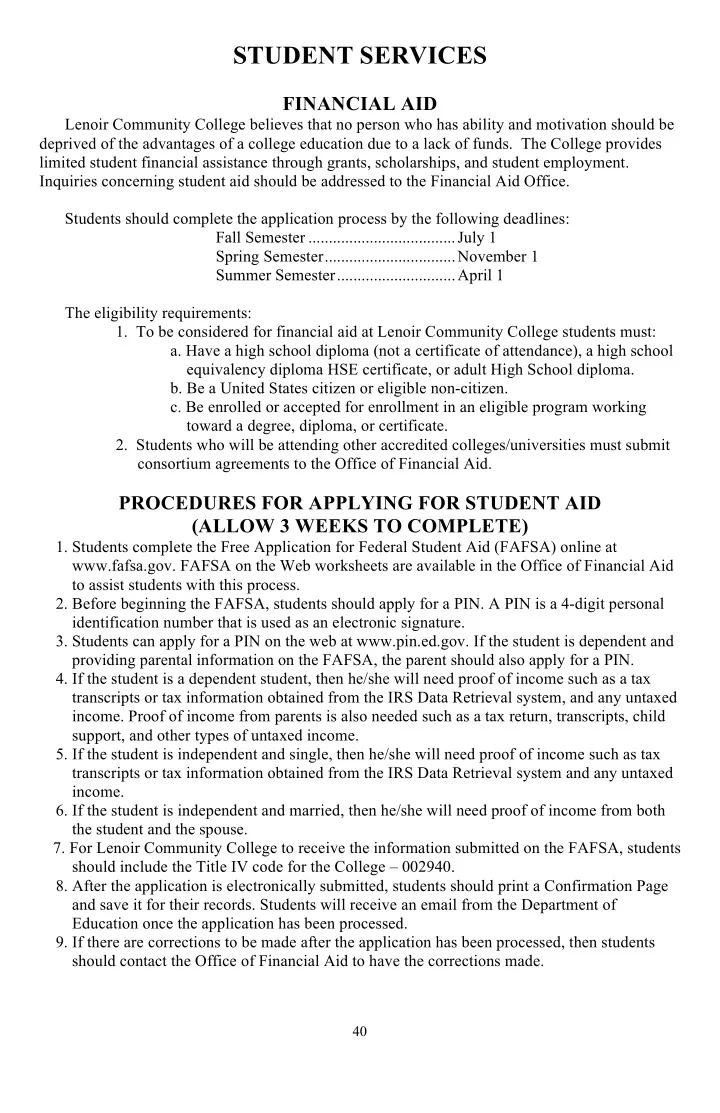
Lenoir Community College believes that no person who has ability and motivation should be deprived of the advantages of a college education due to a lack of funds. The College provides limited student financial assistance through grants, scholarships, and student employment. Inquiries concerning student aid should be addressed to the Financial Aid Office. Students should complete the application process by the following deadlines: Fall Semester .................................... July 1 Spring Semester ................................ November 1 Summer Semester ............................. April 1 The eligibility requirements:

  • 1. To be considered for financial aid at Lenoir Community College students must:
  • a. Have a high school diploma (not a certificate of attendance), a high school

equivalency diploma HSE certificate, or adult High School diploma.

  • b. Be a United States citizen or eligible non-citizen.
  • c. Be enrolled or accepted for enrollment in an eligible program working

toward a degree, diploma, or certificate.

  • 2. Students who will be attending other accredited colleges/universities must submit

consortium agreements to the Office of Financial Aid.

PROCEDURES FOR APPLYING FOR STUDENT AID (ALLOW 3 WEEKS TO COMPLETE)

  • 1. Students complete the Free Application for Federal Student Aid (FAFSA) online at

www.fafsa.gov. FAFSA on the Web worksheets are available in the Office of Financial Aid to assist students with this process.

  • 2. Before beginning the FAFSA, students should apply for a PIN. A PIN is a 4-digit personal

identification number that is used as an electronic signature.

  • 3. Students can apply for a PIN on the web at www.pin.ed.gov. If the student is dependent and

providing parental information on the FAFSA, the parent should also apply for a PIN.

  • 4. If the student is a dependent student, then he/she will need proof of income such as a tax

transcripts or tax information obtained from the IRS Data Retrieval system, and any untaxed

  • income. Proof of income from parents is also needed such as a tax return, transcripts, child

support, and other types of untaxed income.

  • 5. If the student is independent and single, then he/she will need proof of income such as tax

transcripts or tax information obtained from the IRS Data Retrieval system and any untaxed income.

  • 6. If the student is independent and married, then he/she will need proof of income from both

the student and the spouse.

  • 7. For Lenoir Community College to receive the information submitted on the FAFSA, students

should include the Title IV code for the College – 002940.

  • 8. After the application is electronically submitted, students should print a Confirmation Page

and save it for their records. Students will receive an email from the Department of Education once the application has been processed.

  • 9. If there are corrections to be made after the application has been processed, then students

should contact the Office of Financial Aid to have the corrections made.

slide-2
SLIDE 2

41

  • 10. Selected students are chosen for verification which requires documentation for the

information on the FAFSA. Students should submit all requested items to the Office of Financial Aid upon request.

  • 11. Once a student’s file has been completed, financial aid is awarded.
  • 12. Award letters are available for viewing on WebADVISOR at

https://wa.lenoircc.edu/WebADVISOR.

GRANTS Federal Pell Grant Program

The Federal Pell Grant is Title IV Federal Student Aid and is considered to be the basic source

  • f aid to students. Eligibility is determined from information received in the FAFSA. For the

2013–2014 school year the Pell Grant ranges from $582.00 to $5,645.00 per year based on full time enrollment (12 credit/ 450 hours each semester). The amounts may be prorated for three- quarter time, half-time, and less than half-time enrollment. Federal Supplemental Educational Opportunity Grant (FSEOG) The FSEOG is a grant to help students offset their educational expenses after high school. It is for under- graduates only with exceptional financial need (students with a very low Expected Family Contribution on their FAFSA), and it does not have to be paid back. Eligible students will receive an award amount determined by the Office of Financial Aid. North Carolina Community College Grant The North Carolina Community College Grant is a need-based grant designed to offset the tuition, fees, and bookstore charges of students receiving less than maximum Pell Grant awards. Applicants must meet all eligibility requirements for federal and state funding. Students must have completed the FAFSA and have an EFC (Expected Family Contribution) that falls within a determined range set by the state of NC. Students must also be NC residents and enroll at least half-time (six credit hours). Child Care Grant The Office of Financial Aid administers the Child Care Grant program funded through the North Carolina Community College System. Funds are to be used to assist student-parents with their child care needs. Funds are provided directly to approved child care providers. North Carolina Education Lottery Scholarship The North Carolina Education Lottery Scholarship was created to provide financial assistance to needy North Carolina resident students attending college and universities located in North

  • Carolina. Students must have completed the FAFSA and have an EFC (Expected Family

Contribution) that falls within a determined range set by the state of NC. Students must also be NC residents and enroll at least half-time (six credit hours). North Carolina Less than Half-Time Grant The North Carolina Less than Half-Time Grant is a need-based grant which is available for students who have completed the FAFSA and who are enrolled in one to five credit hours. The student’s EFC must be from 801–4000. Eligible students may receive $30-$150 per credit hour.

SCHOLARSHIPS

Scholarships are awarded on a competitive basis by a selection committee. Applicants for scholarships must enroll, demonstrate academic promise, participate in school and community activities, and show some financial need. The scholarship application deadline is the last Friday in March each year. These scholarships are funded by the following gifts to the College and the Lenoir Community College Foundation, Incorporated.

slide-3
SLIDE 3

42

Other Scholarships Lenoir Community College Athletic Lenoir Community College Association of Educational Office Professionals Lenoir Community College Foundation Endowed Scholarships Alpha Kappa Alpha Sorority BB&T Eddie (Bug) Morton Banks Barnes-St. John Eloise C. and Harvey E. Beech

  • E. K. Best, Jr. Memorial
  • W. Robert and Suzanne S. Bizzell Health Sciences

Lonnie H. and Betty B. Blizzard Mildred Dare Blizzard Bojangles’/Tands Jean P. and Peggy Booth Memorial Bowen Family John Hood Brewer Memorial Brantley and Eugenia Casey Briley Thomas Edward and Mozelle Hodges Briley Brody Brothers’ Frank and Sandra Brooks Mildred Quinn Buchan Memorial Henry H. and Vera F. Bullock Memorial Bradley Blair (Brad) Burmahl Memorial Bruce Cannon Memorial Cannon Family Foundation William T. and Imogene Sutton Casey Glenn F. and Joyce Gilbert Cherry Charles Coward/Al Sutton Philip H. Crawford, Jr. and Persis Hodges Crawford Memorial Nell and Ford Dabney Scholars William H. and Clarice P. Davenport Gretchen and Minerva Davis Davis Wholesale Tire Company

  • Dr. Shirley L. Dove

Eastern North Carolina Bluegrass Association

  • E. Merle Edwards

Henry A. and Lucile Reed Edwards Faculty Memorial Dexter E. and Dorothy M. Floyd Gregory E. and Jennifer Floyd Ben and Norma Fountain Fund Edward Earle Franck Robert and Suzanne Gallaher Albert Lionel Garner Memorial Gail G. Grant Memorial Andrew Oscar Greene Memorial

  • W. Foster and Mary L. Gurley Memorial

Gene Haas Foundation Jack P. Hankins Kathryne C. Hankins

slide-4
SLIDE 4

43

  • C. Felix Harvey, Sr.

Margaret Blount Harvey Early Childhood Education Harriet Taylor Herring LPN Harriet Taylor Herring RN William I. Herring, Sr. Memorial Russell Curtis Hill Memorial Fodie H. Hodges Memorial Hodges Family James R. and Carol M. Hood John C. and Scarlett Howard Irene Smith Howell Gaines Barrett (Barry) Huneycutt, Jr. George Dewey and Jessie Heath Jenkins Memorial Jones County Kenneth W. and Gracie Taylor Jones Laura B. Jones Roland J. and Eleanor L. Jones Roy E. and Brenda M. Jones Stephanie M. Jones Memorial Sue Marcom Jones Memorial Martha Wooten Kallam/Arc of Lenoir County Kinston Business and Professional Women’s Club Kinston Exchange Club/Billy C. White Memorial Kinston Jaycees Kinston Rotary Club Clayton G. Koonce Memorial Richard Floyd (Rick) Lennon Memorial Lions Industries for the Blind Milton M. (Mac) Lovick Memorial

  • W. W. and Jeanette Lowery

Pat and Jim MacNeill Graham W. and Jean M. Mallard Christine Suggs Maroules Christopher Maroules, Sr. John Franklin and Lucy Wood Marston George C. and Mildred Boney Matthis Helen McDaniel Memorial Jesse L. and Joyce P. McDaniel Medical and/or Science Careers John and Mary Nicey Clements and Henry Dail (Dink) Meready Montgomery’s Math & Science

  • E. Fred and Louise D. Moore

Rena Ritch and Mark Norcross Frances Carr Parker Frances Carr Parker Culinary Joseph C. and Eunice B. Parker James M. and Erwin W. Parrott Roland L. Paylor, Jr./Robert (R.L.) L. Joyner Rickie Allen Pearson, Jr. Memorial James and Rebecca Perry Foundation Perry Family Horace and Agnes Faye Phillips

slide-5
SLIDE 5

44

Pink Hill Medical Kathryn and Leroy Pittman Rose Pully Memorial Irma J. and Dr. C. B. Randall Mary Mac Ritch Memorial Mayor and Mrs. O. A. (Buddy) Ritch

  • Dr. Frank Rocker, Jr.

Rodriguez Family Sarah Peedin Rose Memorial Schechter James C. and Angeline S. Shell

  • P. E. and Leta Shoulars

Leona Bryant Smith RN Memorial Southwest Christian Church Memorial Southwest Christian Church, Jerry Z. and Effie C. Sutton Memorial Sparbel Victor C. Spence Memorial John (Jake) P. and Eugenia R. Strother Memorial Ned M. and Elsie Croom Stroud Memorial Betty and Bill Stump Memorial Richard Vance Surles Memorial Robert James (Jimmy) Sutton, Jr. Memorial Leroy and Blanche Taylor Kenneth and Lou Ann Tetterton Alice Starr Tingle Entrepreneur/Government Leadership Dalton B. Tripp Emily Brown Tripp Memorial James (Jamie) H. Tripp Memorial Shirley Jenkins Tripp Memorial Lynwood C. and Grace J. Turner Memorial Bobby R. and Ella W. Wade Anne E. and William B. Wallace, Jr.

  • A. Forrest and Ruth King Waller Memorial

Charles Albert Waller Robert Forrest and Marie Buchan Waller Wells Fargo Bank, N.A. West Pharmaceutical Services Richard and Edna Whaley Lester and Geraldine White-Richardson and Margaret Richardson Memorial Isaac, Frances, Marietta, and Rachel Whitfield Memorial Joseph Keith Williams Memorial Walter and Marie Williams Lenoir Community College Foundation — Funds Held for Endowment Charlie H. and Bille J. Albritton Young H. Allen Robert (Rock) Anderson Athletic

  • Dr. Donald E. Becker Memorial

James E. and Annie J. Blue Ruby Boone and Vivian Brock Violet R. Dawson/Champions Health & Fitness Memorial Athletic Tharon Harper Deaver Memorial

slide-6
SLIDE 6

45

Heather Richardson Gagnon Memorial Joe D. and Marilynn Gay Memorial Angela Whitfield Harper Memorial Earl and Carol Harper James R. (Doc) and Frances Petteway Harper Memorial

  • Dr. and Mrs. Jack Harrell

Maude and Bruce Heath Memorial Whitford and Gladys Hill Gloria Hill Horticulture Club Jumping Run Church Lawrence and Lois King Bradley Scott Lanier Memorial Harry L. and Grace W. Malone Memorial Forest and Christine McCullen Memorial Psychology Paula Cogdell Melvin Memorial

  • Drs. James and Elizabeth Odham

Poole Family Foundation John Wesley Rains/Machining Technology Sale Auto Mall Fund Edward T. and Mildred W. Sessoms Selma Wells Skinner Memorial Herbert (Herb) Ingram Spear, Sr. Memorial

  • W. Tyson Stewart Memorial
  • Dr. Patricia M. Stroud Memorial

Paul and Frances Taylor Memorial Shirley H. Taylor Memorial Ronald and Ellen Turnage Memorial Wilda Robinson Turner Memorial Gordon and Linda Vermillion George E. and Betsy P. Vick Memorial Annie Julia Waller and Otis Clark Tutt Memorial

STUDENT EMPLOYMENT

On-campus jobs provide opportunity for students to work part-time to help pay for the expense of higher education. Students may be eligible to work under the Federal Work Study program or under the technical assistant program. Federal Work-Study Program Federal work study offers employment opportunities to eligible students who wish to earn money while attending college. Students work in various areas on campus. On average, students work approximately 15 hours per week at a rate of $7.45 per hour. If you would like to be considered for the federal work-study program, students should visit the LCC website and complete an Employment Application. Technical Assistants The technical assistant program is a state funded, non need-based employment opportunity for students who wish to earn money while attending college. Students work in various areas on

  • campus. Depending on departmental budgets, students can work between 10-20 hours per week

at a rate of $7.45 per hour. If you would like to be considered for the technical assistant program, students should visit the Office of Financial Aid and complete an Employment Interest Application.

slide-7
SLIDE 7

46

LOANS

Lenoir Community College does not participate in any loan programs. Students may seek alternative loans through entities that provide low-interest, long and short-term loans to students with financial need. It is important to remember that all loans must be repaid. Before borrowing, students should consider carefully how much money is needed and the burden of a loan once repayment begins.

LENOIR COMMUNITY COLLEGE LOANS

There are short-term emergency loans available to students who demonstrate need for loans to cover tuition, fees, or books. The student must have financial aid pending.

SATISFACTORY ACADEMIC PROGRESS (SAP) STANDARDS

To be eligible to receive financial aid at Lenoir Community College, a student must meet the College’s satisfactory progress policy (qualitative measurement). The following regulations also apply to financial aid eligibility:

  • 1. Eligibility for financial aid is not affected by whether or not the student previously received
  • aid. Aid is based on the cumulative academic record of each student.
  • 2. Academic records will be reviewed at the end of each semester. Students will be notified at

the end of each semester of their SAP standing.

  • 3. GPA: Students must maintain a required cumulative grade point average of 2.0 in order to

be eligible to receive assistance. Financial aid will follow the College’s policy for calculating GPA for all courses except remedial courses. Grades of “I” are included in GPA calculations but grades of “W” are not included in GPA.

  • 4. Pace: Students must receive a passing grade in 67% of all coursework attempted. Grades of

“F” and “W” are not passing grades. The pace of completion is cumulative and includes all coursework attempted. Transfer credits accepted are included as both attempted and

  • completed. Incompletes, grades of “I”, are included as attempted but not completed until

they are replaced with an accurate grade.

  • 5. Repeated courses will count in both GPA calculations and pace of completion calculations.
  • 6. REMEDIAL COURSEWORK: Students are restricted to 30 hours of Title IV funding for

remedial coursework. Remedial courses are not counted in pace of completion calculations. Remedial courses are factored in GPA calculations in a unique way because only three possible grades can be earned in remedial courses. A grade of “PA” is calculated as 4.00 quality points. A grade of “PB” is calculated as 3.00 quality points. A grade of “R” is calculated as 1.5 quality points.

  • 7. MAXIMUM TIMEFRAME: Students must complete their program of study within the

150% maximum timeframe allowed for that program. Once a student reaches the 150% maximum or it becomes evident that the student will not graduate within the 150% maximum timeframe, the student is no longer eligible to receive Title IV funding. Transfer credits that apply to the student’s program of study are included in the 150% timeframe

  • calculation. Credits earned at LCC that apply to the program of study will count toward the

150% maximum timeframe calculation.

  • 8. After one semester of enrollment, financial aid students who fail to meet the College’s

satisfactory academic progress policy through GPA and/or pace of completion will be placed on Financial Aid Warning. Students in this category may continue to receive financial aid for one additional semester. Students have this one semester period to re- establish satisfactory academic progress. If the student is able to re-establish satisfactory academic progress at the end of the financial aid warning period, the probation is lifted.

  • 9. If the requirements for satisfactory academic progress are not met at the end of the warning

period, the student is placed on Financial Aid Suspension and their Title IV funding is

slide-8
SLIDE 8

47

  • terminated. Students who fail to make satisfactory progress during the probation semester

will become ineligible for aid until their progress is again satisfactory.

  • 10. Students who are on Financial Aid suspension because of GPA and/or pace of completion

standards can regain their eligibility by taking classes and improving their GPA and/or pace. Once their SAP status meets the 2.0 GPA standard and the 67% completion standard, they will be returned to Satisfactory academic progress standing.

  • 11. A student who has become ineligible for financial aid has the opportunity to appeal.

Appeals generally given consideration involve students who have experienced: (a) extended illness or hospitalization of the student, (b) an accident which incapacitates the student for an extended period of time, or (c) death or extended illness of an immediate family member which results in greater family responsibilities for the student. The appeal must be in writing and submitted along with supporting documentation to the Financial Aid Appeals

  • Committee. The committee will review all documents and notify students of their decision.

The decision from the Financial Aid Appeals Committee is final.

  • 12. If an appeal is approved by the SAP committee, the student is placed on Financial Aid
  • Probation. All students on probation meet with a counselor to develop an academic plan.

The plan is designed to return the student to satisfactory academic progress within one, two

  • r three semesters. Students must meet the standards of their academic plan each semester

in order to continue to receive Title IV funding.

STUDENT FINANCIAL AID OVERPAYMENTS

A student who withdraws from the College for any reason during a semester may owe the College a prorated overpayment of the student financial aid received for that semester. It is the policy of the College that if a student repeatedly drops below the enrollment status (full-time, three-fourths time, or one-half time) for which the student has received a Pell Grant payment, that student may have to repay all or part of the Pell Grant payment that was received for that

  • semester. Student financial aid is not awarded for courses never attended, audited, started after

the 10% census date, and/or cancelled. If aid is awarded and it is discovered at a later date that aid was awarded for courses never attended, audited, attended after the 10% census date, and/or cancelled, the student will owe an overpayment. The Director of Financial Aid will compute the amount of overpayment and notify the student of the amount of overpayment. If the student does not reply to the overpayment notice promptly, then the student shall be in violation of the Indebtedness Policy of the College.

REFUND POLICY FOR RECIPIENTS OF FINANCIAL AID

WITHDRAWALS When students withdraw from the College up to the 10% point of the semester, three-quarters

  • f the students’ tuition and all of their student activity fee, technology fee, access fee, and

accident insurance fee are refunded to the appropriate financial aid sources. Withdrawing prior to the 60% point of the semester will result in having to repay financial aid (Federal Pell Grant and Federal Supplemental Educational Opportunity Grant). The Office of Financial Aid will calculate the overpayment from students who withdraw either officially or unofficially (dropped out or are dismissed). Once the calculation is made and the student has an overpayment, the student should contact the Office of Financial Aid or the Cashier’s Office to make arrangements to repay the balance. CANCELLATIONS When a cancelled course reduces a student’s enrollment status, all of the student’s tuition is refunded on a prorated basis to the appropriate financial aid sources. In these cases the student’s

slide-9
SLIDE 9

48

Pell Grant overpayment, if any, is reduced by the amount of the refund to the Pell Grant account. When the enrollment status is not reduced, the refund is made to the student. SPECIAL NOTE Financial aid recipients should register each semester during early registration. APPLICATION Students wishing to apply for student financial aid or students having questions regarding financial aid can contact the Director of Financial Aid at the following address/telephone: Office of Financial Aid Lenoir Community College PO BOX 188 Kinston NC 28502-0188 Telephone: 252-527-6223

VETERANS EDUCATIONAL ASSISTANCE

Individuals who have served in the U.S. Armed Forces and their survivors and dependents may be eligible for educational benefits. Questions regarding veterans’ educational benefits should be directed to the Office of the Veterans Coordinator located in the Office of Financial Aid.

Procedures for applying for Veterans Academic Benefits

Veterans or eligible dependents placed on academic probation for unsatisfactory progress in their programs of study will be referred to counselors for academic and vocational counseling. Students who do not make sufficient improvement in their academic standing to remove the probationary status will be placed on “academic suspension” status and decertified to the Veterans Administration for unsatisfactory progress. Recertification will be dependent upon students achieving status of satisfactory academic progress.

VETERANS SEEKING HSE OR AHS SERVICES READJUSTMENT ACT

HSE and AHS programs are directed by the NC Community College System and the State Board of Community Colleges, and are managed by individual colleges. The College has approval for both programs. To insure the programs comply with standards established for the Department of Veterans Affairs, GI Bill educational benefits contained in CFR 38, 21.4253 & 4254, the following procedures are administered by this institution:

  • A. This institution complies with requirements outlined in NCCCS AHS Procedures Manual,

HSE Testing Procedures Manual, and agreements with the County Boards of Educational Records for clock-hour programs and semester-hour programs are complete and adequate to ensure compliance with DVA reporting requirements (attendance, progress, and rate of pursuit).

  • B. Attendance—For students receiving GI Bill benefits while enrolled in this program, three

(3) unauthorized absences in a calendar month will result in probation. Students who do not maintain an 85% attendance rate will be terminated (institutional standard may be used when above 85%).

  • C. Standards of progress—For students receiving GI Bill benefits while enrolled in this

program, progress will be measured monthly and against state or institutional test results (minimum grade equivalent to 70%). Student’s progress will be classified as satisfactory or

slide-10
SLIDE 10

49

unsatisfactory at the end of the month. When progress is determined to be unsatisfactory, students will be placed on probation.

  • D. Probation—The following probation standards will be administered for students eligible

for DVA benefits:

  • 1. For attendance, two (2) months probation, maximum
  • 2. For standards of progress, two (2) months maximum probation for clock-hour or

semester-hour programs

  • 3. At the end of probation when students have not attained standards, school officials

will de-certify students for DVA educational benefits.

  • 4. Recertified—Officials will manage recertification using school standards;

however, students may be recertified only after supervisors determine conditions have returned to satisfactory status.

  • 5. After two interruptions for benefits, students may not be recertified to VA for

these programs.

ACADEMIC ADVISING

To assist students in their academic programs, the College has established a system of academic advising wherein each student is assigned to a faculty member or counselor who serves as the student’s advisor. The advisor helps to plan the student’s academic program, particularly during early registration and registration periods; keeps a record of academic progress; and is available throughout the year for additional counseling. Advisors make every attempt to give effective guidance to students in academic matters and refer students to those qualified to help them in other matters, but the final responsibility for meeting all academic requirements for a selected program rests with the student.

CAREER PLANNING CAREER COACH/WORK-BASED LEARNING AND JOB PLACEMENT

Career planning services are provided to students and graduates in their search for rewarding

  • careers. Information and guidance are available to aid in career decisions and in job selection. The

services are available to all graduates of Lenoir Community College and current curriculum students. The computerized guidance systems “CHOICES” and “DISCOVER” are available to help students select occupations that meet their needs. The system requires its users to thoughtfully consider their needs, interests, values, and abilities and enter their choices into the computer. This is a mechanism to empower major choice and career direction. Students receive printouts of possible career choices along with specific career information. These computerized career guidance programs are available to all students through www.cfnc.org. We also utilize various

  • ther paper, pencil, and online assessment instruments to match the needs of our students.

Educational and career resources are available and include information on educational requirements, personal qualities, job prospects, locations, details on the nature of the work, and salary ranges, as well as area job opportunities listings. In addition, a variety of workshops and events are offered throughout the year to cater to LCC’s student needs. Students may also access career information and guidance in the NCWorks Career Center through printed materials, various software packages, and Internet web sites.

COUNSELING SERVICES

Lenoir Community College offers a variety of counseling services to assist students in making the most of their opportunities for academic and personal development. Counseling and guidance services are offered free of charge to every student from pre-admissions through graduation. Students may schedule an appointment for counseling sessions, or they may be seen on a walk-in

  • basis. Counselors are available during normal operating hours or by appointment. The