
SLIDE 1
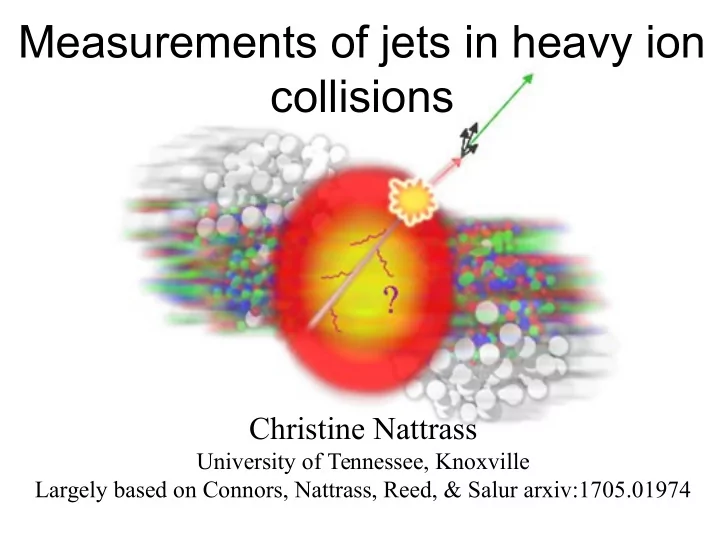
Measurements of jets in heavy ion collisions
Christine Nattrass
University of Tennessee, Knoxville Largely based on Connors, Nattrass, Reed, & Salur arxiv:1705.01974
Measurements of jets in heavy ion collisions Christine Nattrass - - PowerPoint PPT Presentation
Measurements of jets in heavy ion collisions Christine Nattrass University of Tennessee, Knoxville Largely based on Connors, Nattrass, Reed, & Salur arxiv:1705.01974 Overview Jet quenching in a nutshell Partons lose energy in the
University of Tennessee, Knoxville Largely based on Connors, Nattrass, Reed, & Salur arxiv:1705.01974
Christine Nattrass (UTK), ISMD 2017
2
– Partons lose energy in the medium – This lost energy makes jets broader and
softer
– See also talks from
Abhijit Majumder Yen-jie Lee Justin Frantz Laura Havener Cesar Luis da Silva ...
Christine Nattrass (UTK), ISMD 2017
3
Christine Nattrass (UTK), ISMD 2017
4
Christine Nattrass (UTK), ISMD 2017
5
Christine Nattrass (UTK), ISMD 2017
6
Christine Nattrass (UTK), ISMD 2017
7
those in p+p collisions or peripheral A+A collisions
evidence of jet quenching
Enhancement Suppression
Christine Nattrass (UTK), ISMD 2017
8
Christine Nattrass (UTK), ISMD 2017
9
is transparent to them
them - even heavy quarks!
arXiv:1705.01974 [nucl-ex]
Christine Nattrass (UTK), ISMD 2017
10
arXiv:1705.01974 arXiv:1705.01974
Christine Nattrass (UTK), ISMD 2017
11
arXiv:1705.01974 arXiv:1705.01974
Tension between ATLAS & ALICE/CMS
Christine Nattrass (UTK), ISMD 2017
12
Dijet asymmetry
[Phys.Rev.C84:024906,2011,
Phys.Rev.Lett.105:252303,2010,
Di-hadron correlations
[Too many to list]
suppression
γ-hadron correlations
[Phys.Rev.C80:024908,2009, Phys.Rev.D82:072001,2010, Phys.Rev.C82:034909,2010 Physics Letters B 760 (2016)]
s u p p r e s s i
Hadron-jet correlations
[JHEP 09 (2015) 170,
s u p p r e s s i
γ-jet correlations
[Phys. Lett. B 718 (2013) 773]
High-pT hadron v2
[too many to list]
Jet v2
[Phys.Lett. B 753 (2016) 511-525,
Au+Au √sNN=200 GeV ^ q=1.2±0.3 GeV
2
^ q=1.9±0.7 GeV
2 Pb+Pb √sNN=2.76 TeV
[Phys. Rev. C 90, 014909 (2014)]
Pb+Pb √sNN=2.76 TeV
Christine Nattrass (UTK), ISMD 2017
13
Christine Nattrass (UTK), ISMD 2017
14
z=pT/Eγ
0.08 0.14 0.22 0.37 0.61 1.00
Christine Nattrass (UTK), ISMD 2017
15
→ Jet-by-jet fluctuations more important than path length [PLB 735 157(2014)]
– Also needed to explain high pT v2 [PRL 116 252301 (2016)]
Full jets 1) signal+bkgd 2) bkgd dominated 3) bkgd RPF fit
Trigger Associated
Christine Nattrass (UTK), ISMD 2017
16
z=pT/Eγ Fragmentation functions with jets
Kolja Kauder, RHIC/AGS User's Meeting 2016 arXiv:1609.03878
Tracking:6% Tower energy scale: 2%
Leading jet Subleading jet
0 A j= pTleading−pT subleading
pT
leading+ pT subleading
Di-jet asymmetry Fragmentation functions with jets Jet-hadron correlations
Di-hadron correlations
[Lots of papers]
Jet shapes
[arXiv:1708.09429, arXiv:1512.07882, arXiv:1704.03046]
Christine Nattrass (UTK), ISMD 2017
17
Christine Nattrass (UTK), ISMD 2017
18
g=∑
i∈ jet
pT
i
pT
jet ri
pT D=√ ∑
i∈ jet
( pT
i ) 2
∑
i ∈ jet
pT
i
LeSub=pT
leading−pT subleading
Agrees with PYTHIA Jets are slightly more collimated than in pp See also jet grooming (Yen-jie Lee)
Christine Nattrass (UTK), ISMD 2017
19
Christine Nattrass (UTK), ISMD 2017
20
Paraphrased from Sevil Salur
Christine Nattrass (UTK), ISMD 2017
21
Paraphrased from Sevil Salur
Christine Nattrass (UTK), ISMD 2017
22
Christine Nattrass (UTK), ISMD 2017
23
for partonic energy loss
– Using mostly hadron spectra
quantitative constraints out of other
actually sensitive to the physics we want to measure.
things we might not have under control
^ q
Christine Nattrass (UTK), ISMD 2017
24
for partonic energy loss
– Using mostly hadron spectra
quantitative constraints out of other
actually sensitive to the physics we want to measure.
things we might not have under control
^ q
Christine Nattrass (UTK), ISMD 2017
25
for partonic energy loss
– Using mostly hadron spectra
quantitative constraints out of other
actually sensitive to the physics we want to measure.
things we might not have under control
^ q
Christine Nattrass (UTK), ISMD 2017
26
for partonic energy loss
– Using mostly hadron spectra
quantitative constraints out of other
actually sensitive to the physics we want to measure.
things we might not have under control
^ q
Christine Nattrass (UTK), ISMD 2017
27
for partonic energy loss
– Using mostly hadron spectra
quantitative constraints out of other
actually sensitive to the physics we want to measure.
things we might not have under control.
^ q
Christine Nattrass (UTK), ISMD 2017
28
Christine Nattrass (UTK), ISMD 2017
29
Christine Nattrass (UTK), ISMD 2017
30
p+p → dijet
Beam pipe
Christine Nattrass (UTK), ISMD 2017
31
p+p → dijet
Beam pipe
“I know it when I see it” US Supreme Court Justice Potter Stewart, Jacobellis v. Ohio
Christine Nattrass (UTK), ISMD 2017
32
state particles into jet candidates
– Anti-kT algorithm
JHEP 0804 (2008) 063 [arXiv:0802.118 9]
– Infrared safe – Colinear safe
Snowmass Accord: Theoretical calculations and experimental measurements should use the same jet finding algorithm. Otherwise they will not be comparable.
Christine Nattrass (UTK), ISMD 2017
33
Christine Nattrass (UTK), ISMD 2017
34
particles into jet candidates
– Anti-kT algorithm
JHEP 0804 (2008) 063 [arXiv:0802.1189]
background
combinatorial jets and correct energy
Christine Nattrass (UTK), ISMD 2017
35 http://walkthewilderness.net/animals-of-india-72-asiatic-elephant/
Christine Nattrass (UTK), ISMD 2017
36 http://walkthewilderness.net/animals-of-india-72-asiatic-elephant/
Christine Nattrass (UTK), ISMD 2017
37 http://walkthewilderness.net/animals-of-india-72-asiatic-elephant/
Christine Nattrass (UTK), ISMD 2017
38 http://walkthewilderness.net/animals-of-india-72-asiatic-elephant/
assumptions, apply biases
– Quark jets are narrower, have fewer tracks, fragment harder [Z
Phys C 68, 179-201 (1995), Z Phys C 70, 179-196 (1996), ]
– Gluon jets reconstructed with kT algorithm have more particles
than jets reconstructed with anti-kT algorithm [Phys. Rev. D 45, 1448 (1992)]
– Gluon jets fragment into more baryons [EPJC 8, 241-254, 1998]
jets with hard fragments
Christine Nattrass (UTK), ISMD 2017
39 Wiki: “A white elephant is a possession which its owner cannot dispose of and whose cost, particularly that of maintenance, is out of proportion to its usefulness.
Christine Nattrass (UTK), ISMD 2017
40
JHEP10(2012)087
z = pT/Ejet High pT Low pT
Christine Nattrass (UTK), ISMD 2017
41
Background subtraction method:
– Calorimeter jets: Reconstruct jets with
R=0.2. v2 modulated <Bkgd> estimated by energy in calorimeters excluding jets with at least one tower with Etower > <Etower> Track jets: Use tracks with pT>4 GeV/c
– Calorimeter jets from above with E>25
GeV and track jets with pT>10 GeV/c used to estimate background again.
track with pT>7 GeV/c or containing a high energy cluster E >7 GeV are used for analysis down to Ejet = 20 GeV
Constituent biases don't matter that much up here But they do matter down here!
Christine Nattrass (UTK), ISMD 2017
42
Christine Nattrass (UTK), ISMD 2017
43
Balaji Viswanathan
https://balajiviswanathan.quora.com/Lessons-from-the-Blind-men-and-the-elephant
Christine Nattrass (UTK), ISMD 2017
44
– What you see depends on what you look for – Listen to the data – not what you want to hear
– We should look for new observables... but we should make sure they're
sensitive and that we know
– Need realistic models where we can apply experimental methods to
models – Jetscape is coming!
– Experimental cuts matter and are unavoidable
Abhijit Majumder, Tuesday Scott Moreland, Thursday
Christine Nattrass (UTK), ISMD 2017
45
pp-like PYTHIA jets
arXiv:1702.00804
Christine Nattrass (UTK), ISMD 2017
46
z=pT/Eγ
Christine Nattrass (UTK), ISMD 2017
47
Au+Au di-jets more imbalanced than p+p for pT
cut>2 GeV/c
Au+Au AJ ~ p+p AJ for matched di-jets (R=0.4)
Kolja Kauder, RHIC/AGS User's Meeting 2016 arXiv:1609.03878
Tracking:6% Tower energy scale: 2%
A j= pT
leading−pT subleading
pT
leading+ pT subleading
Leading jet Subleading jet
Christine Nattrass (UTK), ISMD 2017
48
– Di-hadron correlations [Lots of papers] – Jet shapes [arXiv:1708.09429, arXiv:1512.07882,
arXiv:1704.03046]
– Dijet asymmetry with soft constituents [PRL119 (2017) 62301]