STRATEGY, CULTURE, STRUCTURE No Magic Bullet PMI-SAC PDC: November - - PowerPoint PPT Presentation

strategy culture structure
SMART_READER_LITE
LIVE PREVIEW

STRATEGY, CULTURE, STRUCTURE No Magic Bullet PMI-SAC PDC: November - - PowerPoint PPT Presentation

STRATEGY, CULTURE, STRUCTURE No Magic Bullet PMI-SAC PDC: November 2012 Paul Robinson Corporate Oasis Inc. STRATEGY, CULTURE, STRUCTURE No Magic Bullet PMI-SAC PDC: November 2012 Paul Robinson Corporate Oasis Inc. INTRODUCTION As


slide-1
SLIDE 1

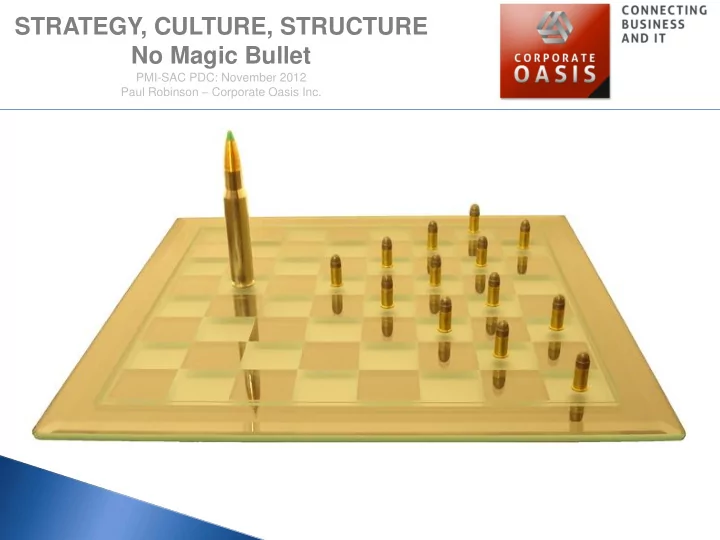
STRATEGY, CULTURE, STRUCTURE No Magic Bullet

PMI-SAC PDC: November 2012 Paul Robinson – Corporate Oasis Inc.
slide-2
SLIDE 2

STRATEGY, CULTURE, STRUCTURE No Magic Bullet

PMI-SAC PDC: November 2012 Paul Robinson – Corporate Oasis Inc.

As Information Technology continues to evolve and mature as an integrated discipline, it is vital that the Project, Program, and Portfolio practices move beyond a simple model of ‘what and when’ to deliver business functionality to encompass the skills and techniques necessary to understand ‘how’ to deliver within the context of the organization’s strategy and culture. The purpose of this presentation is to identify the various strategies, cultures, structures and how you can adapt your behaviour to optimize the results of your initiatives within these parameters.

INTRODUCTION

1

slide-3
SLIDE 3

STRATEGY, CULTURE, STRUCTURE No Magic Bullet

PMI-SAC PDC: November 2012 Paul Robinson – Corporate Oasis Inc.

The goal for this presentation is that you will be able to:

  • 1. Identify a corporate strategy, culture and structure early in a project lifecycle.
  • 2. Adapt your behaviour to a given corporate culture.
  • 3. Discover where you fit into the organizational structure.
  • 4. Plan your Project communication accordingly.
  • 5. Align your Projects, Programs and Portfolios to the organization’s strategy.
  • 6. Determine your role in rewarding the appropriate behavior within your team.

LEARNING OBJECTIVES

2

slide-4
SLIDE 4

STRATEGY, CULTURE, STRUCTURE No Magic Bullet

PMI-SAC PDC: November 2012 Paul Robinson – Corporate Oasis Inc.

STRATEGY: The means that the organization will utilize in order to achieve it’s core objectives. CULTURE: ‘How we do things around here’ in order to achieve the corporate strategy. STRUCTURE: How we organize ourselves in order to support the culture and strategy.

STRATEGY, CULTURE AND STRUCTURE

3

slide-5
SLIDE 5

STRATEGY, CULTURE, STRUCTURE No Magic Bullet

PMI-SAC PDC: November 2012 Paul Robinson – Corporate Oasis Inc.

  • Strategy is the compass used for making decisions
  • It creates a framework for the culture and determines the appropriate skills for leadership.
  • There are two ‘Fundamental Strategies’ which result in one or more ‘Value Disciplines’:

STRATEGY: Product / Service Differentiation STRATEGY: Cost Leadership

Operational Excellence

Superior execution as measured by productivity Lower price

Product Leadership

Differentiate through superior design and engineering yielding higher performance Demand higher price

Customer Intimacy

Differentiate through superior matching of customer expectation with

  • ffer fulfillment

Demand higher price

Disruptive Innovation

Think outside the box. Create new paradigms, new standards Demand higher price

STRATEGY

Source: Geoffrey Moore / Michael Porter

4

slide-6
SLIDE 6

STRATEGY, CULTURE, STRUCTURE No Magic Bullet

PMI-SAC PDC: November 2012 Paul Robinson – Corporate Oasis Inc.

  • Culture is the "way we do things around here“.
  • The philosophy, values, behaviors, etc., that together constitute the unique style and policies of a company.
  • It is a belief system which guides how we make decisions, solve problems, and motivate people.
  • Broadly speaking, there are four types of Corporate Cultures:

COLLABORATION · Egalitarianism · Diversity · Involvement · Harmony · Human Interaction · Spontaneity · Incrementalism CULTIVATION · Growth and Development · Shoot for the stars · Meaningfulness · Fulfillment · Subjectivity · Creative involvement CONTROL · Objectivity · Order · Stability · Standardization · Utility · Discipline · Predictability COMPETENCE · Professionalism · Meritocracy · Pursuit of Excellence · Continuous Improvement · Craftsmanship · Efficiency

CULTURE

Source: William E. Schneider (The Reengineering alternative)

5

slide-7
SLIDE 7

STRATEGY, CULTURE, STRUCTURE No Magic Bullet

PMI-SAC PDC: November 2012 Paul Robinson – Corporate Oasis Inc.

  • In a sense, culture IS the organization.
  • It provides consistency, order and structure, and sets patterns for relationships.
  • It determines conditions for internal effectiveness and drives effective performance.
  • Each of the respective corporate cultures affect the organization in very different ways:

CULTURE (Competence) CULTURE (Control) CULTURE (Collaboration) CULTURE (Cultivation) Celebrates Cherishes Prioritizes Asks Leads By Organizes As Recruits For Achievement Order / Security Affiliation Self-Actualization Top Performers Making the Plan Teamwork Creativity The Work The System The People The Idea How? What? Who? Why? Expertise Authority Process Charisma Work Projects Hierarchy Persistent Teams Little As Possible Competitiveness Loyalty Trustworthiness Brilliance

CULTURE AND THE ORGANIZATION

Source: Geoffrey Moore (Living on the fault line)

6

slide-8
SLIDE 8

STRATEGY, CULTURE, STRUCTURE No Magic Bullet

PMI-SAC PDC: November 2012 Paul Robinson – Corporate Oasis Inc.

CULTURE AND STRATEGY

STRATEGY (Operational Excellence) STRATEGY (Customer Intimacy) STRATEGY (Product Leadership) STRATEGY (Disruptive Innovation) Orientation to Time Focus Key Metric Culture Fit Organizational Leadership From: Process Efficiency Customer Experience Offer Quality Categorical Differentiation Internal (Rhythm) Customer Response Time Competitive Response Time Time to Adoption Number of Misses Customer Re-purchase Product Specifications 10x Advantage Control Culture Collaboration Culture Competence Culture Cultivation Culture Operations / Finance Marketing / Customer Service Sales / Engineering Research / Development

Source: Geoffrey Moore (Living on the fault line)

  • “Culture eats strategy for breakfast.” (Peter Drucker)
  • The most important thing that leaders can do is to create a culture that supports the strategy (Edgar Schein)
  • If you understand what the business is about, you are likely to understand the culture.

7

slide-9
SLIDE 9

STRATEGY, CULTURE, STRUCTURE No Magic Bullet

PMI-SAC PDC: November 2012 Paul Robinson – Corporate Oasis Inc.

  • Structure is all the people, positions, procedures, processes that comprise the organization.
  • It supports the organization’s culture / strategy and is not simply an organizational chart.
  • It defines how all the pieces, parts and processes work together (or don’t in some cases).
  • If an organization changes its strategy, it must change its structure to support the new strategy.
  • When it doesn’t, the structure snaps the organization back to its old strategy.
  • It is important to recognize that there are official and unofficial structures within an organization.
  • Changing strategy means changing what everyone in the organization does.
  • School of thought (1):
  • Just put the right people in place and the right things will get done
  • School of thought (2):
  • Continually improve performance through training and a culture of accountability
  • The majority of high performance organizations combine attention to process and individual development.

STRUCTURE

8

slide-10
SLIDE 10

STRATEGY, CULTURE, STRUCTURE No Magic Bullet

PMI-SAC PDC: November 2012 Paul Robinson – Corporate Oasis Inc.

Description:

  • The organization is divided into segments based on separate functions within the organization.

Advantages:

  • Allows the organization to enhance the efficiencies of these functional groups.
  • Functional structures are successful in large organizations that produces high volumes of products at low costs.
  • Lower costs can be achieved due to the efficiencies within functional groups.

Disadvantages:

  • Communication between functional groups may not be effective.
  • Organizations may find it difficult to achieve their objectives.

STRUCTURE (FUNCTIONAL HIERARCHY)

9

slide-11
SLIDE 11

STRATEGY, CULTURE, STRUCTURE No Magic Bullet

PMI-SAC PDC: November 2012 Paul Robinson – Corporate Oasis Inc.

Description:

  • These types of organizations divide functional areas into divisions.
  • Each division is equipped with its own resources in order to function independently.
  • There can be many criteria to define the divisional structures.

Advantages:

  • Divisions can be defined based on the geographical basis, products / services basis, or any other measurement.

Disadvantages:

  • Does not lend itself well to cross pollination of methodologies.
  • Can lead to non co-located duplication of effort.
  • Can result in ‘culture clash’ within the organization.

STRUCTURE (DIVISIONAL HIERARCHY)

10

slide-12
SLIDE 12

STRATEGY, CULTURE, STRUCTURE No Magic Bullet

PMI-SAC PDC: November 2012 Paul Robinson – Corporate Oasis Inc.

Description:

  • The organization positions the employees based on the function and the product.
  • In this type of an organization, the company uses teams to complete tasks. The teams are formed based on the

functions they belong to. Advantages:

  • A matrix structure gives the best of both worlds based on functional and divisional structures.

Disadvantages:

  • If you want to slow down your enterprise, all you have to do is introduce a matrix organization.
  • Having a matrix, you are not doing the customer a favor because decision processes are slowed.
  • The last thing a company needs is an organization mainly driven by a pre-occupation with itself.

STRUCTURE (MATRIX)

11

slide-13
SLIDE 13

STRATEGY, CULTURE, STRUCTURE No Magic Bullet

PMI-SAC PDC: November 2012 Paul Robinson – Corporate Oasis Inc.

  • WEAK MATRIX:
  • The project manager is usually a part-time or contract role.
  • BALANCED MATRIX:
  • The project manager is a full-time role with more authority.
  • Project decisions and budget responsibilities are shared between the functional

manager and the project manager.

  • STRONG MATRIX:
  • The project manager has more authority over the project than the functional manager.

STRUCTURE (TYPES OF MATRIX STRUCTURES)

12

slide-14
SLIDE 14

STRATEGY, CULTURE, STRUCTURE No Magic Bullet

PMI-SAC PDC: November 2012 Paul Robinson – Corporate Oasis Inc.

COLLABORATION CULTURE · Egalitarianism · Diversity · Involvement · Harmony · Human Interaction · Spontaneity · Incrementalism CULTIVATION CULTURE · Growth and Development · Shoot for the stars · Meaningfulness · Fulfillment · Subjectivity · Creative involvement CONTROL CULTURE · Objectivity · Order · Stability · Standardization · Utility · Discipline · Predictability COMPETENCE CULTURE · Professionalism · Meritocracy · Pursuit of Excellence · Continuous Improvement · Craftsmanship · Efficiency

STRONG MATRIX STRUCTURE FUNCTIONAL/DIVISIONAL STRUCTURE SIMPLE / ORGANIC STRUCTURE WEAK MATRIX STRUCTURE

C u s t

  • m

e r I n t i m a c y S t r a t e g y O p e r a t i

  • n

a l E x c e l l e n c e S t r a t e g y Disruptive Innovation Strategy Product Leadership Strategy

Source: William E. Schneider (The Reengineering Alternative)

STRATEGY, CULTURE, STRUCTURE – HOW THEY RELATE

13

slide-15
SLIDE 15

STRATEGY, CULTURE, STRUCTURE No Magic Bullet

PMI-SAC PDC: November 2012 Paul Robinson – Corporate Oasis Inc.

STRATEGY, CULTURE, STRUCTURE – WHY ORGANIZATIONS FAIL

1. Lack of team Involvement (Not engaged = Not embraced) 2. Culture not aligned to the Strategy (EG: NASA shuttle accidents) 3. Structure not aligned to the Culture and Strategy 4. Organizational / Individual resistance to change (EG: US automobile industry and Deming) 5. Inability to identify / respond to disruptors (EG: Kodak and digital photography technology) 6. Measuring the strategy with outcome metrics only (Achievements are identified too late) 7. Individuals not aware of how to support strategy 8. The plan is vague or poorly communicated 9. Goals are not clear, compelling to the team

  • 10. Too many goals, which may possibly conflict
  • 11. Failure to get external opinions on Strategy

(Believing in one’s own press)

  • 12. Inappropriate planning for leverage or liquidity

(Cash is King and Queen)

  • 13. Cultural implications of strategy are overlooked
  • 14. The correct metrics aren’t chosen or tracked
  • 15. Ineffective executive support for culture / strategy

14

slide-16
SLIDE 16

STRATEGY, CULTURE, STRUCTURE No Magic Bullet

PMI-SAC PDC: November 2012 Paul Robinson – Corporate Oasis Inc.

Let’s check our goals…Are you able to:

  • 1. Identify a corporate strategy, culture and structure early in a project lifecycle.
  • 2. Adapt your behaviour to a given corporate culture.
  • 3. Discover where you fit into the organizational structure.
  • 4. Plan your Project communication accordingly.
  • 5. Align your Projects, Programs and Portfolios to the organization’s strategy.
  • 6. Determine your role in rewarding the appropriate behavior within your team.

HOW DID WE DO?

15

slide-17
SLIDE 17

STRATEGY, CULTURE, STRUCTURE No Magic Bullet

PMI-SAC PDC: November 2012 Paul Robinson – Corporate Oasis Inc.

THANK YOU!