
SLIDE 1
CREATING A
STEAM INNOVATION LAB
FOR CONCORD ELEMENTARY STUDENTS Project Proposal to Concord Education Fund
March 20, 2017
STEAM INNOVATION LAB FOR CONCORD ELEMENTARY STUDENTS Project - - PowerPoint PPT Presentation
CREATING A STEAM INNOVATION LAB FOR CONCORD ELEMENTARY STUDENTS Project Proposal to Concord Education Fund March 20, 2017 Agenda 1. What is an Innovation Lab? What is the Vision for Use? 2. Request #1: Sample Challenges K - 5 &
March 20, 2017
Equipment Needs
Teachers
Section 1
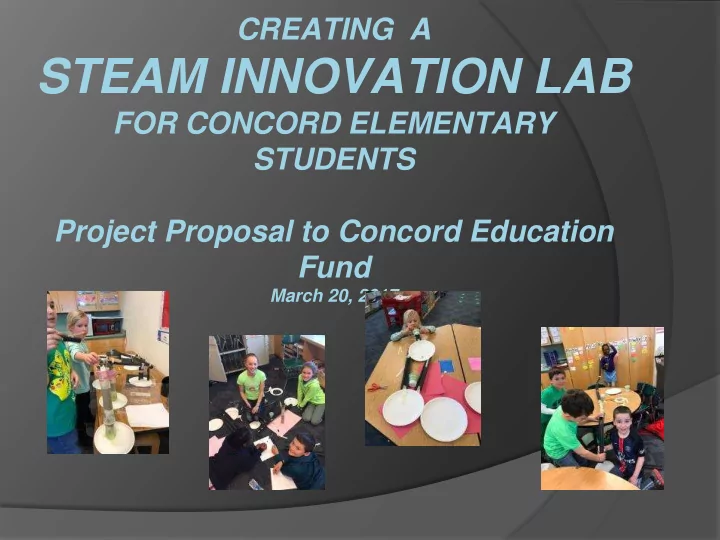
The Innovation Lab will be a “maker space” where students can gather to share ideas and use tools and equipment to design, tinker, build, and create solutions to STEAM design challenges.
24 classes/school x 3 schools = 72 classes total 72 classes x 2 times/year = 144 days lab in use possibility for some classes to come an additional time if appropriate (depending on challenge, project, etc.)
areas
curriculum
various grade levels
Stem Integration for District Leaders program. The goal
plan for the district.
(Align to Next Generation Science Standards)
CPS/CCHS Vision Statement: Every CPS and CCHS student participates in at least 2 STEAM experiences or design challenges each school
CPS/CCHS Golden Goals:
Students see the value in STEAM education.
habits of mind needed to analyze situations and solve problems that they will face in life. These skills and habits of mind give all students opportunities to pursue STEAM paths in life.
Section 2
Engineering Challenge
3 Little Pigs - Materials Science Problem - no more bricks to build house
Can you build a house for the third little pig so that when the wolf comes to visit, he will not huff and puff and blow the house down? Robotics challenge
KIBO -designed for 4-7 Motor & Wheels How can you make KIBO move?
Engineering Challenge
Using Rigamajig -
How can you use these materials to make a chair for Goldilocks? Robotics Challenge
Dash & Dot Life Cycles Challenge: How can you teach Dash & Dot about the life cycle of a frog?
Create a life cycle project Research life cycle of plants or animals Write important facts of each stage Create poster presentation
Engineering Challenge
Using assorted materials (cardboard, cups, paper plates) and Makedo tools (simple plastic tools for cardboard construction)
How can you create a contraption that can hold a 10 lb. bag of potatoes? Robotics Challenge
Cubelets Robot Blocks are a fast and easy way to inspire kids to be better thinkers. Light It Up - How can you create a robot that lights up (night light)?
Engineering Challenge
Gravity Racers (force & motion). Part 1. How can you design a gravity powered vehicle
for a new Olympic racing event?
Optional Part 2. Students use Tinkercad to make a 3D model of their gravity powered cars.
Students race/test their cars.
Robotic Challenge
Dash & Dot Forces of Attraction
How can Dash & Dot be programed to help Kindergarten students design an experiment to find out which objects are magnetic and which objects are not?
Engineering Challenge
Simple Circuit Challenge -Paper Circuits, Drawbots, Bristle Bots, Makey Makey, Squishy Circuits How can you use simple materials to: make a banana produce electricity, make a cup that creates art and/or make a greeting card light up?
Robotic Challenge
Spheros -Use Lightning Lab app; How can you create a program that powers a robotic Jack-o-Lantern?
Engineering Challenge
Little Bits -Invent a Launcher (twist on the catapult) Can you build a launcher that will fling projectiles at a push of a button?
Challenge combines robotics & 3D printing. How can you design and test a contraption for Sphero to carry a load of pennies across a small body of water?
Little Bits, Makey Makey Kits , Squishy Circuits, Rigamajig, Makedo Kit $8,367.12
KIBO, Spheros, Dot & Dash, Cubelets $13,200.35
3D Printers (2), Glowforge Laser Printer, McSquares, MacBook Airs (12), iPads (12), iPad covers (12) $29,260.00
Cardboard, clay, scissors, glue, tape (masking, duct, ..), crayons, dry erase markers, pipe cleaners, straws, paper clips, … $1,283.51
Laminator, projector & whiteboard $6,500.00 $58,610.98
Two Areas of Grant Proposal
Section 3
Lesley University launched a Makerspace in their Graduate School of Education to provide a new way for their students and community partners to engage in learning and inquiry-based
play, tinker, design, and create.
Goal of Partnership:
To support student engagement, intrinsic motivation, critical thinking and curiosity through maker and STEAM learning experiences at the Innovation Lab, and develop a model that enhances the efficacy of the Innovation Lab through transfer and adoption of the maker mindset and STEAM competencies into the general education classroom.
Professional Development Trainers and Curriculum for Educators 1 year partnership = $20,000 Proposal: (1) To provide direct support to conceptualize and launch the new Innovation Lab, ensuring its success as a learning environment designed to engage and inspire young learners through Maker/STEAM activities. (2) To work with a cohort of educators who want to infuse the maker mindset into their work through the development of interdisciplinary, standards aligned lessons that support student engagement, critical thinking, and creative problem-solving.
Section 4
laptop cart)
Section 5: