Start- Start -up Capital Costs for up Capital Costs for Health - - PDF document

start start up capital costs for up capital costs for
SMART_READER_LITE
LIVE PREVIEW

Start- Start -up Capital Costs for up Capital Costs for Health - - PDF document

Who We Are Who We Are Start- Start -up Capital Costs for up Capital Costs for Health Care Co Health Care Co- -ops and ops and Joint work group of the American Academy of Actuaries and the Society of Actuaries a Public Plan a Public Plan


slide-1
SLIDE 1

1

Start Start-

  • up Capital Costs for

up Capital Costs for Health Care Co Health Care Co-

  • ops and
  • ps and

a Public Plan a Public Plan

Cabe Chadick, MAAA, FSA James Galasso, MAAA, FSA, CERA Jay Ripps, MAAA, FSA Moderator: Cori Uccello, MAAA, FSA, FCA, MPP Senior Health Fellow, American Academy of Actuaries

November 2, 2009 November 2, 2009

Joint work group of the American Academy of Actuaries and the Society of Actuaries American Academy of Actuaries

  • Assists public policymakers by providing actuarial insights on

risk and financial security issues.

Who We Are Who We Are

November 2, 2009 Page 2

y

Society of Actuaries

  • Provides basic and continuing education in the fundamental

principles of actuarial science.

  • Conducts research regarding actuarial experience and

projection techniques.

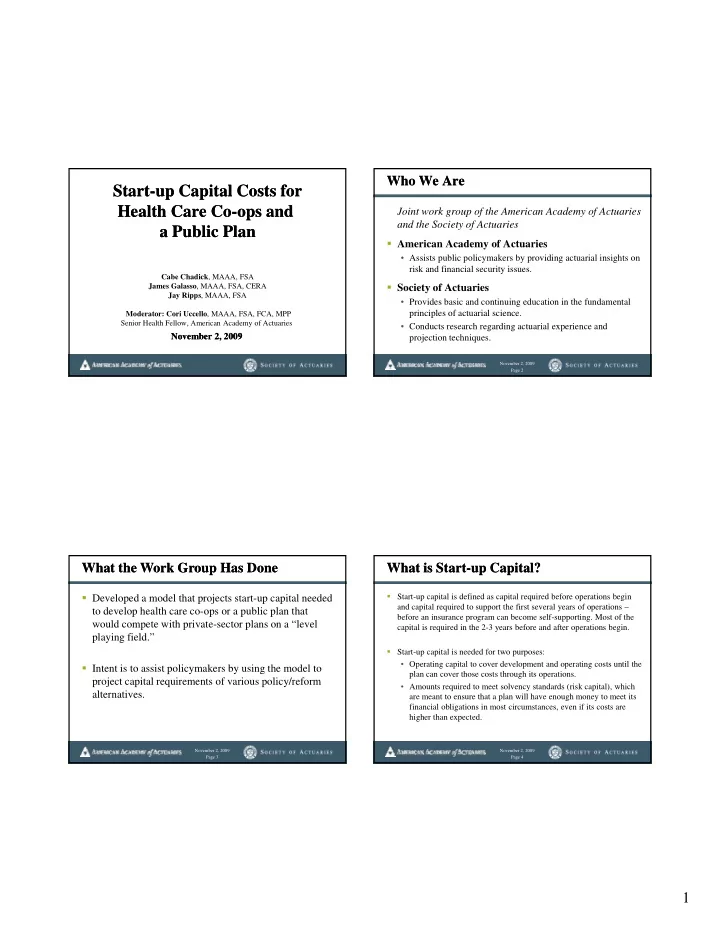
Developed a model that projects start-up capital needed to develop health care co-ops or a public plan that would compete with private-sector plans on a “level playing field.”

What the Work Group Has Done What the Work Group Has Done

November 2, 2009 Page 3

Intent is to assist policymakers by using the model to project capital requirements of various policy/reform alternatives.

Start-up capital is defined as capital required before operations begin and capital required to support the first several years of operations – before an insurance program can become self-supporting. Most of the capital is required in the 2-3 years before and after operations begin. Start-up capital is needed for two purposes:

What is Start What is Start-

  • up Capital?

up Capital?

November 2, 2009 Page 4

  • Operating capital to cover development and operating costs until the

plan can cover those costs through its operations.

  • Amounts required to meet solvency standards (risk capital), which

are meant to ensure that a plan will have enough money to meet its financial obligations in most circumstances, even if its costs are higher than expected.

slide-2
SLIDE 2

2

Health care co-ops or a public plan operate according to the same rules that apply to private-sector health plans regarding:

  • Underwriting (risk selection and coverage restrictions)
  • Pricing
  • Regulatory requirements regarding solvency, coverage, reporting, etc.
  • Consumer protections

What is a Level Playing Field? What is a Level Playing Field?

November 2, 2009 Page 5

p

  • State and local taxes, fees, and assessments
  • Risk adjustment and reinsurance programs

Health care co-ops or a public plan negotiate provider payment rates rather than use Medicare-like administrative price setting.

  • Expressed an opinion on the likely success of health care co-ops or a public

plan, or the likelihood of any scenario.

  • Expressed an opinion on whether health care co-ops or a public plan will

reduce health care costs.

  • Addressed the impact of health reform on underlying medical costs.
  • Addressed the capital requirements of government programs that do not

compete with private-sector health plans.

What the Work Group Has Not Done What the Work Group Has Not Done

November 2, 2009 Page 6

compete with private sector health plans.

  • Projected amounts of subsidies needed to make insurance “affordable” to all.
  • Projected the effects of health care co-ops or a public plan on private-sector

health plan membership, revenues, or profits.

  • Projected the effects of specific risk adjustment or reinsurance programs.
  • Projected the effects of the private-sector response to the inclusion of a health

care co-op or public plan.

Start-up capital requirements of health care co-ops or a public plan vary over a wide range, depending primarily

  • n the number of people they cover and the accuracy of

their pricing.

Results of Modeling Results of Modeling

November 2, 2009 Page 7

The capital requirements for 12 scenarios – six scenarios for a system of 50 statewide co-ops, and the same six scenarios for a single national public plan.

Combinations of two enrollment scenarios (low vs. high) and three experience scenarios (accurate pricing vs. underpricing or

  • verpricing).

Low enrollment – 2 million enrollees in first year (2013), no growth thereafter. High enrollment – 20 million enrollees in first year (2013)

Six Scenarios Modeled Six Scenarios Modeled

November 2, 2009 Page 8

High enrollment 20 million enrollees in first year (2013), growing to 40 million enrollees by 2019. Accurate pricing – revenue exceeds costs by target margin of 3%

  • f premium.

Underpricing – revenue is less than costs by 5% of premium. Overpricing – revenue exceeds costs by 5% of premium.

slide-3
SLIDE 3

3

Projected Start Projected Start-

  • up Capital Costs

up Capital Costs – – Co Co-

  • ops
  • ps

Capital Required to be Infused from Outside Sources During First 10 Years

HEALTH CARE CO-OPS ($ In Billions)

Low Enrollment

(Nationwide enrollment of 2 million people (constant from 2013-2019))

High Enrollment

(Nationwide enrollment of 20 million (2013) growing to 40 million (2019))

Pre- Operational Capitala Risk Capitalb Total Capital Pre- Operational Capitala Risk Capitalb Total Capital

November 2, 2009 Page 9

Capital Capital Capital Capital Capital Capital

Accurate Pricing $0.8 $1.6 $2.4 $0.8 $15.6 $16.4 Initial Under Pricing $0.8 $3.6 $4.4 $0.8 $44.8 $45.6 Initial Over Pricing $0.8 $1.3 $2.1 $0.8 $12.8 $13.6

aPre-operational capital infusions are assumed to be interest-free loans from the federal

government; pre-operational capital amounts are shown prior to any potential loan repayments.

bRisk capital infusions are assumed to be grants from the federal government.

Projected Start Projected Start-

  • up Capital Costs

up Capital Costs – – Public Plan Public Plan

Capital Required to be Infused from Outside Sources During First 10 Years

PUBLIC PLAN ($ In Billions)

Low Enrollment

(Nationwide enrollment of 2 million people (constant from 2013-2019))

High Enrollment

(Nationwide enrollment of 20 million (2013) growing to 40 million (2019))

Pre- Operational Capitala Risk Capitalb Total Capital Pre- Operational Capitala Risk Capitalb Total Capital

November 2, 2009 Page 10

Capital Capital Capital Capital Capital Capital

Accurate Pricing $0.5 $1.4 $1.9 $0.5 $14.4 $14.9 Initial Under Pricing $0.5 $3.3 $3.8 $0.5 $41.0 $41.5 Initial Over Pricing $0.5 $1.2 $1.7 $0.5 $11.9 $12.4

aPre-operational capital infusions are assumed to be interest-free loans from the federal

government; pre-operational capital amounts are shown prior to any potential loan repayments.

bRisk capital infusions are assumed to be grants from the federal government.

Start-up capital requirements can vary over a wide range – from $1.7 billion to $45.6 billion in the scenarios modeled. Start-up capital amounts required to meet solvency standards (risk capital) are much greater than amounts required for

  • perating capital.

Capital requirements for a public plan that competes on a level

What Conclusions Can Be Drawn From the Projections? What Conclusions Can Be Drawn From the Projections?

November 2, 2009 Page 11

Capital requirements for a public plan that competes on a level playing field with private-sector health plans are slightly lower than the capital requirements for health care co-ops. NOTE: If a public plan or health care co-ops experience moderate to severe adverse selection, their capital requirements would be much greater than those projected for the scenarios modeled.

  • In this context, adverse selection means that a disproportionate portion of the co-op or

public plan members would be high-risk/high-cost.

  • If this were to occur and no safeguards were in place to prevent a selection spiral, the

health care co-ops or public plan would require far more capital than shown in the modeled scenarios to remain viable.

  • The likelihood of adverse selection can be reduced by a strong mandate that everyone
  • btain health insurance; otherwise, individuals are likely to obtain and then drop health

insurance as their health care needs change.

Adverse Selection Adverse Selection

November 2, 2009 Page 12

insurance as their health care needs change.

  • The effects of adverse selection might be mitigated by effective risk adjustment or stop-

loss insurance programs. However, such programs could not control the effects of adverse selection on the health insurance market as a whole.

  • The effects of adverse selection could also be mitigated via financial subsidies to make

plans more affordable and/or periodic but infrequent open enrollment times.

  • Did not model adverse selection scenarios that project the effects of the optional

remedies listed above.
slide-4
SLIDE 4

4

Many details of reform legislation remain to be worked out. Those details will have a big influence on likely start-up capital requirements. The model developed by the joint work group can be used to quantify the start-up capital implications of various policy alternatives

Open Questions/Next Steps Open Questions/Next Steps

November 2, 2009 Page 13

alternatives. The American Academy of Actuaries and the Society of Actuaries are available as an ongoing resource to help policymakers understand the start-up capital implications of policy alternatives.