Takeover Game Targets value v is uniform on [0,100] Target knows - - PDF document

takeover game
SMART_READER_LITE
LIVE PREVIEW

Takeover Game Targets value v is uniform on [0,100] Target knows - - PDF document

Dynamic Games with Incomplete Information (continued) Peter Cramton Takeover Game Targets value v is uniform on [0,100] Target knows value; Acquirer does not Acquirers value is 1.5 v What offer p should Acquirer make to


slide-1
SLIDE 1

Dynamic Games with Incomplete Information (continued)

Peter Cramton

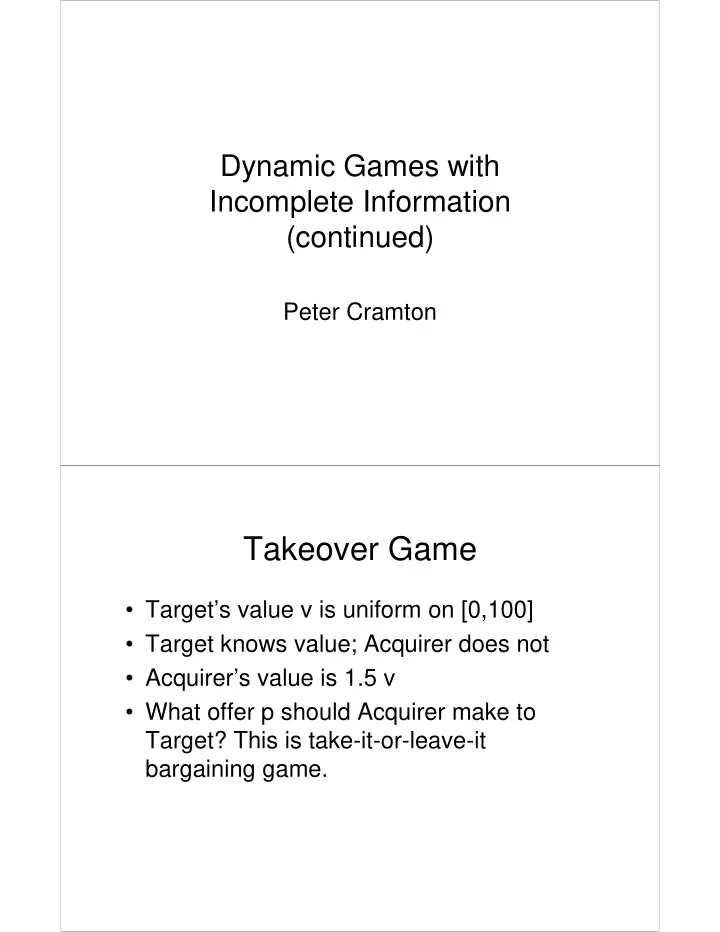
Takeover Game

  • Target’s value v is uniform on [0,100]
  • Target knows value; Acquirer does not
  • Acquirer’s value is 1.5 v
  • What offer p should Acquirer make to

Target? This is take-it-or-leave-it bargaining game.

slide-2
SLIDE 2

Auctions

  • Auctions are important institution.
  • Understanding auctions should help us

understand the formation of markets by modeling the competition on one side of the market.

  • Auctions represent an excellent application
  • f game theory, since in an auction the

rules of the game are made explicit.

Simple Auctions

Auctions typically take one of four simple forms: Oral Sealed Bid English (↑ price) 2nd Price Dutch (↓ price) ≡ 1st Price

slide-3
SLIDE 3

Simple Auctions

  • English: price increases until only one bidder is left; the

remaining bidder gets the good and pays the highest bid.

  • Dutch: prices decreases until a bidder accepts the price;

this bidder gets the good and pays the price at acceptance.

  • Second Price: each bidder submits a bid in a sealed

envelope; the highest bidder gets the good and pays the second highest bid.

  • First Price: each bidder submits a bid in a sealed

envelope; the highest bidder gets the good and pays the amount of his bid.

Auction Exercise

  • Bid for single object
  • Common value = $1 per bean
  • On slip of paper write:

– Name – Estimate (# of beans × $1) – Bid in first-price sealed-bid auction – Bid in second-price sealed-bid auction

slide-4
SLIDE 4

Models of Private Information

(1) Independent Private Value: vi ~ Fi independently of vj for j ≠ i. (2) Common Value: ei = v + εi, εi ~ Fi w/ mean 0. (3) Affiliated Value: vi(x,s), my value depends on private information x = (x1,...,xn) and state of world s.

Winner's Curse

I won. Therefore, I overestimated the most. My bid

  • nly matters when I win, so I should condition my

bid on winning (i.e., that I overestimated the most).

  • Winning is bad news about my estimate of value.

This is a form of adverse selection that arises in any exchange setting: if you want to trade with me, it must be that no one else offered more, because they did not think that the item is worth what I am willing to pay.

slide-5
SLIDE 5

Models of Private Information

  • Independent private value model: It makes sense

if differences in value arise from heterogeneous preferences over the attributes of the item

  • Common Value: It makes sense if the bidders

have homogeneous preferences, so they value the item the same ex post, but have different estimates of this true value.

  • Affiliated value model: In this model, each bidder

has private information that is positively correlated with the bidder's value of the good.

Auction Multiple Items

  • 2 bidders (L and S), 2 identical items
  • L has a value of $100 for 1 and $200 for both
  • S has a value of $90 for 1 and $180 for both
  • Uniform-price auction

– Submit bid for each item – Highest 2 bids get items – 3rd highest bid determines price paid

  • Ascending clock auction

– Price starts at 0 and increases in small increments – Bidders express how many they want at current price – Bidders can only lower quantity as price rises – Auction ends when no excess demand (i.e. just two demanded); winners pay clock price

slide-6
SLIDE 6

What if private information?

  • 2 bidders (L and S), 2 identical items
  • L has constant marginal value u drawn U[0,1]
  • S has constant marginal value v drawn U[0,1]
  • Uniform-price auction

– Submit bid for each item – Highest 2 bids get items – 3rd highest bid determines price paid

  • Ascending clock auction

– Price starts at 0 and increases in small increments – Bidders express how many they want at current price – Bidders can only lower quantity as price rises – Auction ends when no excess demand (i.e. just two demanded); winners pay clock price